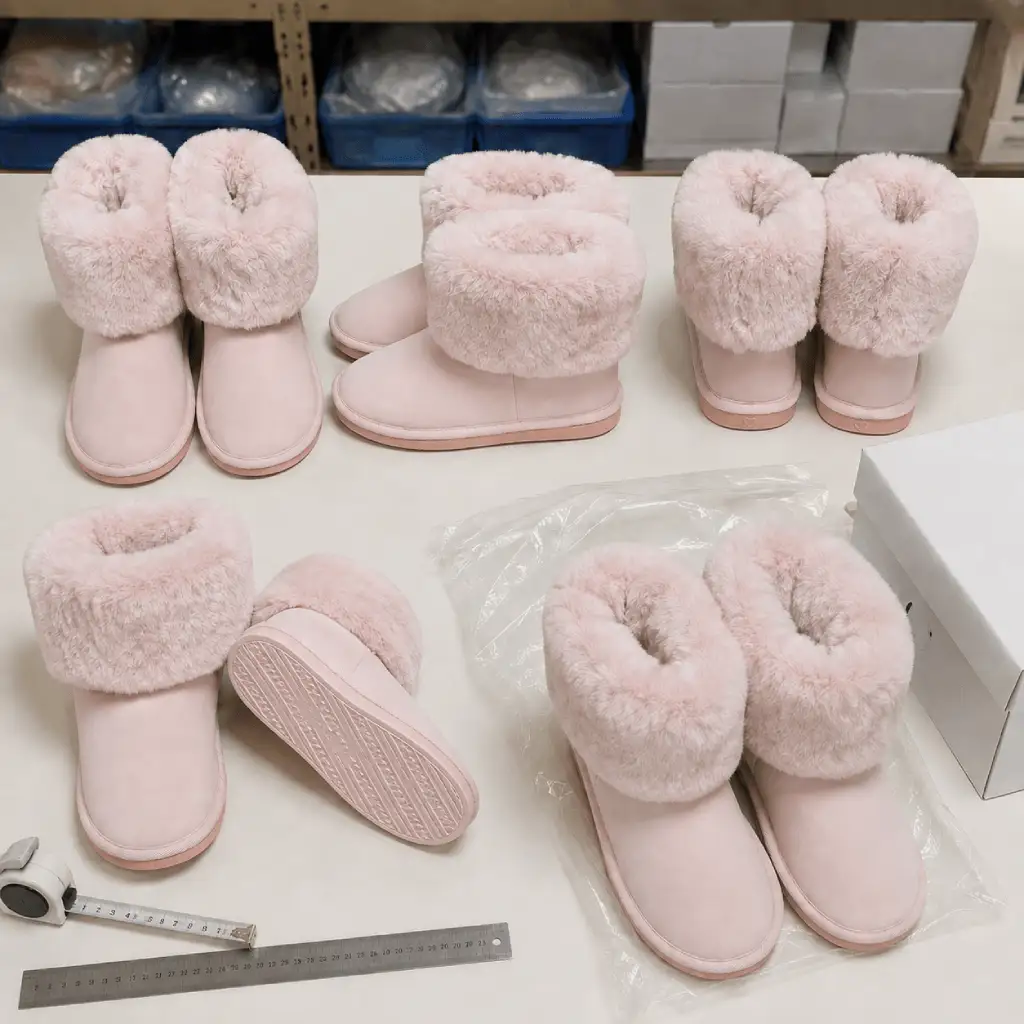
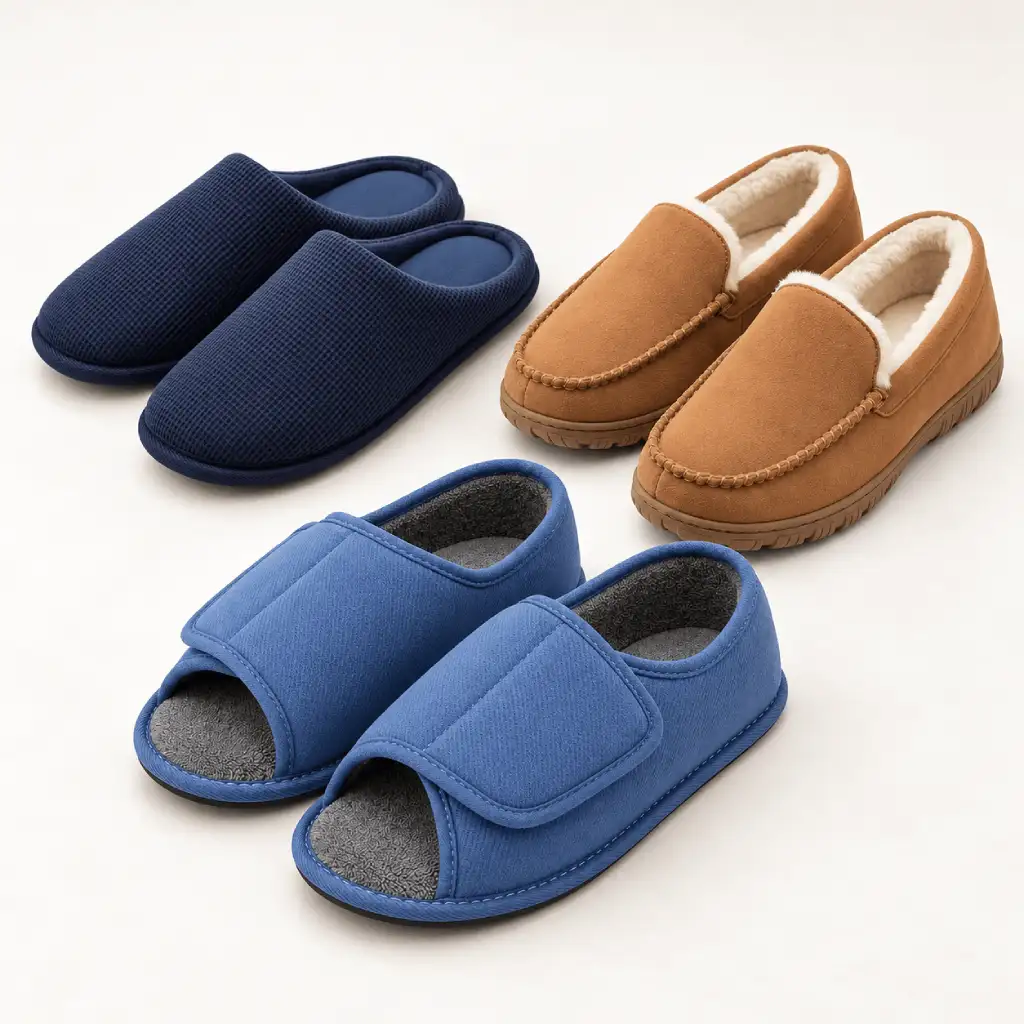
Men’s slipper styles include mules, scuffs, moccasin-style house shoes, slipper boots and adjustable open-toe designs. The names are useful for browsing a range. They are less useful on their own when a factory needs to prepare a sample or quotation.
A photograph described as a “scuff” might also show a mule with a closed toe and open heel. Add a thicker lining or change the opening, and a similar-looking pair can fit quite differently. That is where a style description needs to become more specific.
For brands, importers and wholesale buyers, this guide compares five familiar types of slippers for men and explains what to check before choosing a base style for a private label collection.
Buyer takeaway: choose the silhouette first, then confirm toe coverage, heel coverage, upper depth, lining and outsole. A retail style name should accompany a reference photo, rather than stand in for the product specification.
Use the comparisons below to narrow your shortlist, then review available examples in UTOP’s wholesale men’s slipper range.
By UTOP Slippers
1. Understand How Men’s Slipper Styles Overlap
The most useful distinction is between a style name and a construction feature. “Mule” describes a backless silhouette. “Closed toe” describes front coverage. “Fleece lined” describes part of the material specification. All three can refer to the same pair.
Separating those details makes different types of men’s slippers easier to compare. It also prevents a supplier from filling in missing information differently from the buyer.
| Description layer | Examples | What it tells the factory |
|---|---|---|
| Overall style | Mule, scuff, moccasin style, bootie, adjustable slipper | The intended silhouette and appearance |
| Toe coverage | Open toe or closed toe | Whether the front of the foot is exposed |
| Heel coverage | Open back or closed back | Whether there is material around the heel |
| Upper and lining | Corduroy, jersey knit, micro-suede-style textile, fleece | The selected surfaces and material combination |
| Outsole and attachment | Molded TPR or cut EVA; stitched or cold-glued | The bottom structure and upper-to-sole connection |
A clearer brief might read: “Men’s closed-toe, open-back slipper with a corduroy upper, fleece lining and molded TPR outsole.” The reference photo then shows the opening shape, toe profile and proportions that words cannot fully describe.
These men’s slipper styles are also overlapping retail categories. A closed-back slipper may have moccasin details; a bootie may use the same lining as a scuff. Keep those relationships visible when comparing samples instead of treating every name as a separate manufacturing system.
2. Men’s Mule and Scuff Slippers
Men’s mule slippers have an uncovered heel. In indoor ranges, many also have a covered toe, although the word “mule” does not require a closed front. Upper depth, toe shape and the size of the opening still need to be specified.
Men’s scuff slippers overlap with that group. Merriam-Webster’s entries describe a mule as footwear without rear heel coverage and a scuff as a flat-soled backless slipper. Neither name provides a complete pattern or material specification.
In a product shortlist, compare the actual uppers. A shallow, soft scuff and a deeper mule can leave different amounts of the instep covered. Retailers may use either name for a similar pair, so a firm rule such as “all scuffs are softer than mules” is not reliable.
| Detail to compare | What to look at | Why it matters |
|---|---|---|
| Upper depth | How far the upper extends over the instep | Entry space and how the foot is held |
| Opening shape | Width, topline position and binding | Pressure over the instep and edge comfort |
| Toe volume | Internal height and lining bulk | Usable room at the front |
| Heel landing | Where the heel sits on the footbed | Whether the selected size accommodates the whole foot |
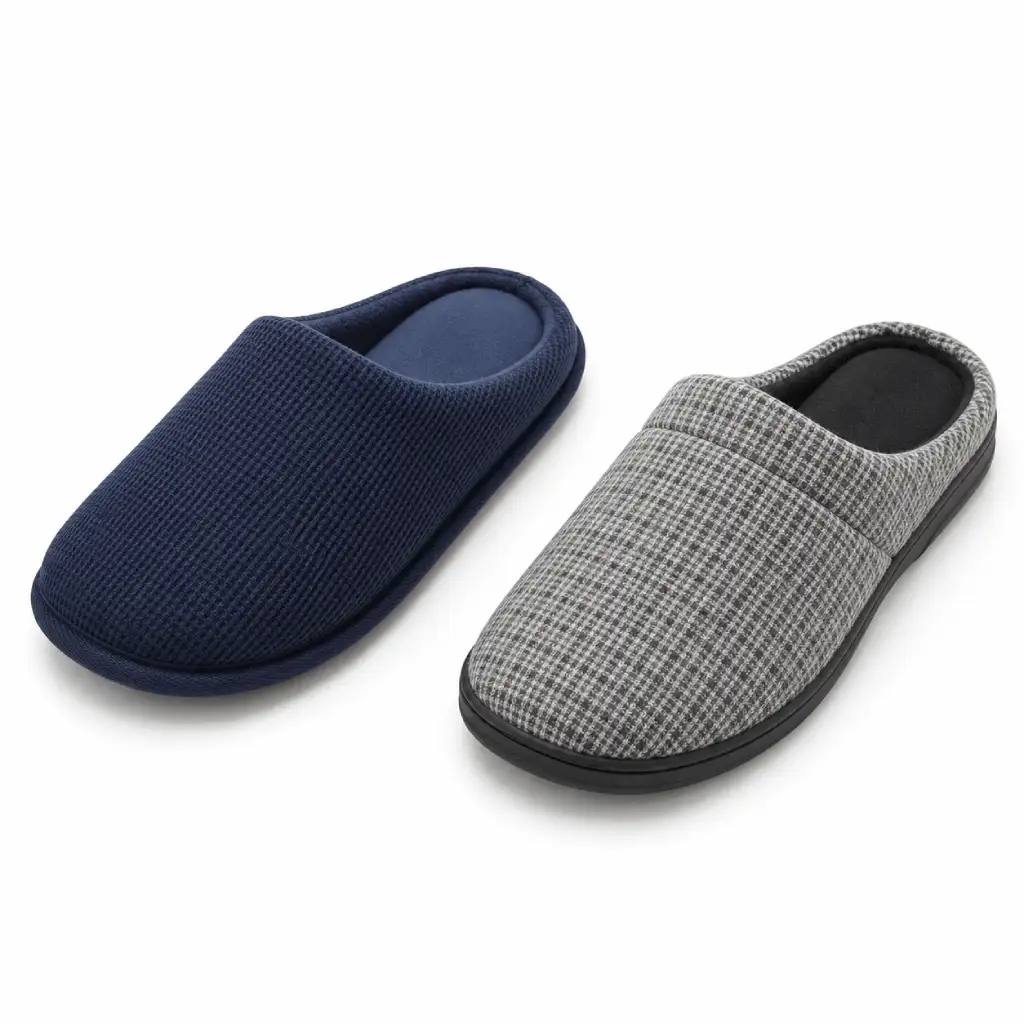
Two product references to start with
UTOP’s waffle knit open-back slipper UT-MS1002 and jersey knit scuff UT-MS1008 offer two textile directions for comparison. Use them to discuss upper appearance and silhouette; confirm the final lining, cushioning and outsole on the development sample.
For men’s open-back slippers, review fit while standing and walking, rather than judging the pair only from a top-view photograph. Look for unwanted forward movement, an uncomfortable opening or a heel that sits too close to the edge. The material and outsole can change, but the base pattern must still suit the intended fit.
Before requesting a sample: mark the desired upper depth and opening on the reference image. This gives the factory a clearer starting point than asking for a “more premium scuff.”
3. Closed-Back House Shoes and Moccasin Styles
Men’s closed-back slippers include material around the heel. Compared with an open-back pair, the opening and heel shape need closer attention: the wearer must be able to enter the slipper, and the back should sit comfortably once the foot is inside.
More heel coverage does not automatically mean a better fit. A stiff edge can rub; a loose back can move against the heel. Review the complete sample with the chosen lining, since a thicker interior reduces usable space even if the outside dimensions remain unchanged.
Where moccasin-style slippers fit
Men’s moccasin slippers are recognized by details such as a defined vamp, visible toe seams or a fuller shoe-like profile. In a sourcing brief, “moccasin style” may describe the appearance rather than a traditional moccasin construction. Ask which seams are functional, which are decorative and how the upper is attached to the outsole.
A plain closed-back house shoe and a moccasin-inspired slipper can serve different visual roles in the same range. The distinction should be visible in the upper shape or seam treatment, rather than relying entirely on a new color.
- Check the heel edge and opening during entry.
- Review toe room with the final lining and cushioning in place.
- Compare seam position and left-right symmetry.
- Confirm fit across the requested sizes, including the smallest and largest samples.
The micro suede closed-back slipper UT-MS1003 is an available UTOP reference for an enclosed textile house shoe. It illustrates heel coverage; it should not be treated as proof that every closed-back design uses the same reinforcement or attachment method.
For a closer review of front coverage and internal space, see our closed-toe slipper buyer’s guide.
4. Men’s Slipper Boots and Booties
Men’s slipper boots and booties extend the upper around the ankle or higher. They offer a different coverage option from a low house shoe and can be considered for cold-season homewear or gifting collections.
The extra upper changes more than appearance. A buyer needs to review shaft height, opening size and how the foot enters. A soft bootie that looks roomy can still be difficult to put on if the opening is narrow or the lining is bulky.
Ask for a side view and a rear view when reviewing the first sample. These make it easier to judge the shaft shape and heel position. Then check the opening on the foot: pulling hard on the collar during entry may expose a pattern problem that is not obvious in a photograph.
Sample check: assess ankle coverage, entry and fit together. Adding a taller upper to a low slipper pattern is not enough to confirm a usable bootie.
Packaging deserves an early check for this family. A taller, padded upper occupies more space and may be compressed by a small box or tight bag. Review the pair after unpacking to see whether the shaft and collar recover to the agreed presentation.
Keep men’s bootie slippers as a defined seasonal option in the shortlist. If the range already has a heavily lined closed-back house shoe, the bootie should offer a clear reason for the additional coverage. Our slipper boots and bootie sourcing guide covers that construction in more detail.
5. Open-Toe and Adjustable Men’s Slippers
Men’s open-toe slippers expose the front of the foot. They may use a fixed band, crossed panels or an adjustable upper. Toe coverage and heel coverage are separate decisions: an open-toe slipper can still have an enclosed heel.
Adjustability is useful when the collection needs an upper that can accommodate different instep volumes. The fastening should be checked at the smallest and largest intended settings, with enough overlap to stay closed and no rough edge against the foot.
Do not assume that an open toe makes the whole slipper breathable or suitable for every warm climate. Lining thickness, upper coverage and the footbed surface still affect the wearing experience. Make the material choice alongside the shape.
An open-toe example with a closed back
UTOP’s adjustable men’s slipper UT-MS1017 combines an open toe and adjustable upper with an enclosed heel. The listed reference uses a jersey upper, terry lining and footbed, and a TPR outsole. It is a useful example of why “open toe” and “open back” should not be used interchangeably.
- Check where the front band sits relative to the toes.
- Review the adjustment range on the fitted sample.
- Confirm closure comfort, seam placement and edge finishing.
- Keep the logo away from folds or fastening areas that affect function.
For private label men’s slippers, settle the panel dimensions before approving embroidery or a label. A logo that works on a flat drawing may become distorted when the upper is tightened.
6. Materials, Outsoles and Slipper Construction
The same silhouette can produce quite different men’s house slippers. Corduroy gives a visible ribbed surface; a micro-suede-style textile gives a smoother appearance; jersey knit offers another surface and stretch direction. Each option needs to be reviewed with its backing, lining and seams.
For men’s slipper materials, look beyond the swatch. A thicker lining or additional foam can reduce internal space. A fabric that stretches easily may need a different pattern allowance or reinforcement from a more stable textile.
| Material direction | What it changes | What to confirm on the sample |
|---|---|---|
| Corduroy | Ribbed texture and directional appearance | Rib direction, panel alignment and seam bulk |
| Jersey and other knits | Surface texture and stretch behavior | Composition, backing, stretch direction and opening stability |
| Micro-suede-style textile | Smooth or lightly brushed appearance | Exact material identity, thickness and lining compatibility |
| Fleece, plush or sherpa lining | Interior hand feel, bulk and coverage | Pile, thickness, usable internal space and seam comfort |
Jersey knit is not wool felt. A suede-look textile is not automatically genuine suede. Write the actual material identity into the brief instead of using a visual description as a composition claim.
TPR and EVA describe outsole materials
In UTOP’s common indoor constructions, a molded TPR outsole can provide a defined profile, sidewall and tread. Cut-sheet EVA is a lightweight, flexible option. EVA can also be molded or injected, so “EVA sole” alone does not identify the outsole shape or production route.
Choose against the required weight, thickness, hardness, tread and intended use. Grip and wear performance depend on the specific outsole and conditions; they should not be assumed from the letters TPR or EVA. Cost also needs a project quotation, including the selected specification, tooling and order quantity.
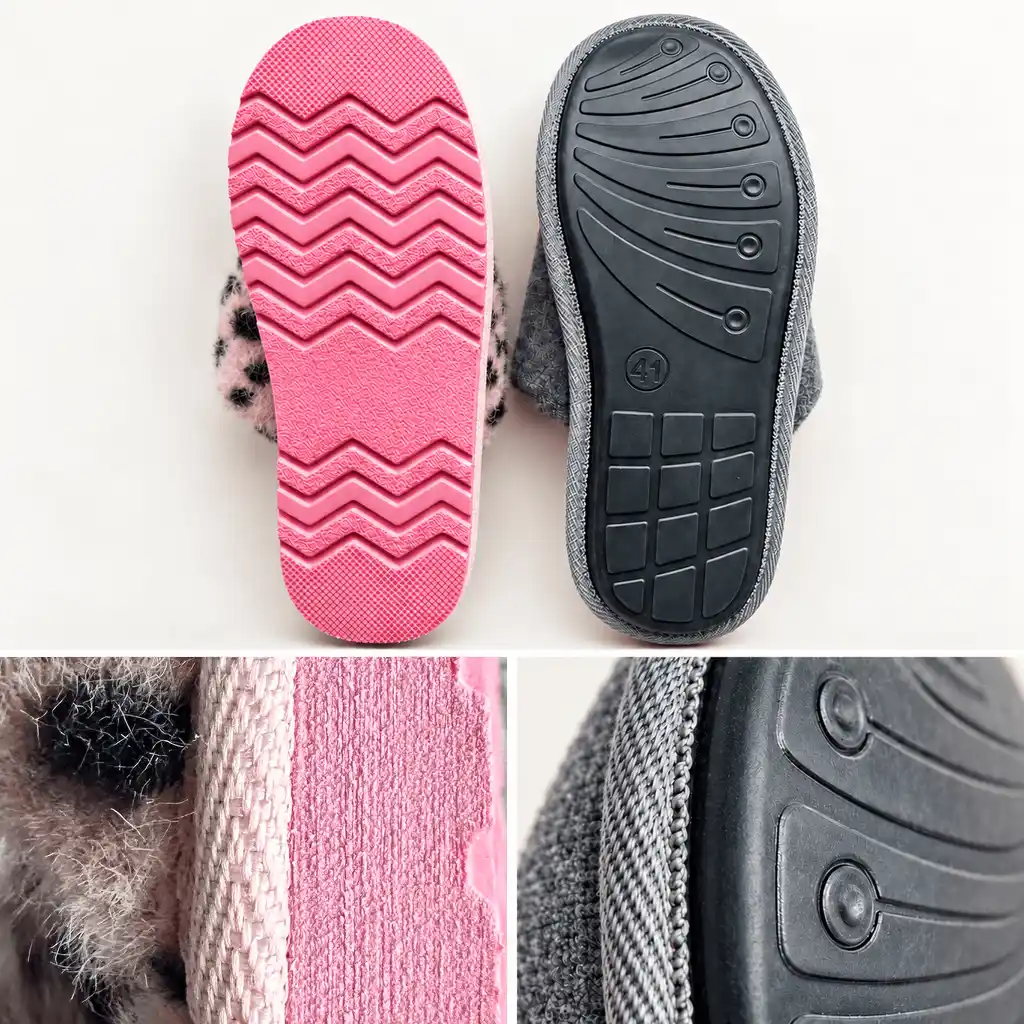
Keep outsole forming and upper attachment separate
A molded outsole still needs to be connected to the upper. Welt-stitched, side-stitched and cold-glued describe attachment routes; injection molding describes a forming process. They are not interchangeable descriptions of the complete slipper.
For UTOP’s common men’s indoor slipper constructions, welt-stitched styles can use TPR or EVA, side-stitched styles commonly use TPR, and cold-glued styles commonly use EVA. TPR can also be cold-glued when suitable surface treatment, adhesive and pressing processes are used.
Buyers do not need to prescribe every production step at the first inquiry. Show the desired edge appearance and outsole profile, explain the intended use, and ask the factory to identify a suitable construction. If the product will carry a slip-resistance or durability claim, agree on the relevant test and acceptance criteria.
Compare like for like: when reviewing two samples, record the upper, lining, foam, outsole and attachment method. Otherwise a difference in feel or price can be attributed to the style name when it actually comes from the specification.
7. Choose Men’s Slipper Styles for a Wholesale Collection
Start with the job each pair needs to do in the range. A collection can offer different men’s slipper styles without repeating almost the same upper, coverage and wearing experience under several names.
For example, a buyer might shortlist an easy-entry mule as a core style, an enclosed house shoe for a more covered option and an adjustable open-toe pair for a lighter seasonal direction. That is a possible assortment, not a forecast of which products will sell best.
| Collection requirement | Style direction to review | Decision before sampling |
|---|---|---|
| Easy step-in indoor wear | Mule or scuff | Upper depth, instep hold and heel landing |
| A more enclosed house shoe | Closed-back or moccasin-inspired style | Entry, heel comfort, toe room and seam details |
| Ankle coverage for a seasonal range | Slipper boot or bootie | Shaft height, opening and packing recovery |
| Open front with adjustable instep coverage | Adjustable open-toe slipper | Panel position, fastening overlap and heel construction |
For wholesale men’s slippers, shortlist the bases before expanding the color range. It is easier to compare fit and material choices across a few clear product directions than across a long list that differs mainly in color.
What to send with the shortlist
Send a product link, SKU or reference image for each style, then state the required toe and heel coverage. Add the target market, size range, estimated quantity and preferred upper, lining and outsole. Branding and packaging can be reviewed against those choices.
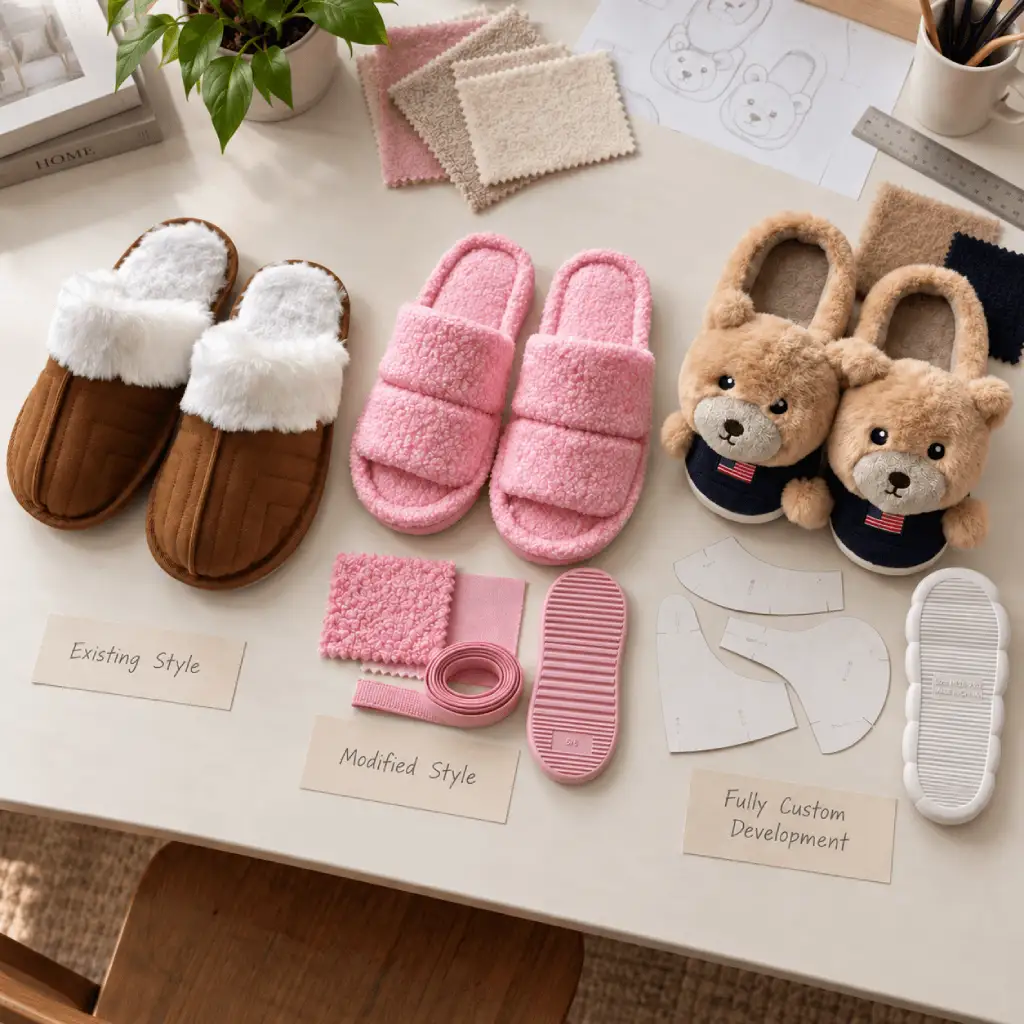
If a reference already matches the required shape and fit, discuss whether materials, colors or brand details can be adapted around it. If the value of the product depends on a different opening, heel shape or outsole, identify that change at the start. Those points affect the development work more than the word “custom.”
Browse UTOP’s men’s indoor slippers for available bases, or review our custom slipper development options when the required structure needs further discussion.
8. Frequently Asked Questions and Next Steps
What are the main types of slippers for men?
Common types include mules, scuffs, moccasin-style house shoes, slipper boots and adjustable open-toe slippers. Open-back, closed-back, open-toe and closed-toe describe features that can overlap with those names.
What is the difference between men’s mule and scuff slippers?
Both can be backless. “Mule” identifies the uncovered heel, while “scuff” is used for a flat-soled backless slipper. Retail usage overlaps, so compare the actual upper depth, opening, lining and outsole before treating the names as different specifications.
Are open-back slippers always open toe?
No. Many men’s open-back slippers have a covered toe. Toe coverage and heel coverage should be written separately in the product brief.
Does a closed back guarantee a more secure fit?
No. Heel coverage can help retain the foot, but the result depends on the opening, heel shape, internal space and materials. Review entry and walking fit on the complete sample rather than relying on the silhouette.
Can different men’s slipper styles use TPR or EVA outsoles?
Both materials can be considered for different styles. The suitable choice depends on the required profile, weight, flexibility, tread and attachment method. Neither the price nor the grip performance can be decided from the material name alone.
Can an existing style be used for a private label collection?
Yes. An available base can be reviewed for changes to materials, colors, logos, labels, outsoles or packaging. A new shape or fit requirement may need additional pattern work or component development.
From a style name to a usable brief
Men’s slipper styles are easier to source when each name is paired with a clear product reference. Keep the silhouette, toe and heel coverage, materials and outsole visible in the brief. The factory can then review what should remain fixed and what needs to change.
Discuss your men’s slipper collection with UTOP
Share the styles you are considering, your target market, estimated quantity, size range and material preferences. UTOP can review available references and customization requirements before sampling.
For standard custom slipper projects, sample development usually takes 7–14 days. Bulk production usually takes 30–45 days after the sample and other necessary approvals are complete. Material preparation, tooling, revisions, testing and order requirements can change the schedule.