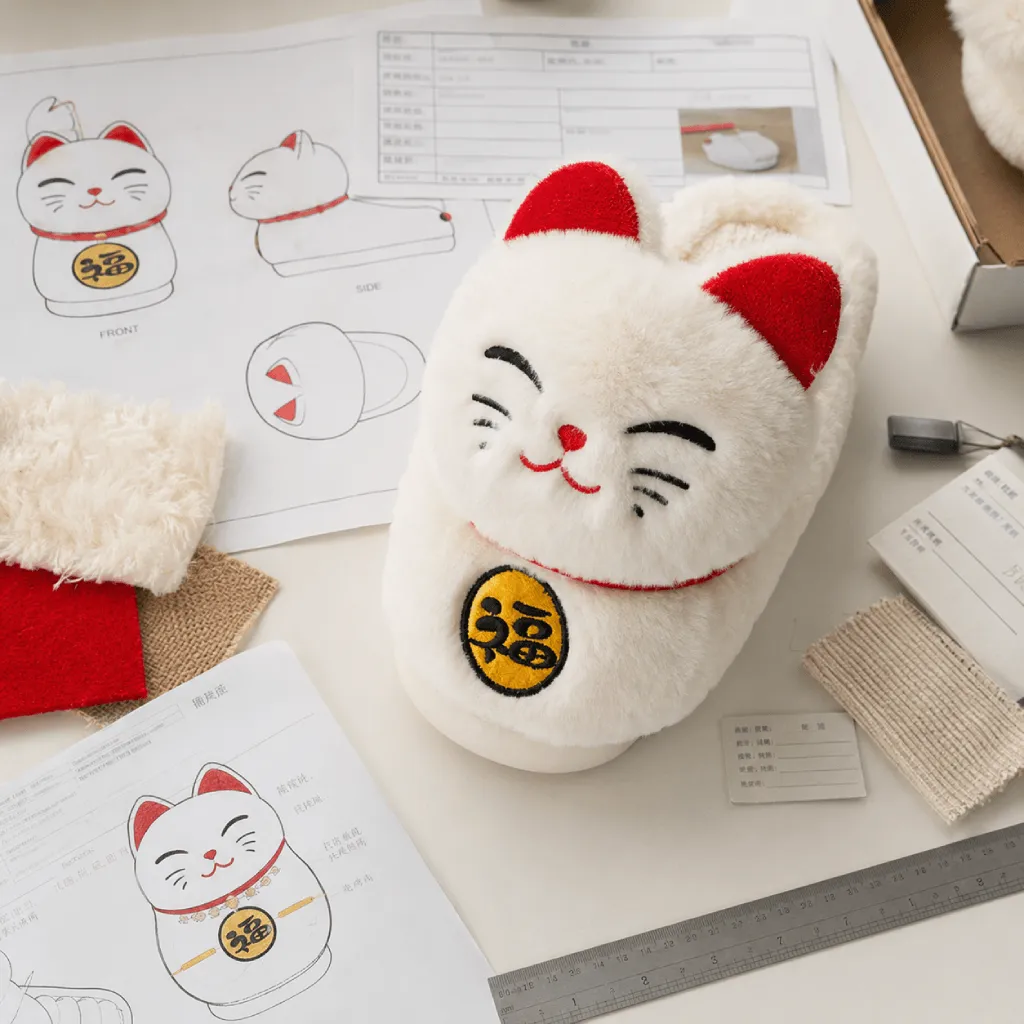
For a private label slipper order, packaging is part of the product specification—not a detail to decide after production. The selected footwear packaging affects presentation, labeling, pair protection, carton utilization, handling, and the information required for a useful quotation.
A lightweight open-back slipper may work with a simple individual polybag and size sticker, while a plush novelty style may need more room to protect pile recovery and raised decorations. Retail programs may also require branded inserts, hangers, barcodes, shoe boxes, defined pack ratios, or customer-specific carton markings.
This guide explains how wholesale buyers can compare slipper packaging options, approve retail details, and prepare packaging instructions before sampling and bulk production.
Buyer takeaway: Choose packaging from the complete slipper specification, sales channel, destination requirements, and approved packed sample. Do not select a box, bag, label, or carton quantity from a generic template alone.
This footwear packaging guide is written for brands, wholesalers, importers, retailers, and sourcing teams developing private label or bulk indoor slippers.
Written by the UTOP Slippers Sourcing Team, with product and packing input from our slipper development team.
1. What Is Footwear Packaging in a Private Label Slipper Order?
Footwear packaging is the complete system used to contain, identify, protect, present, group, and ship a pair of slippers. For a private label program, that system may include individual packing, retail presentation, product labels, inner cartons, master cartons, carton markings, and the approved method for arranging pairs inside each carton.
This definition is broader than a shoe box. Many indoor slippers are sold in polybags, on hangers, with paper bands, in fabric pouches, or in display-ready packaging. A branded shoe box is only one possible format. The correct choice depends on the product, the retail channel, the buyer’s operational requirements, and the condition expected when the goods arrive.
Consumer and retail packaging
This is the packaging a store, distributor, warehouse, or end customer sees around an individual pair. It can carry the brand presentation, product information, size, color, barcode, care details, and other buyer-approved content.
Logistics and carton packaging
This groups individual pairs for handling and shipment. It includes pack ratios, inner cartons when required, master carton dimensions, gross and net weight fields, shipping marks, SKU identification, and destination-specific instructions.
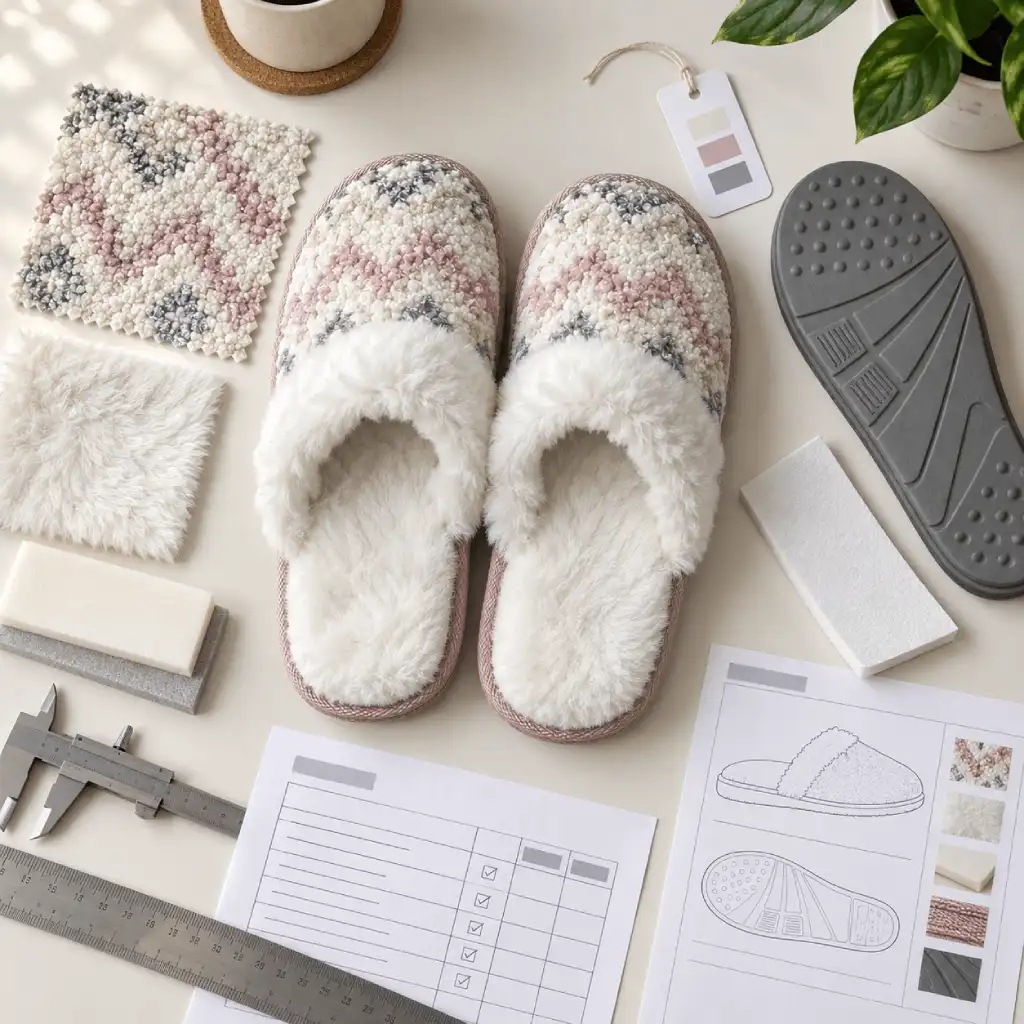
Private label footwear packaging should therefore be reviewed together with the slipper specification. Upper material, lining thickness, outsole structure, decoration, size range, folding direction, and pair orientation can all change the amount of space and protection needed.
Packaging is part of product development
A packaging drawing may look correct on screen but still be unsuitable for the finished pair. Buyers should review the actual packed sample, not artwork alone. This is especially important for thick linings, structured house shoes, plush uppers, bows, pom-poms, ears, embroidery, and molded outsoles.
For a wider view of how packaging fits into product specifications, branding, sampling, and production, see our Private Label Indoor Slippers Manufacturing Guide.
2. Why Packaging Must Be Confirmed Before the Final Quotation
A quotation based only on the slipper can leave important costs and production steps undefined. Footwear packaging requirements may change the material list, artwork work, packing labor, carton size, carton quantity, handling method, and shipping volume. For this reason, the supplier needs at least a preliminary packaging brief before preparing a final commercial quotation.
The purpose is not to force every detail to be final at the first inquiry. It is to prevent two quotations from appearing comparable when they are based on different packing assumptions. A quote for a clear polybag and size sticker is not equivalent to a quote that includes a printed box, tissue paper, insert card, barcode label, and customer-specific master carton marks.
| Packaging decision | What it can affect | What the buyer should provide |
|---|---|---|
| Individual format | Materials, packing sequence, appearance, and pair protection | Preferred bag, band, hanger, pouch, or box direction |
| Printed components | Artwork preparation, printing method, color approval, and lead time | Logo files, dielines if fixed, text, colors, and approval contact |
| Labels and barcodes | SKU control, label printing, placement, and scanning workflow | Final data, barcode files, label size, and placement diagram |
| Carton plan | Pairs per carton, dimensions, weight, shipping volume, and distribution | Pack ratio, assortment rules, carton limits, and marks |
Practical sequence: define the preliminary packing direction for quotation, test it with the actual slipper sample, revise dimensions and placement if necessary, then approve the complete packed sample before bulk packing begins.
Packaging should also be considered when reviewing lead time. Printed components, custom structures, barcode data, buyer approvals, and revised packed samples can require coordination before production. The timing should be discussed for the specific project rather than assumed from the slipper assembly schedule alone.
Our Bulk House Slippers Wholesale Checklist explains how packaging should be confirmed together with materials, sizing, branding, approved samples, and bulk quality expectations.
3. Common Footwear Packaging Options for Slippers
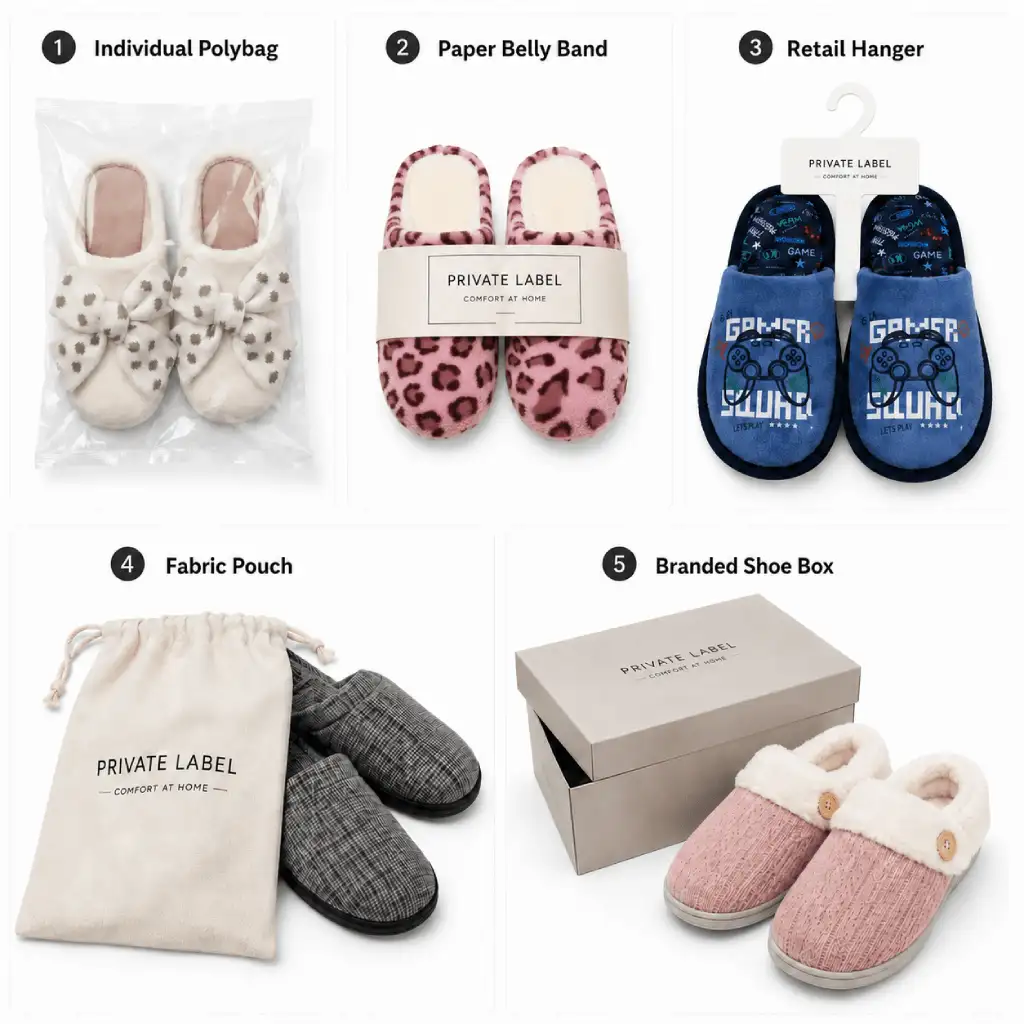
There is no single best slipper packaging format. Buyers should compare how each option presents the brand, protects the pair, supports store or warehouse handling, and uses carton space. The same slipper may also use different packaging for ecommerce, supermarket, department-store, promotional, or wholesale distribution programs.
| Packaging option | Typical role | Points to approve |
|---|---|---|
| Individual polybag | Simple pair containment and identification | Material, size, closure, warning text if required, ventilation, folding direction, and label placement |
| Paper belly band or sleeve | Visible branding with limited coverage | Band width, board strength, print, closure, fit around the pair, and risk of marking soft pile |
| Header card | Brand panel for bagged or hanging retail presentation | Dieline, fold, attachment, hole position, barcode area, and total hanging weight |
| Hanger or hook | Peg or rail display | Hanger type, pair attachment, balance, opening direction, store fixture, and pull resistance |
| Insert card | Brand story, product information, care notes, or shape support | Dimensions, paper specification, print, position, edge contact, and visible orientation |
| Fabric or drawstring pouch | Reusable or gift-oriented presentation | Pouch material, dimensions, closure, logo method, color transfer risk, and whether an outer label is still needed |
| Display box | Retail visibility with partial product exposure | Board, window or opening, structure, pair retention, stacking, barcode panel, and shelf presentation |
| Branded shoe box | Full retail presentation and structured protection | Box style, internal dimensions, board, print, tissue, labels, ventilation, stacking, and master carton efficiency |
A packaging option should not be approved only because it looks attractive in a mockup. The actual pair must fit without excessive pressure, uncontrolled movement, distorted decoration, or an unstable retail presentation. The buyer should also confirm whether the package can be handled, scanned, grouped, and shipped through the intended channel.
Do not over-specify packaging before testing the product
A rigid presentation concept can create unnecessary revisions if it is designed before the slipper dimensions and construction are stable. Begin with the sales-channel requirement, then test the proposed footwear packaging design against the actual approved sample.
For plush products, also review the packaging and recovery considerations in our Plush Slippers Wholesale Guide.
4. How to Select Packaging by Slipper Type
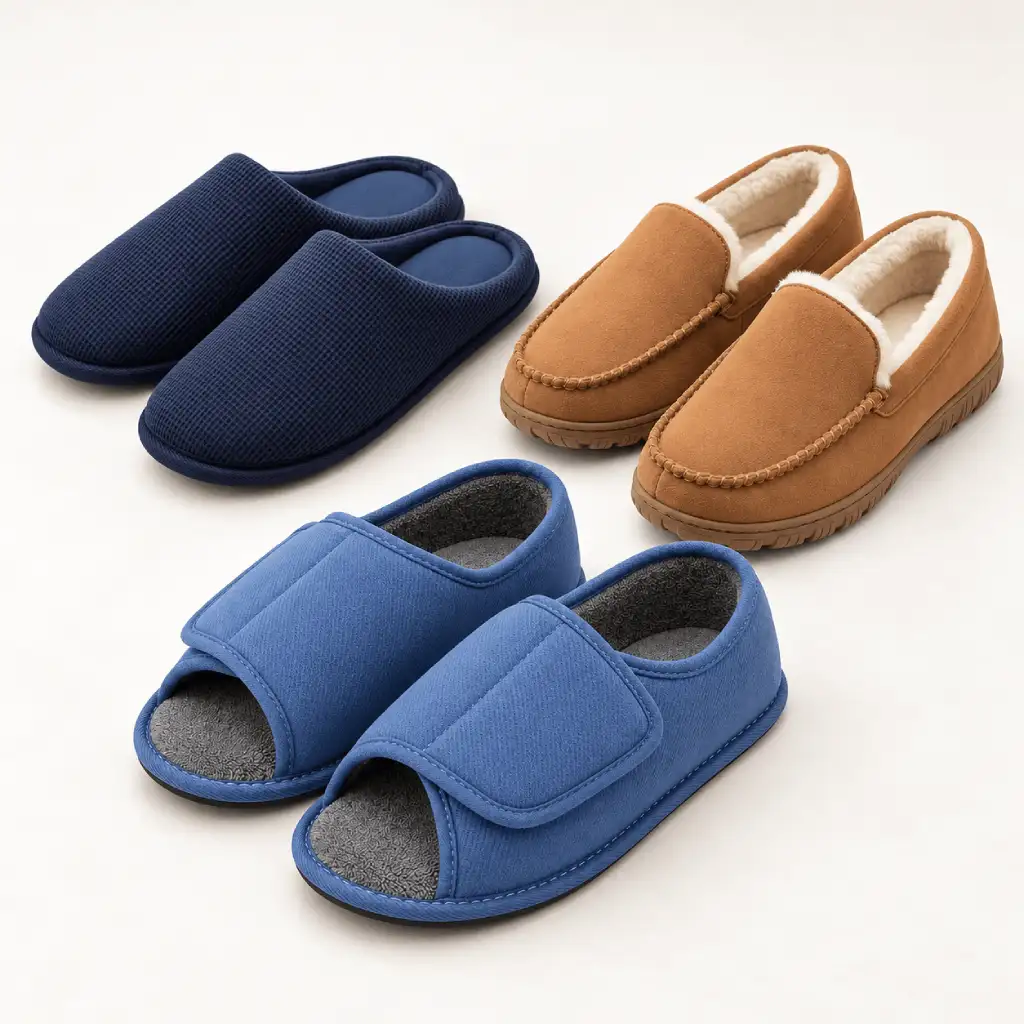
The right shoe packaging format depends on the finished product, not only the brand concept. Slipper categories differ in volume, flexibility, outsole profile, upper structure, pile direction, decoration, and ability to recover after pressure. These differences should shape the packaging trial.
| Slipper type | Packaging priorities | Sample checks |
|---|---|---|
| Open-back slippers | Keep the pair aligned, control movement, and avoid crushing the upper opening | Pair orientation, nesting method, upper recovery, label visibility, and outsole contact with the upper |
| Closed-back house shoes | Protect heel structure and allow sufficient internal volume | Heel deformation, opening shape, toe pressure, box or bag dimensions, and recovery after unpacking |
| Plush slippers | Reduce uncontrolled pile compression and keep the presentation clean | Pile direction, pressure marks, loose fiber appearance, pair matching, and recovery time after opening |
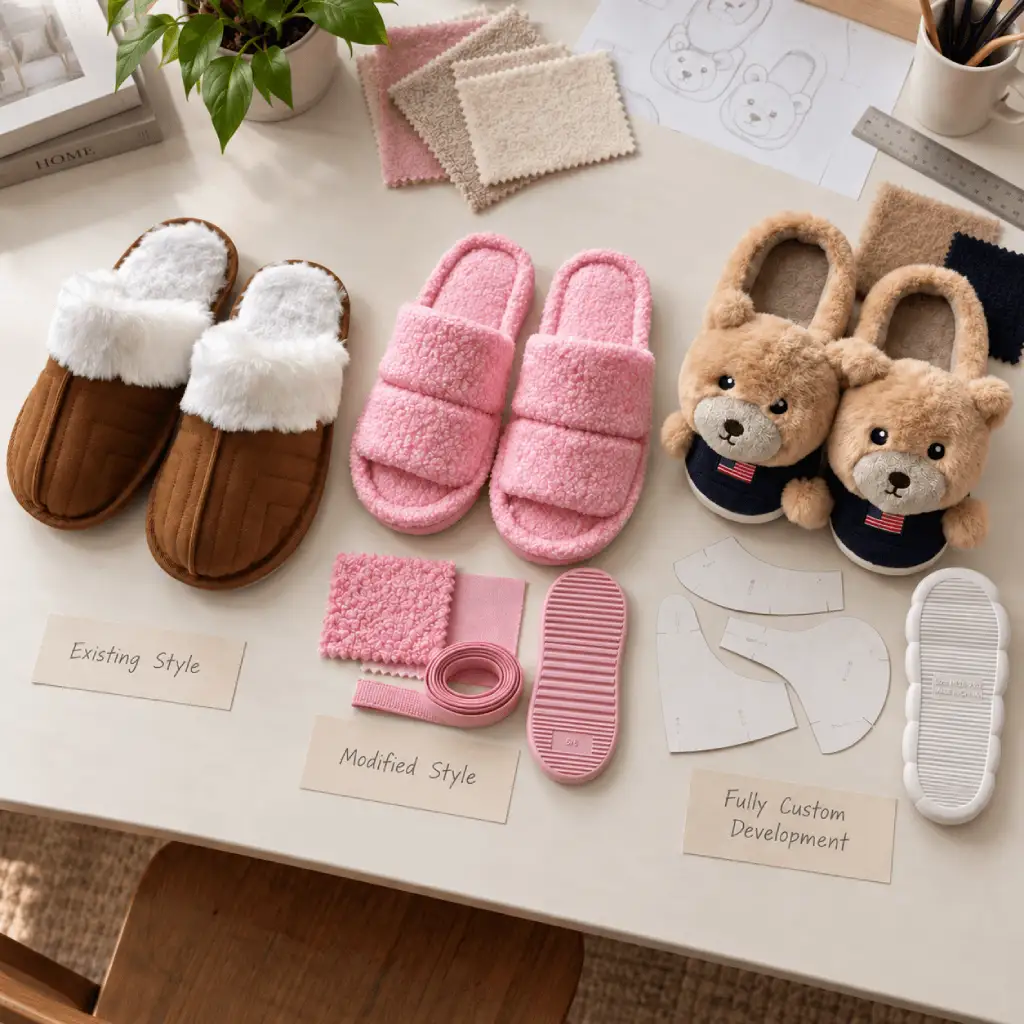
| 3D animal slippers | Protect ears, noses, horns, tails, appliqués, and character proportions | Raised-part direction, symmetry, attachment stress, facial presentation, and carton pressure |
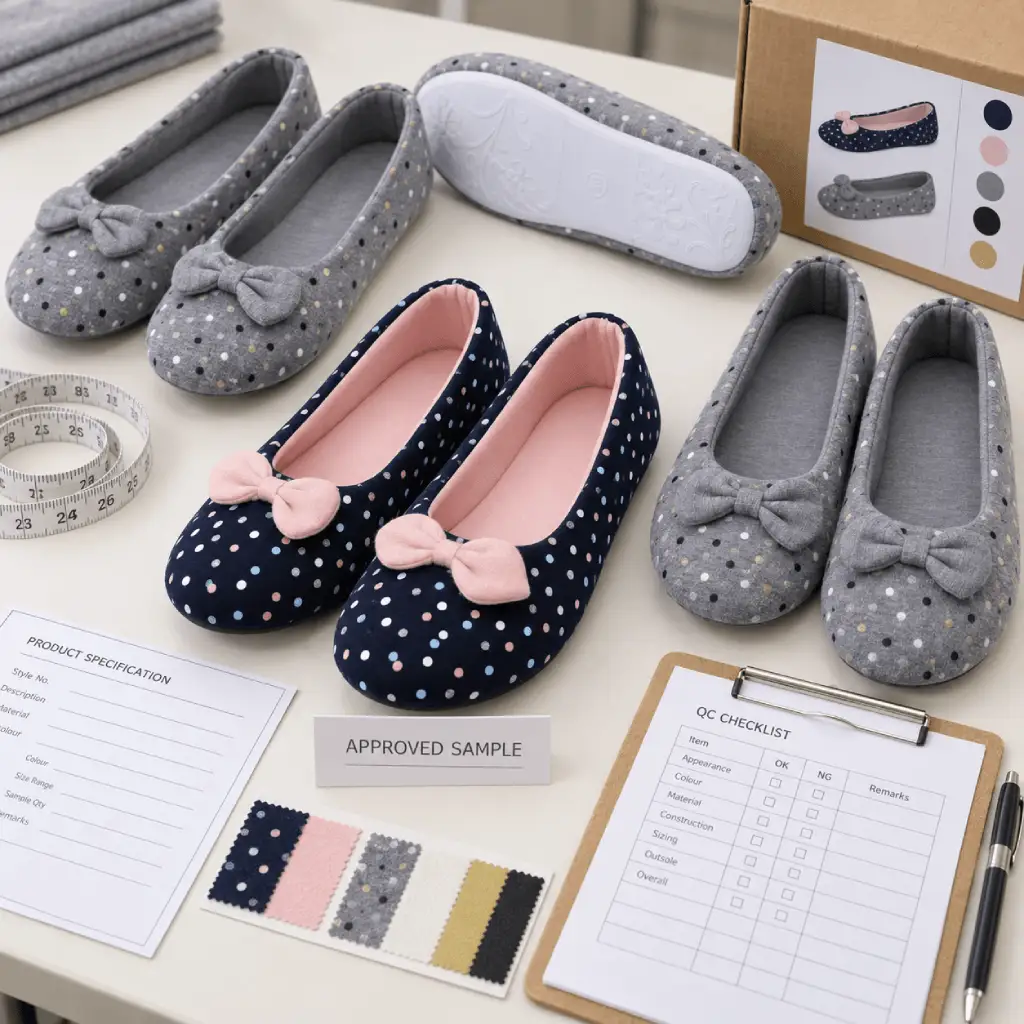
| Ballerina slippers | Maintain a neat low-profile shape without wrinkling the topline or bow | Toe profile, topline, bow position, insole presentation, folding direction, and size label placement |
| Lightweight summer slippers | Use space efficiently while protecting straps, bands, and surface finishes | Band pressure, outsole bending, surface contact, pair alignment, and hanger balance if used |
The examples above are starting points, not fixed rules. A thick open-back slipper can require more space than a lightweight closed-back style. A simple plush scuff may pack differently from a novelty slipper with tall ears. Buyers should approve packaging by the actual material, construction, size range, and product presentation.
Size-range check: do not approve the full packaging program using only one middle size. Test at least the sizes most likely to challenge the selected package, because larger pairs may need more volume and smaller pairs may move excessively inside a box designed around the largest size.
Buyers can compare current product directions in our women’s slippers, men’s slippers, and kids’ slippers categories before discussing a packaging plan.
5. Shoe Box Packaging Design and Dimensions
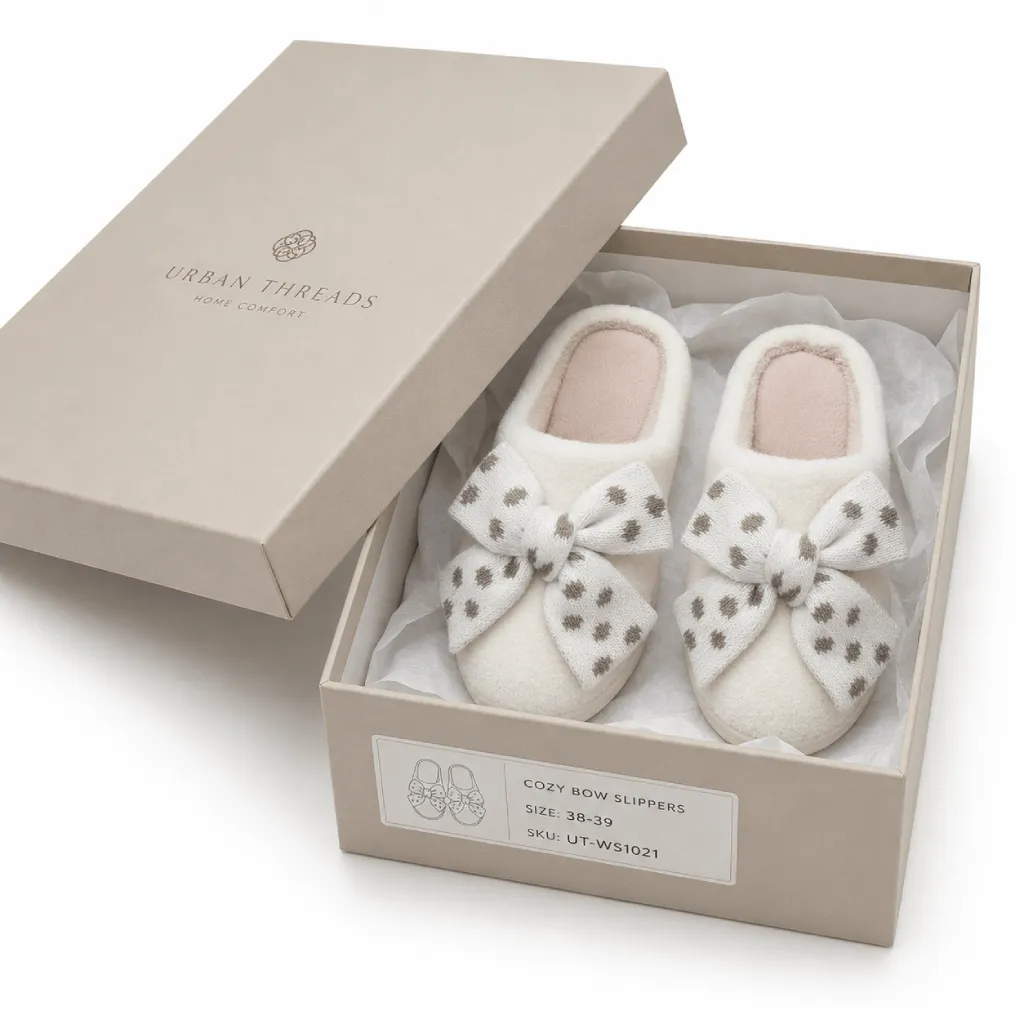
Shoe box packaging can provide structured retail presentation, protect printed or decorated uppers, and create a larger surface for brand communication. It also adds decisions that simple bag packaging does not require: box style, board specification, internal dimensions, print, tissue or inserts, size labels, ventilation, stacking, and master carton utilization.
There is no universal shoe box size for private label slippers. The internal dimensions should be developed from the actual packed pair and the required presentation. Dimensions copied from another footwear style may leave too much movement, press a plush upper, bend a closed heel, or waste space in the master carton.
Structure and fit
- lid-and-base, folding carton, or other approved structure
- usable internal length, width, and height
- board stiffness and finished box strength
- pair orientation and internal movement
- tissue, insert, divider, or retention method
Brand and retail details
- logo position and print colors
- product name, size, color, and SKU panel
- barcode area and scanning orientation
- care, material, or market-required text
- surface finish and approved color reference
How to determine shoe box package dimensions
- Confirm the representative slipper sample, including the outsole and all decorations.
- Place the pair in the intended retail orientation with tissue or inserts if required.
- Check the clearance around the toe, heel, sides, and highest decoration.
- Review whether the product moves, bends, presses against the lid, or loses presentation.
- Test the smallest and largest relevant sizes instead of assuming one box works equally well for the range.
- Review how individual boxes fit into the proposed master carton.
Custom shoe box packaging is a separate supply item
Custom shoe box packaging may require its own artwork approval, dieline confirmation, print sample or color reference, material specification, and production schedule. These details should be coordinated with the slipper order, but they should not be treated as automatically included in a generic product price.
Buyers planning a printed box should send the intended retail presentation and available artwork when they request a private label slipper quotation.
6. Labels, Barcodes, Size Stickers, and SKU Information
Labels connect the physical pair with the buyer’s product data. In a private label footwear packaging program, the supplier may need to apply information to the slipper, individual package, shoe box, inner carton, and master carton. The required content and placement should come from the buyer’s specification and the applicable destination or retail-channel requirements.
| Information type | Possible location | Approval points |
|---|---|---|
| Brand and product name | Insert, band, header card, pouch, or box | Spelling, hierarchy, trademark artwork, color, and placement |
| Size and color | Product label, sticker, bag, box, or hangtag | Size system, conversion, color name, SKU mapping, and visible position |
| SKU or style number | Retail label, box end label, inner carton, and master carton | Exact code, variant logic, revision control, and consistency across all levels |
| Barcode | Hangtag, header card, individual package, or shoe box | Buyer-supplied data, symbol type, print quality, quiet zone, size, contrast, and scan test |
| Care, material, origin, or warning text | Product label, insert, bag, box, or sticker | Exact buyer-approved wording, language, market applicability, and legal review when required |
GTINs and related barcode identifiers should be managed through the buyer’s approved data process. Buyers unfamiliar with identifier structures can review the official GS1 Global Trade Item Number guidance. The factory should not invent, reuse, or alter a customer’s barcode data without written approval.
Retailers can also issue their own detailed vendor instructions. For example, the Foot Locker carton packing and shipping requirements illustrate how retailer-specific rules may cover cartons, packing, labels, and shipment preparation. This is an example of a customer manual, not a universal standard for every footwear order.
Data-control rule: send one approved label data sheet that connects style, color, size, SKU, barcode, package, and carton information. Avoid sending conflicting values across emails, artwork files, spreadsheets, and purchase orders.
Country-of-origin, material, safety, recycling, and warning statements can vary by product and destination. Buyers should confirm applicable requirements with their compliance advisers, customs specialists, retailers, or testing partners. A slipper manufacturer can apply approved content, but should not replace market-specific legal review.
7. Inner Cartons, Master Cartons, and Carton Markings
Individual slipper packaging is only one level of the packing plan. Buyers also need to define how pairs are grouped and shipped. Depending on the distribution program, goods may move directly from master cartons or use inner cartons to separate SKUs, store packs, colors, or size assortments.
Inner carton
An inner carton groups a smaller quantity inside the master carton. It may support SKU separation, store distribution, cleaner handling, or a customer-defined pack. Its dimensions, quantity, closure, labels, and relationship to the master carton should be specified.
An inner carton should not be added automatically. Extra packaging can change space, handling, and cost, so its purpose should be clear.
Master carton
The master carton is the principal shipping carton for the packed pairs. It needs an approved quantity, arrangement, dimensions, closure, board specification, weight information, and markings.
Its final dimensions should be measured after the individual packaging and pair arrangement are confirmed.
What may appear in shoe carton markings?
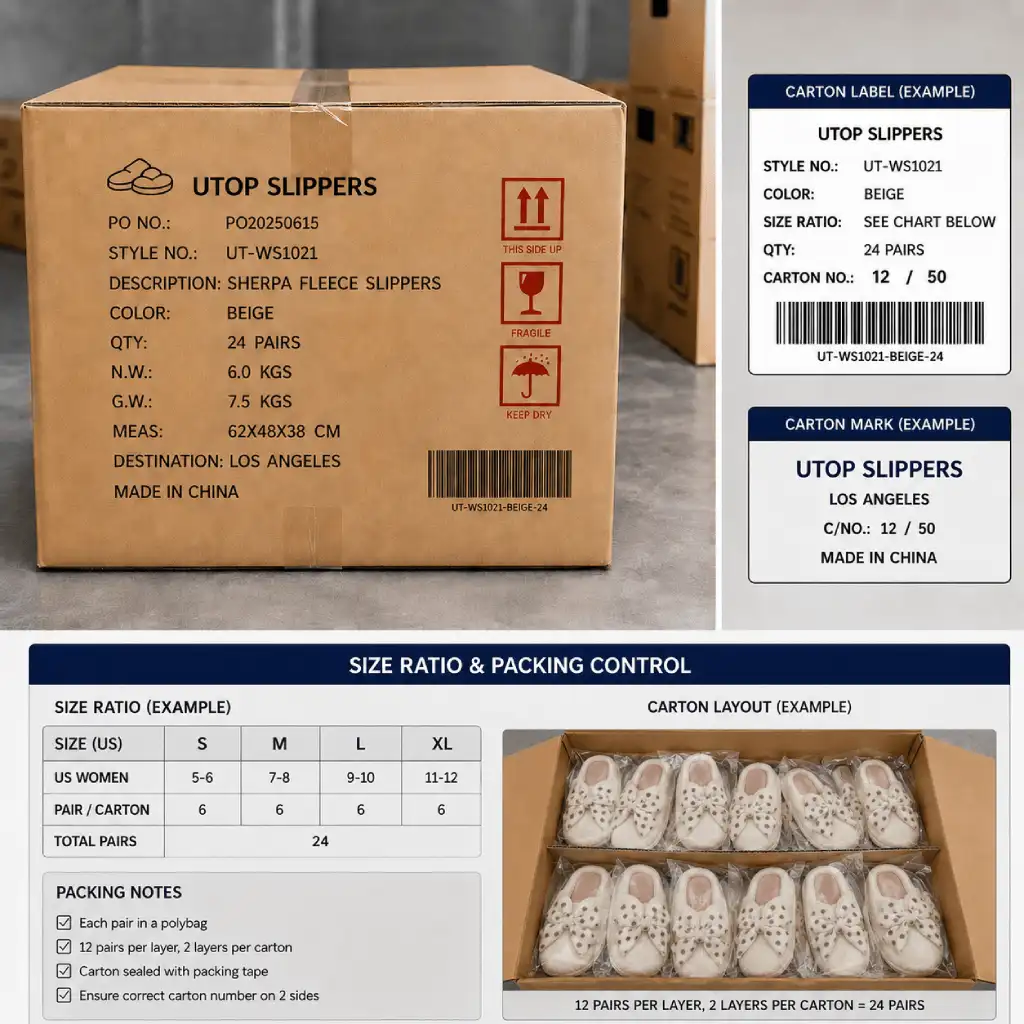
Shoe carton markings vary by buyer, destination, warehouse, and shipping method. A carton mark may include some of the following fields, but the final layout should come from the approved shipping instructions:
- buyer or consignee mark
- purchase order number
- style or SKU number
- product description
- color and size assortment
- pairs per carton
- carton number sequence
- gross and net weight
- carton dimensions
- country-of-origin wording when specified
- handling symbols or warehouse labels
- destination or store-routing information
The carton artwork or stencil should be checked against the purchase order and packing data before mass application. A correct-looking carton can still create a warehouse problem if the SKU, color, size range, quantity, barcode, or destination does not match the goods inside.
Confirm shipping marks late enough—but not too late
Carton marks need final purchase-order and logistics data, but waiting until packing has started can create delays or rework. Agree on the template early, then release the final variable data through a controlled approval before carton printing or marking.
8. Pack Ratios and Carton Quantity
A pack ratio defines how sizes, colors, or SKUs are distributed within a carton or inner pack. Carton quantity defines the number of pairs grouped at that level. These decisions influence warehouse receiving, store allocation, picking, carton utilization, weight, and the risk of packing the wrong assortment.
The preferred ratio should come from the buyer’s sales and distribution plan—not from a generic factory assortment. A brand selling direct to consumers may prefer solid-SKU cartons. A retailer supplying stores may request a mixed-size ratio. A distributor may separate colors but mix sizes. Each approach needs different labels and packing controls.
| Pack approach | Possible use | Control points |
|---|---|---|
| Solid size and solid color | Warehouse or ecommerce SKU handling | SKU label, size, color, quantity, carton number, and purchase-order match |
| Mixed sizes, one color | Retail size assortment | Exact ratio, packing order, assortment label, and total pairs |
| Mixed sizes and colors | Store-ready or promotional packs | Variant matrix, physical separation, verification method, and carton identification |
| Inner packs within a master carton | Distribution or store allocation | Pairs per inner, inners per master, labels at both levels, and dimensional fit |
How should carton quantity be selected?
Carton quantity should balance product protection, handling, weight, dimensional efficiency, and the buyer’s distribution needs. More pairs per carton do not automatically mean a better result. Excess pressure can affect soft products, while a carton with too much empty space can allow movement and reduce packing stability.
- Start from the approved individual package and actual size range.
- Arrange the pairs without uncontrolled bending, pressure, or empty space.
- Measure the packed carton rather than estimating from an unpacked pair.
- Review gross weight and any buyer, carrier, or warehouse limits.
- Check whether mixed assortments can be packed and verified reliably.
- Confirm the relationship between order quantity, carton quantity, and any remaining pairs.
Approval point: the packing list, carton labels, carton marks, physical assortment, and purchase order should use the same size and color logic. Ambiguous abbreviations can create errors even when the total pair quantity is correct.
9. Packaging Risks for Plush and Decorated Slippers
Soft footwear can look easy to pack because it bends and compresses. That flexibility can hide quality risks. Pressure, friction, humidity, pair orientation, decoration contact, and time inside the package may change the appearance seen after unpacking. A reliable slipper packaging plan should therefore be tested on the actual product.
| Risk | What may happen | What to review |
|---|---|---|
| Pile compression | Plush may appear flattened, directional, or uneven after unpacking | Package pressure, pile direction, recovery method, presentation standard, and packed-sample review |
| Decoration distortion | Ears, bows, pom-poms, appliqués, or embroidery areas may bend or press against another surface | Orientation, clearance, attachment stress, inserts, box height, and pair-to-pair contact |
| Shape deformation | Toe, topline, opening, heel, or upper structure may not return to the approved shape | Folding direction, stuffing or support, packed duration, carton pressure, and size-specific fit |
| Surface transfer or marking | Dark materials, printed components, metal parts, or outsoles may mark adjacent surfaces | Colorfastness information, barriers, tissue, material contact, moisture, and test requirements |
| Excess movement | Pairs can rub, turn, scuff, or arrive in an untidy presentation | Internal fit, retention, fill, pair arrangement, carton gaps, and transport simulation when required |
Packaging tests should match the project rather than rely on a universal pass claim. Product weight, carton size, distribution route, climate, stacking, carrier handling, and buyer standards can all change the test plan. The SGS footwear packaging performance-testing overview provides an example of the types of package and transport-performance considerations that may be evaluated by a testing provider.
Compression is not automatically a defect
Some soft slippers can be packed efficiently and recover acceptably after unpacking. Others need more room or support. The acceptable result should be defined through the approved packed sample, recovery expectations, and any required testing—not through a general statement that all plush materials behave the same way.
For more detail on pile, backing, construction, and packing recovery, read the Plush Slippers Wholesale Guide. Buyers can also review broader workmanship risks in Common Indoor Slipper Manufacturing Defects.
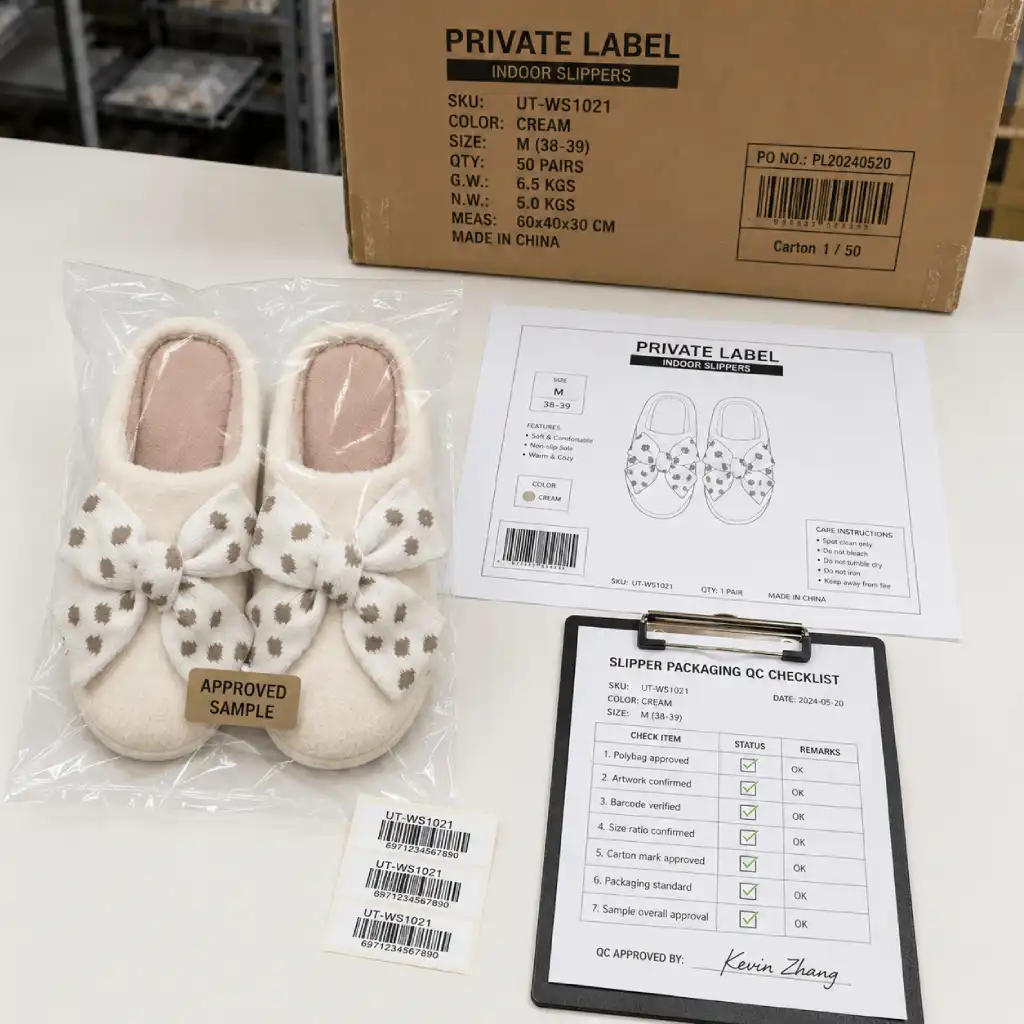
10. Packaging Sample Approval Checklist
Packaging approval should cover the physical packed product, printed components, labels, carton plan, and data accuracy. Approving artwork alone does not confirm that the finished footwear packaging fits the slipper or works through the intended distribution process.
Individual package and product fit
- The correct slipper style, color, outsole, size, and decorations are used.
- The pair orientation matches the approved presentation.
- The package dimensions fit without excessive pressure or uncontrolled movement.
- The toe, opening, heel, pile, straps, bows, ears, and other raised parts recover as expected.
- The outsole does not leave unacceptable marks on the upper or lining.
- Any tissue, insert, band, hanger, pouch, or retention component is correctly positioned.
Artwork, print, and labels
- The latest approved logo and artwork files are used.
- Text, language, punctuation, size, color, SKU, and product description are correct.
- Print color and surface finish match the approved reference or agreed tolerance.
- Barcode data, symbol, dimensions, contrast, placement, and scan result are checked.
- Country-of-origin, care, material, safety, or warning statements match the approved market-specific instruction.
- Variable data is consistent across the product, individual package, inner carton, master carton, and packing list.
Carton and distribution checks
- Pairs per inner carton and master carton match the approved pack plan.
- Mixed-size and mixed-color ratios are physically verified.
- Carton dimensions and gross and net weights are recorded after packing.
- Shipping marks, carton numbers, labels, and routing information match the purchase order.
- The carton closes correctly without excessive bulging, empty space, or product pressure.
- Any required package or transport test is completed to the buyer-approved method.
Keep one controlled approval record
The final record should identify the approved physical sample, artwork version, label file, barcode data, packing method, carton ratio, carton marks, and date. If one component changes, confirm whether a revised packed sample or written reapproval is needed.
Learn more about UTOP’s product-development and production support on our About Us page.
11. Information Buyers Should Include in a Packaging RFQ
A useful RFQ connects the slipper specification, sales channel, individual packaging, labels, and carton plan. Buyers do not need every detail finalized before the first discussion, but they should separate confirmed requirements from open questions. This helps the supplier identify what can be quoted immediately and what needs a sample or packaging trial.
| RFQ section | Information to provide | Why it matters |
|---|---|---|
| Slipper product | Reference image or sample, upper, lining, outsole, decorations, size range, colors, and quantity | Defines volume, pressure sensitivity, orientation, and pack testing needs |
| Sales channel | Retail store, ecommerce, supermarket, distributor, gift, promotional, or other program | Shapes presentation, handling, labeling, and distribution requirements |
| Individual packaging | Polybag, belly band, header card, hanger, insert, pouch, display box, or shoe box | Defines materials, artwork, packing labor, fit, and product presentation |
| Artwork and branding | Logo files, colors, copy, dielines, print references, and approval process | Supports accurate sampling, print review, and lead-time planning |
| Labels and barcodes | SKU matrix, size and color names, barcode files, label dimensions, placement, and required text | Prevents data conflicts and supports scanning and warehouse identification |
| Carton plan | Pack ratio, pairs per inner and master carton, weight or size limits, carton marks, and routing labels | Defines the shipping configuration and packing-control points |
| Market and testing | Destination, retailer manual, compliance documents, package tests, and inspection requirements | Allows requirements to be reviewed before material and production approval |
| Schedule | Target sample date, artwork approval date, delivery window, and destination | Helps coordinate slipper sampling, printed packaging, approval, packing, and shipment |
If the buyer already has a vendor manual, packaging specification, retailer label guide, or approved dieline, it should be shared at the beginning. If no fixed format exists, the buyer can explain the required presentation and distribution process so the supplier can propose a practical starting point for review.
Quotation tip: ask every supplier to list the assumed individual package, printed components, labels, carton quantity, and carton marks. This makes comparisons more meaningful than reviewing one total price with undefined packaging.
Preparing a private label slipper program? Contact UTOP Slippers with your product reference, target quantity, size range, packaging direction, destination, and delivery schedule.
12. Frequently Asked Questions About Footwear Packaging
What is the best packaging for private label slippers?
There is no universal best format. The right private label slipper packaging depends on the product structure, materials, decoration, size range, sales channel, brand presentation, destination requirements, distribution process, and approved packed sample. A polybag may suit one program, while another may need a hanger, paper band, pouch, display carton, or branded shoe box.
Is a shoe box required for indoor slippers?
No. Many indoor slippers use individual bags, paper bands, header cards, hangers, inserts, or pouches. Shoe box packaging may be selected for structured protection, stacking, gift presentation, or a specific retail program, but it should be justified by the product and channel.
When should custom shoe box packaging be designed?
The brand direction can begin early, but final dimensions should be confirmed after the representative slipper sample, pair orientation, tissue or inserts, and required clearance are known. Artwork, structure, labels, and master carton fit should then be approved through an actual packed sample.
What information is normally shown on slipper packaging?
Depending on the project, packaging may show the brand, product name, style or SKU, size, color, barcode, care information, material information, origin, warnings, recycling details, or retailer-specific data. The exact content must be confirmed for the destination market and buyer program rather than copied from another product.
Who should provide barcode numbers for private label footwear?
The buyer or brand should provide approved barcode data through its product-information process. The supplier can print and apply the barcode according to the approved file and placement specification, then perform the agreed verification. The factory should not create or change customer barcode data without authorization.
How are carton quantities and size ratios selected?
They are selected from the buyer’s SKU and distribution plan, the actual packed product dimensions, carton utilization, weight, product protection, and warehouse requirements. Buyers should specify whether cartons are solid size, mixed size, solid color, mixed color, or arranged in inner packs.
Can plush slippers be compressed for shipping?
Some plush slippers may recover acceptably after controlled packing, while others may show pile pressure, decoration distortion, or shape changes. The decision should be based on the specific materials, construction, packaging pressure, recovery expectation, approved packed sample, and any buyer-required testing.
What should be approved before bulk packaging begins?
Buyers should approve the physical packed sample, packaging structure and dimensions, artwork, print reference, labels, barcode data, pair orientation, size and color ratio, carton quantity, carton marks, and any required packaging test. The approved versions should be recorded clearly.
Final takeaway: effective footwear packaging is not simply the most decorative or the smallest package. It is the approved system that presents the brand, fits the slipper, carries correct data, supports distribution, and protects the expected product condition through the intended supply chain.
Review UTOP’s current custom slipper product directions or send your packaging brief for project review.