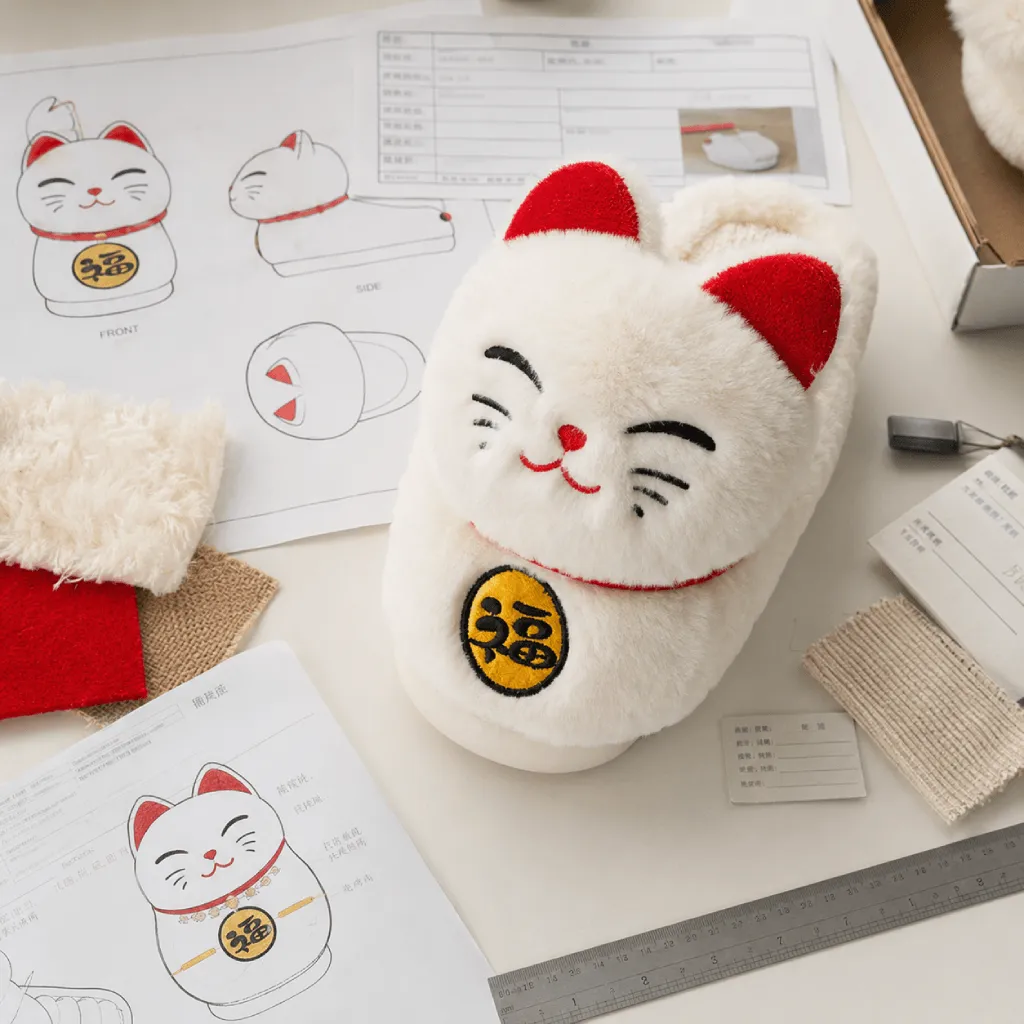
For buyers sourcing plush slippers wholesale, the product may look simple at the sample stage. The upper feels soft, the lining looks warm, and the finished pair may seem ready for a retail shelf, gift program, or seasonal homewear collection.
The real sourcing challenge starts when the same design has to be produced across different sizes, colors, materials, and production batches.
Small specification changes can create visible differences in bulk production. A slight change in pile density may affect the surface appearance. A thicker lining can reduce the internal fitting space. Long fibers may hide a detailed logo. Tight packaging can flatten the upper before the goods reach the buyer’s warehouse.
Buyer note: Wholesale plush slippers should not be reviewed only as “soft slippers.” Before sampling and bulk production, buyers need to confirm the material, pile structure, fit, outsole, branding method, packaging, and bulk quality standard.
This guide explains what wholesale buyers, private label brands, retailers, distributors, and sourcing teams should check when developing plush slippers for bulk orders.
Table of Contents
- What Wholesale Buyers Mean by Plush Slippers
- Define the Sales Channel Before Choosing Materials
- Check Plush Type, Pile Height, Density, and Backing
- Match Materials to Season, User, and Product Positioning
- Choose the Right Construction for Plush House Slippers
- Check Fit, Lining Thickness, and Cushioning
- Match the Outsole to Indoor Use and Price Position
- Plan Custom Plush Slippers Branding Without Losing Logo Clarity
- Protect Plush Shape During Packaging and Shipping
- Set Bulk QC Standards for Shedding, Shade, and Surface Consistency
- Working With UTOP on Custom Plush Slipper Projects
- FAQ About Plush Slippers Wholesale Orders
- Conclusion
1. What Wholesale Buyers Mean by Plush Slippers
The term plush slippers wholesale does not refer to one single material or one fixed slipper style.
In sourcing conversations, buyers may use “plush slippers” to describe many types of soft indoor footwear, including teddy fleece slippers, short plush slippers, faux fur slippers, sherpa slippers, coral fleece slippers, velvet plush slippers, animal slippers, and fuzzy winter house slippers.
Why the material name matters
A buyer may ask for “fluffy slippers,” but one supplier may understand that as long-pile faux fur, while another may recommend sherpa, teddy fleece, or short plush. These materials can all look soft in photos, but they behave differently in cutting, sewing, logo application, packing, and bulk production.
For example, faux fur usually has a longer and more decorative pile. Sherpa often has a shorter, curly, wool-like surface. Short plush gives a cleaner appearance and is easier to control around seams, logos, and decorative details. Teddy fleece creates a warm, rounded look that works well for winter and casual homewear styles.
For this reason, buyers should confirm the actual fabric before requesting or approving a sample. General words such as “soft,” “fuzzy,” or “fluffy” are useful for describing the desired look, but they are not enough for production.
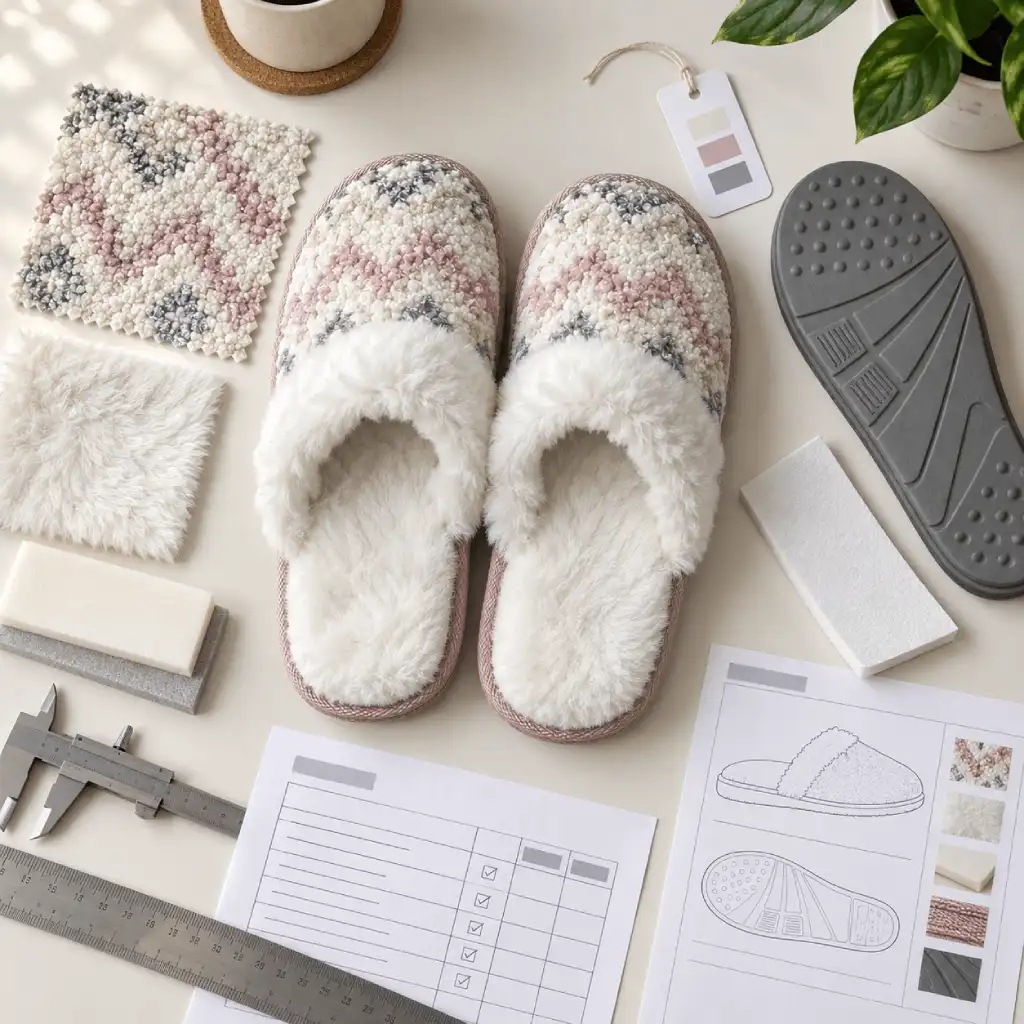
A Clear Material Specification Should Include
- Fabric name
- Fiber composition, if available
- Fabric weight
- Pile height
- Pile density
- Backing structure
- Stretch direction
- Color reference
- Expected hand feel
- Approved swatch or reference sample
Photos are useful for communicating the design direction, but they cannot fully show pile density, backing strength, stretch, or shape recovery. For bulk plush slipper orders, the approved swatch and finished sample should become the real production reference.
Plush Material Options for Wholesale Slipper Projects
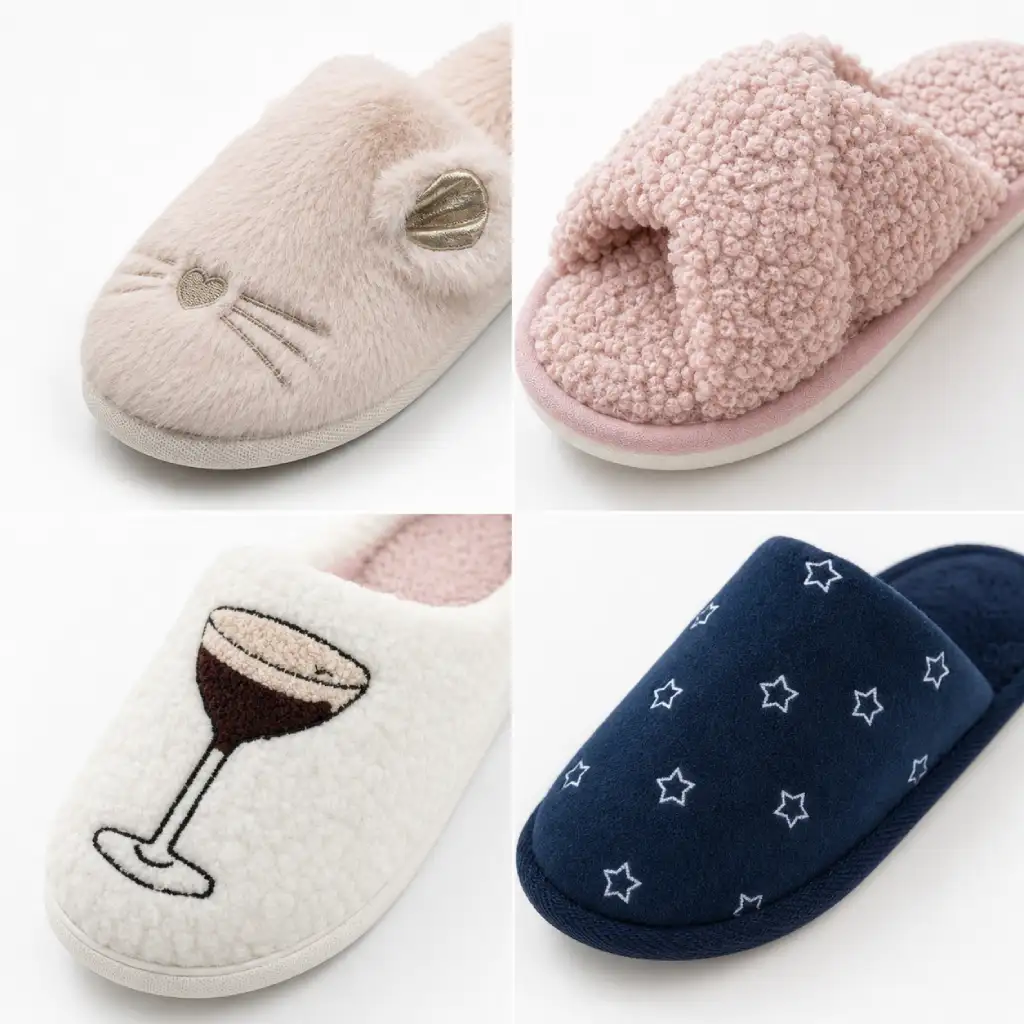
The table below can help buyers compare common plush materials before requesting samples. It should be used as a sourcing reference, not as a fixed industry classification. The approved swatch and finished sample should remain the final production reference.
2. Define the Sales Channel Before Choosing Materials
Before choosing a fabric or requesting a sample, buyers should first define where the plush slippers will be sold and how the order will be used, especially when developing products for private label brands.
The same pair of wholesale plush slippers may need very different specifications depending on the sales channel. A private label homewear brand may focus on custom colors, material hand feel, logo position, and branded packaging. A supermarket or chain retail program may care more about target cost, barcode labels, size ratios, carton quantity, and shelf presentation.
Seasonal gift collections may require fuller materials, decorative trims, and gift-ready packaging. Wholesale distributors may prefer stable construction, efficient carton packing, and styles that can be reordered with consistent specifications.
For this reason, buyers should not start only with a photo and a target price. The quotation becomes more useful when the supplier understands the full project context.
A Clear Sales Channel Brief May Include
- Target market
- Retail or wholesale channel
- Private label or open-line product
- Target selling season
- Expected retail price range
- Target order quantity
- Size range and size ratio
- Packaging format
- Barcode or SKU requirements
- Delivery window
- Testing or compliance requirements
For example, a pair of plush house slippers for a winter retail shelf may need a fuller upper, stronger packaging, and clearer size labeling. A cost-sensitive promotional order may need a simpler construction, lighter material, and more compact packing. A private label collection may need more attention to logo clarity, color matching, and sample approval.
This is why two suppliers may give very different prices for products that look similar in a photo. One quote may be based on thicker plush, a heavier sole, custom packaging, and stricter QC requirements. Another may be based on a simpler material and basic packing.
Common sourcing mistake
A common mistake is asking suppliers to quote “the same plush slipper” based only on a product image.
A photo can show the style direction, but it does not confirm pile density, lining thickness, outsole weight, logo method, packaging, or carton quantity. Without those details, the quote may be fast, but it may not be accurate enough for bulk production planning.
Buyer note: Before comparing prices, buyers should make sure each supplier is quoting the same specification. This is the only way to compare cost, quality, and delivery expectations fairly.
For buyers sourcing plush slippers wholesale, the sales channel should guide the product specification. Material, sole, decoration, packaging, and inspection standards should work together instead of being decided separately.
3. Check Plush Type, Pile Height, Density, and Backing
After the buyer has defined the sales channel, the next step is to confirm the plush material in more technical detail.
For plush slippers wholesale orders, fabric surface is only one part of the decision. Buyers should also review material selection, pile height, pile density, and backing structure before approving a sample.
Three details are especially important when reviewing plush materials for bulk slipper production: pile height, pile density, and backing structure.
Pile Height
Pile height refers to the length of the visible fibers on the material surface.
Longer pile can create a fuller, softer, and more decorative appearance. It is often used for faux fur slippers, fluffy slippers, novelty slippers, and fashion-led winter styles. However, long fibers can also hide seam lines, reduce logo clarity, and create more variation in appearance depending on brushing direction.
Shorter pile usually gives a cleaner and more controlled surface. It can be easier to use around embroidery, woven labels, appliqué details, and shaped upper panels. For buyers who need a more consistent look across sizes and colors, short plush may be easier to manage than a very long-pile material.
Pile Density
Pile density affects how full and warm the slipper feels. It also affects material consumption, cost, weight, and packing volume.
A dense plush surface may look richer and more suitable for winter retail programs, but it can increase the overall cost and make the slippers bulkier in cartons. A lighter material may be more practical for price-sensitive programs, promotional orders, or compact packing requirements.
The key is not to choose the thickest material automatically. Buyers should match density to the retail price, target season, wearing experience, and packaging method.
Backing Structure
The backing is the base layer that supports the plush surface.
A soft material with weak backing may look attractive in a swatch, but it can stretch, distort, or lose shape during cutting and sewing. This is especially important for closed-toe slippers, plush house slippers, animal slippers, and styles with a shaped upper.
For custom plush slippers, backing also affects how well the material holds embroidery, patches, side labels, or decorative pieces. If the backing is too soft or unstable, the finished logo area may not look as clean as expected.
Before Approving the Material, Buyers Should Check
- Whether the fabric stretches in one direction or multiple directions
- Whether the backing is stable enough for the slipper structure
- Whether the pile direction affects color appearance
- Whether the material recovers after compression
- Whether the same material can be secured for bulk production
- Whether the approved swatch matches the finished sample
A fabric swatch is useful, but it is not enough by itself. Buyers should also review a finished slipper sample made with the intended material and construction. Only then can they see how the plush behaves after cutting, sewing, shaping, logo application, and packing.
Buyer tip
When comparing wholesale plush slippers from different suppliers, ask whether the quotation is based on the same pile height, density, backing, lining, and outsole. These details may not be obvious in photos, but they can explain why two similar-looking samples have different prices.
4. Match Materials to Season, User, and Product Positioning
A common mistake in plush slipper sourcing is assuming that the softest or thickest material is always the best choice.
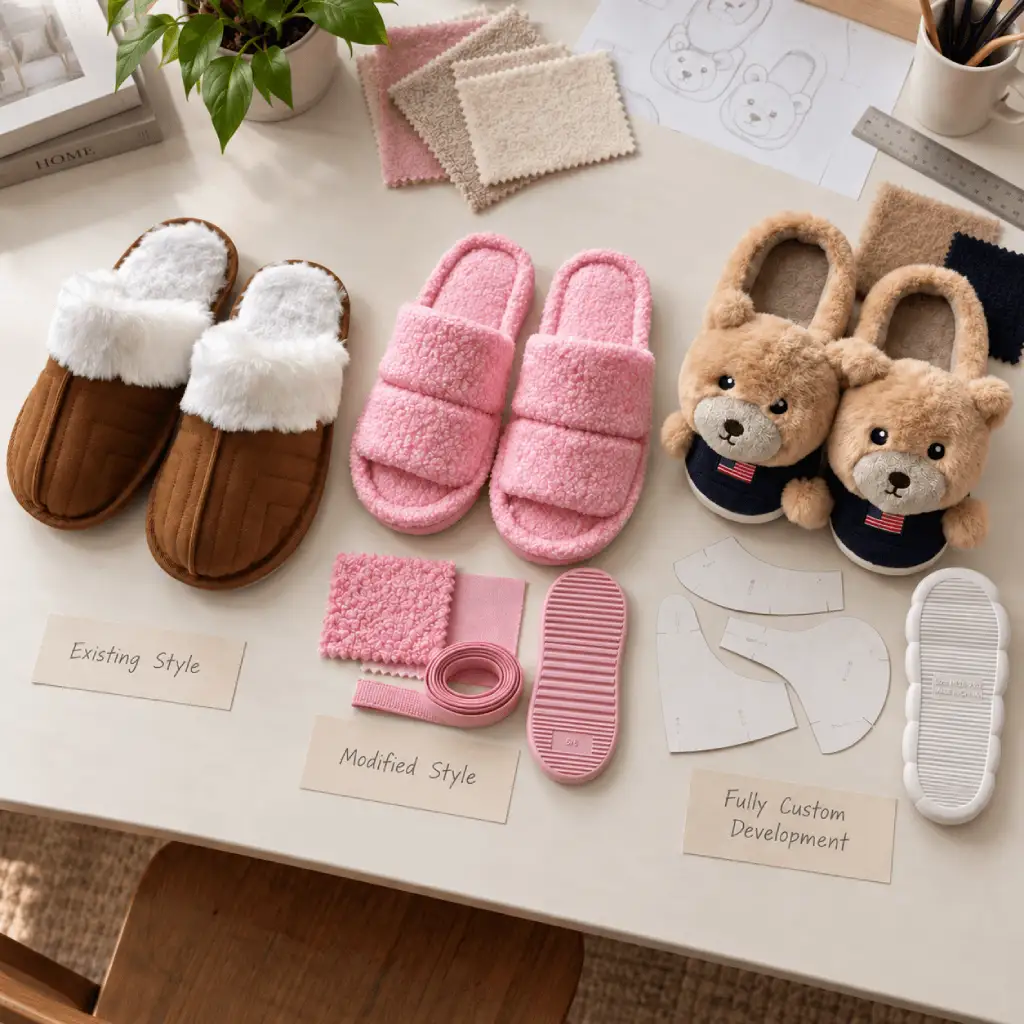
In real wholesale projects, material selection should start from the product’s selling season, target user, price point, and retail positioning. A winter gift collection, a women’s fashion slipper, a children’s animal slipper, and a basic indoor house slipper may all use plush materials, but they should not be developed with the same fabric standard.
For winter retail programs, teddy fleece, sherpa fleece, faux fur, or dense short plush can create a warmer and fuller look. These materials often work well when the product needs a strong seasonal appearance on the shelf or in online product images.
For lighter indoor collections, soft short plush or coral fleece may be more practical. They can offer a soft hand feel while keeping the slipper lighter, easier to pack, and more suitable for price-sensitive programs.
Women’s plush slippers
For women’s plush slippers, buyers may also consider decorative details such as lace trim, bows, embroidery, faux fur collars, or seasonal motifs. These details can improve retail appeal, but they should be checked during sampling because they may affect stitching accuracy, logo visibility, and bulk consistency.
Men’s plush house slippers
For men’s plush house slippers, the material choice often needs to feel more controlled. Practical colors, stable upper structure, and a clean surface may matter more than a very fluffy appearance. A material that looks attractive in a women’s fashion style may not be suitable for a men’s closed-toe house slipper.
Kids’ plush slippers and animal slippers
For kids’ plush slippers or animal slippers, material choice becomes even more sensitive. Ears, faces, appliqué parts, and three-dimensional decorations need enough structure to keep their shape after sewing and packing. If the fabric is too soft or unstable, the finished slipper may lose the intended character expression.
Material choice should be reviewed together with
- Target selling season
- User group
- Retail price range
- Slipper structure
- Decoration complexity
- Logo method
- Packaging method
- Carton volume
- Expected reorder stability
The right material is not simply the one that feels softest in a swatch. It is the material that supports the full product plan: appearance, fit, cost, production consistency, packaging, and final customer experience.
Buyer tip: When developing custom plush slippers, buyers should ask the supplier to explain why a material is suitable for the target product, not just whether it is available. A good material recommendation should connect the fabric to the market, construction, price point, and bulk production requirements.
5. Choose the Right Construction for Plush House Slippers
Construction affects appearance, fit, warmth, walking stability, production difficulty, and packing volume. This is especially important for buyers sourcing bulk house slippers for retail or private label programs.
For buyers sourcing plush slippers wholesale, construction should be reviewed together with material, outsole, size range, and packaging plan. A style that looks attractive in one sample may become harder to control when produced across multiple sizes and colors.
Common Plush Slipper Constructions
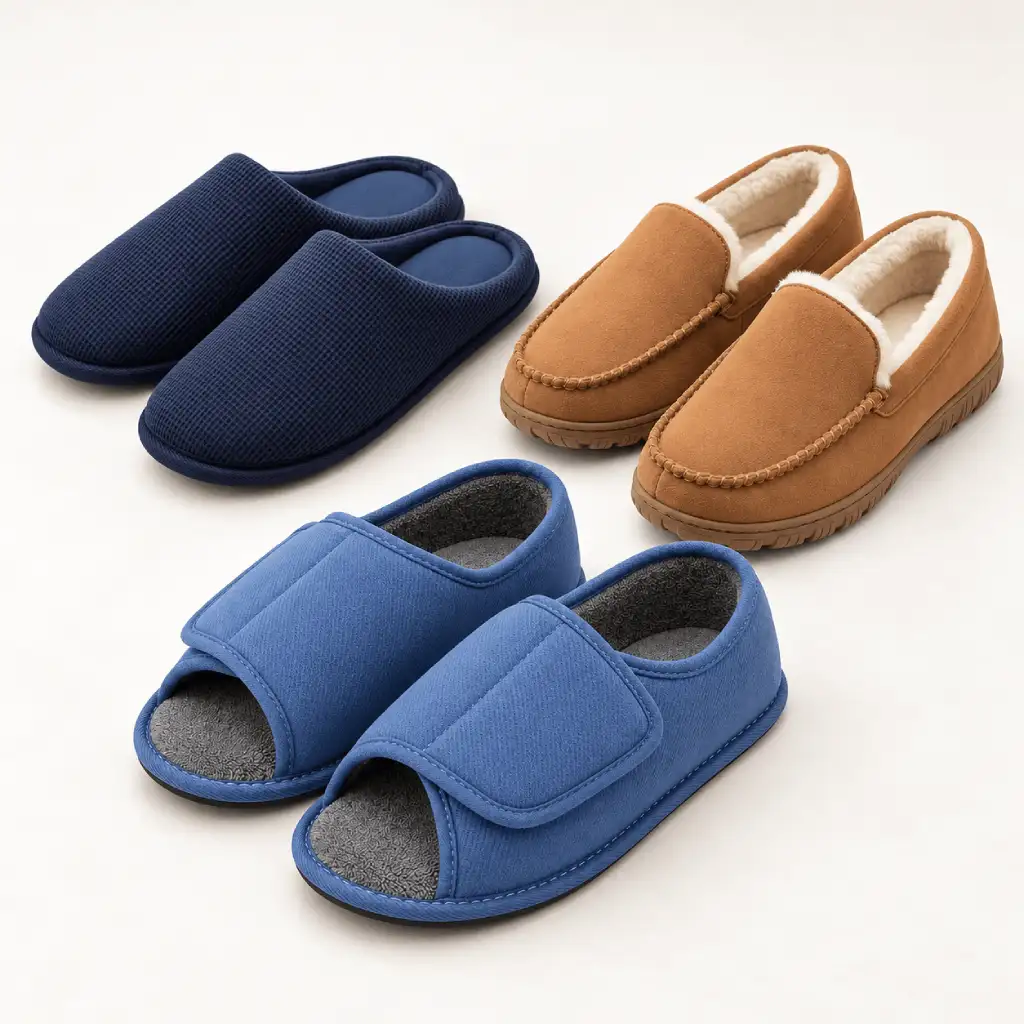
- Open-back mules
- Closed-toe house slippers
- Open-toe cross-band slippers
- Moccasin slippers
- Closed-back house shoes
- Ballerina slippers
- Slipper boots
- Clog-style slippers
- 3D animal slippers
Open-back mules and closed-toe slippers
An open-back mule is easy to wear and suitable for many retail and homewear collections. Buyers still need to check heel length, opening shape, and whether the lining reduces the usable footbed space.
Closed-toe slippers can create a warmer and more complete indoor footwear style, but they need closer control of toe shape, upper volume, and internal space. If the plush material is too thick, the slipper may look full from the outside but feel tight when worn.
Cross-band, moccasin, and closed-back styles
Open-toe cross-band slippers are popular for soft homewear and gift collections. The overlap area should be checked carefully because thick plush can create bulk at the crossing point. If the fabric is too soft, the upper may collapse or twist after packing.
Moccasin slippers and closed-back house shoes usually need more structure. Buyers should review seam control, heel shape, opening width, and whether the material backing is stable enough to hold the intended shape.
Animal slippers and novelty plush styles
Animal slippers and novelty plush slippers need even more attention to shape retention. Ears, faces, appliqué details, and filled parts may look good before packing but become flattened or uneven after compression.
Before Approving the Construction, Buyers Should Check
- Whether the style fits the target user and season
- Whether the material supports the intended upper shape
- Whether the lining affects the internal fit
- Whether the outsole matches the structure
- Whether decorations remain clear after sewing
- Whether the style can be packed without losing shape
- Whether size grading changes the overall proportion
The right construction is not only a design decision. It affects the full sourcing plan, from material selection and sample review to carton packing and final inspection.
Buyer tip
When comparing different plush house slipper styles, buyers should ask for both a visual sample and a fit review. A sample that looks good on a table still needs to be checked for wearing comfort, internal space, shape stability, and packing recovery.
6. Check Fit, Lining Thickness, and Cushioning
Plush slippers often feel smaller inside than their outsole length suggests.
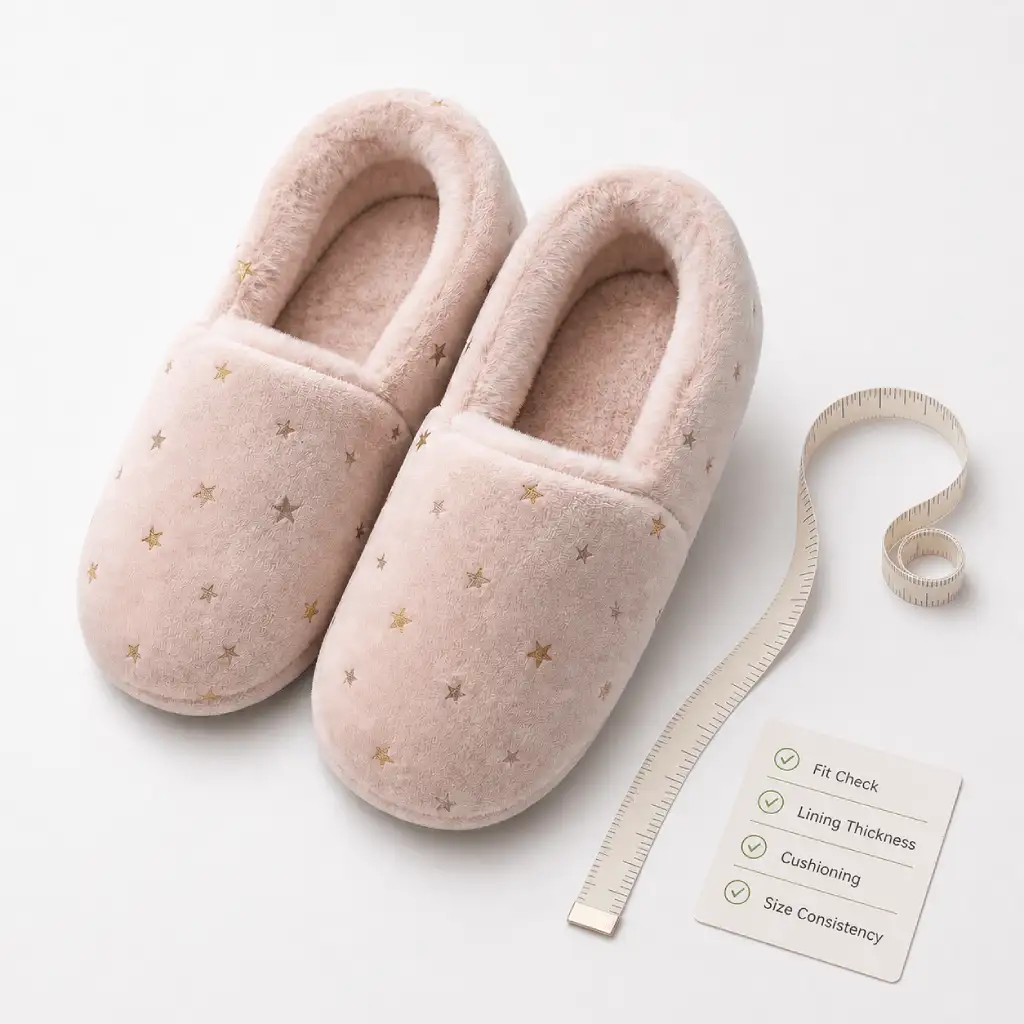
The reason is simple: thick lining, cushioning foam, toe shape, and upper volume all take up part of the internal space. This is especially important for winter styles using teddy fleece, sherpa, faux fur, or thick plush lining.
For buyers sourcing plush slippers wholesale, fit should be reviewed as a production specification, not just a sample impression. A slipper may look correct on the table but feel tight, shallow, or unstable when worn.
Before Approving Fit, Buyers Should Check
- Internal footbed length
- Outsole length
- Toe room
- Opening width
- Instep space
- Heel coverage
- Lining thickness
- Insole cushioning
- Size label method
- Full size grading
Why one sample size is not always enough
A sample may fit correctly in one size but become too tight or too loose when graded across the full size range. If the same thick lining is used across all sizes, smaller sizes may feel tight inside. Larger sizes may lose proportion if the upper volume is enlarged without adjusting the opening and heel shape.
Combined size ranges such as S/M/L also need careful review. Buyers should confirm which foot lengths each combined size is intended to cover and whether the plush lining reduces usable space.
Cushioning also changes the fit
A thicker foam insole may improve the soft step-in feeling, but it also raises the foot position and reduces internal space. If the upper is already low or the lining is thick, extra cushioning may make the slipper feel tighter than expected.
For this reason, buyers should not approve only one development sample when the order covers multiple sizes, regions, or user groups.
A Size-Set Review Is Especially Useful When
- The lining is thick
- The style is closed-toe
- The order uses combined sizes
- The target market has specific size expectations
- The upper has a structured or filled shape
- The product is intended for winter retail programs
Fit problems are difficult to correct after bulk production starts. It is better to check internal length, lining thickness, upper volume, and size grading before confirming the production sample.
Buyer tip: When reviewing plush house slippers, buyers should ask the supplier to measure both the outsole length and the internal footbed length. The difference between these two measurements can explain why a slipper looks right externally but feels smaller when worn.
7. Match the Outsole to Indoor Use and Price Position
The outsole is often treated as a small detail in plush slipper development, but it can change the final product more than buyers expect.
For plush slippers wholesale orders, the outsole affects walking stability, flexibility, product weight, packing volume, durability, and final cost. A slipper that looks soft and comfortable in a sample photo may feel very different once the outsole material, thickness, and attachment method change.
There is no single “best” outsole for every plush slipper project. The right choice depends on how the product will be sold and used.
Lightweight Bedroom Slippers
Buyers may prefer a softer and more flexible sole. This keeps the product light, easy to pack, and comfortable for casual indoor use.
Structured Plush House Slippers
For winter home footwear or higher-value retail programs, a thicker or more supportive outsole may improve shape, grip, and perceived value.
Common outsole options for plush slippers include TPR, EVA, fabric soles with anti-slip dots, and other lightweight indoor sole materials. Each option has a different balance of flexibility, grip, weight, cost, and appearance.
Before Confirming the Outsole, Buyers Should Clarify
- Whether the slippers are for indoor-only use or occasional light outdoor use
- The target retail price range
- The expected product weight
- The required flexibility
- The floor surface where the slippers are likely to be used
- Whether the outsole should look soft, durable, lightweight, or premium
- Whether the outsole thickness affects packing volume
- Whether the same outsole can be used consistently across all sizes
Do Not Ignore Outsole Attachment
Attachment is also important. A good outsole choice can still create problems if the edge is not clean, the bonding is uneven, or the outsole does not align well with the upper.
This is especially visible on plush slippers because the soft upper material can make shape control more difficult during sewing and assembly.
For custom plush slippers, outsole selection should be reviewed together with upper material, lining thickness, size grading, and packaging. If the sole is too soft, the finished slipper may lose shape. If the sole is too thick, the product may become heavier than expected and increase shipping volume.
Buyer tip: when comparing quotations, check whether each supplier is using the same outsole material, thickness, attachment method, and size range. A small change in outsole specification can create a visible difference in both price and finished quality.
8. Plan Custom Plush Slippers Branding Without Losing Logo Clarity
Customization is one of the main reasons buyers choose a plush slipper supplier, but plush materials are not always friendly to small logos or fine details.
For custom plush slippers, the logo method should be decided together with the fabric, pile height, upper shape, and target price. A branding option that looks clean on short plush may become unclear on long faux fur or teddy fleece.
The softer and thicker the surface, the more carefully the logo position and method need to be tested.
Common Branding Options for Plush Slippers
- Embroidery
- Woven labels
- Printed labels
- Rubber patches
- Fabric patches
- Hang tags
- Customized packaging
- Decorative elements such as bows, lace, appliqué, or small 3D details
Embroidery
Embroidery can look premium, but it is not suitable for every plush surface. On high-pile materials, stitches may sink into the fabric or lose sharp edges. Small letters, thin lines, and detailed icons are especially risky.
Woven or Side Labels
Woven labels and side labels are often more stable for soft plush uppers. They can keep text clearer when the upper material is too fluffy for direct embroidery.
If embroidery is required, buyers should check the logo size, thread color, stitch density, backing support, and whether the logo remains readable after the upper is sewn.
Label placement still matters. A label that is too close to a seam, edge, or curved area may look uneven in bulk production.
Packaging Can Also Carry the Brand
For private label plush slippers, packaging is also part of the branding plan. A simple hang tag, belly band, polybag sticker, color box, or custom insert card can sometimes communicate the brand more clearly than forcing a small logo onto a difficult plush surface.
Before Confirming Branding, Buyers Should Review
- Logo size and minimum readable detail
- Logo position on the upper, side, insole, outsole, or packaging
- Whether the plush pile hides or distorts the logo
- Thread color, label color, or patch color against the upper material
- Whether the logo method affects comfort inside the slipper
- Whether the same branding method works across all sizes and colors
- Whether the logo remains clear after sewing, brushing, packing, and compression
- Whether packaging can carry part of the brand message instead of adding too much detail to the slipper itself
Decoration Needs Bulk Consistency
Decoration should also be reviewed carefully. Lace trim, bows, animal ears, embroidered faces, metal details, and appliqué can improve visual appeal, but they also add production steps. For bulk orders, buyers need to check placement consistency, stitching strength, color matching, and whether the decoration changes shape after packing.
Buyer tip: send suppliers the original logo file and ask them to recommend a suitable branding method based on the plush material, not only based on the logo design. Buyers can also review this custom slippers logo guide before confirming embroidery, labels, or packaging-based branding. On soft slippers, the best branding choice is often the one that stays clear after production, packing, and handling.
9. Protect Plush Shape During Packaging and Shipping
Packaging is easy to leave until the end of a plush slipper project, but for soft indoor footwear, it can affect how the product looks when the buyer receives it.
Plush materials are sensitive to pressure. Long-pile faux fur, sherpa, teddy fleece, and thick plush linings can become flattened if the slippers are packed too tightly.
Decorative uppers, bows, animal faces, embroidery, and raised details may also lose shape if they are compressed for a long time during storage or shipping.
For plush slippers wholesale orders, packaging should be reviewed before the final quote, not after the sample is approved. The packaging method can affect unit cost, carton quantity, shipping volume, product presentation, and even the buyer’s quality expectations.
Tighter Packing
A very tight packing method may reduce volume, but it can also create visible creases, flattened pile, or distorted uppers.
Looser Packing
A looser packing method may protect the product better, but it can increase carton size and freight cost.
The right decision depends on the product value, retail channel, and how the slippers will be displayed or delivered.
Common Packaging Options
- Simple polybags
- Hang tags
- Belly bands
- Paper inserts
- Color boxes
- Display-ready packaging
- Customized private label packaging
For retail programs, buyers may also need to confirm barcode standards, size stickers, hang tags, or carton marks before final packaging approval.
Before Confirming Packaging, Buyers Should Check
- Whether the slipper shape changes after packing
- Whether the plush pile becomes flat or uneven
- Whether the lining is compressed too much
- Whether decorations, bows, ears, or appliqué stay in position
- Whether the left and right slippers are packed symmetrically
- Whether inserts are needed to support the upper
- Whether the packaging protects the logo, label, or embroidery
- Whether carton quantity affects product compression
- Whether the packaging method matches the target retail channel
- Whether barcode, sticker, hang tag, or private label information is required
For custom plush slippers, packaging should also be tested with the actual bulk material and size range. A packing method that works for one sample size may not work for larger sizes or thicker winter styles. If the slippers are part of a seasonal order, buyers should also consider how long the goods may stay packed before reaching the final retail shelf.
Carton Packing Also Matters
If too many pairs are packed into one carton, the bottom layers may carry more pressure. If the carton is too loose, products may shift during transport. Both situations can affect the final presentation of soft plush slippers.
Buyer tip: ask for packed sample photos or a short packing test before bulk production. For plush slippers, the product should be reviewed not only when it is fresh from the sample room, but also after it has been packed, compressed, and reopened.
10. Set Bulk QC Standards for Shedding, Shade, and Surface Consistency
A plush slipper sample can look good, but bulk production needs a different level of checking.
The real question is not only whether one pair looks soft and attractive. Buyers also need to know whether hundreds or thousands of pairs will look consistent after cutting, sewing, brushing, packing, and carton handling.
For plush slippers wholesale orders, bulk quality control should focus on the details that are most likely to change from pair to pair: plush surface, color shade, shape, size, logo position, outsole alignment, and packaging condition.
Shedding
Some loose fibers may appear after cutting or brushing, especially on long-pile materials. Buyers should check whether shedding is temporary from production handling or continues after normal touching and packing.
Shade Consistency
Plush fabrics can look different under different lighting or brushing directions. Buyers should confirm the approved color standard and review whether different batches stay close enough for the retail program.
Surface Consistency
Long-pile faux fur, sherpa, teddy fleece, and short plush each behave differently during cutting and sewing. Buyers should check whether the surface looks even and whether left and right slippers look balanced.
Bulk QC Checklist for Plush Slippers
| QC Point | What to Check | Why It Matters | Buyer Action |
|---|---|---|---|
| Shedding | Loose fibers after handling, brushing, or packing | Excessive fiber loss can affect appearance and customer perception | Ask for handling photos or simple shedding review during inspection |
| Shade Consistency | Color shade compared with the approved sample | Plush pile direction can make the same color look lighter or darker | Confirm a color standard or approved fabric swatch before bulk production |
| Surface & Pile Direction | Pile direction, surface evenness, seam coverage, and brushing result | Uneven surface can make bulk pairs look inconsistent on the shelf | Review several pairs together, not only one close-up sample photo |
| Pair Shape | Left and right slipper shape, opening size, toe shape, and upper volume | Soft uppers can deform during sewing, stuffing, or packing | Ask for paired product photos and size-set review when needed |
| Logo & Decoration | Logo position, embroidery clarity, bow placement, appliqué, or label alignment | Small placement changes become very visible in custom plush slippers | Set an approved reference photo for logo and decoration placement |
| Packing Condition | Shape after compression, carton quantity, packaging position, and surface recovery | Packing can flatten plush pile or distort soft slipper uppers | Check packed and reopened samples before confirming shipment |
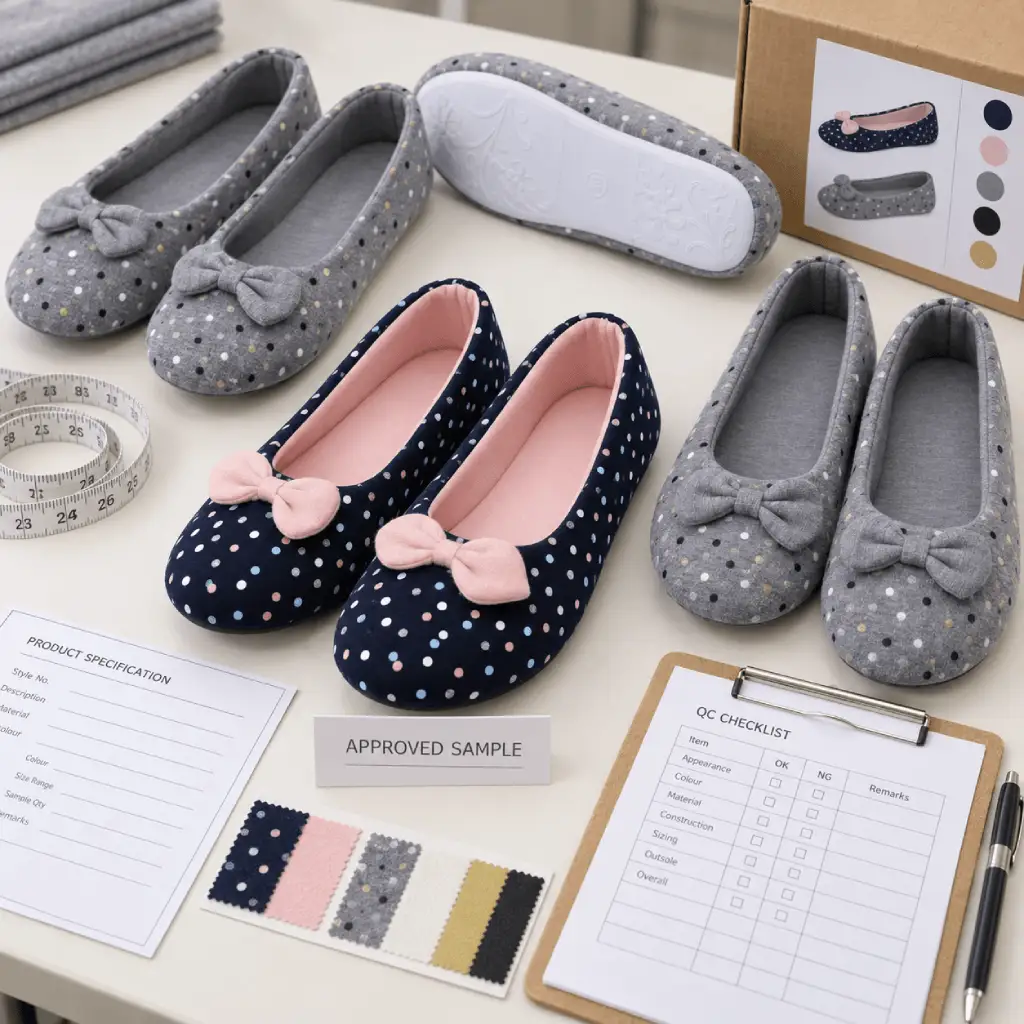
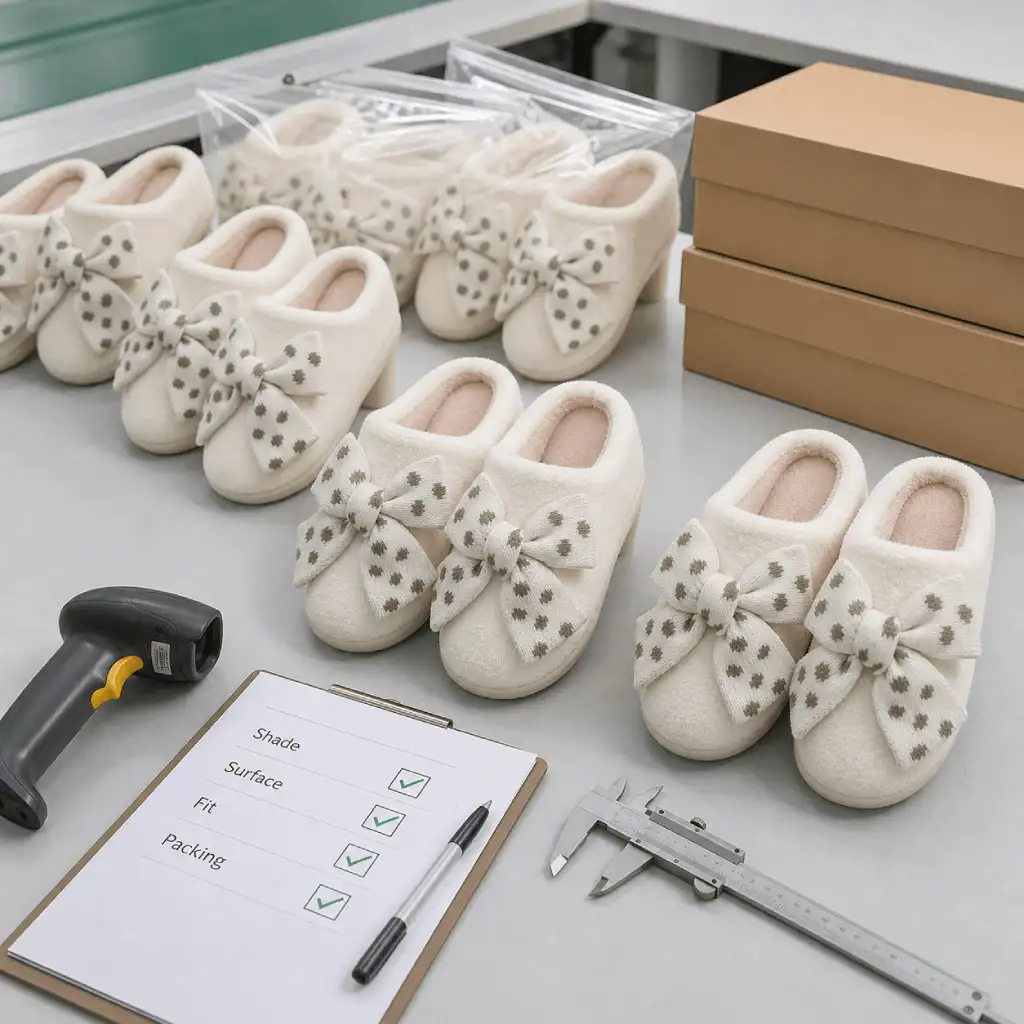
For a finished short-plush example where buyers can review appliqué placement, elasticated opening shape, pair matching, and dotted textile outsole consistency, see our UT-CS1001 girls’ plush slippers.
Keep Production References Clear
For custom plush slippers, buyers should also confirm how the supplier will handle production references. A clear approved sample, fabric swatch, color standard, logo file, packaging sample, and size specification can reduce misunderstanding before bulk production starts.
It is also useful to separate “sample approval” from “bulk approval.” A sample confirms the intended design. Bulk inspection confirms whether production can repeat that design consistently and helps reduce common indoor slipper manufacturing defects before shipment.
This distinction is important for plush slippers because the final look depends heavily on material behavior and manual handling during sewing and finishing.
Buyer tip: before shipment, ask for bulk photos or inspection photos that show more than one pair. One perfect close-up photo is not enough. Buyers should review multiple pairs, different sizes, packaging condition, and any details that may change across the order.
11. Working With UTOP on Custom Plush Slipper Projects
For plush slipper buyers, a good supplier is not only someone who can make a soft sample. The more important question is whether the supplier can help turn that sample into a repeatable bulk product.
At UTOP, custom plush slipper projects usually start with a clear discussion around material, construction, fit, outsole, branding, packaging, and order requirements. Buyers can also learn more about UTOP’s custom slipper service before starting a new project.
This helps both sides avoid quoting based on a vague photo or a general description such as “soft,” “fluffy,” or “warm.”
For plush slippers wholesale orders, small details can change the final product. A different pile height may affect logo clarity. A thicker lining may change internal fit. A heavier outsole may improve structure but increase packing weight. A tighter carton plan may reduce shipping volume but affect the surface and shape of the slippers.
Why Early Specification Alignment Matters
Before sampling or bulk production, buyers can prepare reference photos, target retail channel, size range, preferred material, logo file, packaging requirements, and any special market requirements. If some details are not yet fixed, they can still be discussed during development.
UTOP Can Support Buyers With
- Plush material selection
- Slipper construction and shape
- Lining and cushioning
- Outsole options
- Logo and private label methods
- Decoration placement
- Packaging format
- Size range and fitting details
- Sample review points
- Bulk production consistency
The goal is not to make the sample look good only once. The goal is to make the final bulk order match the approved direction as closely as possible, within the agreed material, construction, cost, and production conditions.
For Retailers, Importers, Distributors, and Private Label Brands
Early communication can reduce revisions and make the sourcing process more predictable. It also helps buyers compare quotations more fairly, because each supplier is being asked to quote the same specification instead of a different interpretation of the product.
Buyer tip: when contacting UTOP for a custom plush slipper project, send more than one reference if possible. A product photo, target material, logo file, packaging idea, and expected order quantity can help the supplier provide more useful suggestions from the beginning.
12. FAQ About Plush Slippers Wholesale Orders
These common questions can help buyers clarify materials, customization, sampling, and bulk quality before starting a plush slippers wholesale project.
What is the difference between plush slippers and plush house slippers?
Plush slippers usually refer to soft indoor slippers made with plush, sherpa, faux fur, teddy fleece, coral fleece, or similar soft materials. Plush house slippers often suggest a more homewear-focused product, usually designed for indoor comfort, warmth, and daily use at home.
In wholesale sourcing, the difference is not always fixed. Buyers should confirm the actual material, lining, outsole, and construction instead of relying only on the product name.
Are faux fur slippers, sherpa slippers, and teddy slippers all plush slippers?
In many sourcing conversations, yes. These terms are often grouped under plush slippers because they all refer to soft-surface indoor footwear. However, they are not the same material.
Faux fur usually has a longer decorative pile. Sherpa often has a curly wool-like texture. Teddy fleece has a rounded, cozy surface. Each material behaves differently in cutting, sewing, logo placement, packing, and bulk production.
What information should I prepare before asking for a plush slippers wholesale quote?
A useful inquiry should include reference photos, target market, expected quantity, size range, preferred material, outsole type, logo requirements, packaging method, and delivery timing.
If you are developing custom plush slippers, also prepare the logo file, color direction, packaging idea, and any retail channel requirements. Clear information helps the supplier quote the same product you actually want to produce.
Can plush slippers be customized with a private label logo?
Yes, plush slippers can usually be customized with embroidery, woven labels, printed labels, patches, hang tags, packaging, or other branding methods. The best method depends on the plush material and logo detail.
For high-pile materials, small embroidery may not stay clear. In some cases, a woven label or packaging-based branding method may produce a cleaner result.
What should buyers check before approving a plush slipper sample?
Buyers should check material surface, pile direction, lining thickness, fit, outsole, logo clarity, decoration placement, packaging method, and whether the sample can be repeated in bulk production.
The sample should not be reviewed only by appearance. It should also be checked against the target sales channel, price point, user group, and packaging plan.
How can buyers reduce quality issues in bulk production?
The best way is to confirm specifications clearly before production. Buyers should define material, color standard, size range, logo method, outsole, packaging, and inspection points.
For bulk orders, ask for production photos, packed sample photos, or inspection photos showing more than one pair. This helps identify shade difference, surface inconsistency, shape changes, and packaging compression before shipment.
Do thicker plush materials always mean better quality?
Not necessarily. Thicker plush can feel warmer and fuller, but it may also affect fit, packing volume, logo clarity, and cost. A lighter material may be better for some retail channels or warmer seasons.
The right material should match the product positioning, target market, season, and expected retail price.
Are plush slippers suitable for private label or seasonal retail programs?
Yes, plush slippers can work well for private label, gift, holiday, winter, and homewear retail programs. Buyers should pay attention to material selection, decoration durability, size range, packaging presentation, and delivery timing.
For seasonal programs, early development is important because material approval, sampling, packaging, and bulk production all need time to align properly. If the order is intended for specific markets, buyers should also confirm any relevant material, labeling, or packaging requirements early, such as EU REACH regulation or California Proposition 65.
Conclusion: Build Plush Slippers for Real Bulk Orders, Not Just Sample Photos
Plush slippers may look simple at first, but wholesale development involves many small decisions: material type, pile height, lining thickness, outsole, branding, packaging, fit, and bulk quality control.
For buyers sourcing plush slippers wholesale, the safest approach is to confirm these details before bulk production starts. A clear specification makes sampling easier, quotation comparison fairer, and final production more predictable.
If you are developing custom plush slippers for retail, private label, seasonal programs, or homewear collections, UTOP can help review the key production details from material selection to bulk delivery planning.
Contact UTOP to discuss your plush slipper project and prepare a more accurate wholesale quotation.
Contact UTOP for Plush Slippers Wholesale