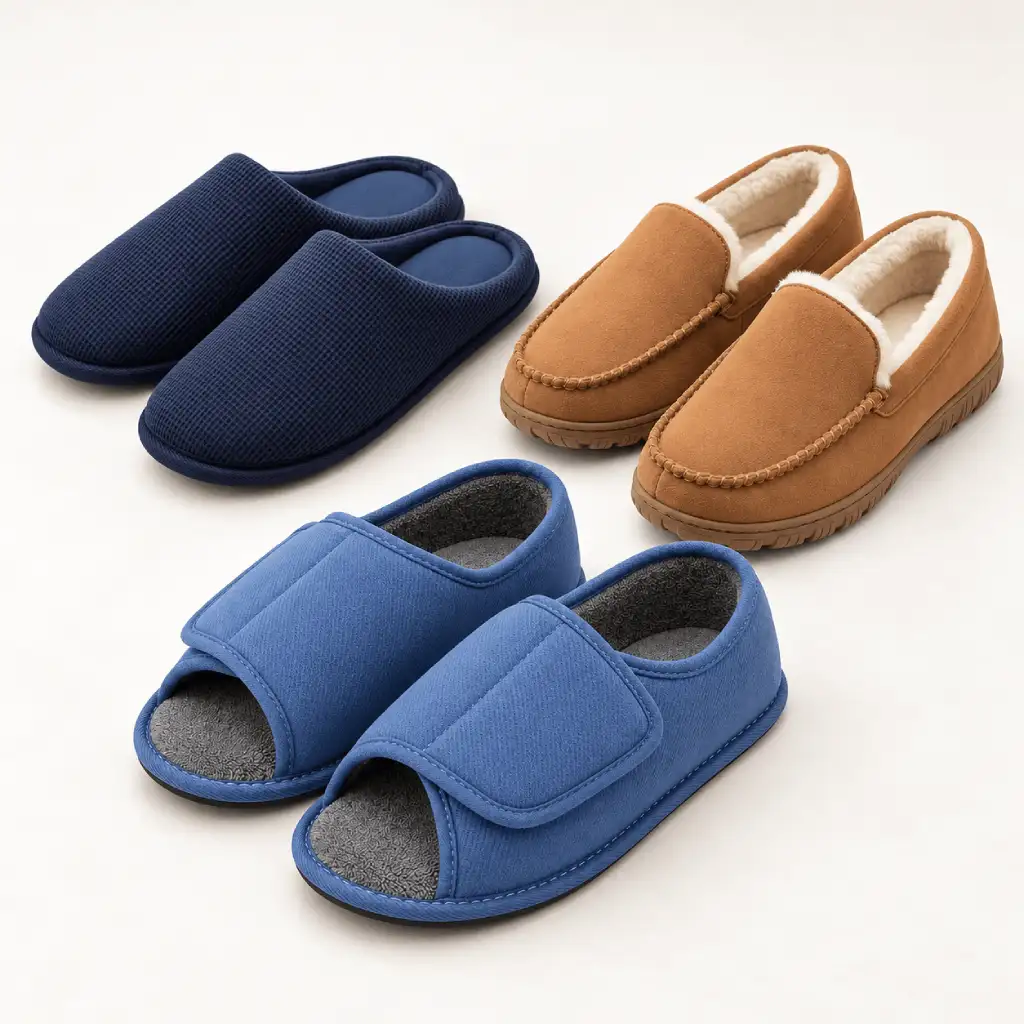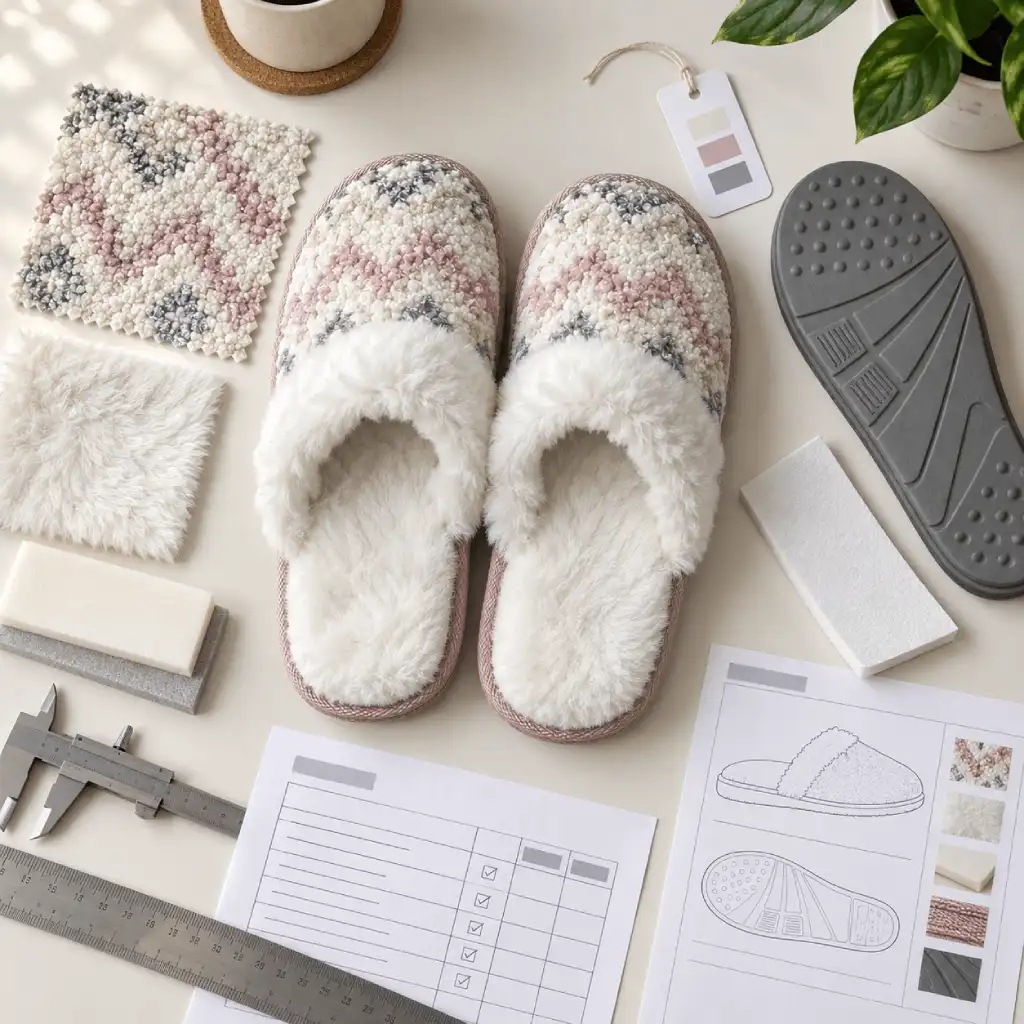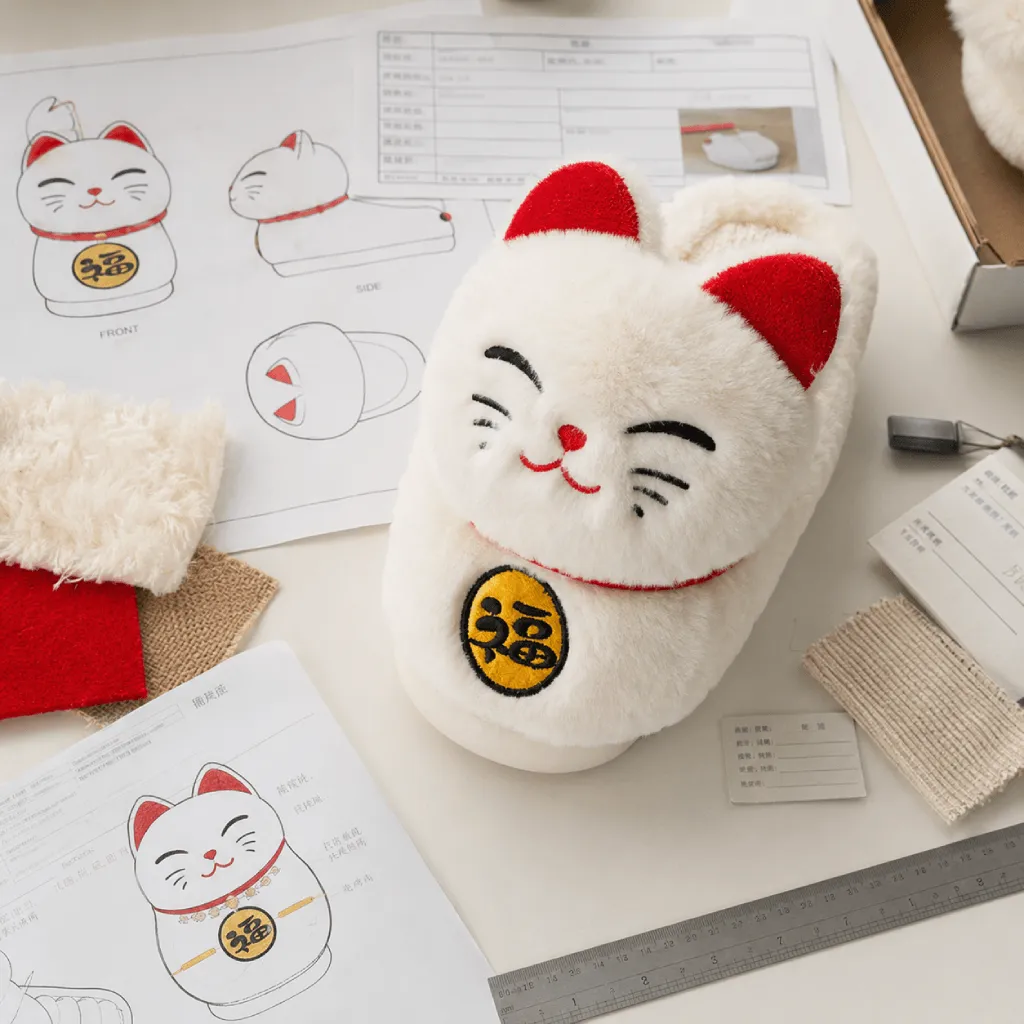
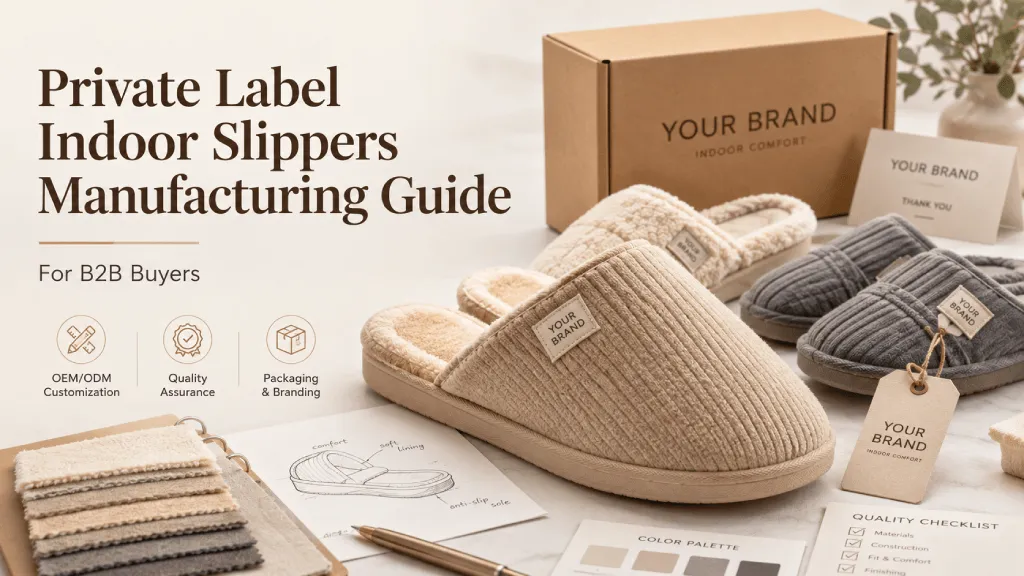
A successful private label slippers program is not created by adding a logo to a standard pair. The product still needs a clear target customer, price position, material specification, fit direction, outsole structure, branding method, packaging plan, approval process, and production standard.
For B2B buyers, the difficult part is turning a commercial idea into repeatable manufacturing instructions. An attractive reference image may start the conversation, but it cannot define how the slipper should feel, fit, perform, pack, or remain consistent across sizes and purchase orders.
This guide explains how to plan private label indoor slippers from the first product brief through sample approval, bulk production, quality control, and shipment release. It is designed for brands, retailers, importers, distributors, and sourcing teams that need a practical manufacturing framework rather than a list of decoration options.
Buyer takeaway: begin with the product and sales requirements, then select the development route, materials, construction, branding, packaging, and control points that support them. A reliable quotation and production plan depend on how clearly those decisions are defined.
Buyers who already have a reference style, drawing, sample, or partial specification can also review UTOP’s custom slipper development services. Product examples in the custom indoor slipper range can be used as starting directions for a new brief.
Written by the UTOP Slippers Sourcing Team, with product-development, sampling, manufacturing, and quality-control input from our indoor slipper team.
1. What Private Label Slippers Mean
Private label slippers are manufactured for sale under the buyer’s brand. Depending on the project, the buyer may begin with an existing factory style, adapt an established construction, submit a reference sample, or provide an original design and technical specification.
The term describes the commercial relationship, not one fixed level of customization. A private label program may include only selected colors, a logo, labels, and branded packaging. A more developed program may require a different upper pattern, lining, cushioning system, outsole, size grading, artwork, retail presentation, and project-specific testing.
| Term | Typical use | What the buyer should confirm |
|---|---|---|
| Private label | Product made for sale under the buyer’s brand | Actual customization scope, ownership of artwork, approvals, and production reference |
| OEM | Manufacturer produces to buyer-defined requirements | Who provides the design, specification, materials, tooling, and acceptance criteria |
| ODM | Supplier contributes an existing design or development direction | Permitted changes, exclusivity, artwork rights, and market suitability |
| White label | Often used for a relatively standardized product sold under different brands | The supplier’s own definition, because usage varies across companies |
These labels are not applied consistently across the footwear industry. Do not choose a supplier or sign off a quotation based on the term alone. Ask for a written list of what is standard, what will be changed, what requires tooling, what the buyer must supply, and what sample will govern bulk production.
Buyer takeaway: define the product scope first. “Private label,” “OEM,” “ODM,” and “white label” are useful conversation labels, but the approved specification and sample determine what will actually be made.
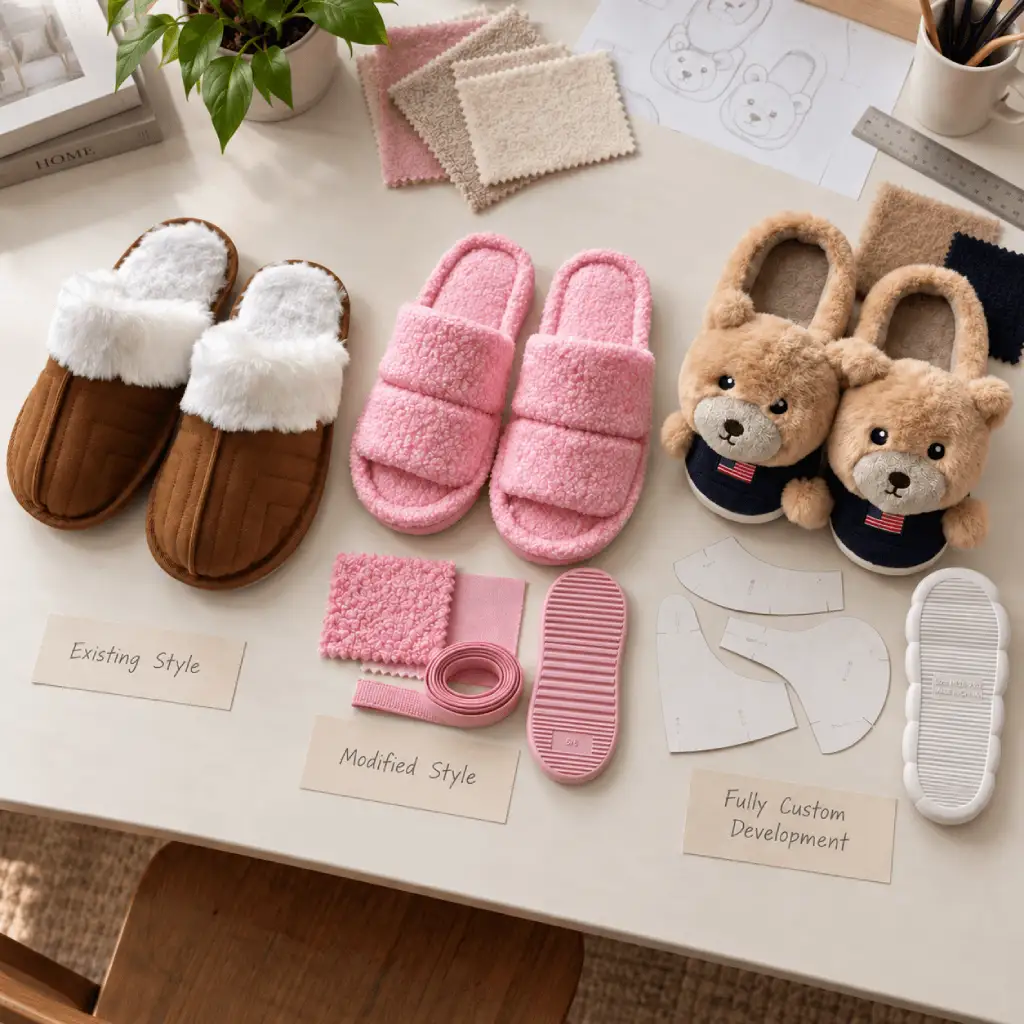
2. Choose the Right Development Route
The development route affects sampling time, material commitments, tooling, cost, and the amount of technical information the buyer must control. For most private label slipper manufacturing projects, the practical choice falls into one of three routes.
Existing Style
Use a proven reference style and customize selected colors, branding, labels, or packaging. This is usually the most direct route when the existing fit, construction, and outsole are suitable.
Adapted Style
Change materials, pattern details, cushioning, outsole direction, size range, or presentation while retaining part of an established construction. Each change still needs feasibility and sample approval.
Original Development
Develop from a design brief, drawing, tech pack, or original reference sample. This route may require pattern work, material sourcing, multiple sample rounds, grading, and outsole tooling.
An existing style is not automatically the right answer simply because it can be sampled quickly. It must still suit the destination market, intended customer, season, selling channel, size range, comfort direction, and expected retail position. Likewise, an original design should not be selected only to create novelty if the program does not have enough time or volume to support the additional development work.
Questions to settle before choosing
- Is the commercial goal speed, differentiation, a target cost, a particular material story, or a unique fit and appearance?
- Which features are essential, and which can be adapted after the manufacturer reviews feasibility?
- Does the schedule allow for material development, tooling, revised samples, testing, and package approval?
- Will the expected quantity support minimums for custom materials, colorways, trims, outsoles, and packaging?
UTOP’s customized slipper services explain how a project can begin from a product reference, physical sample, image, design file, or complete technical package.
3. Prepare a Product Brief Before Quotation
A price request that contains only a picture and total quantity forces the supplier to make assumptions. Two quotations may then appear comparable while using different materials, foam thicknesses, outsole structures, branding methods, packaging, or size ratios. A concise brief gives a private label slipper manufacturer enough context to identify these differences before pricing.
| Brief section | Information to provide | Why it matters |
|---|---|---|
| Market and customer | Destination, channel, target user, season, and retail position | Frames product, packaging, and compliance decisions |
| Product direction | SKU, link, image, sketch, tech pack, or reference sample | Establishes the starting style and development route |
| Assortment | Quantity, color breakdown, size range, and ratio by size | Affects material use, production planning, packing, and cost |
| Product specification | Upper, lining, cushioning, footbed, outsole, construction, and fit | Defines what the quotation and sample should represent |
| Brand presentation | Logo files, labels, hang tags, inserts, individual packing, retail packaging, and carton marks | Connects product development with retail and logistics requirements |
| Timing and delivery | Required sample date, launch window, destination, and shipping expectations | Allows feasibility and lead-time risks to be reviewed early |
If part of the specification is still open, label it as a question instead of allowing a temporary assumption to appear approved. The manufacturer can then propose options with visible differences in appearance, construction, minimum quantity, lead time, and cost.
A structured shoe tech pack becomes especially useful when the project has original patterns, several materials, multiple colorways, detailed measurements, or repeated sample revisions. Buyers do not need a perfect file before the first discussion, but unresolved decisions should be closed before the final sample is approved.
4. Specify Materials and Construction as One System
Material names alone do not define a slipper. Plush, fleece, jersey knit, wool felt, faux suede, corduroy, and velvet can each vary in weight, backing, stretch, thickness, surface character, color consistency, sewing behavior, and availability. The selected upper must work with the lining, binding, cushioning, footbed, outsole, branding method, and assembly process.
For example, high-pile plush can reduce the clarity of small embroidery; a stretchy knit can change pattern control and fit; and a thick lining can reduce internal space. These are product-system decisions, not isolated fabric choices. Buyers should therefore approve materials on the intended slipper construction rather than from a small swatch alone.
Define each functional layer
- Upper and lining: material type, composition where required, weight or thickness reference, color standard, pile or texture direction, stretch, and approved hand feel.
- Cushioning and footbed: layer structure, material, thickness, feel, recovery expectation, cover material, and the effect on fit.
- Binding, thread, and trims: material, width, color, placement, stitch appearance, labels, and decorative components.
- Outsole and attachment: material, construction, thickness, hardness or feel reference, tread, color, flex direction, and attachment method.
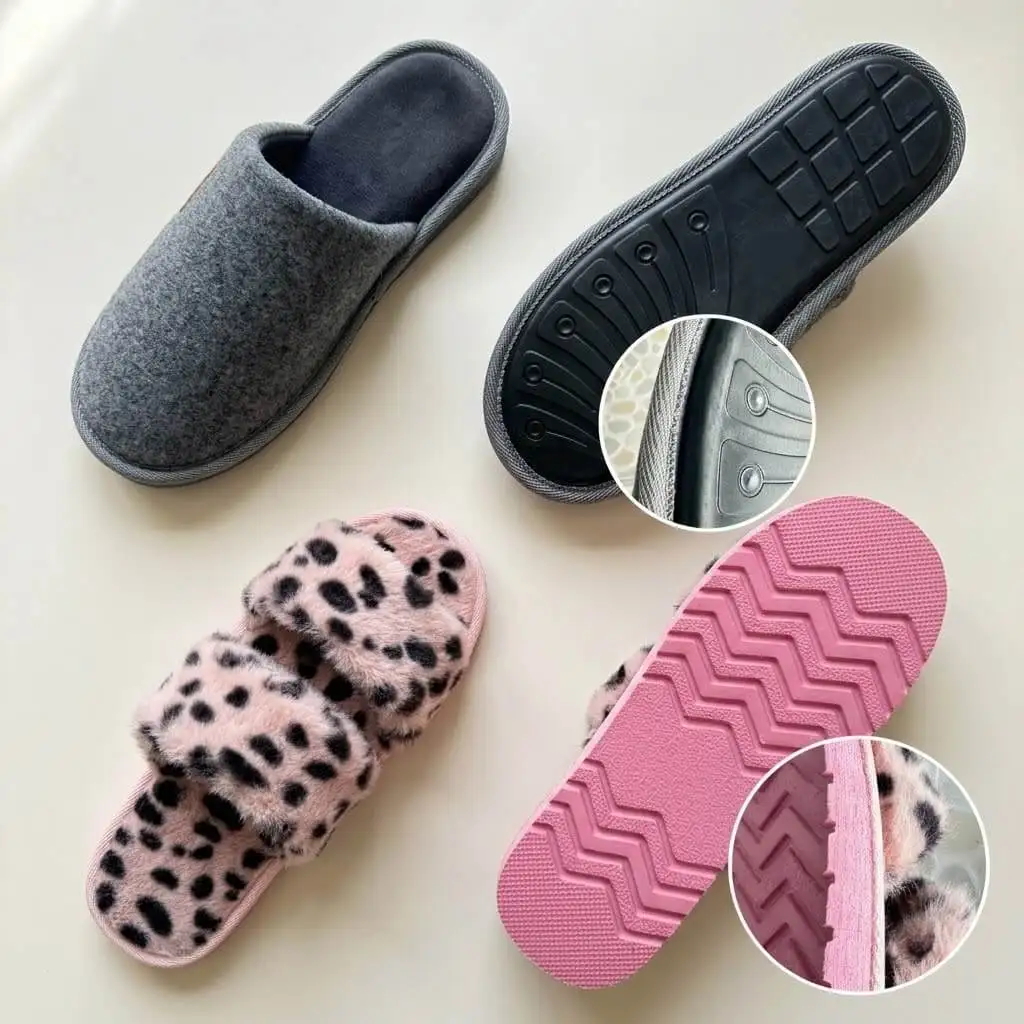
Construction terminology must also be precise. Welt-stitched, side-stitched, cold-glued or cold-cemented, and injection-molded slippers use different assembly relationships. At UTOP, welt-stitched styles can be developed with TPR or EVA outsole directions; side-stitched styles usually use a suitable TPR outsole; and cold-glued styles often use EVA. TPR can also be cold-glued when compatible surface preparation, adhesive, pressing, and process control are established.
For a component-level overview, review UTOP’s guide to materials for custom indoor slippers. For outsole selection, the TPR vs EVA slipper sole guide explains why performance should be evaluated by formulation, hardness, thickness, tread, construction, floor conditions, and agreed test method rather than material name alone.
Buyer takeaway: approve a complete material-and-construction combination. Changing one layer after approval can affect appearance, fit, flexibility, weight, branding, assembly, cost, and repeatability.
5. Confirm Sizing, Fit, and Outsole Requirements
Size labels do not guarantee equivalent fit across brands, markets, or slipper constructions. An EU, US, or UK size reference must be connected with the target customer, internal dimensions, upper volume, opening, lining thickness, cushioning compression, toe shape, back structure, and intended wearing condition.
Open-back, closed-back, ballerina, bootie, mule, and novelty slippers hold the foot differently. A soft plush upper may also behave differently from a structured felt or faux-suede upper. For this reason, a private label indoor slippers project should approve fit on the intended material and construction, not only on a similar sample.
Build a controlled size and fit reference
- State the size system, full range, size labels, pair mapping, and order ratio by size.
- Identify the sample size and the agreed measurement points, methods, units, and tolerances.
- Fit the sample on appropriate wearers or an agreed last and record the result, rather than relying on a label conversion alone.
- Review how the approved upper, lining, foam, footbed, and outsole affect internal space and foot retention.
- Confirm grading and outsole size groups before the full assortment enters production.
The outsole is part of the same fit and performance system. Buyers should specify material and construction, thickness, hardness or feel reference, tread profile, flex behavior, weight direction, color, attachment, and any proprietary logo or pattern. Molded TPR can provide a defined profile and tread; cut-sheet EVA can support a lightweight and flexible construction. Neither material name alone proves slip resistance, durability, or suitability.
If a proprietary outsole shape, tread, or logo is required, the project may need tooling and additional approval time. Review the tool drawing, size coverage, ownership, maintenance responsibility, approval sample, and cost before production. For deeper evaluation, see UTOP’s slip-resistant outsole guide.
Important: if measurable outsole performance is required, define the destination-market standard, test method, conditioning, surface conditions, responsibility, and acceptance criteria before bulk production.
6. Plan Branding, Labels, and Packaging Together
Branding for private label slippers can include embroidery, woven or printed labels, insole branding, screen or transfer printing, patches, trims, hang tags, insert cards, and printed packaging. The right method depends on the artwork, material surface, pile height, stretch, product structure, target appearance, order quantity, and intended use.
Approve the logo on the actual material. A method that looks clean on flat jersey may lose detail on plush, distort on a stretchy knit, or create an uncomfortable area on the footbed. Specify the artwork version, dimensions, colors, placement, orientation, application method, and acceptable appearance. The complete guidance in UTOP’s custom slipper logo guide can help buyers compare common application routes.
Connect product identity with retail data
Labels and packaging must match the approved SKU structure. Confirm size and care labels, fiber or country-of-origin information where applicable, barcode data, hang tags, color and size stickers, inserts, individual packing, retail boxes or display packaging, assortment ratios, carton marks, and shipping-label requirements.
The brand owner is normally responsible for assigning product identifiers. Buyers preparing retail packaging can consult GS1’s official barcode and GTIN guidance, then provide verified numbers and placement requirements before artwork approval. A supplier should not guess or reuse product codes.
Make packaging part of development
Packaging should protect the slipper, preserve presentation, carry the required information, fit the sales channel, and pack efficiently into master cartons. A bulky plush style, structured slipper, gift set, and e-commerce shipment may need different protection and dimensions. Confirm pack orientation, pair retention, tissue or inserts, moisture-control requirements where applicable, package dimensions, carton quantity, gross and net weight review, and drop or transit checks if the project requires them.
For packaging structure and approval steps, see UTOP’s footwear packaging guide. If an environmental paper claim is planned, verify the precise material, supplier documentation, chain-of-custody requirements, and permitted trademark use; the Forest Stewardship Council’s paper and packaging information is a useful official starting point.
Buyer takeaway: product, label, barcode, package, and carton information should be approved as one SKU system. This prevents a correct slipper from being packed with the wrong identity or retail data.
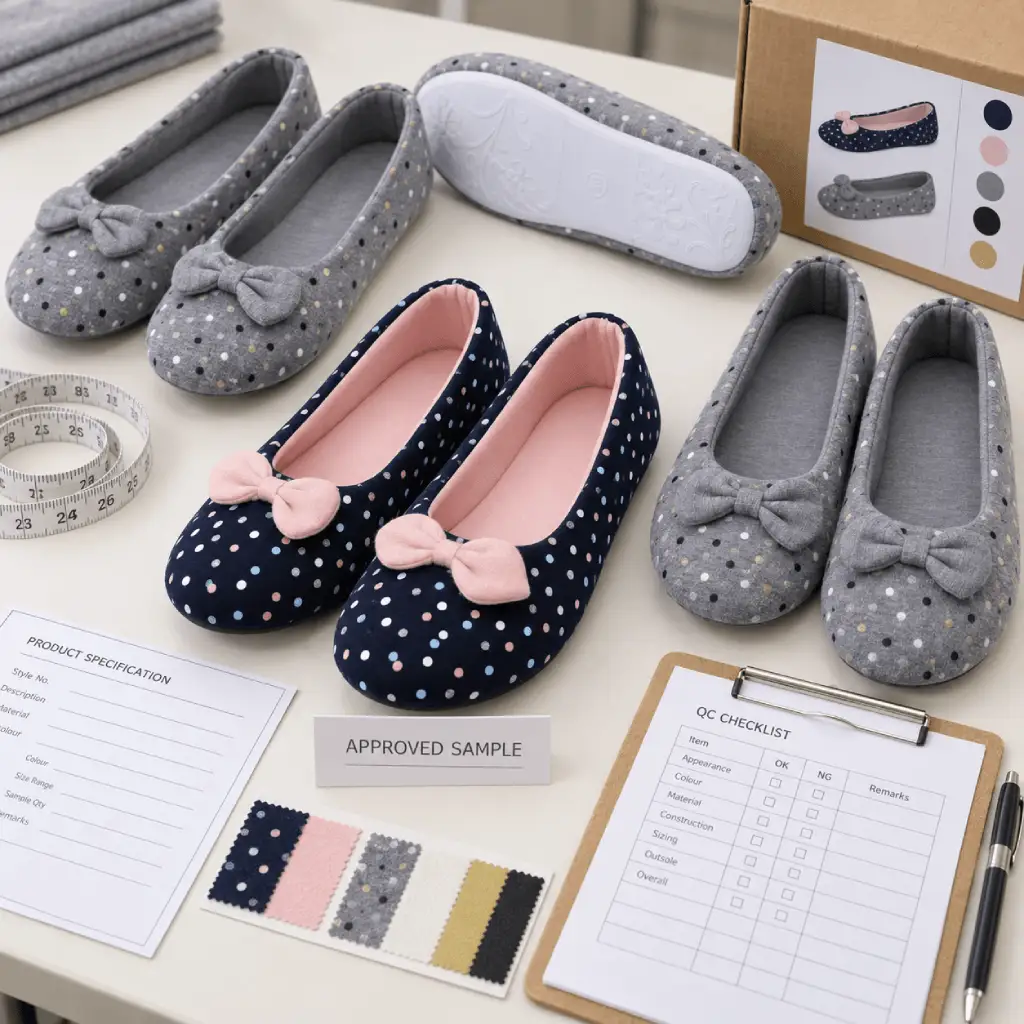
7. Control Sampling and Approvals
Sampling is where the private label slipper development brief becomes a physical product. It should resolve open questions and establish controlled references for materials, dimensions, fit, workmanship, branding, packaging, and production—not simply produce a presentable photo.
| Sample or approval | Main purpose | Buyer control |
|---|---|---|
| Development sample | Review shape, construction, materials, and feasibility | Record differences from the intended specification |
| Fit or size-set sample | Confirm fit direction, measurements, grading, and size range | Approve the sample size and agreed grading evidence |
| Color and material approval | Control appearance and material identity | Use physical or agreed digital standards with status and date |
| Pre-production sample | Represent the confirmed bulk specification as closely as practical | Approve or list every remaining exception before production |
| Packaging approval | Confirm artwork, data, structure, pack method, and carton details | Freeze files and verify SKU mapping |
UTOP samples generally require about 7–14 days, but the actual time is project-dependent. Custom materials, outsole tooling, artwork conversion, revised patterns, testing, or repeated sample rounds can extend the schedule. A realistic plan begins after the supplier has reviewed the complete request and confirmed what inputs are available.
Each comment round should identify the sample version, issue, requested change, responsible party, status, and supporting photo, measurement, color reference, or artwork. Avoid instructions such as “make it better” or “same as last time.” When the final sample is approved, retain a clearly identified approval sample and matching specification as the production reference.
Approval rule: do not approve one sample while separate emails contain unresolved changes. Consolidate the final requirements and state any accepted exceptions in writing before bulk material cutting or assembly begins.
8. Plan MOQ, Cost, and Lead Time as Connected Decisions
There is no single private label slipper MOQ or standard unit cost that applies to every project. The workable quantity depends on the style, material minimums, number of colors, size assortment, branding method, outsole, tooling, packaging, production process, and confirmed order structure.
A low total quantity can still create high component minimums when it is divided across many colors, materials, sizes, or package versions. Conversely, a well-consolidated program may be easier to plan even when the product has meaningful customization. Ask the supplier to explain which component or process drives the minimum instead of negotiating only against one headline number.
Compare quotations on the same basis
- Confirmed upper, lining, cushioning, footbed, outsole, construction, and workmanship reference
- Quantity by color and size, permitted over/under tolerance, and pack ratio
- Logo, labels, hang tags, inserts, individual packing, retail package, and master-carton requirements
- Tooling, sample, testing, inspection, documentation, and other one-time or separate charges
- Incoterm, currency, validity period, payment schedule, shipment point, and exclusions
Lead time is equally dependent on decisions upstream. Material booking cannot be completed if colors are open; packaging cannot be printed if barcode data is missing; and bulk production should not begin while the sample or specification is still changing. Build the schedule backward from the required in-market date and include development, approvals, bulk production, inspection, export preparation, transport, customs, and receiving time.
After the approved sample and required approvals are complete, UTOP bulk production is generally about 30–45 days. The actual schedule depends on materials, outsole tooling, sample revisions, testing, quantity, branding, packaging, production loading, and the final order requirements. For larger programs, review the planning principles in UTOP’s high-volume footwear manufacturing guide.
Buyer takeaway: the lowest quoted price or smallest MOQ is not meaningful unless the product, assortment, approvals, packaging, delivery basis, and quality requirements are the same.
9. Control Bulk Production and Quality
Bulk quality should not be defined as “same as the sample” without identifying which sample, specification, color standard, artwork, packaging file, and agreed tolerance are current. A controlled private label slippers manufacturing program gives production and inspection teams the same reference set.
Start with incoming materials
Material review should confirm the approved type, color, odor, weight or thickness where specified, hand feel or hardness reference, surface appearance, usable width or dimensions, and relevant supplier identity. The checks depend on the component. A plush upper, molded TPR outsole, cut-sheet EVA outsole, woven label, and printed box do not use the same acceptance method.
Control the production process
Early production checks can identify issues before the full order is completed. Depending on the slipper, the team may review cutting direction, component matching, embroidery or print placement, stitching, binding, upper symmetry, cushioning assembly, outsole alignment, attachment, pair consistency, size identification, and cleanliness.
Changes made during bulk production should be treated as controlled deviations. Record what changed, why it changed, which quantities are affected, what evidence supports acceptance, and who approved it. Silent material substitutions or undocumented construction changes can make later inspection difficult even if the product appears similar.
Inspect the finished product and packing
Finished-pair checks commonly include material and color, dimensions, appearance, shape, flatness, left-right pairing, stitching, bonding or attachment, tread, flex point, logo, labels, size marking, and workmanship. Packaging checks should verify the correct slipper, size, color, SKU, barcode, insert, pack method, quantity, carton mark, and carton condition.
Performance testing is project-specific. If the buyer requires testing for slip resistance, abrasion, colorfastness, restricted substances, bonding, or another property, agree on the applicable method, sample selection, acceptance criteria, timing, laboratory or responsible party, and action for a failed result before production. For a fuller control framework, see UTOP’s footwear quality control guide for bulk slippers.
Buyer takeaway: quality control is a sequence of material, process, finished-product, and packaging checks. Final inspection is important, but it cannot efficiently correct every issue created earlier in production.
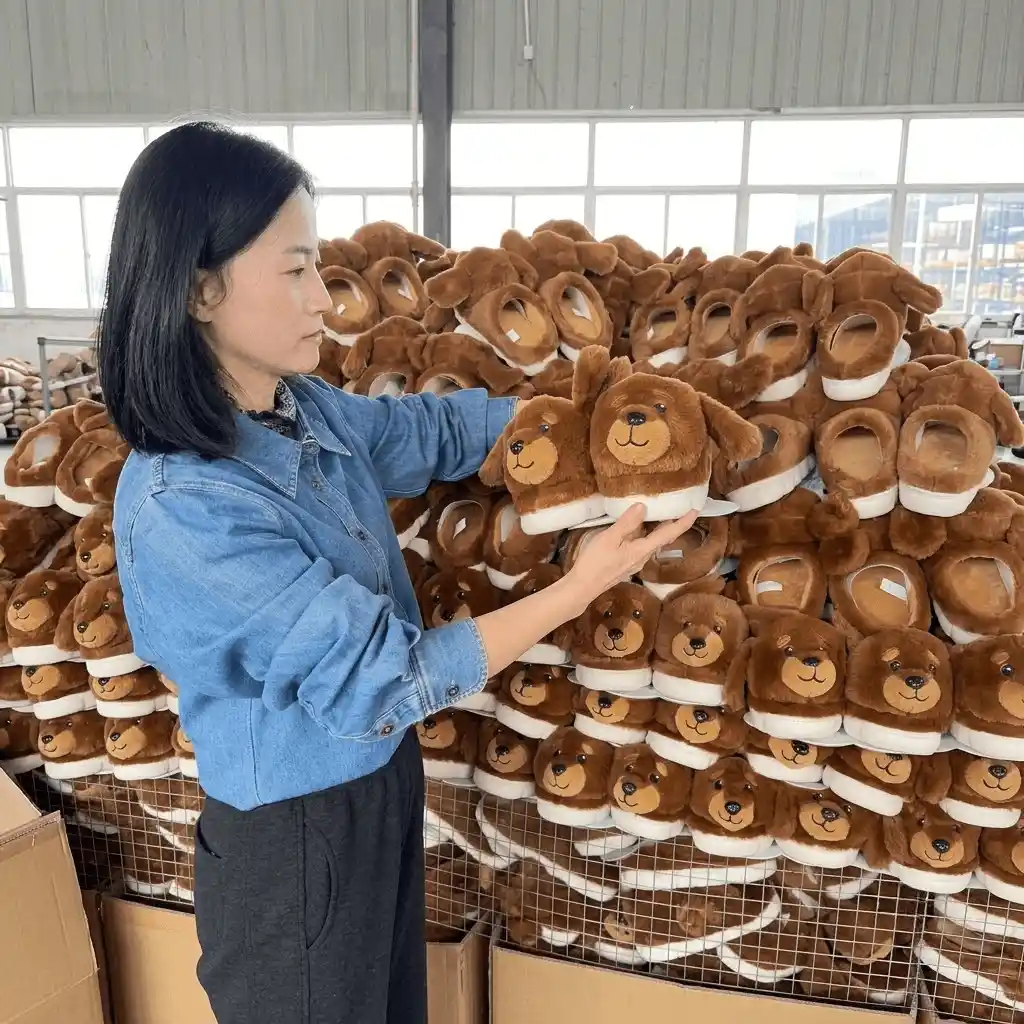
10. How to Evaluate a Private Label Slipper Manufacturer
A capable private label slippers manufacturer should do more than confirm that a design is possible. The supplier should be able to identify missing information, explain trade-offs, connect the sample with the bulk process, and communicate what must be approved before materials and production are committed.
| Evaluation area | Useful evidence | Warning sign |
|---|---|---|
| Product understanding | Specific questions about market, user, materials, construction, fit, quantity, and packaging | Immediate confirmation without reviewing technical details |
| Development process | Clear sample stages, revision records, approval status, and realistic timing | Unidentified samples or changing specifications across messages |
| Manufacturing fit | Explanation of the intended construction, equipment, material route, and outsource scope | No distinction between different slipper structures or outsole processes |
| Quality control | Checks tied to approved samples, specifications, production stages, and packing data | Only a general promise that quality will be “good” |
| Commercial clarity | Quotation basis, MOQ drivers, exclusions, tooling, payment, Incoterm, and lead-time assumptions | A unit price without a defined product and delivery basis |
| Communication | Named contacts, milestone updates, issue escalation, and documented decisions | Vague status reports and late disclosure of production risks |
Buyers can request recent representative samples, a video review of relevant processes, a factory assessment, or an independent audit according to project risk. The evidence should match the type of slipper being sourced. Experience with simple hotel slippers does not automatically demonstrate capability for structured plush, closed-back, molded-outsole, or detailed novelty products.
Also ask how the supplier protects buyer artwork and project information, manages approved standards, controls subcontracted processes, handles nonconforming production, and supports repeat orders. A reliable private label slipper supplier should make these responsibilities visible before problems occur.
11. How UTOP Supports Private Label Slipper Projects
Utop Slippers is the indoor slipper brand of Hefei Utop Trade Co., Ltd. Our office is in Hefei, Anhui, and our manufacturing base is in Tianchang, Anhui. With nearly 15 years of indoor slipper manufacturing and export experience, our team supports overseas B2B buyers from product review and sampling through bulk production, quality control, packing, and shipment preparation.
We work with brands, retailers, importers, distributors, and sourcing teams on private label slippers, OEM/ODM programs, and wholesale indoor slipper projects. The focus is on practical product development, production feasibility, specification control, and dependable execution for ongoing or scaled programs.
1. Project Review
Review the reference style or design, destination market, quantity, size range, materials, construction, branding, packaging, timing, and missing decisions.
2. Development Route
Confirm whether the project should use an existing direction, an adapted construction, or original product development and tooling.
3. Quotation and Sampling
Define the quotation basis, prepare the sample, record deviations and revisions, and align product, artwork, labels, and packaging approvals.
4. Production Preparation
Confirm the approved reference, material and component requirements, size and color assortment, packaging data, schedule, and control points.
5. Bulk Control
Review materials, key process stages, finished pairs, branding, labels, packing, and project-specific inspection requirements.
6. Shipment Preparation
Confirm packing completion, shipment information, required documents, and coordination details according to the agreed order terms.
Sample development generally takes about 7–14 days, and bulk production is generally about 30–45 days after the approved sample and required approvals are complete. These are planning ranges rather than unconditional promises; the final timeline depends on materials, tooling, revisions, tests, quantity, branding, packaging, and production requirements.
Best starting information: send the preferred style or SKU, reference images or tech pack, destination market, estimated quantity, colors, size range and ratio, material and outsole direction, logo files, packaging requirements, delivery destination, and requested schedule.
12. Private Label Slippers Buyer Checklist and FAQ
Final checklist before sample approval
- The target market, customer, sales channel, season, product position, and delivery window are stated.
- The current design, style number, colorways, size range, ratios, and total quantity are identified.
- Upper, lining, cushioning, footbed, outsole, construction, measurements, fit, and workmanship references are confirmed.
- Logo artwork, method, size, colors, placement, labels, barcodes, packaging, and carton marks are approved.
- Any required testing has a method, acceptance criteria, responsibility, sample plan, and timing.
- The quotation basis, MOQ drivers, tooling, payment, Incoterm, lead time, and exclusions are understood.
- The approved sample and specification match, and every accepted exception is recorded.
- Bulk control points, final inspection, packing checks, and shipment information are agreed.
Frequently Asked Questions
What are private label slippers?
They are slippers manufactured for sale under the buyer’s brand. The customization scope can range from selected colors, logos, labels, and packaging to original materials, patterns, sizing, outsole tooling, and product specifications.
What is the difference between private label and white label slippers?
Private label often allows a buyer-specific product scope, while white label is often used for a more standardized product offered under different brands. Usage varies by supplier, so buyers should confirm the actual design, branding, packaging, tooling, and approval scope in writing.
What information is needed for a private label slipper quotation?
Provide the preferred style or reference, destination market, estimated quantity, color and size breakdown, material and construction requirements, logo files, labels, packaging, delivery destination, and requested schedule. State which details are confirmed and which still need supplier proposals.
How long does private label slipper sampling take?
UTOP samples generally take about 7–14 days. The actual time depends on material availability, pattern or outsole development, branding, packaging, testing, revisions, and the completeness of the buyer’s information.
How long does bulk production take?
UTOP bulk production is generally about 30–45 days after the approved sample and required approvals are complete. Materials, tooling, order quantity, production loading, branding, packaging, testing, and revisions can change the final schedule.
How is the MOQ for private label slippers determined?
MOQ depends on the slipper style, material and color minimums, number of variants, outsole and tooling requirements, branding method, packaging, size assortment, and production process. The most useful approach is to identify the component that drives the minimum.
Can an existing slipper be used as a development reference?
Yes. A physical sample, UTOP style, product image, sketch, or design file can begin the review. The buyer and manufacturer should then identify what may be retained, what must change, and what measurements, materials, branding, and performance requirements need separate approval.
Should TPR or EVA be used for private label indoor slippers?
The answer depends on the complete product. Formulation, hardness, thickness, tread, weight, flexibility, attachment method, floor conditions, intended use, and test requirements all matter. Compare approved outsole constructions rather than choosing by material name alone.
Plan Your Private Label Slipper Project
Send UTOP your reference style or design, target market, quantity, size range, materials, logo, packaging, destination, and required schedule. Our team will review the development route, manufacturing feasibility, sampling needs, and quotation basis.
Request a Private Label Project ReviewFinal takeaway: a scalable private label slipper program is built on a controlled product brief, approved materials and construction, clear commercial terms, documented samples, staged quality control, and accurate packaging—not on branding alone.