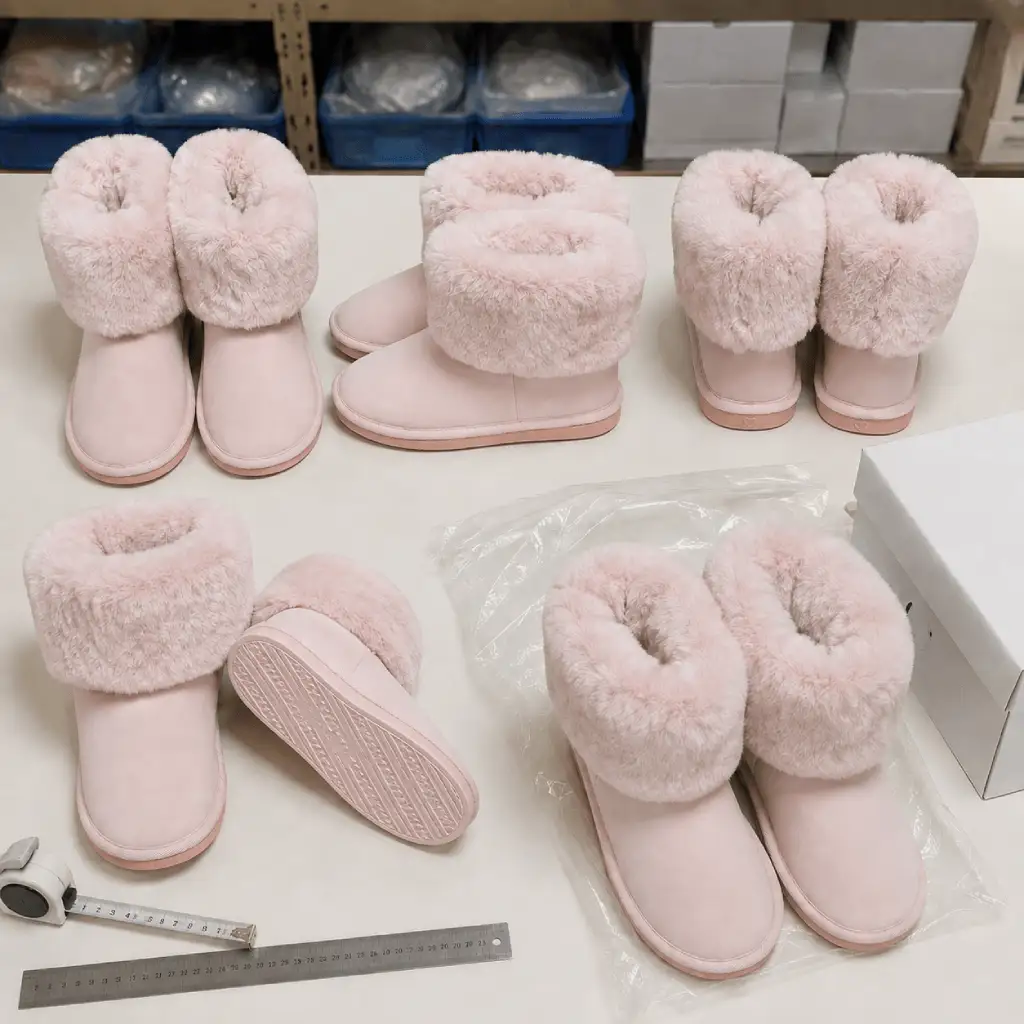
Ballerina slipper bulk quality control can look straightforward until several finished pairs are placed side by side. Then small differences become obvious: one opening sits higher, one vamp is deeper, the heels lean at different angles, or the bow shifts from left to right.
These are not minor details on a low-cut slipper. The opening, vamp, toe profile, back-quarter shape, binding tension, cushioning, and outsole all work together. A change in one area can alter both fit and shelf appearance.
This checklist is written for brands, importers, retailers, sourcing teams, and private-label buyers reviewing ballerina-style house slippers before shipment. It focuses on the checks that deserve extra attention in this particular low-profile construction.
Buyer takeaway: do not approve ballerina slippers from a single top-view photograph. Review the pair on a flat surface, compare left and right shoes, check representative sizes, and confirm how the product looks after packing and recovery.
Scope: this is a construction-specific ballerina slipper QC checklist. For inspection planning, incoming materials, general defect classification, AQL, reporting, and wider order controls, use the Footwear Quality Control Guide for Bulk Slipper Orders. The products discussed here are indoor house slippers, not technical ballet or performance dance shoes.
Written by the UTOP Slippers Sourcing Team, with product-development, production, and quality-control input from our indoor slipper manufacturing team.
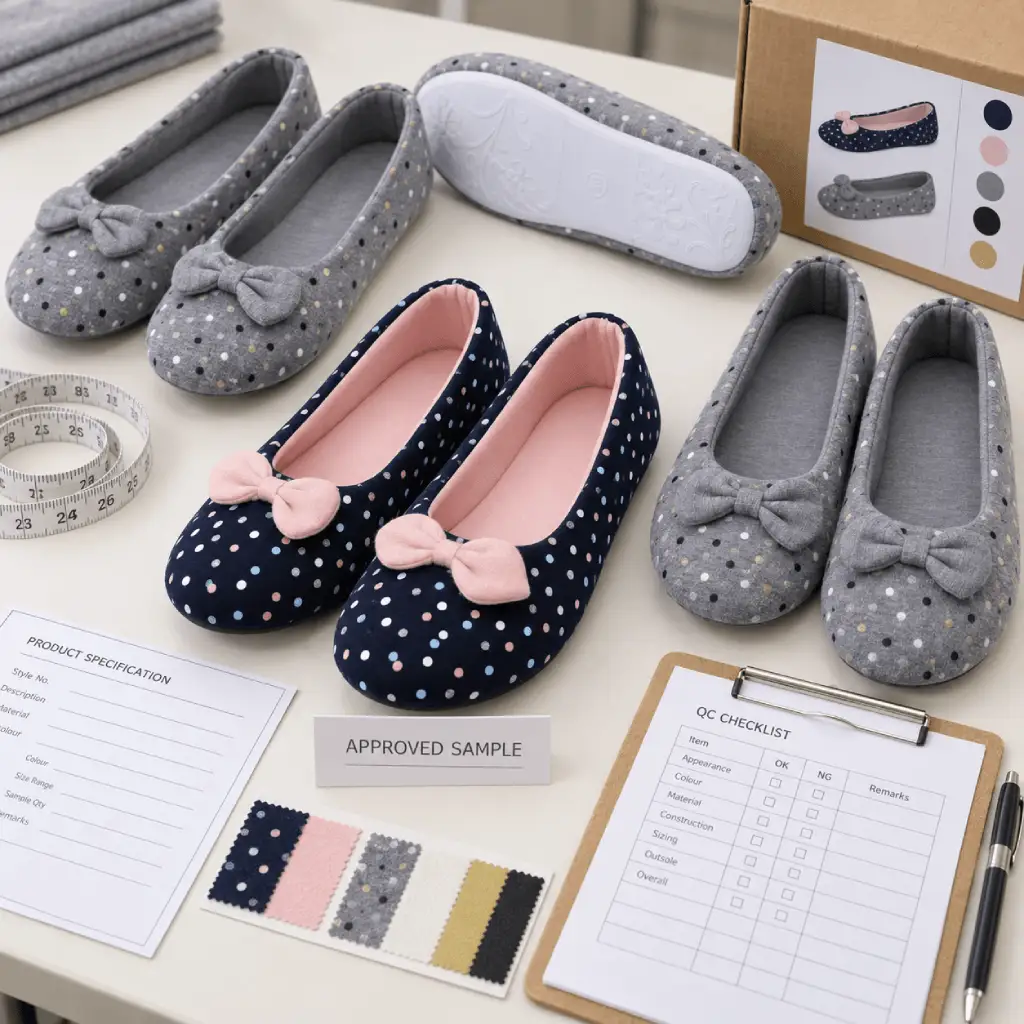
1. Build the Inspection Standard Around an Approved Pair
A final inspection cannot answer a question that was never settled during development. Before bulk cutting or assembly begins, identify the sample and documents that control the order. For ballerina house slippers, the reference set should show more than the general color and shape.
| Control reference | What it should settle | Common gap |
|---|---|---|
| Approved pair | Silhouette, opening, toe fullness, heel position, decoration, and overall workmanship | Only one shoe is photographed or retained |
| Size specification | Footbed, outsole, opening, vamp, and other project-specific dimensions and tolerances | Only overall length is controlled |
| Material and color approvals | Upper, lining, binding, foam, insole cover, outsole, thread, and trim direction | A color image is used instead of a physical or controlled reference |
| Artwork and placement file | Logo or decoration size, orientation, position, and left-right rule | Placement is described as “centered” without a reference point |
| Packed sample | Pair orientation, shaping, labels, inserts, closure, and recovery after unpacking | The shoe is approved loose but shipped folded or compressed |
Give the approved pair an identifiable status and date. If the upper material, lining thickness, binding, foam, outsole, or packaging changes afterward, review whether the physical sample and specification also need updating. A consistent production lot can still be wrong when it follows an obsolete reference.
Practical check: place the approved left and right shoes beside the production pair in the same orientation and lighting. Ballerina slipper inspection becomes much more reliable when the team compares pairs rather than isolated shoes.
2. Check the Vamp, Opening, and Topline Together
The opening is the first place where a low-cut slipper reveals variation. A few millimetres at the vamp or back quarter can change the apparent shape of the whole shoe. Binding tension, elastic recovery, seam allowance, lining thickness, and material stretch can also pull the topline away from the approved curve.
Review the opening from more than one angle
- Top view: compare opening length, width, vamp depth, toe exposure, and left-right balance.
- Side view: check whether the edge rises smoothly from the vamp to the heel without a sudden dip or wave.
- Front view: look for twisting, uneven binding width, toe displacement, and a vamp line that leans to one side.
- On the agreed fitting reference: review gaping, edge pressure, foot movement, and heel retention according to the buyer-approved fit direction.
Do not correct a gaping opening by tightening the binding without checking the rest of the construction. Extra tension may distort the vamp, narrow entry, create pressure at the edge, or change the approved appearance. The useful question is not simply “Is the opening tight?” It is “Does the opening match the approved shape and fit direction?”
Record observable conditions. “Opening differs from the approved sample,” supported by a photograph, location, size, and measurement where specified, is more useful than “shape looks bad.”
3. Compare Toe Shape, Heel Position, and Pair Symmetry
Ballerina slippers are usually displayed and sold as a close pair, so left-right differences are easy to notice. The toe may be rounded, softly squared, or slightly tapered, but the approved profile should carry across the order without one shoe looking fuller or longer than its partner.
| Pair area | Compare | Possible source of variation |
|---|---|---|
| Toe | Outline, fullness, seam position, and left-right orientation | Cutting direction, sewing, lasting or shaping, lining, and foam placement |
| Vamp | Depth, height, centerline, and visible coverage | Pattern alignment, seam allowance, material stretch, and assembly position |
| Heel | Height, angle, collapse, and back-quarter symmetry | Upper tension, reinforcement, lining volume, pressing, and packing |
| Bottom | Outsole alignment, edge distance, flex position, and flatness | Component size matching, positioning, bonding, stitching, or molding variation |
Use a flat inspection surface. Nesting one shoe inside the other can help reveal an outline difference, but it should not replace checking both shoes upright. A soft upper can be pushed temporarily into shape; the question is whether it returns to the approved form without repeated hand correction.
When a mirrored print, embroidery, bow, or label is part of the design, define whether the two shoes should mirror each other or repeat the same orientation. Pair consistency does not always mean identical decoration, but the intended rule must be clear.
4. Validate Size Grading and Fit Direction
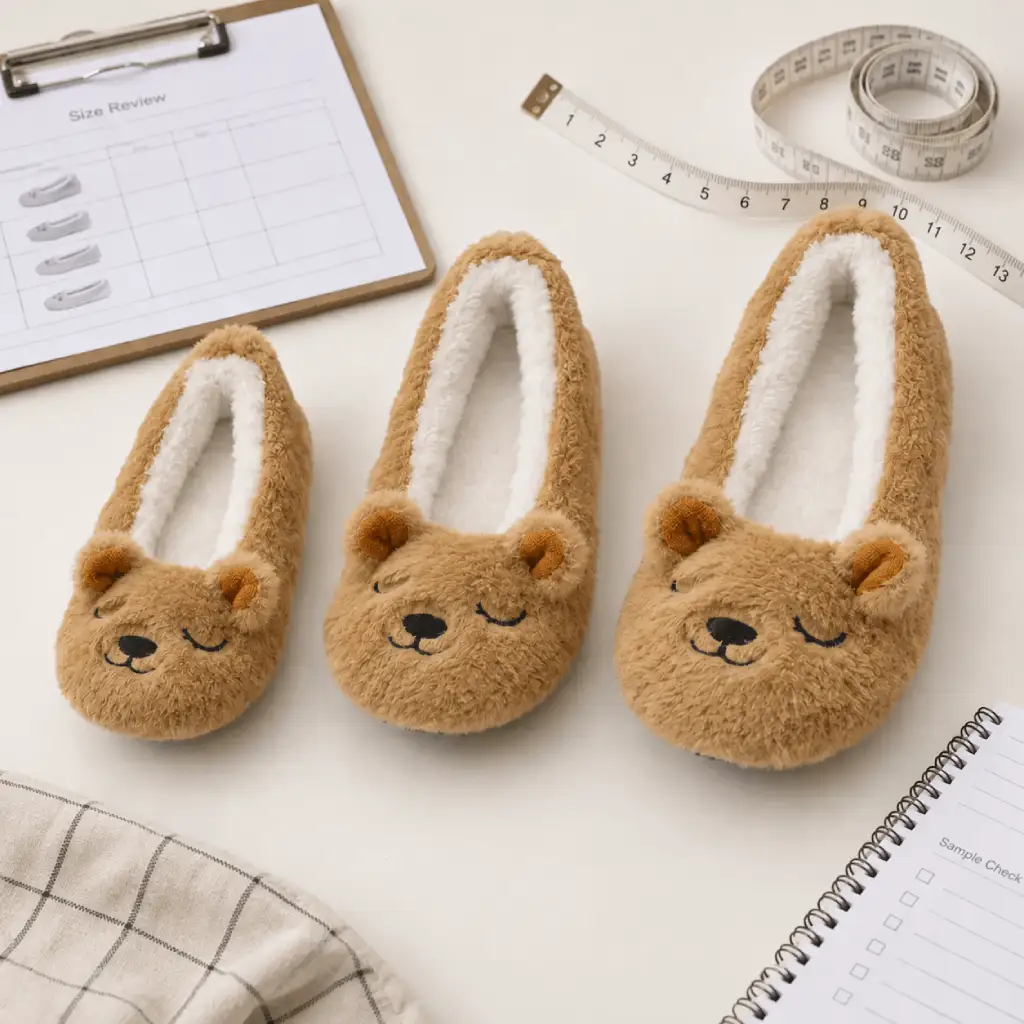
A ballerina slipper size range should not be judged from overall length alone. As sizes change, the opening, vamp, toe room, forefoot width, heel position, binding length, footbed, and outsole need to remain proportionate. If only the base size is approved, an error can become more visible at one end of the range.
Before bulk production, review representative fitted samples from the requested size system. A practical set often includes the approved base size plus a smaller and a larger size, but the actual selection should follow the buyer’s range, risk, and inspection plan.
| Size review | What to compare | Warning sign |
|---|---|---|
| Small size | Entry space, toe room, vamp proportion, and edge pressure | The opening becomes restrictive or the vamp looks unusually deep |
| Base size | All approved dimensions, fit direction, and visual references | Production follows a different sample revision |
| Large size | Opening hold, heel retention, width, toe shape, and proportion | The opening becomes loose or the upper looks flat and spread |
Keep measurement and fit decisions separate
A slipper can meet an overall length measurement and still feel wrong because the opening, forefoot width, lining volume, foam thickness, or heel position differs. Conversely, one person’s comfort comment does not replace a controlled measurement check. Record both types of evidence and state which approved reference applies.
Generic EU, UK, and US conversion charts are useful for communication, but they do not prove that a specific ballerina slipper pattern has been graded correctly. For a fuller explanation of inside length, size conversion, fit, and bulk size planning, see the Slipper Size Chart and Bulk Sizing Guide.
Bulk check: confirm that size labels, outsole sizes, footbeds, uppers, and packed assortments belong to the same size. A correctly made shoe in the wrong labeled size is still a nonconforming product.
5. Control Soft Materials, Lining, and Binding
Soft ballerina slippers may use jersey knit, plush, fleece, velour, faux suede, satin-look textiles, or other confirmed upper materials. Each behaves differently during cutting, sewing, shaping, and packing. The material name alone does not define stretch, recovery, surface direction, shade variation, or finished appearance.
Inspect production materials against the approved swatch and sample before large quantities are cut. For directional or pile fabrics, confirm the cutting direction and left-right rule. For stretchier textiles, review how the opening and toe hold their shape after sewing. Jersey knit should not be recorded as wool felt, and a general description such as “soft fabric” is not enough for production control.
Look at the complete material stack
- Upper material identity, color, surface, direction, and visible flaws
- Lining identity, thickness direction, alignment, and internal smoothness
- Binding or elastic width, color, joining point, tension appearance, and recovery
- Foam or cushioning position, thickness direction, edge transition, and surface flatness
- Thread, trims, labels, and components that contact the foot
A thicker lining or foam can reduce internal space and raise the foot within the slipper. That may change effective vamp or heel coverage even when the outer pattern is unchanged. Material substitutions therefore need a fit and appearance review, not only a color approval.
Do not judge recovery immediately after handling. If the product has been compressed in storage or packing, allow the agreed recovery procedure before deciding whether the upper shape, plush surface, or heel is acceptable.
6. Verify Decoration, Branding, and Color Placement
A small bow, embroidery, appliqué, woven label, print, or insole logo can become the visual center of a ballerina slipper. Placement differences that would be less noticeable on a bulky upper can make a low-profile pair look uneven.
Check the decoration against the approved artwork and physical sample. Record a usable reference point, such as the vamp centerline, seam, topline, or another confirmed construction feature. “Centered on the shoe” can be ambiguous when the opening, toe, and outsole do not share exactly the same visible center.
| Item | Inspection points | Pair check |
|---|---|---|
| Bow or appliqué | Shape, size, angle, attachment, edge finish, and surface condition | Equal position and intentional orientation |
| Embroidery or print | Artwork, color, scale, clarity, distortion, and approved placement | Matching height, angle, and left-right rule |
| Label or insole logo | Correct version, wording, size, color, adhesion or stitching, and readability | Correct pair, size, and brand presentation |
Inspect from inside where the attachment or embroidery backing may contact the foot. A decoration can look acceptable from outside and still leave a hard point, rough edge, loose thread, or local distortion at the vamp.
For private label ballerina slippers, branding approval should also include the size label, SKU, barcode data, hangtag, insert, and retail pack where applicable. The Private Label Indoor Slippers Manufacturing Guide covers the wider development and approval sequence.
7. Inspect the Outsole and Upper-to-Bottom Connection
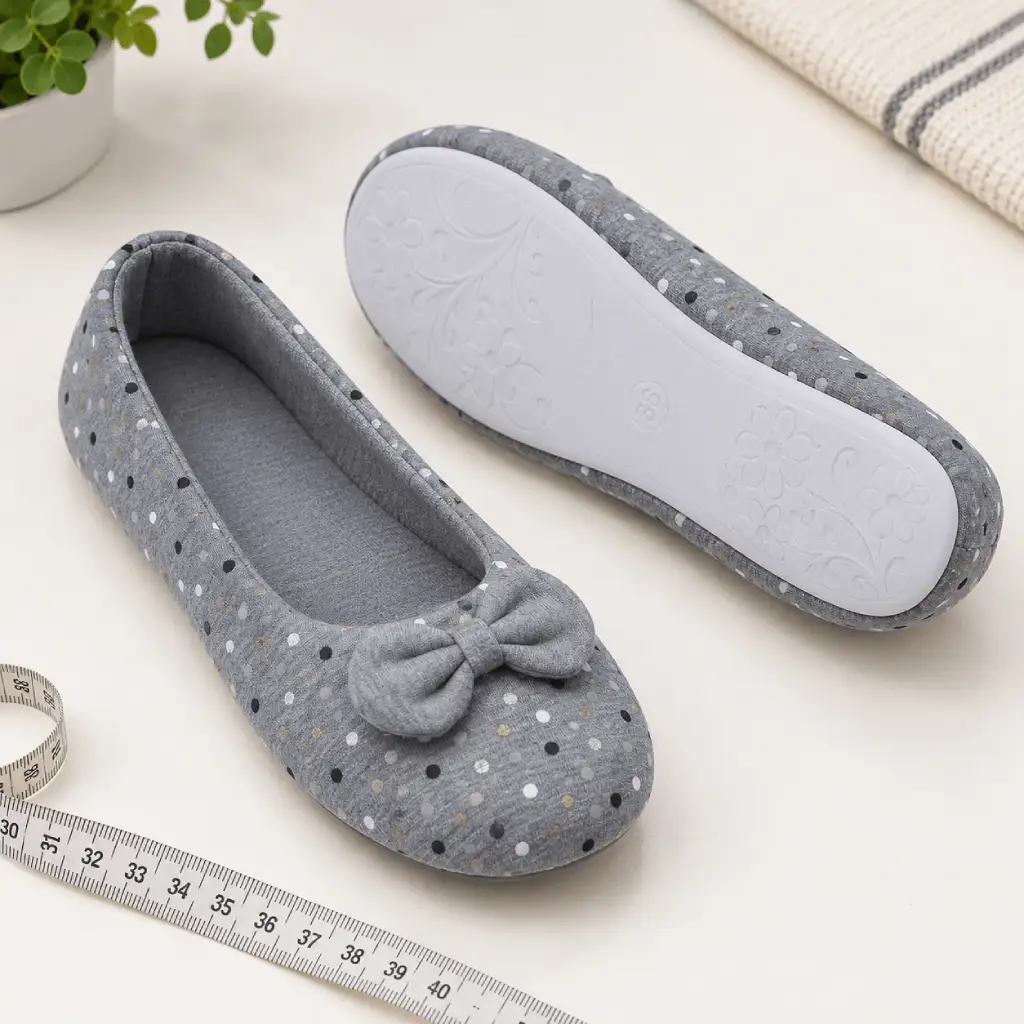
The outsole should be inspected as a specified component and as part of the finished pair. Depending on the project, a ballerina house slipper may use a soft textile bottom, cut EVA, molded TPR, or another confirmed construction. Each option needs its own inspection points; material names do not provide a universal performance ranking.
| Area | Check | Reference |
|---|---|---|
| Outsole identity | Material direction, color, size, shape, thickness or weight when specified, tread, and molded or cut detail | Approved component, specification, and finished sample |
| Pairing | Correct left-right orientation, size match, dimensions, flatness, and surface condition | Size set and approved pair |
| Connection | Alignment, edge coverage, open areas, stitch path or bond line, visible adhesive, and flex location | Construction specification and approved sample |
| Finished stance | Rocking, twisting, toe lift, heel position, edge distortion, and pair balance | Flat-surface comparison |
Match the check to the construction
A welt-stitched, side-stitched, or cold-glued connection should not be inspected as though the terms mean the same thing. Stitch continuity, spacing, edge distance, and upper-to-bottom alignment matter on stitched constructions. Bonded constructions also require correct component matching, preparation, adhesive process, pressing, curing, and edge condition.
Visible stitching can add a mechanical connection, but it does not by itself guarantee bond performance or structural stability. Likewise, a clean adhesive edge does not prove an adequate bond. If the buyer requires a measurable bond-strength result, the method, construction, specimen, timing, and acceptance requirement should be confirmed separately.
SATRA TM411 publicly describes a method for assessing the peel strength of footwear sole bonds on applicable constructions. Referencing a test method does not mean that a particular UTOP product or order has been tested; testing must be agreed for the project.
Performance boundary: do not approve slip resistance, abrasion resistance, flex durability, or service life from outsole material or tread appearance alone. Confirm any required claim through the buyer’s applicable specification and test plan.
8. Review Packing Recovery and Retail Presentation
A ballerina slipper may leave the inspection table in good shape and reach the shelf with a collapsed heel, creased vamp, flattened bow, or mismatched pair orientation. Packing is therefore part of the product approval, especially when the shoes are nested, folded, rolled, held by a band, or packed in a pouch or compact box.
Inspect an approved packed sample and repeat the agreed packing method during production. After unpacking, allow the agreed recovery time and handling before comparing the pair with the reference. Record whether manual reshaping is expected and what level of recovery is acceptable.
- Opening and heel recovery after compression
- Vamp, toe, bow, embroidery, or appliqué protection
- Left-right pair orientation and visible presentation
- Correct size, SKU, barcode, warning, care, and country information where required
- Insert, tissue, hanger, band, pouch, polybag, box, and other approved components
- Assortment, pairs per carton, carton condition, and shipping marks
Photographs of an unpacked pair do not approve a complete retail pack. Use the Footwear Packaging Guide to plan the wider label, barcode, assortment, carton, and packing checks.
9. Use the Ballerina Slipper Bulk Quality Control Checklist
The checklist below is a planning framework rather than a universal acceptance standard. Adapt it to the approved sample, actual construction, purchase order, size range, market, packaging, buyer manual, and agreed defect definitions.
| Checkpoint | What to inspect | Main reference | Record |
|---|---|---|---|
| Order identity | Style, color, size, SKU, pair quantity, and assortment | Purchase order and SKU matrix | Lot and inspected quantity |
| Opening and fit direction | Vamp depth, opening shape, topline, binding, entry, heel position, and specified measurements | Approved pair, size specification, and fitting record | Size, location, measurement, and observation |
| Pair appearance | Toe, vamp, heel, color, surface, symmetry, cleanliness, and finishing | Approved pair and defect references | Pair photograph and defect classification |
| Materials and comfort surfaces | Upper, lining, binding, cushioning, footbed, internal seams, and hard or rough points | Specification, swatches, and approved sample | Component and affected area |
| Construction | Seams, binding joint, upper assembly, bottom attachment, outsole alignment, and workmanship | Construction specification and sample | Operation, location, and frequency |
| Branding and decoration | Artwork version, scale, placement, color, attachment, orientation, and pair rule | Artwork, placement file, and approved sample | Actual position and visible condition |
| Outsole | Identity, size, dimensions, flatness, tread, pairing, flex position, and connection | Outsole specification and approved pair | Size, side, area, and result |
| Packing | Pair orientation, labels, pack components, recovery, assortment, carton, and marks | Packed sample and packing instruction | Carton sampled and packed-pair condition |
Record the reference used as well as the result. A simple “pass” offers little protection if the inspector, buyer, and supplier were comparing against different sample or document revisions.
For wider examples of sole separation, open seams, size inconsistency, foam deformation, decoration problems, and outsole defects, see 8 Common Shoe Defects in Indoor Slipper Manufacturing.
10. Set Sampling, Testing, and Release Rules
Inspection scope should be agreed before the goods are presented for final review. The buyer should define the lot, sampling method or 100% inspection requirement, defect categories, acceptance criteria, report format, reinspection rule, and person authorized to release the shipment.
ISO 2859-1:2026 defines AQL-indexed sampling schemes for lot-by-lot inspection by attributes. AQL is a sampling framework; it does not create the product specification, decide which ballerina slipper differences are critical, or replace buyer-approved defect definitions.
Do not insert a familiar sample size or AQL value into the order merely because it was used on another product. The correct arrangement depends on the buyer’s quality system, order risk, retailer requirements, product history, lot structure, and applicable inspection standard.
Keep visual inspection and testing in their proper roles
A final visual and dimensional inspection can review workmanship, pair consistency, labels, packaging, specified measurements, and many visible construction conditions. It cannot prove every material, chemical, slip, abrasion, flex, colorfastness, attachment, or bond-performance requirement.
Where testing is required, confirm the target market, product claim, test method, specimen, timing, laboratory, and acceptance limit. Intertek’s footwear testing overview shows examples of physical, mechanical, chemical, material, component, and whole-shoe evaluation. This link describes available testing services; it is not evidence that a particular product has passed a test.
Release rule: a shipment should not be treated as approved simply because the inspection is complete. Record the result, open issues, approved concessions if any, required corrective action, and the person authorized to release the order.
11. Respond to Repeated or Nonconforming Results
When a difference is found, first describe what is visible or measurable. Record the style, color, size, carton or production lot, left or right shoe, affected area, frequency, reference used, and photographs. Avoid assigning a cause before the relevant operation and materials have been reviewed.
One twisted opening may be an isolated workmanship issue. The same opening distortion across several sizes or cartons suggests that the team should check the pattern, cutting direction, binding length, sewing method, lining, shaping, or another shared production factor. Reworking individual pairs will not stop a repeated cause.
A useful response sequence
- Contain: identify and separate the known affected goods.
- Confirm scope: determine which sizes, colors, dates, lines, operations, or cartons may share the condition.
- Compare references: check the approved pair, current specification, material approval, artwork, and packing instruction.
- Review cause: examine the relevant material, pattern, tool, machine, method, handling, or instruction.
- Agree disposition: define rework, sorting, replacement, concession, rejection, or another buyer-approved action.
- Verify: inspect corrected goods and confirm that the response did not create a new fit, appearance, or packing problem.
A concession for one order should not silently become the standard for the next. Record what was accepted, why, by whom, and whether the product specification or defect reference needs to change.
12. Frequently Asked Questions About Ballerina Slipper Quality Control
What makes ballerina slipper inspection different from a general slipper inspection?
The low-cut upper makes opening shape, vamp depth, heel position, binding tension, toe profile, and pair symmetry especially visible. General material, construction, labeling, and packing checks still apply, but these low-profile areas need closer pair comparison.
Is checking overall slipper length enough?
No. Overall length does not confirm opening dimensions, forefoot width, vamp coverage, lining volume, heel retention, footbed position, or correct size grading. Use the project-specific size specification and approved fitted samples.
Should every left and right ballerina slipper look identical?
The construction, shape, color, workmanship, and approved pair presentation should be consistent. Decorations may be mirrored or intentionally different, but the left-right rule needs to be defined in the artwork and approved sample.
Does an AQL inspection replace in-process quality control?
No. Final sampling can identify nonconforming finished goods, but it may find a repeated issue only after much of the order is complete. Material, cutting, sewing, decoration, assembly, and packing risks should be checked at useful production stages.
Can outsole material confirm slip resistance or durability?
No. Results depend on the formulation, hardness, thickness, tread, complete shoe construction, surface, conditions of use, and applicable test method. Confirm performance requirements and testing for the actual product and market.
What should a buyer provide before ballerina slipper production?
Provide the approved pair or product reference, current specification, size range, materials, colors, artwork, outsole direction, packaging, estimated quantity, destination market, inspection requirements, and any applicable testing or compliance needs.
Conclusion: Inspect the Pair, Not Just the Product Type
A useful ballerina slipper bulk quality control plan starts with the approved pair and follows the details that define this low-cut construction. Opening geometry, vamp depth, toe profile, heel position, size progression, material recovery, decoration, outsole alignment, and packed presentation should all be checked against controlled references.
Keep the checklist specific to the order. The inspection method, sample size, tolerances, defect classes, tests, and release decision should come from the buyer-approved quality plan rather than a generic template.
Planning a private-label ballerina slipper order?
Share the target style, materials, size range, outsole, branding, packaging, estimated quantity, market, and quality requirements. UTOP can review the information needed for sampling, bulk production, and order-specific inspection planning.