A slipper size chart is useful only when you know what its numbers describe. A printed EU, US, UK, or S/M/L label may indicate the intended wearer, while the millimetre value may refer to foot length, last length, outsole length, or the usable space inside the finished slipper. Those measurements are not interchangeable.
For a shopper, the immediate question is simple: how should slippers fit? For a brand, importer, wholesaler, or private-label buyer, the same question continues into size mapping, measurement points, size grading, fitting samples, and the size ratio used for a bulk order.
This guide starts with three real UTOP product-size references, then shows how to read them, measure finished slippers, review fit across a size range, and turn the approved sizing into a practical order breakdown.
Quick answer: choose slippers by the intended foot length and finished fit, not by the label alone. Toes should not press against the front, the heel should sit in the intended position, the upper should hold the foot without pinching, and the slipper should not slide excessively during normal walking.
Important: the UTOP tables below are product-family reference specifications, not a universal conversion standard. Lining thickness, upper pattern, toe shape, outsole, construction, and target market can change the final mapping and fit.
Buyers developing a new program can use this article together with UTOP’s Custom Slipper Development Services, where size range, fit direction, materials, branding, packaging, and sample approval are reviewed as one project.
Written by the UTOP Slippers Sourcing Team, with product-development and sizing input from our indoor slipper team.
1. UTOP Slipper Size Chart References
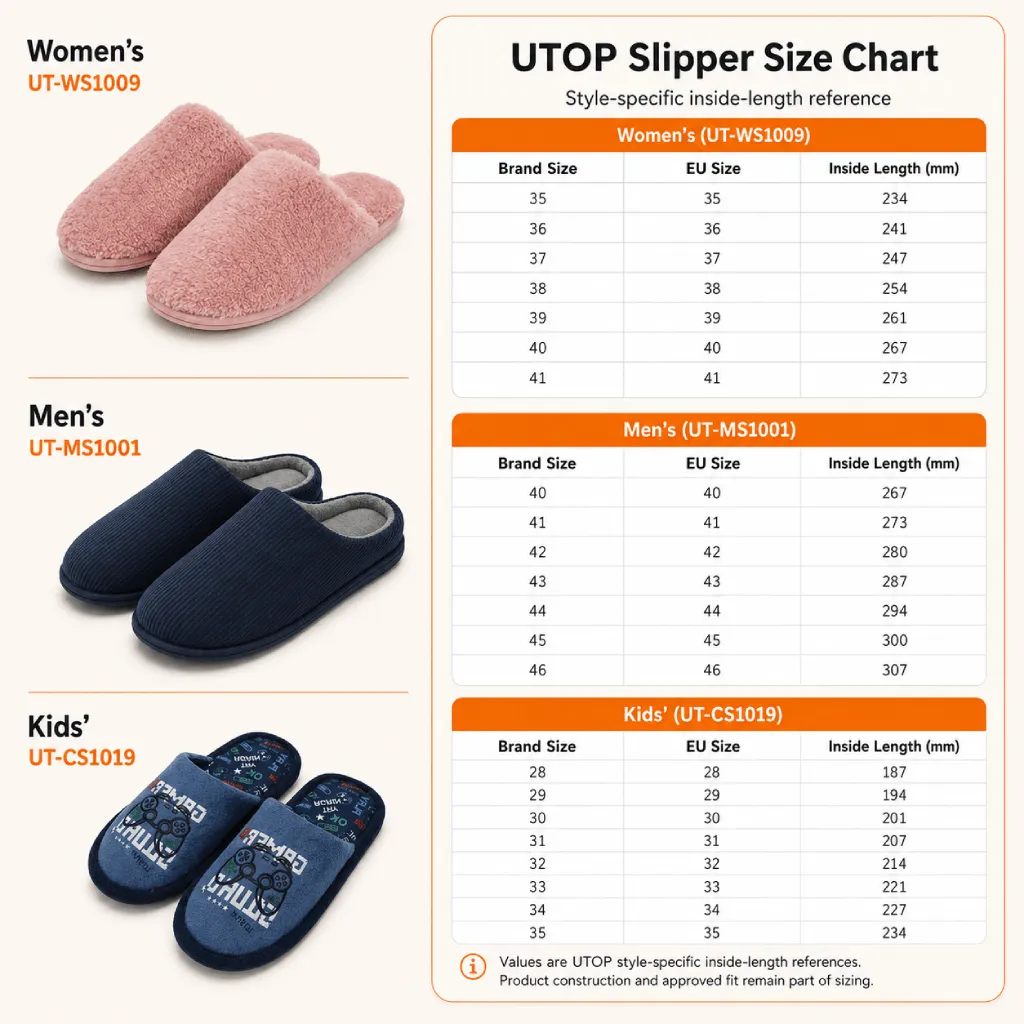
There is no single chart that describes every UTOP slipper. The three tables below show the current inside length references for one women’s style, one men’s style, and one kids’ style. They are a useful starting point for understanding how a slipper size chart works, but each new product should still be reviewed on its own construction and fit.
Women’s Slipper Size Chart: UT-WS1009
This women’s reference comes from the UT-WS1009 teddy plush slipper, a closed-toe, open-back style in EU 35–41.
| Brand Size | EU Size | Inside Length (mm) |
|---|---|---|
| 35 | 35 | 234 |
| 36 | 36 | 241 |
| 37 | 37 | 247 |
| 38 | 38 | 254 |
| 39 | 39 | 261 |
| 40 | 40 | 267 |
| 41 | 41 | 273 |
Men’s Slipper Size Chart: UT-MS1001
This men’s reference comes from the UT-MS1001 corduroy open-back slipper in EU 40–46.
| Brand Size | EU Size | Inside Length (mm) |
|---|---|---|
| 40 | 40 | 267 |
| 41 | 41 | 273 |
| 42 | 42 | 280 |
| 43 | 43 | 287 |
| 44 | 44 | 294 |
| 45 | 45 | 300 |
| 46 | 46 | 307 |
Kids’ Slipper Size Chart: UT-CS1019
This kids’ reference comes from the UT-CS1019 boys’ gamer slipper in EU 28–35.
| Brand Size | EU Size | Inside Length (mm) |
|---|---|---|
| 28 | 28 | 187 |
| 29 | 29 | 194 |
| 30 | 30 | 201 |
| 31 | 31 | 207 |
| 32 | 32 | 214 |
| 33 | 33 | 221 |
| 34 | 34 | 227 |
| 35 | 35 | 234 |
Read the Tables as Product References
The repeated values across these tables do not mean the slippers fit identically. An inside length of 267 mm appears in both the women’s teddy plush run and the men’s corduroy run, but the upper volume, toe shape, lining, opening, and intended wearer are different. Inside length gives one useful dimension; it does not describe the whole fit.
The sequence is not perfectly uniform either. Rounding, pattern development, outsole grouping, and the approved grade can affect the millimetre values shown for adjacent sizes. Buyers should therefore retain the confirmed table for the actual style rather than rebuilding it from a single assumed increment.
Chart rule: use the style number, size label, inside length, construction, and approved sample together. A row copied without its product context can look precise and still lead to the wrong fit.
2. Understand What the Slipper Size Numbers Mean
Most sizing errors begin before anyone tries on a sample. A spreadsheet says “length,” the supplier reads it as outsole length, the buyer expects foot length, and both sides think they have confirmed the same number. A usable slipper sizing record names the dimension and the measurement method.
| Term | What it describes | How buyers should use it |
|---|---|---|
| Foot length | The wearer’s foot from heel to longest toe, measured under an agreed method | Starting point for selecting a size and defining the intended wearer |
| Inside length | Usable heel-to-toe space inside the finished slipper | Product measurement used in the UTOP reference charts above |
| Outsole length | External bottom length of the outsole | Useful for components, tooling, packing, or finished dimensions; not a direct fit measurement |
| Last or pattern length | A development dimension used to create the shape and grade the product | Keep in technical records; do not present it as the consumer’s foot length |
| EU / US / UK / brand size | A size designation or commercial label | Map it to the intended foot-length range and approved finished fit for the target market |
| S / M / L or combined size | A grouped retail label that may cover more than one numeric size | Define the exact numeric mapping for the brand; never assume a universal range |
International systems are related, but they were not all built in the same way. ISO 9407:2019 describes the Mondopoint designation system using defined foot measurements. ISO 19407:2023 provides conversion guidance across major sizing systems and also notes the long-standing difficulty of shoe-size conversion.
That is why a conversion label should be treated as a mapping decision, not as proof that two products have the same internal dimensions. A brand can keep its familiar US label while changing the last, lining, or upper volume enough to alter how the finished slipper feels.
Specification wording: replace “length: 254 mm” with “finished slipper inside length: 254 mm, measured from the frontmost point the toes can reach to the rearmost point the heel can reach, using the agreed style-specific method.”
3. How Should Slippers Fit?
A good fit feels secure without making the foot search for space. The toes should lie naturally rather than pressing into the front. The heel should sit where the design expects it to sit. The upper should hold the foot during a normal step without pinching the instep or forcing the wearer to grip with the toes.
That sounds obvious, but slipper construction changes the signs you need to watch.
| Fit area | A useful fit looks like | Warning signs |
|---|---|---|
| Toe space | Toes lie flat and do not touch or curl against the front during a normal step | Pressure at the longest toe, toe curling, or a visible bulge in the upper |
| Heel position | Heel sits inside the intended footbed area or against the back without pressure | Heel overhang, heel pushed too far forward, or repeated loss of the slipper |
| Width and instep | Upper holds the foot with comfortable contact and normal flex | Pinching, seam pressure, foot spilling over the footbed, or excessive looseness |
| Walking security | Slipper follows the foot without demanding an exaggerated shuffle or toe grip | Frequent sliding, heel slap beyond the intended open-back feel, or unstable foot position |
Should Slippers Be a Size Bigger?
Not automatically. A thick lining may reduce usable internal space, but simply moving up one labelled size can also make the slipper too long or loose. Start with the brand’s intended foot-length range, then check the finished pair with the lining, socks, and use conditions expected for the product.
If a wearer falls between two sizes, the better choice depends on the construction. A flexible open-back mule may tolerate slightly more length; a closed-back house shoe needs enough toe space without allowing the heel to lift. Width and instep can matter more than the number printed on the sole.
Fit rule: do not use “true to size” as the only approval comment. Record what happened at the toes, heel, width, instep, opening, and during walking—and identify the sample size and tester’s relevant foot measurement.
4. Slipper Size Conversion and Shoe-Size Labels
Are Slipper Sizes the Same as Shoe Sizes?
They may use the same label, but they do not necessarily fit the same. A customer who wears EU 39 in a structured shoe may also choose EU 39 in a slipper, yet the internal space can feel different because a slipper has a different toe shape, upper support, lining, footbed, and heel construction.
A useful slipper size conversion therefore has two layers. First, map the commercial label used in the destination market. Second, connect that label to the intended foot-length range and the approved finished product. Stopping after the first layer creates a neat chart without proving fit.
| Label situation | What can go wrong | Better buyer instruction |
|---|---|---|
| EU to US or UK conversion | A generic online conversion is copied without checking the brand’s existing fit | Confirm the intended foot-length range and compare with the brand’s approved reference product |
| Women’s and men’s labels | The same US number is assumed to represent the same size across gender systems | State the system clearly on the chart, packaging, barcode data, and order sheet |
| S / M / L grouping | One combined label is expected to cover too broad a foot-length range | Define which numeric sizes and foot-length range each group is intended to serve |
| Dual-size labels | A label such as 38/39 is treated as two separately fitted sizes | Approve the actual shared outsole, pattern, inside length, and fit range represented by the label |
| Brand migration | A new supplier inherits old labels but not the old product measurements | Send a controlled reference sample and an explicit mapping table for comparison |
For private-label packaging, keep the same mapping across the product specification, woven or printed size label, outsole marking, hang tag, polybag sticker, barcode file, carton assortment, and e-commerce listing. A correct slipper with the wrong label is still a sellable-size problem.
Conversion rule: approve the label and the fit separately. The label tells the market what the size is called; the fitting sample shows who the finished slipper actually fits.
5. How to Measure Slipper Inside Length
For the UTOP size references in this article, inside length means the usable distance from the frontmost point the toes can reach to the rearmost point the heel can reach inside the finished slipper. It is not the outsole length and it is not measured through the upper from the outside.
The normal working method uses a soft measuring tape. The exact start and end points must be confirmed for the style because an open-toe slide, closed-toe mule, and closed-back house shoe do not provide the same physical boundaries.
- Identify the finished style and size. Record the style number, labelled size, left or right foot, sample status, and measurement date.
- Confirm the reachable endpoints. Locate the frontmost point the toes can reach and the rearmost point the heel can reach for that construction.
- Follow the usable internal path. Place the soft tape along the centre of the foot-contact area without changing the intended line.
- Do not compress the lining. Thick fleece, plush, or padding should remain in its natural finished condition. Pressing it flat can create a longer reading that the foot does not actually experience.
- Read and record consistently. Use the agreed unit and rounding rule, then repeat the check if the tape position or endpoint is uncertain.
ISO 19410-1:2022 provides a standardized method for effective in-shoe length, but its stated scope does not apply to heel-open or toe-open footwear. That limitation matters for slippers: buyers and suppliers still need a clear, repeatable style-specific method for open-back mules, slides, and other constructions outside that scope.
Put the Method Next to the Number
A measurement table becomes much easier to reproduce when the method travels with it. A short record can show more than a column of millimetres without turning into a laboratory manual.
| Record item | Example of useful wording | Why it matters |
|---|---|---|
| Dimension | Finished slipper inside length, mm | Prevents confusion with outsole, last, or foot length |
| Tool and condition | Soft tape; finished slipper relaxed; lining not compressed | Keeps the reading close to usable internal space |
| Endpoints | Style-specific frontmost toe reach to rearmost heel reach | Makes the method usable across different slipper shapes |
| Reference | Approved fitting sample and current size specification | Connects the number with the actual fit |
| Tolerance | Buyer-approved value and decision rule for this project | Avoids inventing one tolerance for every construction |
Use Size-Set or Fitting Samples When the Range Is New
One central-size sample can confirm the general look, but it may hide problems at the smallest and largest sizes. For a new slipper style or a new size range, UTOP can arrange size-set samples or fitting samples so the buyer can review inside length, upper volume, heel position, toe space, and the overall grade before bulk production.
The required sample coverage depends on the project. Some programs need every size; others can use selected control sizes plus the approved grade and measurement table. The decision should reflect the construction, number of outsole groups, target user, market risk, and buyer approval process.
These checks sit within the wider custom slipper development process, where sizing is reviewed together with materials, construction, branding, packaging, and the intended market.
Measurement rule: a number is controlled only when the dimension, tool, product condition, endpoints, rounding, sample reference, and tolerance decision are understood by both sides.
6. Build and Approve the Full Slipper Size Range
Slipper size grading is the controlled change from one size to the next. It is more than adding the same number of millimetres to every component. The outsole, upper pattern, opening, lining, footbed, decorative placement, and size label all have to move together without changing the character of the product.
The UTOP reference charts show why an assumed fixed step is risky. Their adjacent inside-length changes are close, but rounding and style-specific development mean the sequence is not identical in every row. The approved grade—not a rule copied from another shoe—is the production reference.
| Sizing decision | What to confirm | Approval evidence |
|---|---|---|
| Size mapping | EU, US, UK, brand, or combined labels and intended foot-length range | Final mapping table and approved label artwork |
| Measurement points | Inside-length endpoints plus any width, opening, heel, or outsole dimensions required | Marked diagram, method note, and measured samples |
| Size grading | Pattern, outsole, upper volume, opening, and component changes through the range | Grade table, size set, or selected control sizes |
| Fit approval | Toe room, heel position, width, instep, walking security, and intended socks | Fitting comments tied to identifiable samples and testers |
| Tolerance | Which dimensions are controlled, acceptable variation, and how differences are judged | Buyer-approved specification and inspection rule |
A thick plush lining may need extra internal volume. A rigid molded outsole may limit how a range can be grouped. A closed back can reveal heel-position problems that an open-back mule hides. When one of these elements changes, the fit and grade should be reviewed again rather than inherited automatically.
UTOP can help buyers review size mapping, measurement points, size grading, and bulk size ratio planning. The buyer still defines the target market, brand fit, acceptance requirements, and final approval. For the wider development sequence, see UTOP’s Private Label Indoor Slippers Manufacturing Guide.
During production, measured pairs should be checked against the current approved references. UTOP’s Footwear Quality Control Guide for Bulk Slipper Orders covers size, measurement, pair consistency, inspection records, and other bulk-control points in more detail.
Grading rule: approve the smallest and largest size implications, not only the central sample. A grade can look smooth on paper while producing a crowded small size or an unstable large one.
7. Plan the Bulk Slipper Size Ratio
A technically correct size range can still become a poor order if the quantity mix does not match demand. Bulk size ratio planning translates the approved slipper sizes into pair quantities for purchase orders, packing, cartons, barcodes, and warehouse receipt.
Do not copy another market’s ratio simply because the size labels look familiar. The useful inputs are the buyer’s own sales history, returns, customer profile, channel, season, promotional plan, and whether the range is being launched or replenished.
Illustrative Size-Ratio Calculation
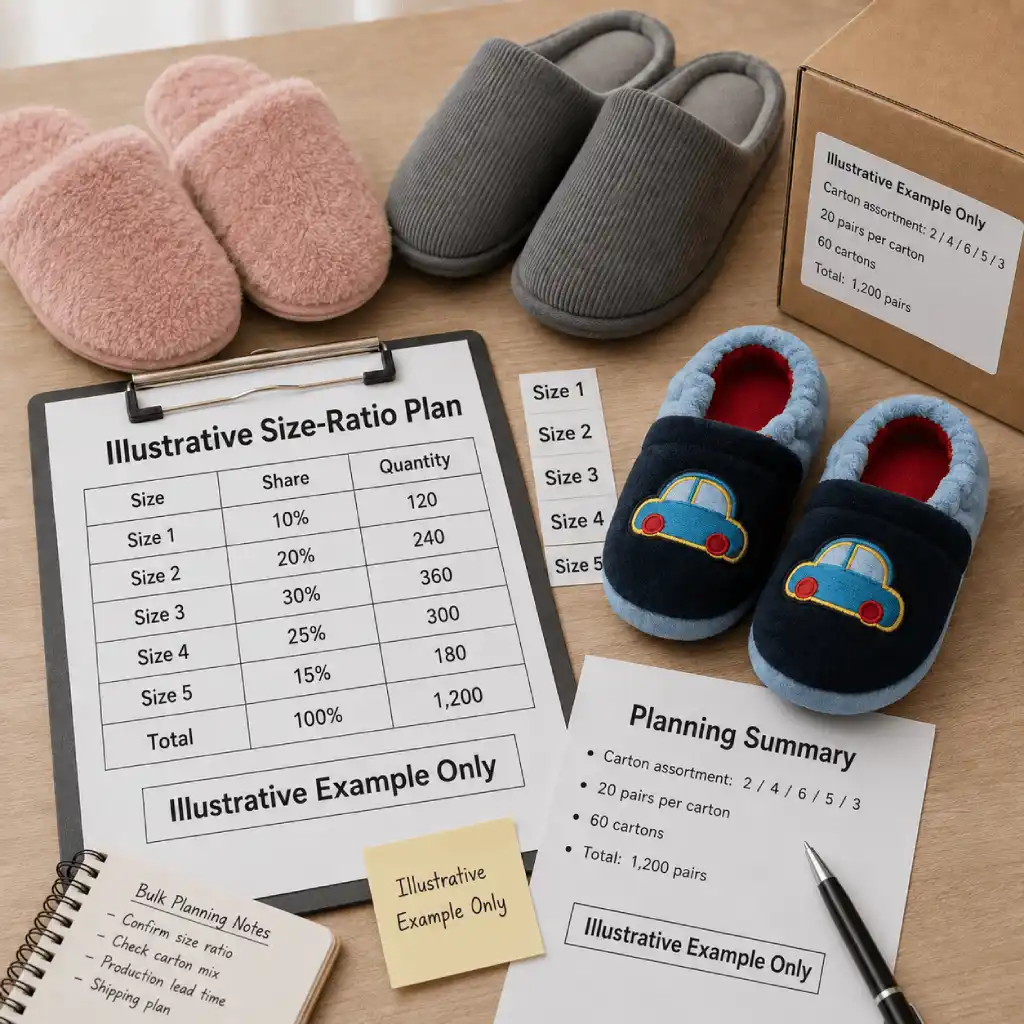
The example below is a calculation method, not a recommended market ratio. For a 1,200-pair order covering five sizes, the buyer has chosen a 10% / 20% / 30% / 25% / 15% mix.
| Size | Planned Share | Calculation | Pair Quantity |
|---|---|---|---|
| Size 1 | 10% | 1,200 × 10% | 120 |
| Size 2 | 20% | 1,200 × 20% | 240 |
| Size 3 | 30% | 1,200 × 30% | 360 |
| Size 4 | 25% | 1,200 × 25% | 300 |
| Size 5 | 15% | 1,200 × 15% | 180 |
| Total | 100% | — | 1,200 |
Check the Ratio Against Packing and Sales Data
After converting percentages to pairs, test the result against carton packing. If the master carton uses a fixed mixed-size assortment, each ratio unit must multiply cleanly into the order quantity. If sizes ship in solid cartons, the final numbers still need to match pairs per carton, label quantities, and warehouse expectations.
Then run a commercial check. Are the edge sizes underrepresented because they sell slowly, or because the previous collection rarely stocked them? Are returns concentrated in one label because the mapping is wrong rather than demand being weak? Is a retailer asking for equal packs even though the brand’s own sales history points elsewhere?
- For a new launch: use the best available customer profile and comparable product data, then plan an early review.
- For a repeat order: compare sell-through, returns, out-of-stock dates, and leftover inventory by size.
- For multiple channels: consider separate ratios when store, e-commerce, promotional, or regional demand differs.
- For combined sizes: confirm that the shared fit really serves the customer range before increasing volume for packing convenience.
UTOP’s Bulk House Slippers Wholesale Checklist covers the wider order review, including sizing, quantity, materials, branding, packaging, inspection, and delivery information.
Ratio rule: the total must balance mathematically, operationally, and commercially. A percentage table is not finished until it also matches carton logic, labels, purchase-order quantities, and the buyer’s demand evidence.
8. Buyer’s Slipper Sizing Checklist
Before approving a new slipper size chart or confirming a bulk order, bring the commercial labels, technical measurements, fitting evidence, quantity ratio, and packaging data into one current record. The checklist below is short enough to use during development and specific enough to expose missing decisions.
| Review area | Information to confirm | Controlled reference |
|---|---|---|
| Market and user | Destination, sales channel, intended wearer, socks, season, and brand fit direction | Product brief and target-customer profile |
| Size mapping | EU, US, UK, brand, dual-size, or S/M/L labels and intended foot-length range | Approved mapping table |
| Inside length | Value by size, tool, endpoints, product condition, rounding, and buyer-approved tolerance | Measurement method and current size specification |
| Construction and grade | Outsole groups, upper pattern, lining, opening, width, instep, and size-to-size changes | Grading record and component references |
| Fit approval | Toe room, heel position, width, instep, walking security, and edge sizes | Approved fitting or size-set samples and comments |
| Bulk size ratio | Pair quantity by size, ratio basis, carton logic, and total reconciliation | Purchase order, assortment sheet, and packing instruction |
| Labels and packaging | Product size label, outsole marking, barcode, retail label, bag or box sticker, and carton mark | Approved artwork and SKU data |
| Production checks | Correct size pairing, measurement frequency, size distribution, label accuracy, and packing quantity | Quality plan and inspection record |
Packaging deserves a final cross-check because size mistakes often appear after the slipper itself is complete. UTOP’s Footwear Packaging Guide explains how size stickers, SKU data, barcodes, pack ratios, and carton information should remain aligned from the individual pair to the master carton.
Final-check rule: read one size across every document and physical reference. The label, inside length, sample, barcode, pair quantity, individual pack, and carton mark should all describe the same SKU.
9. Slipper Size Chart FAQs
How should slippers fit?
Toes should have comfortable space without pressing into the front, the heel should sit in the intended position, and the upper should hold the foot without pinching. During normal walking, the slipper should follow the foot without excessive sliding or forcing the wearer to grip with the toes.
Should slippers be a size bigger than shoes?
Not as a universal rule. Thick lining, toe shape, upper volume, and heel construction affect the fit. Start with the intended foot-length range and brand chart, then choose the size that gives enough toe room and secure walking without becoming overly long or loose.
Are slipper sizes the same as shoe sizes?
They can use the same EU, US, or UK label, but the finished fit may differ. Slippers often have different lining thickness, upper support, footbed construction, toe shape, and heel coverage. Use the label as a starting point and the product-specific fit as the decision.
Is inside length the same as outsole length?
No. Inside length describes usable heel-to-toe space inside the finished slipper. Outsole length is the external bottom dimension. The two measurements serve different purposes and should be named separately on the specification.
How do you measure the inside length of a lined slipper?
Use a soft measuring tape along the agreed internal path, from the frontmost point the toes can reach to the rearmost point the heel can reach. Confirm the endpoints for the style and do not compress the lining while measuring.
Does every slipper use the same S/M/L size mapping?
No. S/M/L and combined labels are brand-defined groupings. Buyers should state which numeric labels and foot-length range each group covers, then approve the finished fit and repeat the same mapping on the product label, packaging, barcode, and carton data.
Can UTOP arrange fitting samples for a new size range?
Yes. For a new style or size range, UTOP can arrange size-set samples or fitting samples according to the project needs. UTOP can also help buyers review size mapping, measurement points, size grading, and bulk size ratio planning before production.
Conclusion: Make the Chart Traceable to the Product
A reliable slipper size chart does not stop at EU, US, UK, or S/M/L labels. It connects each label to a defined inside length, a clear measurement method, the intended foot range, and an approved finished fit. For bulk orders, that same information should continue into grading, size ratios, labels, barcodes, cartons, and production checks.
The practical sequence is straightforward: define the target user and market, agree on the size mapping, confirm how the finished slipper is measured, review representative fitting or size-set samples, approve the grade, and calculate the bulk ratio from real demand evidence.
Buyers preparing a new collection can review UTOP’s custom indoor slipper range to select a starting style or share an existing product, image, sample, or tech pack for development review.
Planning a custom slipper size range?
Share your target market, intended wearer, current size chart or reference sample, required labels, size range, construction, lining, estimated quantity, and available sales data. UTOP can review the information needed for size mapping, measurement, grading, fitting samples, and bulk size-ratio planning.