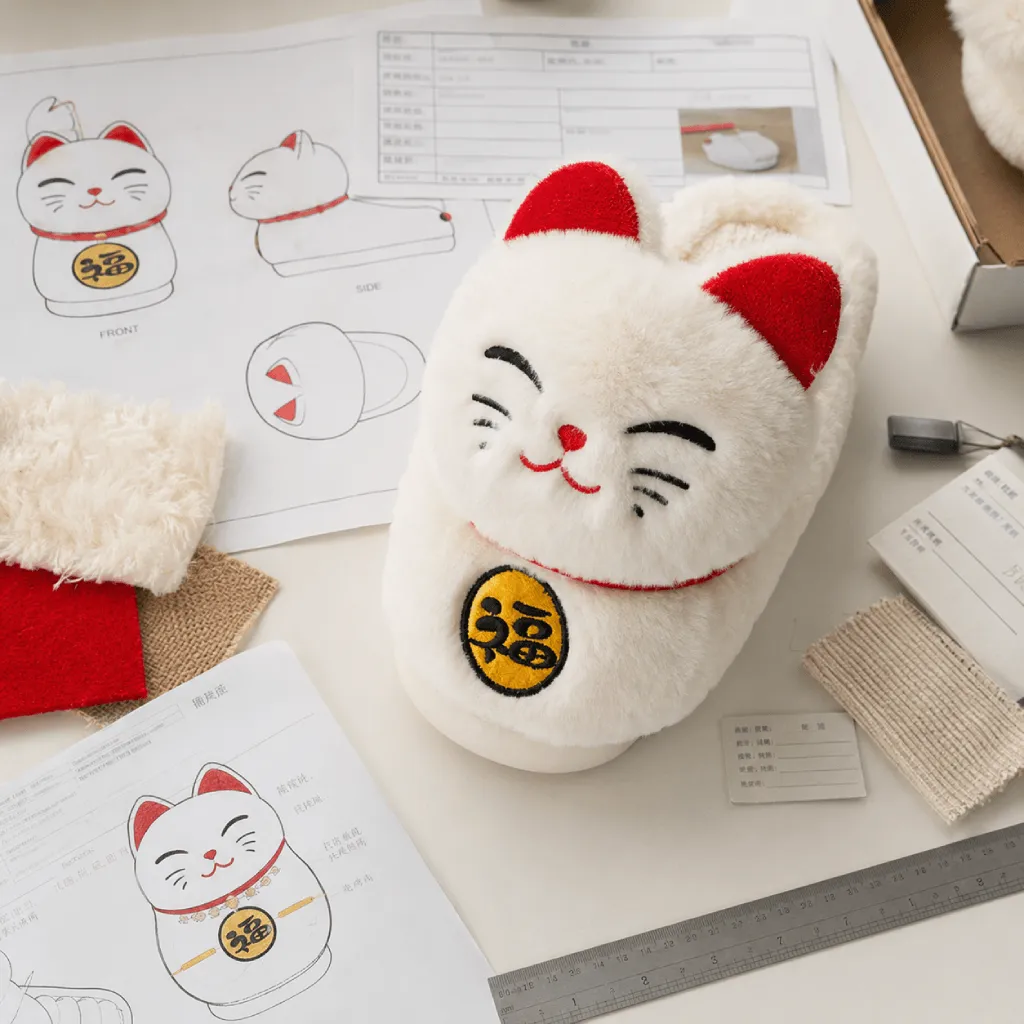
Memory foam slippers can feel convincing in a showroom sample and still disappoint when the bulk order arrives. One production pair may feel thinner than the approved sample. Another may recover slowly after packing, or feel noticeably different from left to right.
For brands, importers, wholesalers, retailers, and private-label buyers, the problem is rarely solved by asking for “more memory foam.” The useful work is to define the foam grade, density where relevant, firmness or compression requirement where relevant, thickness, layer sequence, finished fit, recovery reference, and the checks that will carry the approved feel into production.
This buyer’s guide explains how memory foam works inside a slipper, why density and firmness should not be confused, how memory foam and EVA can share different jobs, what to record during sample approval, and how to control the cushioning system during bulk production.
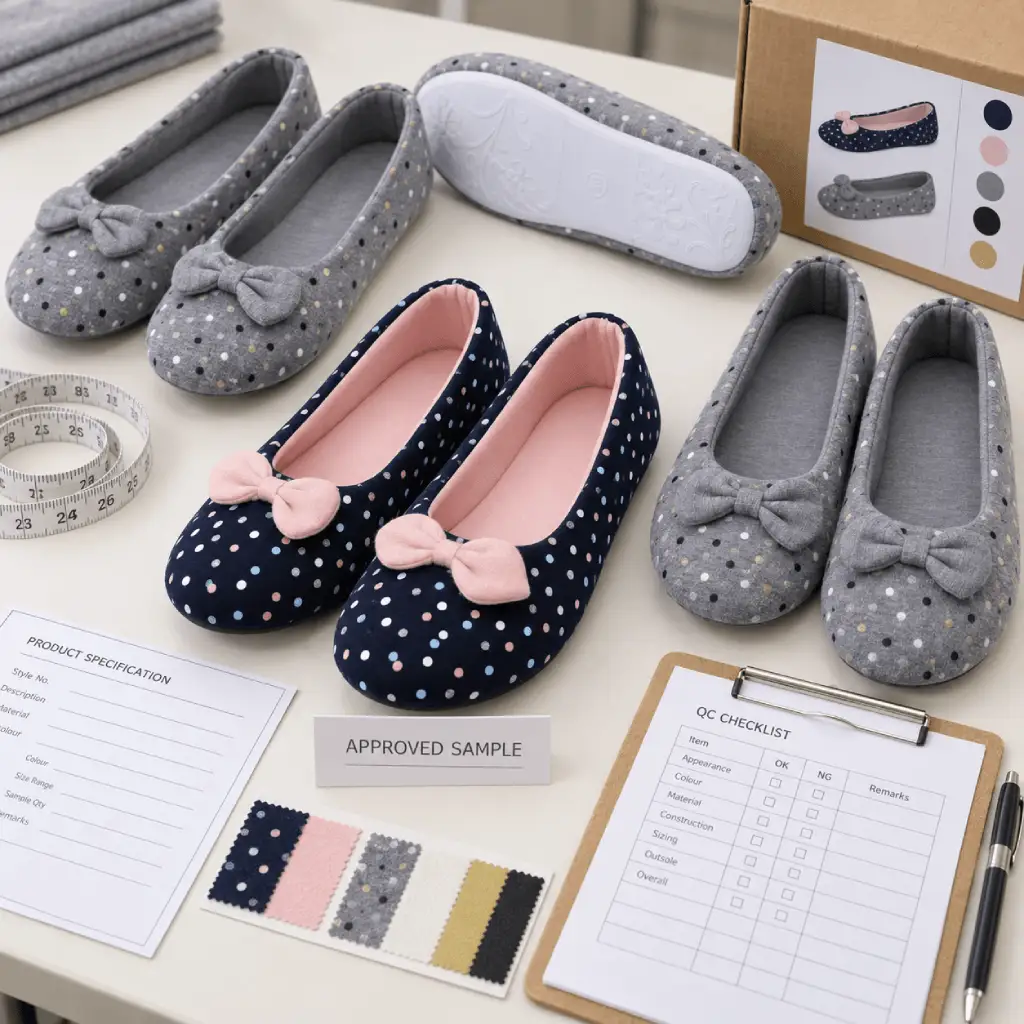
Buyer takeaway: approve the complete slipper, not a loose foam swatch or a marketing label. The reference should connect the material record with the layer construction, finished fit, cushioning feel, and recovery result that production is expected to reproduce.
Specification boundary: there is no universal “best” density or thickness for every memory foam slipper. The right choice depends on the foam grade, support layers, upper pattern, internal volume, outsole construction, target feel, packing method, and buyer-approved test or comparison standard.
For a wider inspection framework covering approved references, incoming materials, in-process checks, final inspection, records, and nonconformity handling, use UTOP’s Footwear Quality Control Guide for Bulk Slipper Orders.
Written by the UTOP Slippers Sourcing Team, with product-development and quality-control input from our indoor slipper team.
1. Why Memory Foam Slippers Need a Complete Specification
“8 mm memory foam” sounds precise. In practice, it still leaves most of the buying decision open. Is 8 mm the thickness of the incoming sheet, the laminated component, or the finished cushioning stack? Which foam grade is being used? Is there a firmer layer underneath it? Does the upper leave enough volume for that stack?
The same problem appears with phrases such as high-density memory foam slippers, “premium foam,” or “extra cushioning.” They may work as retail descriptions, but they do not tell the production team what has to be repeated from the approved sample.
| Quotation wording | What is still unclear | What the buyer should record |
|---|---|---|
| Memory foam | Grade, supplier reference, firmness, density, and recovery behavior | The agreed material identity and approved comparison sample |
| 8 mm foam | Where and when the thickness is measured | Incoming-sheet, cut-component, or finished-stack measurement point |
| High density | Actual density value and whether firmness is being confused with density | Density and firmness as separate specifications when required |
| Extra soft | How softness is judged and how much comes from the cover, lining, or support layer | A finished-pair feel and compression reference under agreed conditions |
A practical memory foam slipper brief usually needs the foam type or supplier grade, density when it forms part of the purchase specification, firmness or another agreed compression value when required, cut thickness, layer sequence, support materials, finished fit, and the sample reference that bulk production must follow.
Working rule: if two suppliers can use the same phrase while quoting materially different constructions, the phrase is not yet a usable buying specification.
2. How Memory Foam Works Inside a Slipper
Memory foam is commonly a viscoelastic flexible polyurethane foam. In its technical overview, Covestro describes viscoelastic foam as a pressure-contouring material with slow recovery. That slow return helps create the familiar cushioned, conforming feel.
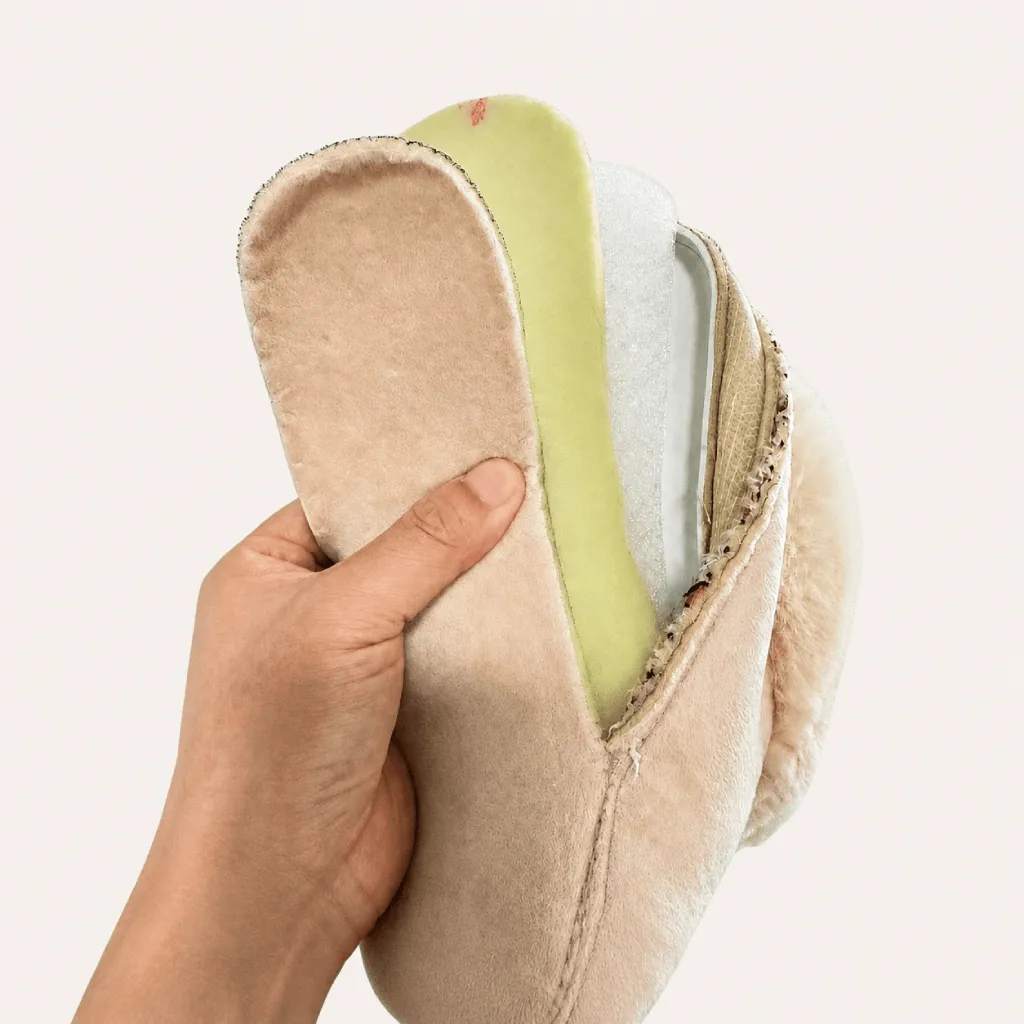
Inside memory foam slippers, however, the memory foam is usually only the comfort layer closest to the foot. It does not carry the whole job. The insole cover changes the first touch. A support layer controls how deeply the foot sinks. A structural layer may help the footbed hold its shape. The outsole then affects the overall weight, flex, balance, and ground contact of the finished pair.
A representative cushioning stack may include:
- Insole or foot-contact cover: the textile, lining, or laminated surface felt directly by the foot
- Memory foam comfort layer: the conforming, slow-recovery layer
- Support foam or EVA layer: a firmer or more resilient layer used to tune sink, stability, and shape
- Structural component: used where the footbed or construction needs additional form
- Outsole: the ground-contact component, which may use EVA, TPR, or another approved construction
There is no universal stack for every pair of memory foam house slippers. A soft open-back mule, a plush closed-toe slipper, and a structured house shoe can all need different combinations.
Why a Loose Foam Swatch Can Mislead
A loose swatch is useful for identifying the material, but it cannot show the final fit or foot position. After lamination and assembly, the same foam may feel firmer, thinner, or less responsive because the surrounding layers limit how it moves. A tighter upper can also preload the cushioning before the slipper is worn.
This is why buyers comparing slippers with memory foam should press, wear, and inspect the complete sample rather than judging only a piece of foam or a memory foam insole component. The finished pair is where cushioning, fit, balance, and construction meet.
Layer rule: document the sequence from the foot-contact surface down to the outsole. If EVA is included, state whether it is an internal support layer or the outsole; the material name alone does not explain its location or function.
3. Separate Density, Firmness, Thickness, and Recovery
When buyers discuss memory foam slippers, density, firmness, thickness, and recovery are often rolled into one conversation about softness. They are not interchangeable. A buyer who separates them early will have a much easier time comparing samples and investigating bulk differences later.
The Polyurethane Foam Association’s foam performance guidance defines density as mass per unit volume and explains that firmness is independent of density. It also describes Indentation Force Deflection, or IFD, as a common way to express the force required to indent a foam sample under a defined procedure.
| Property | What it describes | What it does not prove | Useful buyer control |
|---|---|---|---|
| Density | Mass of foam per unit volume | Surface softness, finished-slipper life, or overall quality by itself | Record the agreed grade and density when density is part of the specification |
| Firmness / IFD | Resistance to indentation under a defined method | Foam density or complete footbed support on its own | Specify separately when a measured compression value is required |
| Thickness | Depth of the foam sheet, cut component, or finished stack | Softness, durability, or fit without the rest of the construction | Define the measurement stage and location |
| Recovery behavior | How the foam returns after compression | A universal service life or packing result | Compare conditioned samples under the same agreed method |
A higher-density foam can still be soft, and a lower-density foam can be firm. That is why “high density” should not be used as a shortcut for “better.” Density may form part of a durability or material-identity discussion, but the finished result still depends on the foam formulation, thickness, support layers, construction, and use conditions.
When laboratory values are not part of the program, a practical alternative is to lock the supplier grade, thickness reference, layer sequence, and approved finished pair, then use repeatable comparative checks during production. That approach is more useful than inventing a technical number that neither side can verify.
4. Memory Foam vs EVA: Define the Job of Each Layer
Buyers sometimes frame the decision as memory foam vs EVA slippers. In many constructions, that is the wrong contest. Memory foam and EVA can sit in the same pair of memory foam slippers and perform different jobs.
Memory foam is commonly selected for a conforming, slow-recovery feel close to the foot. EVA may be used as an internal cushioning or support layer, or as the outsole in a different part of the construction. The exact behavior depends on the EVA type, density or hardness direction, thickness, location, and the surrounding materials.
| Comparison point | Memory foam | EVA |
|---|---|---|
| Typical role | Comfort layer near the foot | Internal support or cushioning layer; in other designs, outsole material |
| Common behavior | Conforming and deliberately slow to recover | Often lighter and more resilient, depending on grade and construction |
| Buyer should define | Grade, density if used, firmness or compression if used, thickness, and recovery reference | EVA type, density or hardness direction, thickness, location, and function |
| Frequent mistake | Treating density as firmness or quality | Saying only “EVA” without stating whether it is an internal layer or outsole |
If the project uses an EVA outsole, review it as a separate product decision. UTOP’s TPR vs EVA Sole for Slippers Guide explains how outsole material type, thickness, density or hardness, tread, construction, tooling, and target use should be compared.
Selection rule: ask what each layer is expected to do. A material comparison is useful only after its position and function in the complete slipper have been defined.
5. How Foam Thickness Changes Fit, Feel, and Packing
Searches for thick memory foam slippers and extra thick memory foam slippers reflect an understandable preference for a plush first step. In product development, though, adding thickness changes more than softness.
A thicker cushioning stack raises the foot inside the upper. That can reduce internal volume, tighten the vamp, move the heel closer to the edge, and change how much of the footbed is visible. If the layer is very soft, the initial height may disappear quickly under load. If it is firmer, the same nominal thickness can make the slipper feel crowded.
Thickness also changes the way a pair behaves in packing. A plush upper and a high cushioning stack may be compressed by tissue, bands, bags, boxes, or tight carton loading. That does not automatically mean the product is defective, but the buyer and factory should agree on how representative packed pairs will be opened, conditioned, and compared with the approved sample.
Check Thickness in the Complete Sample
- Define whether thickness refers to the incoming sheet, cut component, laminated part, or finished stack
- Check foot position, vamp volume, heel landing, and exposed footbed edge
- Compare the left and right shoes for even cushioning and centering
- Confirm that the layer does not shift, wrinkle, or create a local hard edge after assembly
- Pack representative pairs using the intended method and review recovery after an agreed conditioning period
- Repeat the fit review if the upper, lining, insole cover, outsole, or pattern changes
A number on a foam sheet is therefore only one part of the decision. The approved result is the combination of thickness, grade, support, internal volume, finished fit, and packing response.
6. Approve the Cushioning System During Sample Development
Sample development is where a vague request such as “soft but supportive” becomes a production reference. The mistake is to approve the pair by feel and then leave no record of what created that feel.
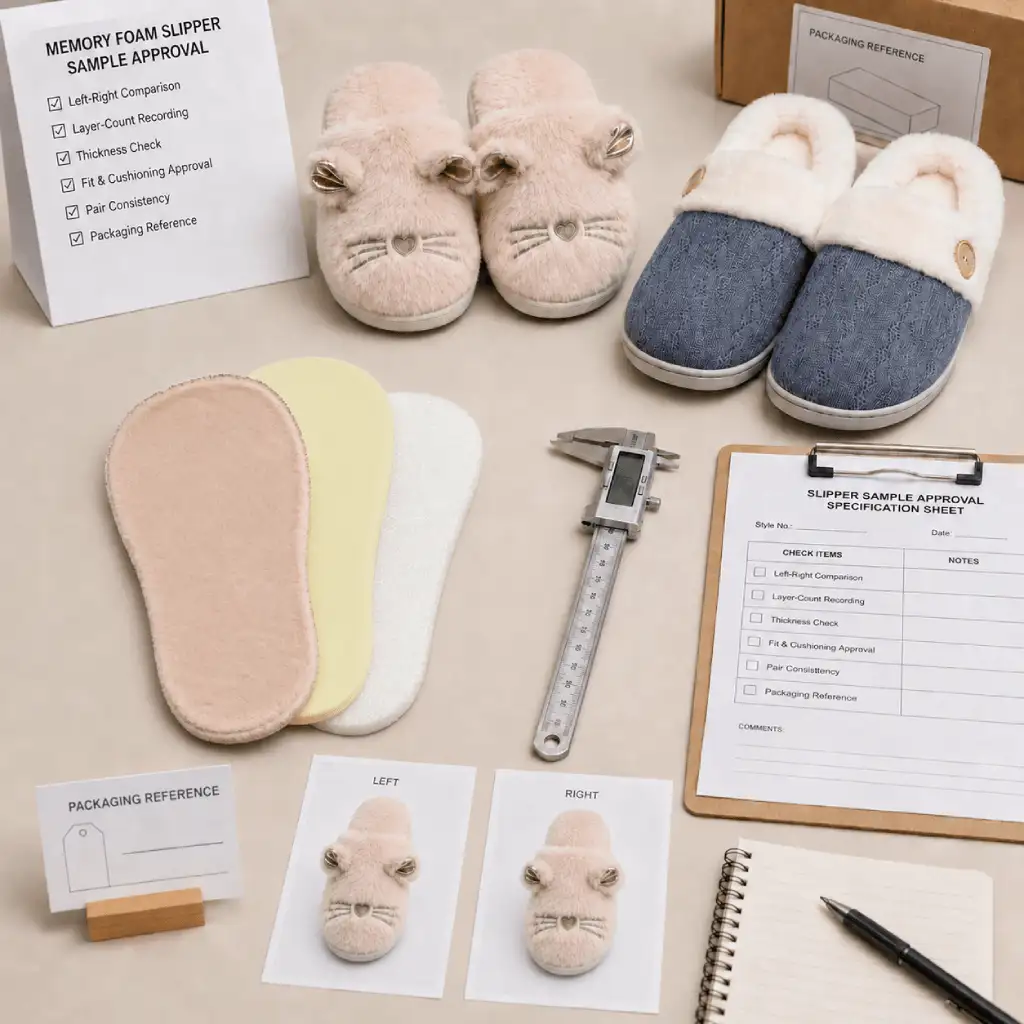
A useful approval combines material information with finished-product observations. The buyer may approve a foam grade and thickness, for example, while also recording that the pair should feel even from heel to forefoot, recover within the agreed comparison method, fit without crowding the upper, and show no obvious left-right difference.
| Sample record item | What to record | Why it matters |
|---|---|---|
| Foam identity | Material type, supplier code or grade, color, and practical batch reference | Reduces the risk of replacing the approved material with a visually similar grade |
| Density | The agreed value when density forms part of the purchase specification | Helps define material identity without treating density as firmness |
| Firmness / compression | IFD or another agreed method when the program requires a measured value | Separates compression behavior from density |
| Thickness | Nominal value, tolerance if applicable, location, and measurement stage | Avoids confusion between raw foam and the assembled stack |
| Layer sequence | Every cover, cushioning, support, structural, and outsole layer in order | Makes the approved construction reproducible |
| Finished feel and fit | Compression, recovery, hard spots, pair consistency, foot position, and upper volume | Connects material data to the actual product experience |
| Packing recovery | Packing method, conditioning time, and acceptable comparison result | Prevents surprises after storage and shipment |
Recheck the Sample When Another Component Changes
A cushioning system does not sit in isolation. Changing the lining, insole cover, upper pattern, outsole, or even the way the layers are laminated can alter fit and feel. A revised material may look harmless on the specification sheet and still reduce internal space or change how the footbed compresses.
For custom and private-label memory foam slippers, keep the current approved sample, construction record, colorway, size, and packing reference aligned. When a later revision is accepted, identify which version replaces the earlier one so that production and inspection are not working from different standards.
UTOP’s Private Label Indoor Slippers Manufacturing Guide covers the wider sequence from product brief and material selection to branding, packaging, sample approval, and production control. For UTOP’s usual custom slipper projects, sampling typically takes 7–14 days, although material preparation, outsole tooling, revisions, testing, and project complexity can change the schedule.
Approval rule: the signed or otherwise confirmed sample should be supported by a short, usable record. A sample that cannot be identified and described clearly is difficult to reproduce consistently.
7. Control Memory Foam Quality During Bulk Production
Bulk quality control for memory foam slippers should follow the cushioning system through production rather than waiting for a final squeeze test. By the time a finished pair feels wrong, the foam may already be laminated, covered, assembled, and packed. Earlier checks make the cause easier to find and the correction more practical.
| Inspection stage | What to check | Reference | Why it matters |
|---|---|---|---|
| Incoming material | Foam grade or supplier reference, representative thickness, condition, color, and batch identity where used | Approved material record and order specification | Finds obvious substitution, damage, contamination, or thickness variation before cutting |
| First production | Cut dimensions, layer order, centering, lamination, adhesive control, fit, and finished feel | Approved sample and construction record | Stops a wrong grade or reversed layer sequence before a large quantity is affected |
| In-process production | Thickness variation, wrinkles, shifted pads, local overlap, adhesive bleed-through, and left-right matching | First-production approval and process samples | Catches problems while the layer position and bonding process can still be reviewed |
| Finished pairs | Insole surface, hard spots, pair consistency, fit, foot position, comparative compression, and recovery | Approved finished pair under the same comparison conditions | Confirms that material and assembly controls produced the intended complete product |
| Packed goods | Shape, layer position, visible distortion, and recovery after representative unpacking and conditioning | Approved packing method and agreed recovery requirement | Checks the product as the buyer or customer will receive it |
When a program requires formal foam-property testing, ASTM D3574-25 provides test methods for slab, bonded, and molded flexible polyurethane foams. It can support material specifications and acceptance decisions under the conditions of the selected test, but it is not a finished-slipper inspection standard.
Use Comparative Checks for the Finished Pair
A consistent hand-press or compression comparison is not a laboratory measurement, but it is still useful for screening production. If the same person compares conditioned pairs in the same area and finds an obvious left-right or pair-to-pair difference, that result should trigger investigation rather than immediate diagnosis.
The next step is to trace the construction: confirm the material batch, cut thickness, layer order, placement, bonding, upper volume, and support layer. Opening or dissecting a rejected pair may be necessary when the problem is hidden below the insole cover.
For the broader inspection plan, use UTOP’s Footwear Quality Control Guide. It covers control references, material and component checks, in-process inspection, final inspection, size and pair consistency, packaging, testing records, and nonconformity response.
QC rule: a material test answers a material question. A finished-pair check answers a product question. Buyers may need both, but one should not be presented as a substitute for the other.
8. Troubleshoot Common Memory Foam Slipper Problems
With memory foam slippers, “too flat,” “too firm,” and “not like the sample” are symptoms, not diagnoses. Similar complaints can come from different materials, layer positions, assembly pressure, upper fit, or packing conditions. Start with the approved construction and work backwards.
| Observed symptom | Possible causes to investigate | Useful buyer or QC check |
|---|---|---|
| Production feels flatter than the sample | Different foam grade, reduced cut thickness, stronger assembly compression, changed support layer, or packing pressure | Check material identity, cut thickness, stack sequence, assembly, and unpacked comparison |
| Left and right feel different | Component thickness variation, pad misalignment, uneven bonding, or mixed material lots | Compare component dimensions, placement, bonding, and pair-level compression |
| Local hard spot underfoot | Excess adhesive, folded layer, overlap, shifted component, or foreign material | Open a rejected pair and compare the stack with the approved construction |
| Foot sits high or upper feels tight | Stack thicker than approved, changed lining or insole cover, or unchanged pattern volume | Measure the stack and recheck the complete sample fit |
| Recovery differs between batches | Foam grade or formulation variation, mixed lots, different conditioning, or assembly pressure | Verify batch identity and compare conditioned samples under the same method |
| Footbed remains distorted after packing | Excess packing compression, layer shift, unsuitable support, or insufficient recovery for the packing method | Inspect representative unpacked goods and review both packing and material specifications |
UTOP’s guide to Common Indoor Slipper Manufacturing Defects provides a wider troubleshooting framework for foam compression, pair inconsistency, sole attachment, stitching, outsoles, decorations, and finishing.
Investigation note: do not assign a cause from appearance alone. Record the affected size, color, carton, material lot, production stage, and frequency before deciding corrective action.
9. Buyer’s Memory Foam Slipper Specification Checklist
Before confirming a bulk order of memory foam slippers, the technical file or approved sample record should answer the questions below. The goal is not more paperwork. It is to make sure the factory, buyer, and inspection team are referring to the same cushioning system.
- Is the memory foam type, supplier reference, or agreed material grade recorded?
- Is nominal density recorded when it forms part of the purchase specification?
- Is firmness, IFD, or another agreed compression requirement recorded when needed?
- Does the thickness value state where and when it is measured?
- Is the complete layer sequence documented from insole cover to outsole?
- Is the function and material of the support layer below the memory foam clear?
- Does the approved sample use the final upper, lining, insole cover, outsole, pattern, and size?
- Are left-right cushioning consistency and pad placement included in first-production and final checks?
- Do in-process checks cover wrinkles, overlap, hard spots, adhesive issues, and layer shift?
- Does the packing approval include representative unpacking and recovery?
- Are any required material test methods, sample conditions, and acceptance limits written into the order specification?
- Are retail phrases such as “premium,” “high density,” or “extra thick” supported by the actual construction record?
Final check: someone who did not attend the sample meeting should still be able to read the file, identify the approved construction, and understand how production will be compared with it.
10. FAQs About Memory Foam Slippers for Bulk Orders
Do memory foam slippers flatten over time?
Flexible foams can change with repeated loading, compression, storage, and use. The amount of height or firmness change depends on the foam formulation and grade, density, thickness, support layers, construction, packing, and use conditions. No material name can guarantee a universal service life.
Is higher-density memory foam always firmer or better?
No. Density and firmness are different properties. A higher-density foam can be soft, and a lower-density foam can be firm. Buyers should review density, firmness or compression, thickness, support, finished fit, and the approved sample together.
How thick should memory foam be in slippers?
There is no universal best thickness. The right value depends on the pattern, internal volume, target feel, support layer, insole cover, outsole construction, size range, and packing method. Approve thickness in the complete sample and state where the value is measured.
Can memory foam slippers be machine washed?
Washability depends on the complete slipper, not only the foam. Upper fabric, lining, lamination, adhesives, decorative components, insole construction, outsole, and care-label validation all matter. Use the approved care instruction for the finished product rather than assuming every memory foam slipper can use the same washing method.
Is memory foam better than EVA for slippers?
They are not direct substitutes in every construction. Memory foam is commonly used for a conforming comfort layer. EVA may provide internal cushioning or support, or work as an outsole material in a different location. The better choice depends on the job assigned to each layer.
Can memory foam be specified for custom or private-label slippers?
Yes, the cushioning stack can be developed as part of a custom slipper specification, subject to material availability, order requirements, testing needs, and sample approval. Buyers should share the target feel, product reference, preferred construction, size range, outsole direction, branding, packaging, and estimated quantity before sampling.
Conclusion: Specify the Cushioning System, Not Just the Label
Memory foam can create a comfortable, conforming surface in indoor slippers, but “memory foam” is not a complete product specification. Density, firmness, thickness, recovery, support layers, upper volume, outsole construction, assembly, and packing all shape the finished result.
For buyers, the practical sequence is straightforward: define the target feel, document the layer stack, approve the complete sample, check materials and first production, follow the cushioning system through assembly, and compare finished and packed pairs with current references.
Buyers planning a new program can review UTOP’s custom indoor slipper range before preparing the product brief.
Planning a custom memory foam slipper project?
Share your reference sample or concept, target market, cushioning feel, upper and lining materials, outsole direction, size range, logo method, packaging, estimated quantity, and any required testing or inspection standard. UTOP can review the information needed for sampling and bulk production planning.