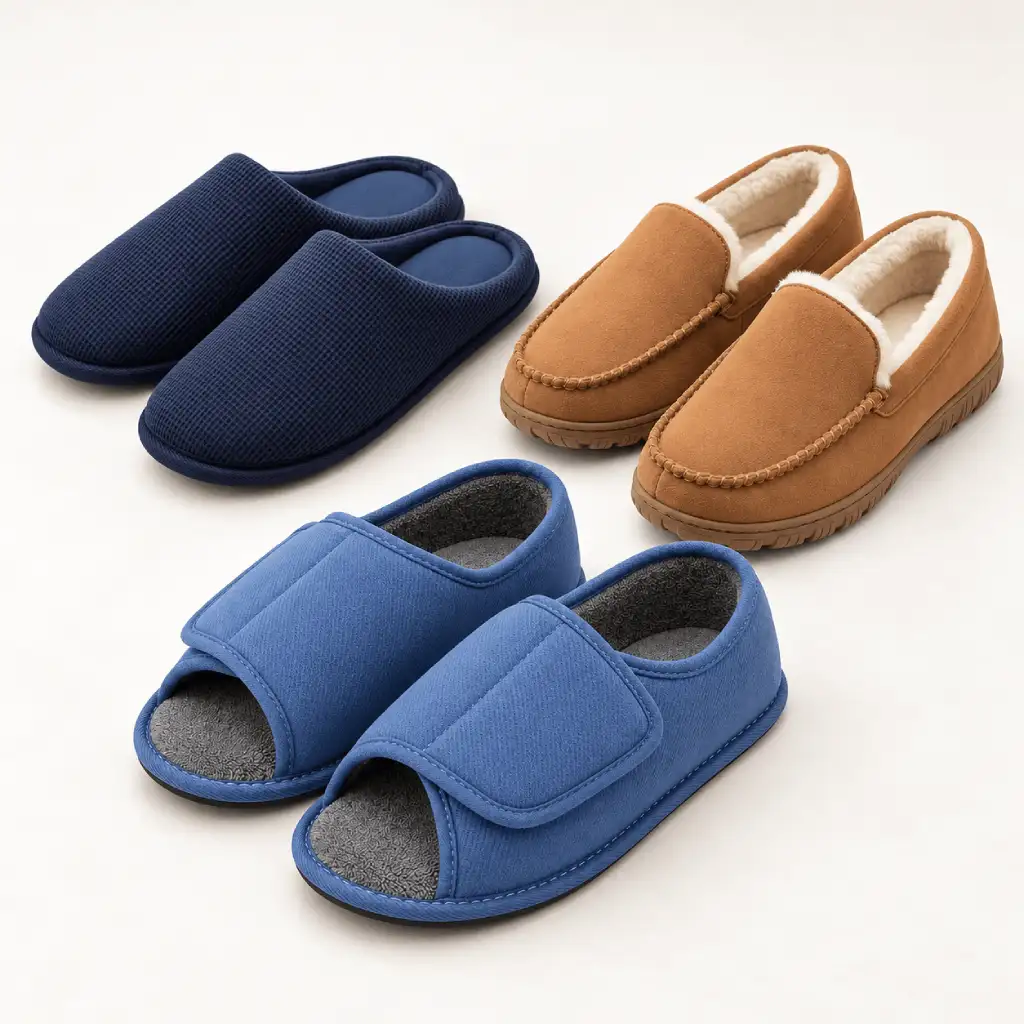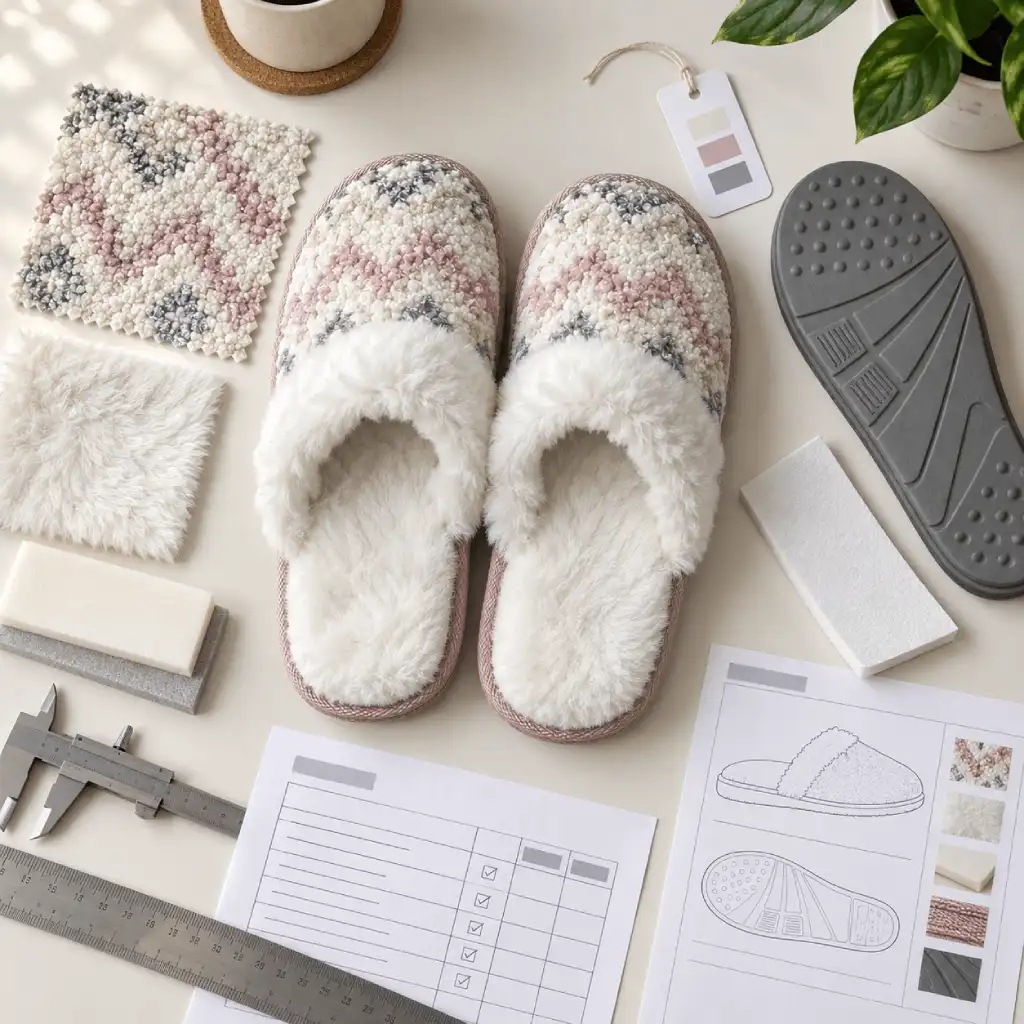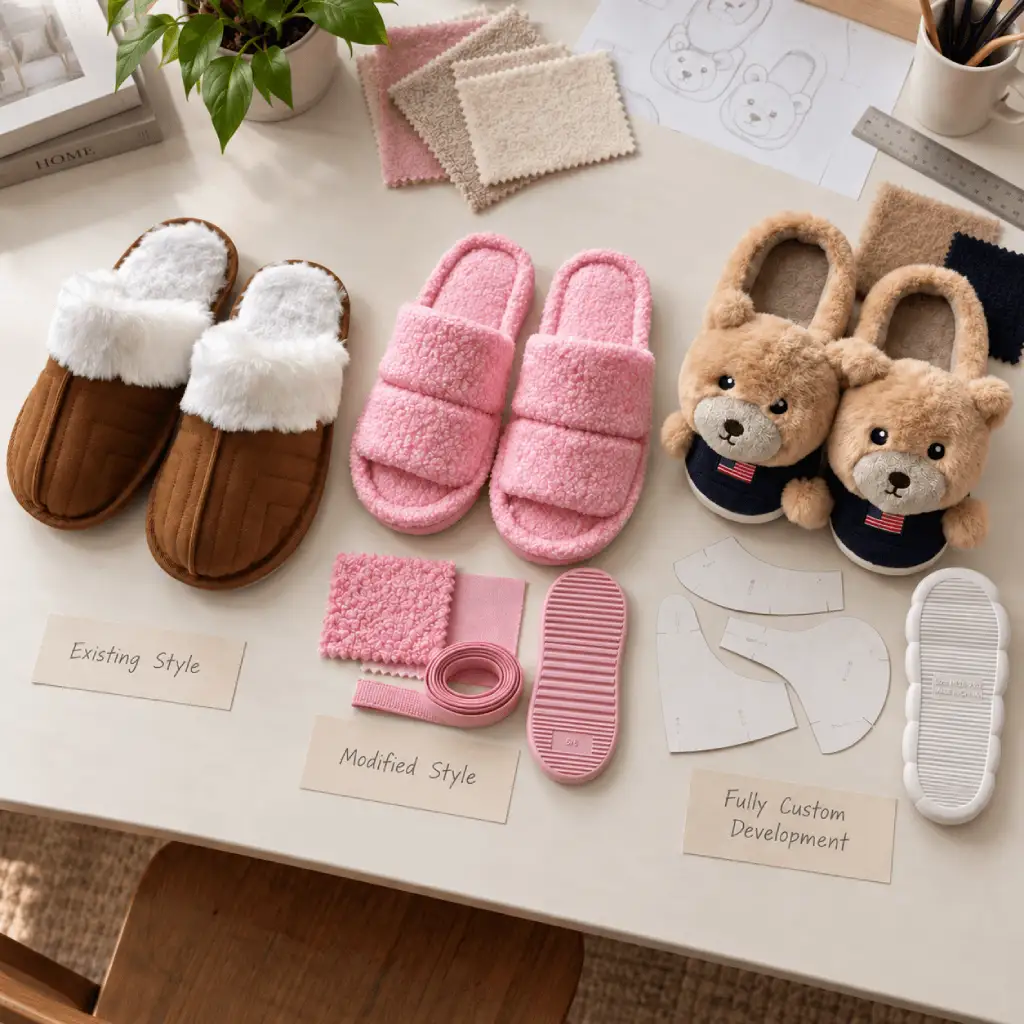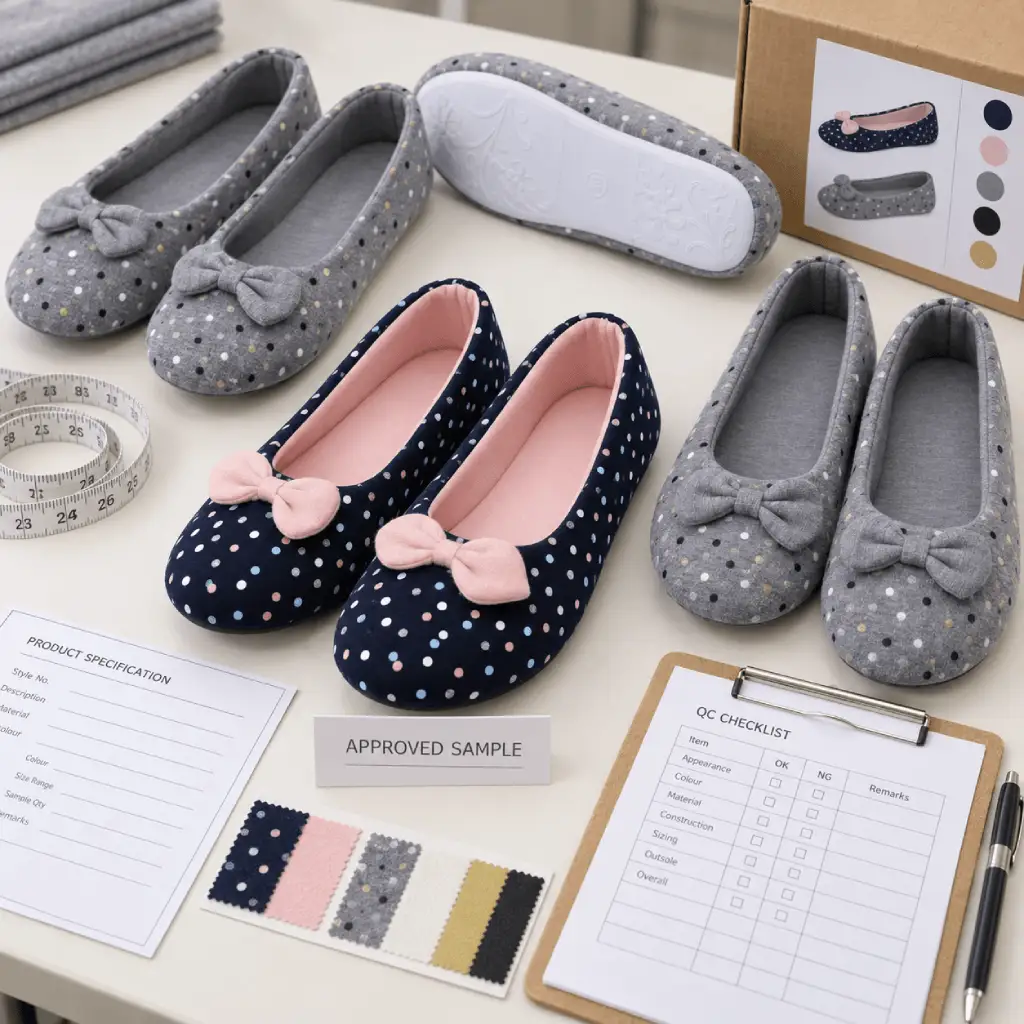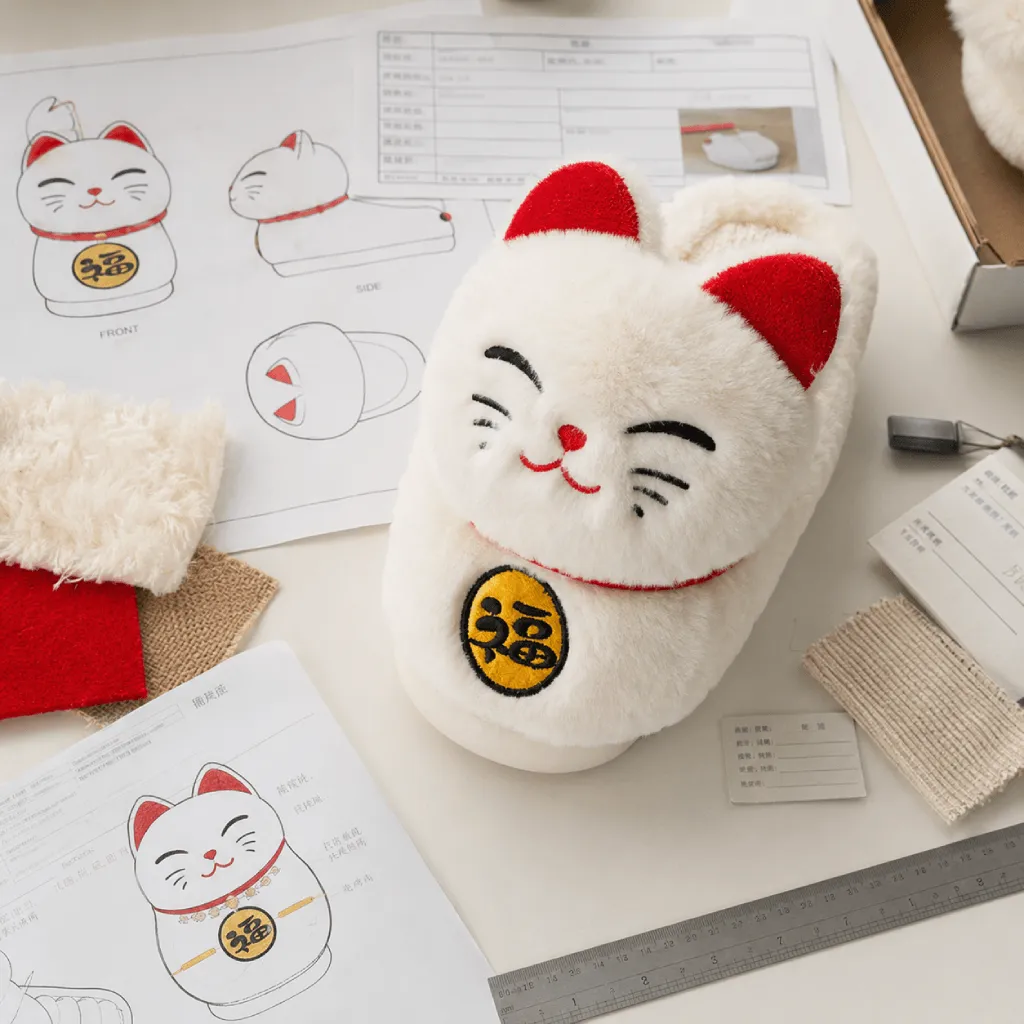
Open toe slippers are often presented as simple warm-season products, but a wholesale program still depends on controlled decisions about the front opening, upper position, lining volume, cushioning, outsole balance, size grading, packaging, and pair consistency.
Two styles can use similar materials and the same outsole while fitting very differently. A cross-band upper may shift the pressure point across the forefoot. A single band may become loose or tight when its height changes. An adjustable strap may add useful fit flexibility, but only when the usable fastening range is confirmed across the requested sizes.
This guide gives brands, importers, wholesalers, retailers, and sourcing teams nine practical checks for developing wholesale open toe slippers from the first product brief through sample approval and bulk quality control.
Buyer takeaway: approve the upper, lining, cushioning, outsole, size grading, branding, and packaging as one complete system. A change in one component can alter fit, appearance, packed shape, or bulk consistency.
This sourcing guide is written for B2B product development. It does not rank consumer products or treat “summer,” “adjustable,” or “open toe” as proof of a particular comfort or performance result.
Written by the UTOP Slippers Sourcing Team, with product-development input from our indoor slipper team.
1. Define the Open-Toe and Heel Construction
Open toe slippers expose part of the forefoot or toes. The term describes the front of the slipper, not the heel. An open-toe style can also have an open back, a back strap, or a closed heel. A closed-toe mule, by comparison, may have an open back without being an open-toe product.
This distinction matters when buyers request samples, compare quotations, or build a seasonal collection. Online catalogs may use terms such as slides, open back slippers, cross band slippers, spa slippers, and open toe house slippers for products that do not share the same construction.
| Construction | Front | Heel | Buyer review points |
|---|---|---|---|
| Open toe + open back | Toes partly exposed | No heel coverage | Entry, forefoot retention, toe exposure, and outsole balance |
| Open toe + back strap | Toes partly exposed | Strap behind the heel | Strap position, retention, adjustability, and edge comfort |
| Open toe + closed heel | Toes partly exposed | Heel enclosed | Opening, heel shape, internal volume, and fitting control |
| Closed toe + open back | Toes covered | No heel coverage | Toe volume, upper depth, heel landing, and lining thickness |
Specification rule: describe both ends of the slipper. “Open toe, open back, cross-band textile upper, light lining, cushioned footbed, and specified outsole” is more useful than a broad category name alone.
Buyers comparing open toe vs. open back slippers can review UTOP’s women’s summer slipper range and men’s summer slipper range as starting points for a clearer construction brief.
2. Choose Cross-Band, Single-Band, or Adjustable Uppers
The upper structure controls more than appearance. It affects forefoot coverage, instep pressure, entry width, seam placement, shape retention, and the visual relationship between the upper and outsole. Buyers sourcing cross band slippers, single-band slides, or adjustable open toe slippers should approve each construction according to its own risks.
| Upper type | Product direction | Main risks | Approval focus |
|---|---|---|---|
| Cross-band | Layered coverage and a familiar warm-season silhouette | Uneven crossover height, visible left-right mismatch, or uncomfortable seam position | Band angle, crossover point, edge alignment, and pair symmetry |
| Single-band | Clean profile with fewer upper components | Opening feels loose, tight, too high, or too low on different feet | Band width, opening width, lining thickness, and instep pressure |
| Adjustable band | A defined range of fit flexibility | Limited usable overlap, weak attachment, bulky closure, or inconsistent strap placement | Minimum and maximum wearable positions, fastening area, attachment, and grading |
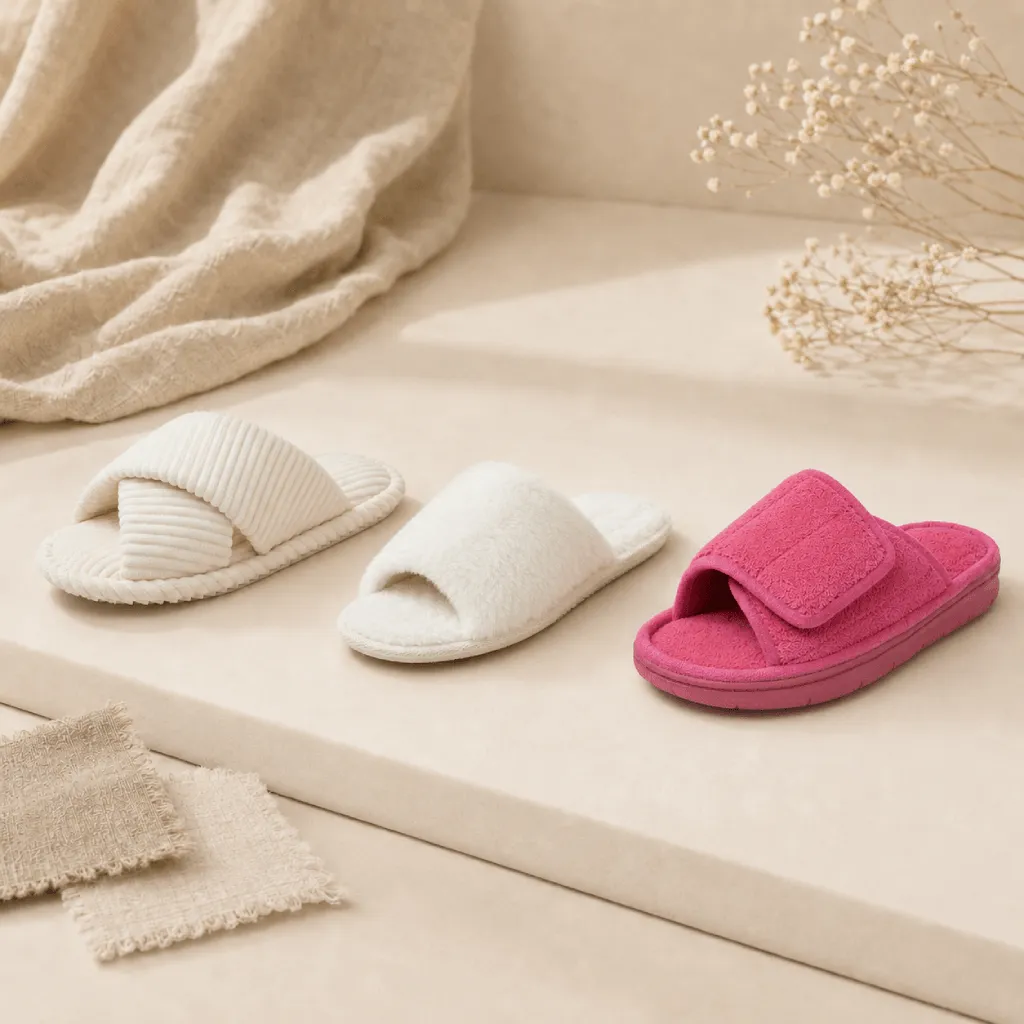
Cross-band patterns require especially careful cutting and pairing when the material has stripes, ribs, nap, pile direction, or a printed motif. A small difference in band angle can make the left and right slipper appear unrelated even when the pair uses the same material lot.
Single-band uppers are visually simpler, but that does not make fit automatic. The height of the band, the shape of the opening, reinforcement, foam, and lining can change usable space. Approval comments should describe the required change rather than say only “make it more comfortable.”
Questions to answer during sample approval
- Does the upper hold the forefoot at the intended position?
- Are the left and right bands aligned at the same height and angle?
- Do edges, seams, and crossover points avoid concentrated pressure?
- Does the opening remain balanced in the smallest, middle, and largest review sizes?
- For adjustable styles, is the usable fit range documented rather than assumed?
UTOP’s UT-MS1017 men’s adjustable open toe slipper provides one reference direction for discussing strap placement, upper coverage, material, size range, and outsole construction. Final details should still be confirmed for each buyer project.
3. Review Toe Exposure, Band Position, and Size Grading
For open toe house slippers, fit cannot be judged from outsole length or a single middle-size sample. The upper, footbed, cushioning, lining, edge construction, and outsole shape determine where the foot sits and how much of the toes remains visible.
Buyers should define the fit checkpoints that will be measured and the observations that will be assessed during wear review.
| Fit checkpoint | What to review | Why it matters |
|---|---|---|
| Toe exposure | Visible front opening and toe position on the footbed | Confirms that the opening looks intentional and the foot is not positioned too far forward |
| Forefoot coverage | Area held by the upper | Influences retention and the visual balance of the open front |
| Band position | How far forward or back the band sits | Changes pressure, entry, and the wearer’s tendency to slide forward |
| Instep pressure | Hold after the final lining, foam, and reinforcement are added | A sample can become tighter after component changes |
| Opening balance | Left-right shape, width, height, and edge alignment | Open constructions make small differences easy to see |
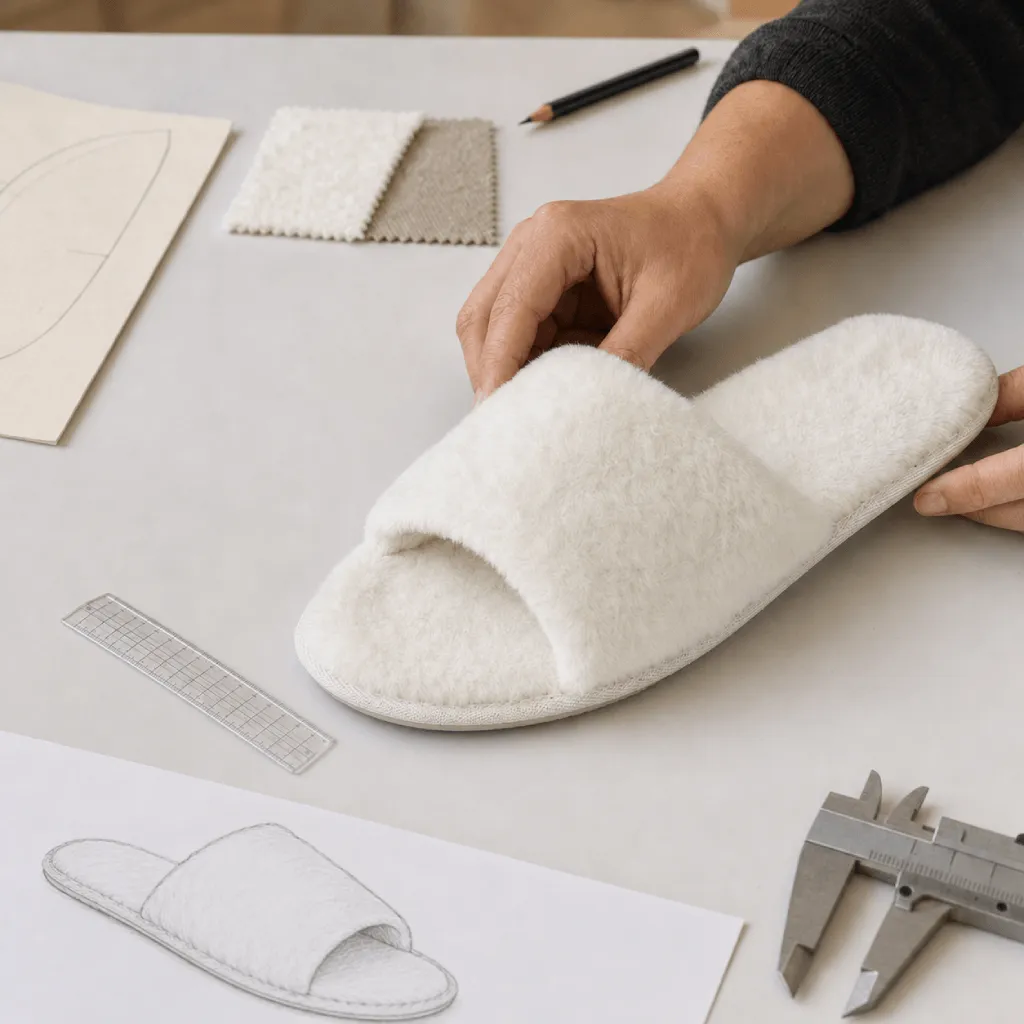
A useful size-set review includes representative small, middle, and large sizes when the requested range is broad or the band position is sensitive to grading. Simply enlarging one upper pattern can create too much coverage in larger sizes or insufficient holding power in smaller sizes.
Practical sample comment: instead of writing “make the opening more comfortable,” identify the location, requested dimensional change, features that should remain unchanged, and the sizes in which the change must be confirmed.
Size conversion is only a reference. The published ISO 19407:2023 footwear sizing conversion standard covers conversion between major sizing systems, but a conversion table does not replace the buyer’s fit standard, product measurements, or approval of the completed slipper.
When documenting how open toe slippers should fit, combine measurable points with wear observations. Record whether the foot remains centered, whether the upper holds without excessive pressure, whether the outsole edge supports the intended position, and whether the result remains consistent across representative sizes.
4. Match Materials and Lining to the Product Direction
Open construction is often selected for summer house slippers, spa-inspired ranges, and lighter indoor programs. However, toe exposure alone does not prove that a slipper is lightweight, cool, or breathable. Upper coverage, fabric weight, backing, lining, foam, footbed, and outsole all influence the finished product.
Material selection should therefore begin with the intended season, retail channel, appearance, upper stability, logo method, fit, and packing method—not with a fabric name alone.
| Material direction | Possible use | Points to confirm before bulk |
|---|---|---|
| Jersey knit or light knit | Flexible, lighter indoor directions | Fabric weight, stretch recovery, backing, edge stability, color, and shape retention |
| Terry-lined textile | Soft-contact footbeds and adjustable upper concepts | Loop consistency, lining thickness, edge bulk, color behavior, and fit effect |
| Corduroy or structured woven | Textured products with a more defined upper | Rib direction, fraying control, reinforcement, shade, compression marks, and pair symmetry |
| Chenille or textured knit | Soft visual positioning and gift-oriented ranges | Snagging, pile consistency, backing, recovery, edge finishing, and logo clarity |
| Short plush or fleece | Transitional or comfort-led indoor collections | Pile direction, shedding expectation, lining volume, packing compression, and heat level |
A lining change can alter fit even when the outer pattern stays the same. Replacing jersey with thicker terry, for example, can reduce usable space and change strap overlap. The upper, lining, reinforcement, foam, binding, thread, and footbed cover should be recorded as one approved material package.
Avoid unsupported performance language
For indoor summer slippers, use construction-based descriptions such as reduced upper coverage, selected lining, specified fabric weight, or lightweight outsole direction. Do not promise breathability, cooling, moisture control, or another measurable result without a defined test and evidence.
Buyers can compare broader seasonal directions in UTOP’s women’s summer slippers and men’s summer slippers categories.
5. Confirm the Usable Adjustment Range
Hook-and-loop closures are common on adjustable open toe slippers because they are easy to operate and can be incorporated into textile uppers. The presence of a strap does not, by itself, prove that the product offers a useful adjustment range.
Buyers should review the usable overlap rather than the total strap length. Part of the strap is needed for attachment, edge finishing, reinforcement, and visual balance. Only the remaining section provides adjustment to the wearer.
| Adjustment check | What to approve | Risk if undefined |
|---|---|---|
| Minimum overlap | Required contact area at both wearable limits | Insufficient engagement or an insecure upper |
| Loose-end length | Appearance and position at the smallest setting | Untidy projection, lifting, or catching during packing and use |
| Attachment area | Stitching, reinforcement, edge finishing, and pulling direction | Distortion or reduced attachment reliability |
| Surface alignment | Flat, centered hook-and-loop positioning | Twisting, uneven fit, or visible pair mismatch |
| Size grading | Usable range in representative sizes | A fixed strap proportion that works only in one size |
Products sometimes described online as open toe Velcro slippers should be specified as hook-and-loop adjustable slippers in technical files unless the buyer is authorized to use a particular trademark. Sampling comments should mark the minimum and maximum acceptable fastening positions and show how the upper should sit at both limits.
Claims boundary: an adjustable upper can provide a defined range of fit flexibility. It should not be marketed as medical, orthopedic, diabetic, therapeutic, or suitable for a specific condition unless the design, evidence, documentation, and applicable marketing rules support that claim.
6. Balance Cushioning, Upper Retention, and Outsole
A light upper paired with a relatively heavy outsole can feel unbalanced if the band does not retain the foot effectively. A thick cushioned footbed under a narrow upper may also allow more movement above the sole. For lightweight house slippers and more structured open-toe designs alike, the upper, cushioning, and outsole should be reviewed together.
| Outsole direction | Possible construction role | Details to confirm |
|---|---|---|
| Molded TPR | Can provide a defined outsole profile, sidewall, and tread geometry | Formulation, hardness, thickness, weight, tread, color, tooling, and attachment |
| Cut-sheet EVA | Can support lightweight and flexible indoor constructions | Density, thickness, weight, edge finish, flatness, compression, and attachment |
| Molded or injected EVA | Can provide a more defined molded form than cut-sheet construction | Material specification, density, tooling, dimensions, surface, weight, and construction method |
| Point-plastic cloth | May suit soft, low-structure indoor slipper directions | Base cloth, printed points, flexibility, edge finishing, floor conditions, and intended use |
Material names do not establish grip, abrasion performance, support, outdoor suitability, or cost. Those outcomes depend on the formulation, dimensions, weight, tread, construction, attachment, floor conditions, order quantity, tooling, and any agreed test method.
For open toe slippers, outsole width and forefoot shape also affect toe position. Approve the upper fit on the intended outsole or a clearly equivalent development sole before locking the band pattern. Record cushioning thickness and recovery together with the final footbed cover because both can affect internal height and stability.
Selection rule: compare outsole specifications and completed samples—not TPR and EVA as labels. Cost and performance should be evaluated for the actual project.
Read UTOP’s TPR vs EVA Sole for Slippers guide for a specification-based outsole comparison.
7. Plan Sizes, Colors, Assortments, and Packaging
A wholesale order is both a product specification and an assortment plan. Size ratios, colors, packaging, labels, and carton quantities can expose problems that are invisible in a single sample. This is especially important when one program includes open toe slippers for women, men’s open toe slippers, or several related upper constructions.
| Planning area | What the buyer should confirm | Common risk |
|---|---|---|
| Size system | EU, US, or UK labeling, internal measurements, and representative fit sizes | Labels and physical fit do not match the buyer’s standard |
| Size ratio | Quantity by size for each color and SKU | The supplier must infer the assortment from a total quantity |
| Color plan | Approved standards, lining color, thread, closures, logos, and outsole colors | Shade or component mismatches become visible across the range |
| SKU control | Separate code when construction, outsole, material, or packaging changes | Different products are treated as simple color variations |
| Packaging | Pair orientation, strap position, bag or box, insert, labels, barcode data, and carton marks | Bands collapse, closures catch, or product data becomes inconsistent |
Cross-band slippers may need an insert or controlled pair orientation if the bands lose shape under compression. Adjustable straps should be fastened in the approved packing position so the hook surface does not catch the lining or another pair. A packing trial should use the actual pair, final labels, and intended packaging dimensions.
Product labels, polybag or box labels, and master carton marks should use the same SKU and size logic. Barcode numbers and retailer data must come from the buyer’s approved files; the factory should not invent or alter them.
Approve the assortment before bulk production
Confirm the size breakdown, color breakdown, SKU matrix, pair presentation, individual packing, and carton ratio in writing. These are production inputs, not details to be decided after the slippers are finished.
UTOP’s Footwear Packaging Guide provides a more detailed checklist for individual packing, labels, cartons, ratios, and approval records.
8. Set Bulk Quality Control Standards
Final inspection should not be the first time the factory checks the opening, band position, or pair symmetry. The approved sample and written specification should control materials, color, construction, fit, outsole, logo, labels, packaging, and workmanship throughout production.
Small inconsistencies are especially visible on open toe slippers. One band may sit farther forward, one crossover may be higher, or one adjustable patch may be misaligned. Each issue may look minor in isolation, but repeated differences reduce the consistency of the complete retail presentation.
| QC stage | Key checks for open-toe slippers | Controlled reference |
|---|---|---|
| Incoming materials | Fabric, color, weight, stretch, surface direction, lining, foam, closure material, and outsole batch | Approved swatches, component references, and specification |
| In-process checks | Band cutting, crossover angle, stitching, reinforcement, strap attachment, upper-to-sole alignment, and left-right balance | Approved sample, patterns, measurements, and workmanship criteria |
| Pre-packing review | Opening shape, toe exposure, pair matching, loose threads, stains, logo, size label, and closure position | Size-set samples, color standards, artwork, and packing sample |
| Final inspection | Quantity, assortment, workmanship, pair symmetry, fastening function, outsole connection, labels, packaging, and carton marks | Purchase order, approved specification, samples, and agreed inspection plan |
The inspection plan should state which sizes and colors will be reviewed, what counts as a defect, which reference controls the result, and what action follows a nonconformity. AQL sampling, 100 percent inspection, photographs, or a third-party report may be required for some projects, but these should not be presented as identical requirements for every order.
Where measurements are used, tolerances should come from the confirmed product specification, approved sample, or buyer standard. A single universal millimeter tolerance is not suitable for every band, material, outsole, size, and construction.
Pair-consistency rule: inspect open-toe products as pairs. Compare band height, crossover angle, opening shape, toe exposure, outsole alignment, surface direction, logo position, and packed presentation from the same viewing angle.
For a complete order-control framework, see UTOP’s Footwear Quality Control Guide for Bulk Slipper Orders before finalizing the inspection standard.
9. Prepare a Custom Open-Toe Slipper Project Brief
A useful request for custom open toe slippers should define the product and order plan before the supplier prepares a detailed quotation. A reference image is helpful, but it does not communicate the complete material, fit, size, branding, packaging, testing, and quality requirements.
| Brief section | Information to provide | Why it matters |
|---|---|---|
| Product direction | Reference product, drawing, open-toe and heel construction, upper type, and intended use | Defines the starting structure and feasibility review |
| Commercial plan | Target market, sales channel, season, estimated quantity, price position, and requested schedule | Guides materials, process, assortment, quotation assumptions, and planning |
| Materials and fit | Upper, backing, lining, foam, fit reference, size system, range, ratio, and colors | Controls appearance, internal space, grading, and repeatability |
| Outsole | Material direction, structure, thickness, weight, tread, color, tooling, and attachment | Affects balance, construction, appearance, cost, and quality control |
| Branding and packaging | Logo file, method, size, position, labels, barcode data, individual packing, and carton marks | Allows application and presentation to be sampled on the actual product |
| Testing and inspection | Destination, retailer manual, required tests, inspection method, and report needs | Identifies market and buyer requirements before approval |
UTOP can review an existing product, an original design, a physical sample, or a reference image as the starting point for an OEM/ODM project. Available adjustments depend on construction, material availability, tooling, size assortment, branding, packaging, quantity, and the approved specification.
For private label planning across specifications, branding, sampling, and production, read the Private Label Indoor Slippers Manufacturing Guide. Buyers targeting the European Union can also consult the European Commission’s REACH Regulation overview. Applicable testing, documentation, labeling, or compliance decisions should be confirmed for the actual product and market.
Quotation tip: ask the supplier to list assumptions for materials, lining, cushioning, outsole, sizes, colors, branding, packaging, inspection, testing, and timing. Two prices are not comparable when the underlying specifications are different.
Explore UTOP’s custom indoor slipper directions, learn more about UTOP Slippers, or send your wholesale open toe slipper brief for a project review.
10. Frequently Asked Questions About Open Toe Slippers
What are open toe slippers?
They are slippers that expose part of the forefoot or toes. “Open toe” describes the front construction; the heel may be open, secured by a back strap, or enclosed.
How should open toe slippers fit?
The upper should hold the forefoot at the intended position without excessive pressure or looseness. Buyers should review toe exposure, forefoot coverage, band position, opening width, instep pressure, footbed position, and stability in representative sizes.
Are open toe slippers suitable for summer collections?
They can be developed for warm-season indoor collections, but the open front alone does not determine warmth, weight, or breathability. Upper coverage, fabric, backing, lining, foam, footbed, and outsole should be reviewed together.
Which is better: open toe or closed toe slippers?
Neither construction is universally better. The choice depends on season, upper coverage, wearer, retail channel, fit target, materials, packaging, and the intended indoor product direction.
Which outsole is suitable for open toe house slippers?
TPR, EVA, point-plastic cloth, and other suitable constructions may be considered. The choice depends on the complete specification, including weight, thickness, hardness or density, tread, attachment, upper retention, intended use, and any required test method.
Can open toe slippers be customized for private label orders?
Yes. Depending on the design and order requirements, buyers can discuss upper and lining materials, colors, size ranges, cushioning, outsoles, logos, labels, packaging, and carton marks. Final options should be confirmed through feasibility review and approved samples.
What information is needed for a wholesale quotation?
Provide a product reference, target market, estimated quantity, size range and ratio, colors, upper and lining materials, outsole direction, logo file, packaging requirements, destination, inspection or testing needs, and requested schedule.
Final takeaway: a reliable wholesale program depends on a controlled relationship between upper structure, fit, materials, cushioning, outsole, grading, packaging, approvals, and bulk consistency—not on the open-toe silhouette alone.
Looking for an open toe slipper manufacturer for a wholesale or private label program? Send UTOP your product reference and project requirements for a practical development review.