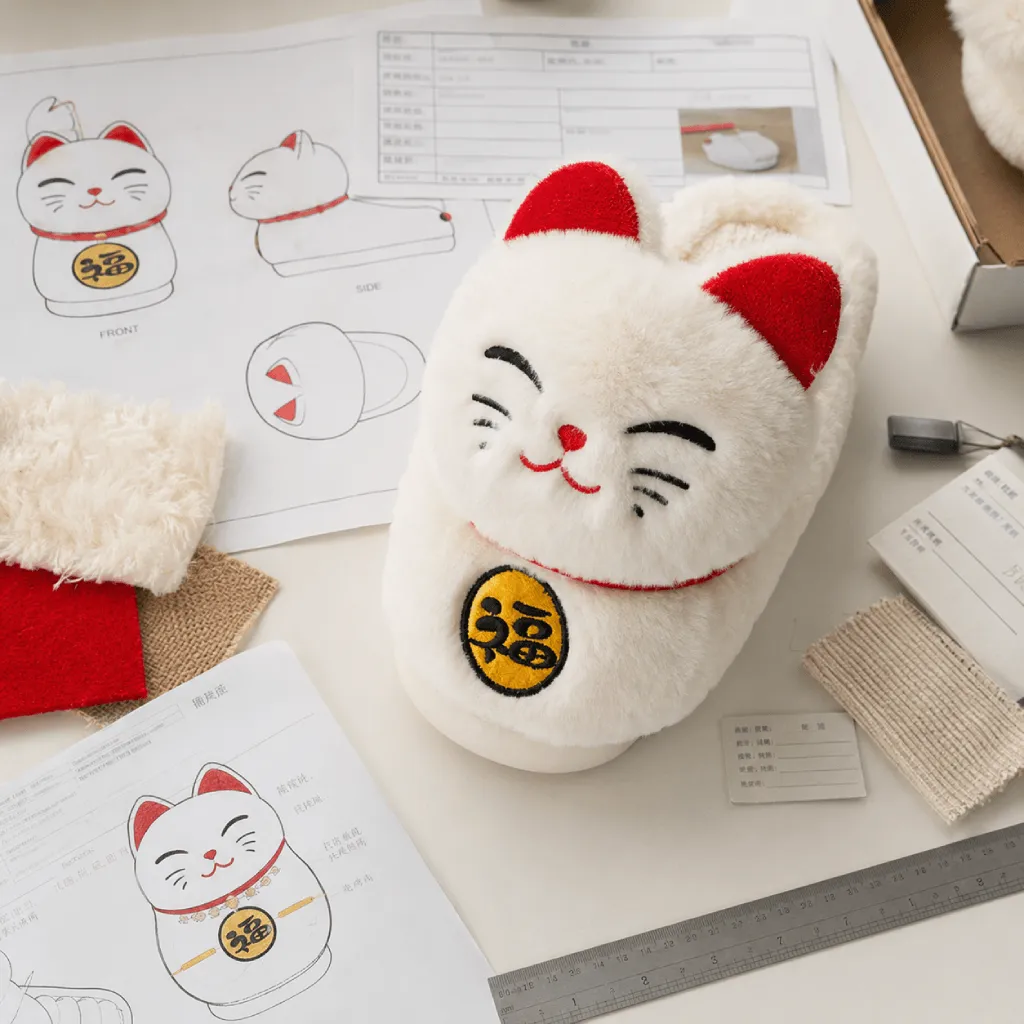
Buying bulk Christmas slippers is not simply a matter of adding a festive upper to an existing house shoe. A seasonal program has a fixed selling window, more artwork than a basic carryover style, and an assortment that may divide the order across several motifs, colors, sizes, and packaging formats.
The real work happens before bulk production. Buyers need to turn the collection idea into a clear product brief, check whether embroidery and appliqué details can be repeated, approve materials and fit as one system, and leave enough time for sampling, revisions, production, inspection, and freight.
This guide explains nine practical checks for planning a Christmas slipper manufacturing program. It is written for brands, retailers, importers, wholesalers, and sourcing teams that need seasonal slippers to look consistent, arrive in the right assortment, and be ready for the intended sales channel.
Buyer takeaway: plan backward from the required delivery date, then freeze the product, approval, packaging, and quantity decisions that the factory needs to build a workable production schedule.
Scope: this is a B2B development and sourcing guide, not a consumer shopping list or legal opinion. Product requirements depend on the destination market, intended user, materials, design, claims, sales channel, and buyer standards.
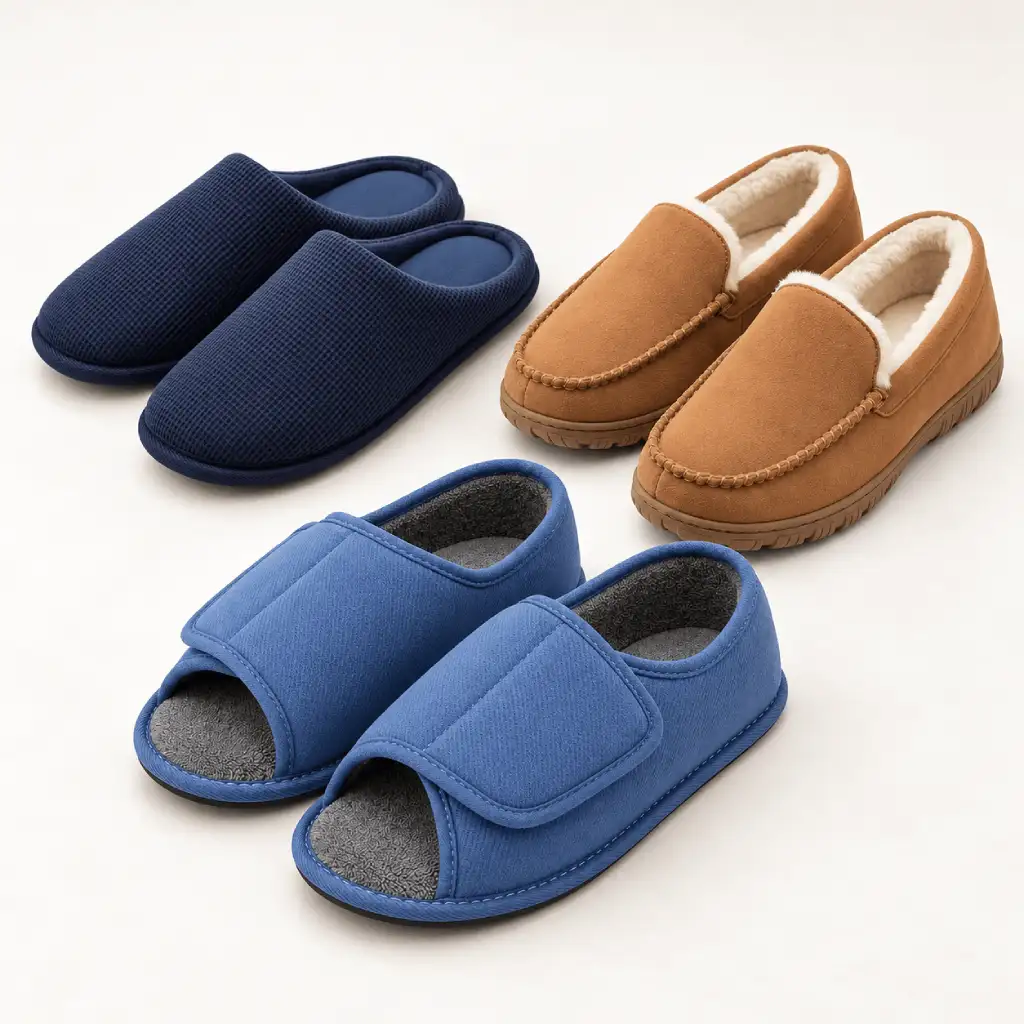
For an established seasonal reference, buyers can review UTOP’s Christmas plush slipper collection. A custom project can then begin from that type of existing style, a reference sample, an image, or an original specification.
1. Set the Delivery Date and Commercial Brief
A Christmas slipper collection has more than one deadline. There may be a sample review date, photography date, retailer booking date, warehouse handover date, and launch date. Write down which one the factory is being asked to meet. “Needed for Christmas” is too vague to support a reliable production plan.
The first brief for bulk Christmas slippers should identify the destination market, sales channel, estimated order quantity, target price position, intended wearer, required size range, product concept, packaging level, and requested delivery point. It should also state whether the date means factory completion, shipment departure, port arrival, or delivery to the buyer’s warehouse.
Practical rule: treat the launch date as a commercial constraint, not as the manufacturing start date. Freight, customs, receiving, allocation, photography, and merchandising all need time after the slippers leave the factory.
Give the supplier a decision owner
Seasonal slipper production often slows down while color, artwork, fit, or packaging feedback passes through several teams. Name the person who can consolidate comments and approve each stage. A delayed approval can move the production slot even when the factory has finished its part on time.
UTOP’s bulk slipper lead-time guide explains the same principle in more detail: lead time is a chain of confirmed inputs and approvals, not a single factory promise.
2. Build an Assortment the Order Can Support
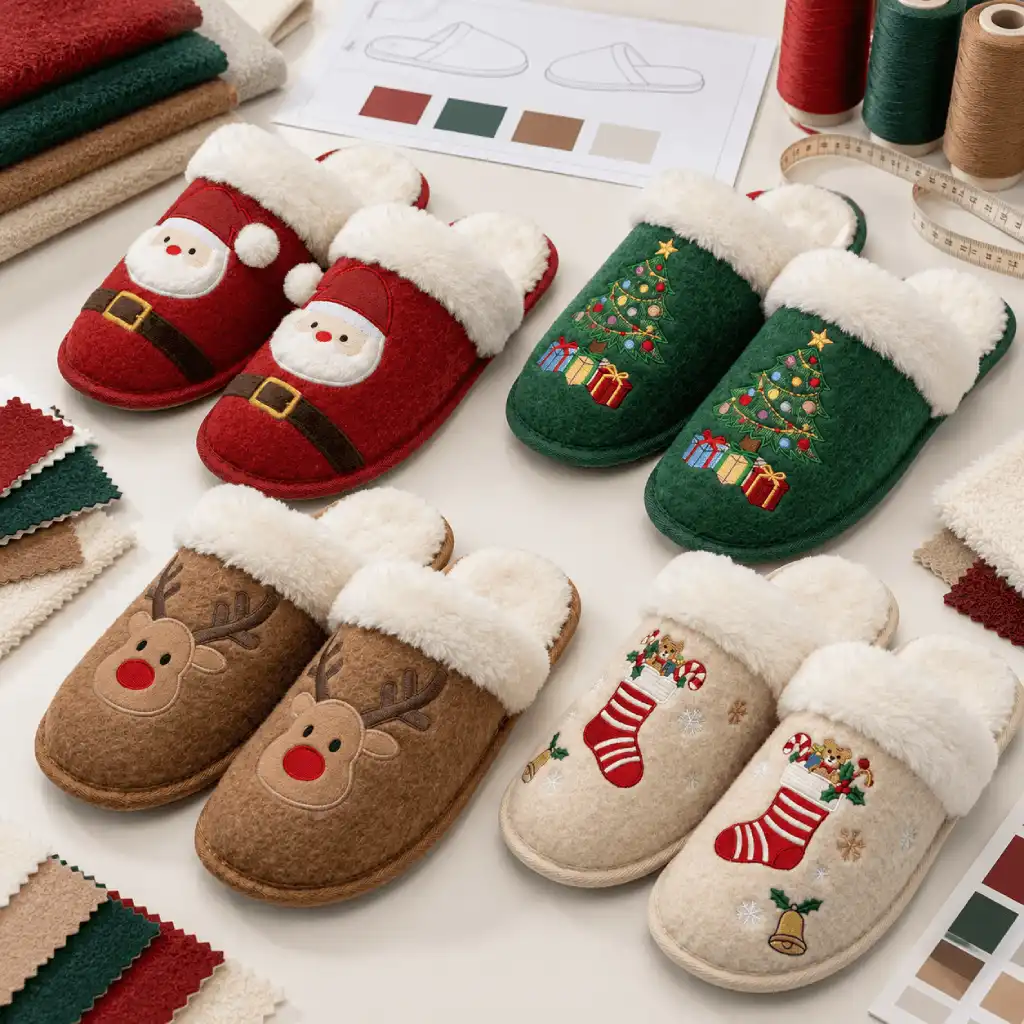
A four-design collection may look compact on a mood board. Once each design is offered in two colorways, seven sizes, and two packaging formats, it becomes 112 SKU combinations. That affects material allocation, labels, packing instructions, carton ratios, and the quantity available for each individual combination.
Before asking for a quotation on Christmas slippers in bulk, build a simple assortment matrix. It does not need to be sophisticated, but it must show where the order will be divided.
| Assortment decision | What to record | Why it matters |
|---|---|---|
| Style or motif | Santa, reindeer, tree, stocking, or another approved design | Each may use different artwork, thread, trims, and sewing steps |
| Colorway | Color reference and quantity by color | Very small splits can complicate material purchasing and shade control |
| Size range | Size system, labels, and pair quantity by size | The factory needs an exact ratio, not only a total order quantity |
| Sales pack | Single pair, gift pack, display box, or retailer-specific format | Packaging can create additional SKUs and approval work |
Keep the first collection as broad as the commercial plan requires, but no broader. Fewer well-supported variations are usually easier to sample, inspect, replenish, and explain to the sales team than many lightly funded variations. For wholesale Christmas slippers, this is a margin and execution decision as much as a design decision.
3. Choose the Development Route and Construction
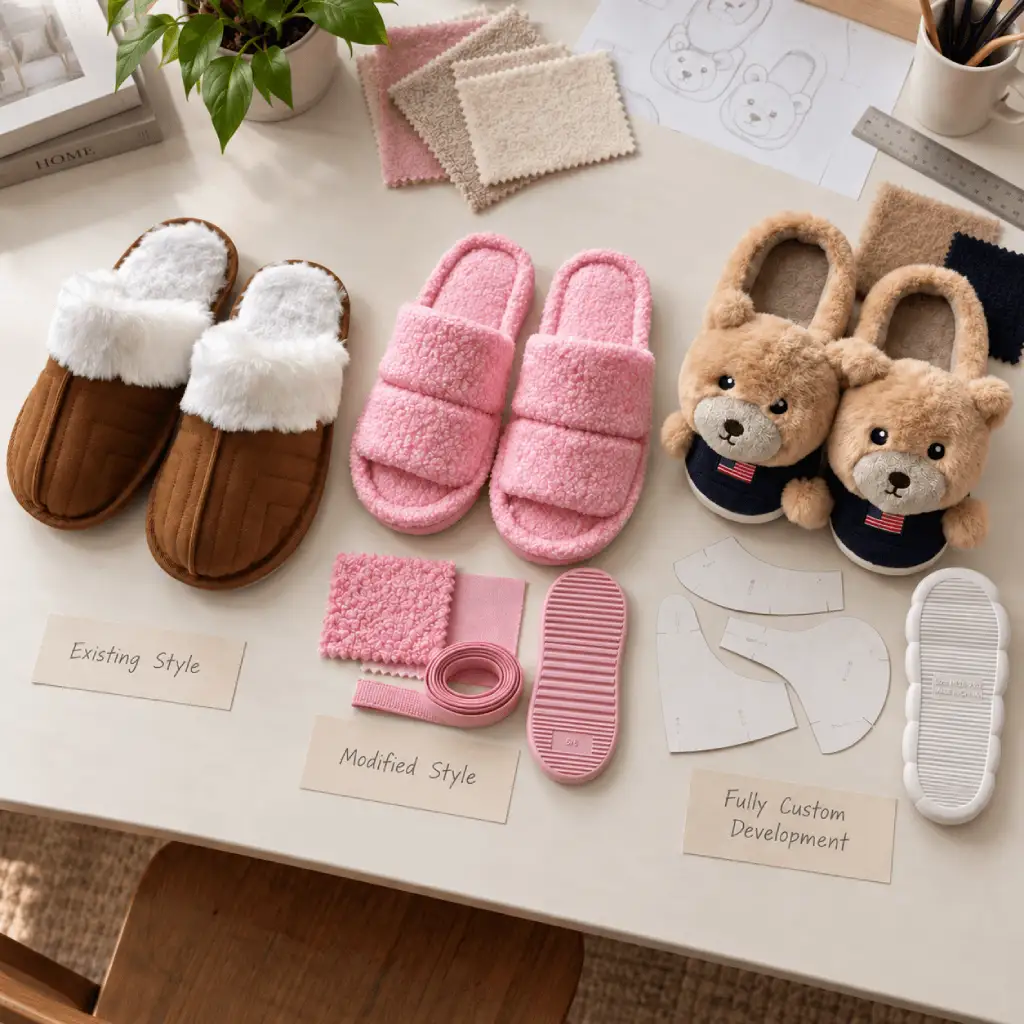
There are three practical starting points for OEM Christmas slippers: adapt an existing factory style, develop from a reference sample or image, or work from a complete tech pack. They do not carry the same amount of development work.
- Existing style: usually the clearest route when the shape, outsole, and basic construction already suit the program. Materials, colors, branding, decoration, and packaging can then be reviewed around a known base.
- Reference sample or image: useful for communicating direction, but hidden layers, exact materials, measurements, and construction still need to be defined.
- Original tech pack: gives the factory more information, provided the drawings, bill of materials, sizing, artwork, tolerances, packaging, and approval points agree with one another.
The construction decision belongs here, not after the artwork has been approved. A welt-stitched slipper, side-stitched slipper, and cold-glued slipper place seams and attachment areas differently. That can change the usable space for a tree motif, a heel label, or edge binding.
At UTOP, welt-stitched constructions can commonly be developed with TPR or EVA bottoms. Side-stitched styles commonly use a molded TPR outsole with a suitable sidewall. Cold-glued styles commonly use cut EVA, while TPR can also be cold glued when surface preparation, adhesive, pressing, and process conditions match the construction. The finished specification and sample should confirm the actual combination.
Ask before sampling: which parts are proven on an existing style, which parts require new development, and which decisions could require tooling or a different construction?
Buyers can compare these routes in UTOP’s custom slipper development service before committing the full Christmas slipper collection to sampling.
4. Engineer Festive Artwork for Repeatable Production
Christmas artwork is often designed at screen size, while the factory works with fabric, thread, seam allowance, pile direction, and a curved upper. Fine antlers, tiny lettering, narrow outlines, and closely spaced colors may need adjustment before they become clean production details.
For Christmas slipper manufacturing, approve more than the illustration itself. Record the finished dimensions, placement reference, orientation, thread or fabric colors, stitch or appliqué method, backing, attachment method, and how the decoration changes across sizes.
| Decoration | Development check | Bulk-order risk to control |
|---|---|---|
| Embroidery | Stitch density, backing, thread colors, detail readability, placement | Puckering, distortion, buried detail, shade variation |
| Flat appliqué | Material, edge finish, overlap, sewing route, symmetry | Frayed edges, lifting, inconsistent shape |
| Raised or stuffed detail | Component shape, position, reinforcement, attachment access | Rotation, weak attachment, uncomfortable internal stitching |
| Pom-pom or other trim | Size, material, supplier reference, attachment, target-market review | Detachment, inconsistent appearance, unsuitable small component |
Plush adds another variable. A long or dense pile can hide small stitches and change the apparent edge of a motif. A sample made on the actual production-direction fabric is more useful than a perfect decoration made on a smooth substitute material.
The goal is not to remove character from the design. It is to decide which details carry the character and which can be simplified without weakening the collection.
Approve the decoration on the actual upper
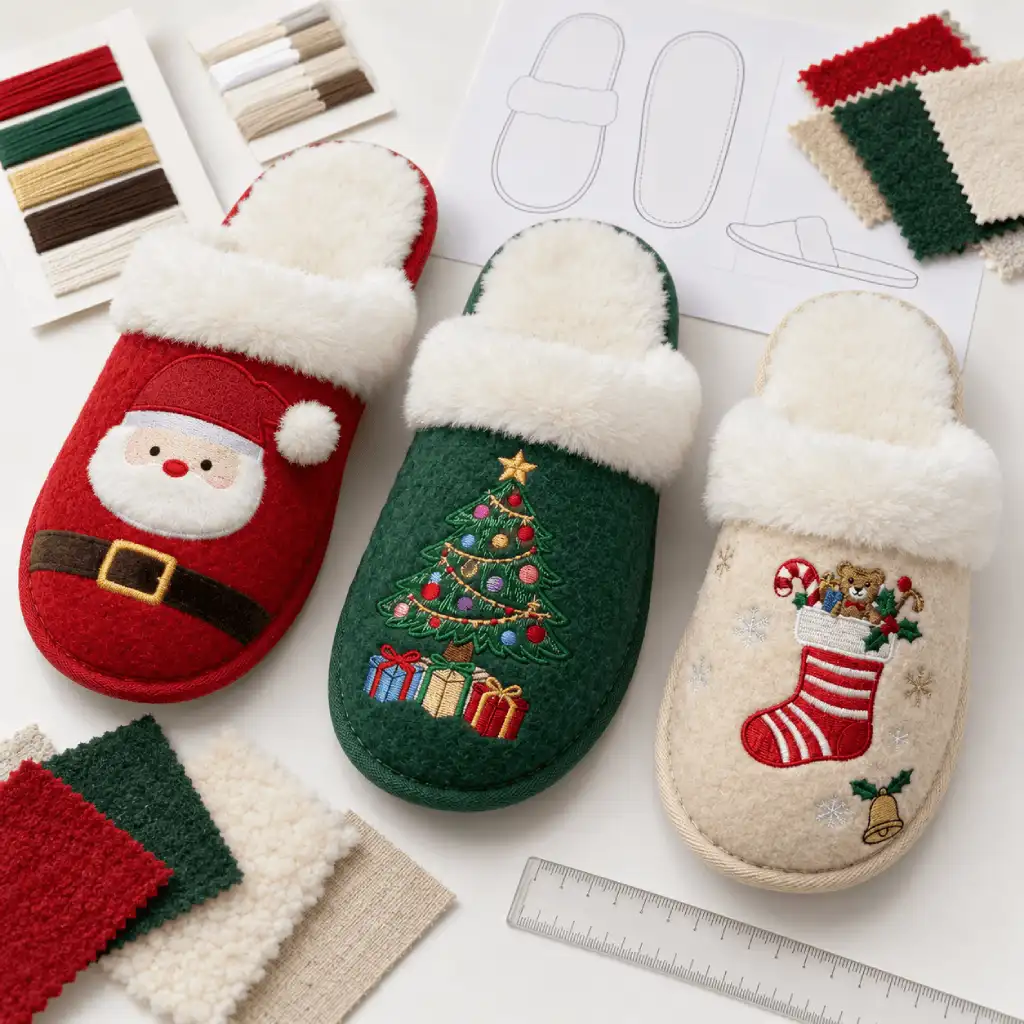
Review the festive design after it has been assembled into the slipper, not only as a loose embroidered panel. Check the left and right pair together. The motif should sit consistently, remain readable after shaping, and avoid seams, binding, or flex areas that interfere with its appearance.
For a multi-size Christmas slipper collection, decide whether the artwork remains one size or is graded. One fixed motif may dominate the smallest size; aggressive grading can make line weight and small details inconsistent. Representative-size samples reveal this more clearly than a single middle size.
Treat detachable details as a separate approval item
If the product includes pom-poms, bells, bows, stuffed parts, or other attached components, specify how each one is secured and how attachment will be checked. If children’s sizes are included, the intended age and destination requirements need particular attention. The U.S. Consumer Product Safety Commission’s small-parts business guidance is one useful official reference for understanding scope; it should not be treated as a substitute for a product-specific compliance review.
Do not write a generic pull-force number into the specification unless a defined buyer standard, test method, age classification, or market requirement supports it. State the requirement, method, sample stage, and acceptance criterion together.
Approval record: keep the signed-off artwork file, decoration dimensions, color references, component sample, placement measurement, attachment method, and approved finished slipper under the same revision.
For branded details used alongside seasonal artwork, UTOP’s private label slipper guide covers logo, label, packaging, and approval decisions in a wider program context.
5. Specify Materials, Fit, and Outsole as One System
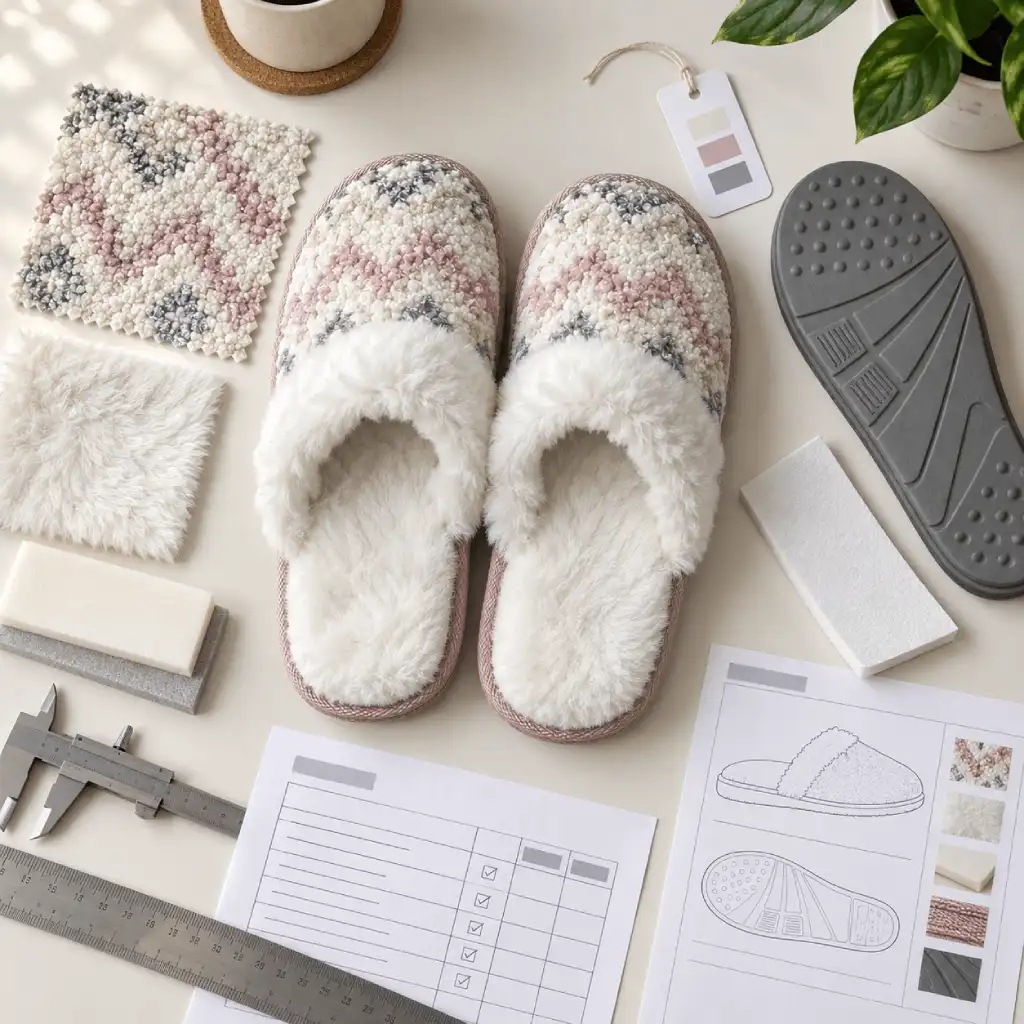
“Soft plush upper, warm lining, memory foam, and non-slip sole” describes a direction, not a production specification. A useful specification identifies the materials and layers closely enough for the sample and bulk order to be compared.
For bulk Christmas slippers, record the upper and backing, lining, reinforcement, footbed cover, cushioning layers, structural layers, outsole, binding or welt, thread, trims, labels, and adhesives where relevant. Add color references, thickness, weight, density, hardness, composition, dimensions, or supplier references when they are important to the product.
| Product area | What to confirm | Interaction to review |
|---|---|---|
| Upper and lining | Material identity, pile, backing, stretch, color, surface direction | Shape, embroidery stability, seam appearance, internal volume |
| Cushioning and footbed | Layer sequence, foam direction, dimensions, cover, lamination | Fit, compression, edge shape, recovery after packing |
| Outsole | Actual material, method, thickness, dimensions, tread, color | Flex, weight, floor contact, attachment, tooling, testing |
| Construction | Pattern, seams, reinforcement, binding, stitching or gluing method | Component compatibility, flex area, visible workmanship |
Warm materials change fit
A fuller lining or thicker cushioning stack uses space inside the slipper. Changing either one after the fit sample can make the production pair feel tighter even when the outer pattern has not changed. Approve fit using the intended material direction and check more than one representative size.
Material names also do not prove performance. TPR and EVA can support different indoor slipper constructions, but neither label alone guarantees grip, abrasion resistance, comfort, durability, or price. Review UTOP’s TPR vs. EVA sole guide and confirm the chosen outsole on the finished OEM Christmas slipper sample.
6. Approve Samples with Production in Mind
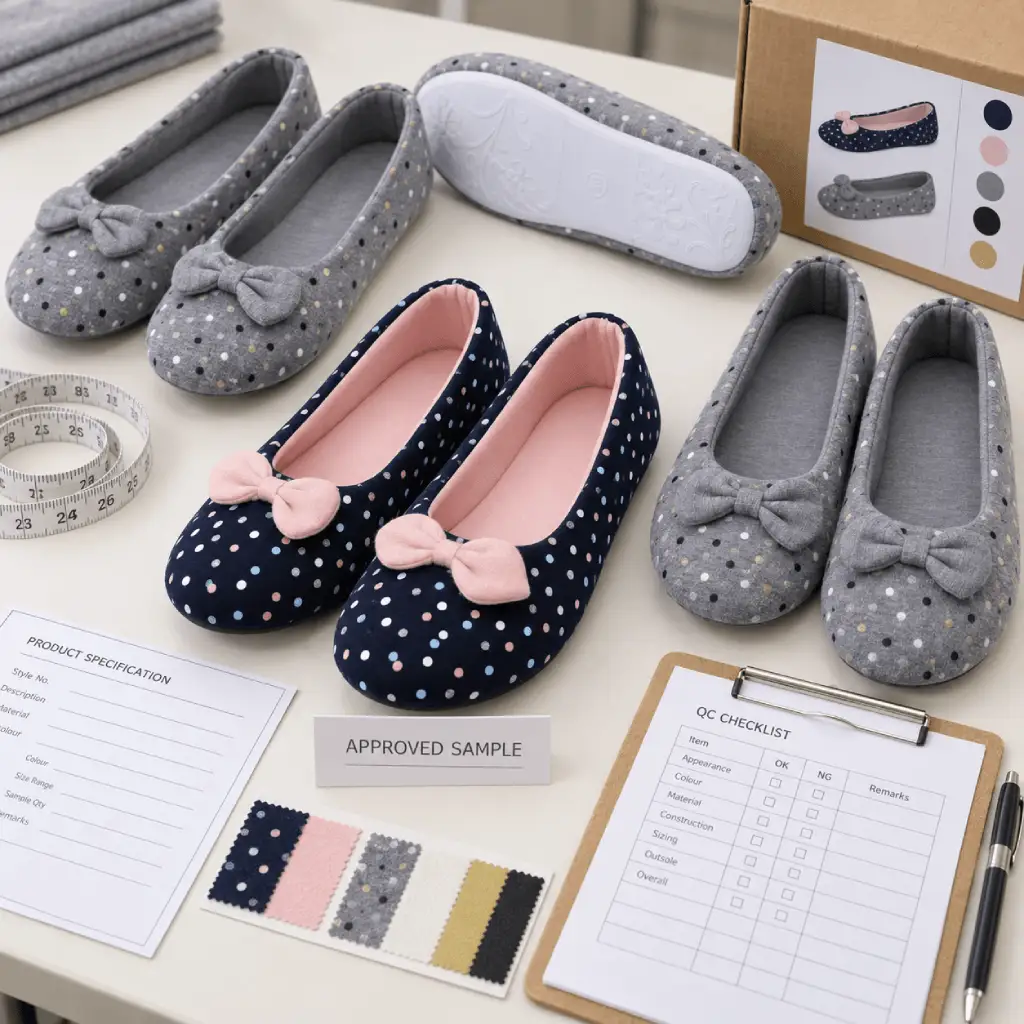
A good sample answers decisions; it does not merely look attractive in a photograph. Before approving Christmas slipper sample development, compare the sample with the latest specification and artwork revision. Mark any temporary material or process used for the sample, then decide whether a production-direction sample is still required.
Review the following points on the complete pair:
- Overall shape and left-right balance
- Fit and internal volume
- Upper, lining, and footbed feel
- Artwork size, color, and placement
- Seams, binding, and outsole attachment
- Trim security and internal comfort
- Logo and label content
- Packing method and recovery after compression
A single sample may not be enough for a multi-style program. If motifs use different embroidery, trims, upper materials, or constructions, each variation needs an appropriate approval reference. For sizing, use selected representative sizes or a size set according to the project risk; a conversion chart alone cannot prove fit.
Close revisions clearly
Consolidate comments into one numbered revision. Separate required corrections from optional ideas, include measurements or marked photographs where useful, and state whether another physical sample is needed. When the final sample is approved, align the specification, artwork, bill of materials, color references, labels, packaging, and order breakdown to the same version.
Buyer takeaway: the approved sample is a control reference, but it works only when its materials, revisions, measurements, and allowed variations are documented.
Use UTOP’s slipper size and bulk sizing guide to structure size-system, measurement, fit, grading, and order-ratio decisions before the seasonal order is released.
7. Control Quality and Product Changes
Christmas slipper quality control should follow the risks agreed during development. A visual final check is useful, but it cannot replace material confirmation, first-production review, process checks, and clear handling of changes.
| Control stage | Typical review | Seasonal-program focus |
|---|---|---|
| Incoming materials | Identity, color, surface, dimensions, approved reference | Shade and pile consistency across motifs and colorways |
| First production | Shape, measurements, decoration, construction, workmanship | Catch placement or assembly problems before volume builds |
| In-process checks | Cutting, sewing, pairing, attachment, labels | Keep multiple designs and sizes matched to the right order data |
| Final inspection | Appearance, measurements, workmanship, quantity, packing | Verify assortment, barcode, carton mark, and shipment readiness |
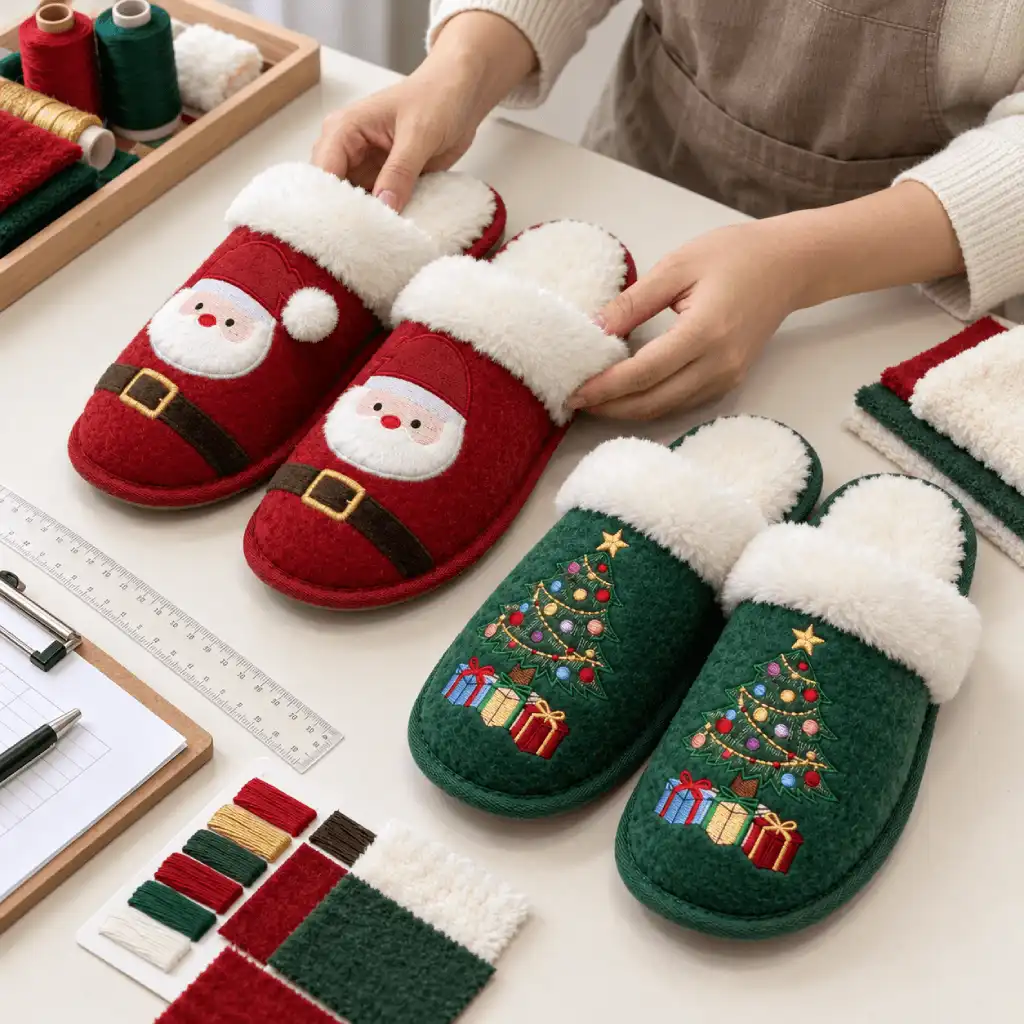
Set defect examples and acceptance criteria around the product. For a Santa design, beard placement and symmetry may be critical. For a tree design, thread colors and motif alignment may matter more. The control plan should distinguish product-critical issues from minor appearance variation that does not affect use or the approved look.
Control substitutions and late changes
If a material, color, trim, label, adhesive, outsole, or packaging component must change, ask for the reason, affected quantity, sample or evidence, performance and appearance impact, compliance impact, timing impact, and written approval. Quiet substitutions make the approved sample less useful as a bulk reference.
For EU consumer products, the official General Product Safety Regulation is a primary source buyers can include in their market-specific review. Applicable testing and documentation should be confirmed for the actual product and destination rather than inferred from a generic slipper description.
UTOP’s footwear quality control guide gives a fuller framework for linking specifications, approved samples, inspection stages, and corrective action on wholesale Christmas slipper orders.
8. Prepare Retail Packaging, Labels, and Cartons
Seasonal packaging tends to collect decisions from many teams: branding, merchandising, compliance, logistics, and the retailer. If those inputs arrive after the slipper is approved, a simple pack can become the reason the shipment misses its booking.
For Christmas slippers in bulk, confirm the pair presentation, tissue or insert, hangtag, hanger, polybag, gift box or display box, barcode label, size and country markings, warnings where applicable, master-carton mark, carton assortment, and any retailer routing requirements. Provide print-ready artwork and identify who approves physical color, text, and barcode scans.
Test the product and pack together
Full plush and dimensional decorations can compress in a small box. A long-pile collar can also look uneven immediately after unpacking. Review how the finished pair enters the pack, whether trims are bent, whether left and right slippers rub against one another, and how the product recovers after a realistic packed period.
- Match the consumer-facing size to the slipper, pair label, inner pack, and carton data.
- Match each barcode and SKU description to the correct motif, color, size, and pack format.
- Approve carton quantities and mixed-size ratios before packing begins.
- Check finished carton dimensions and weight for the agreed shipping and warehouse constraints.
Common miss: approving a packaging dieline without packing the actual slipper. The graphics may be correct while the product fit, recovery, or carton utilization is not.
For a broader checklist covering retail packs, barcodes, carton ratios, marks, compression, and approval records, see UTOP’s footwear packaging guide.
9. Build a Backward Production Timeline
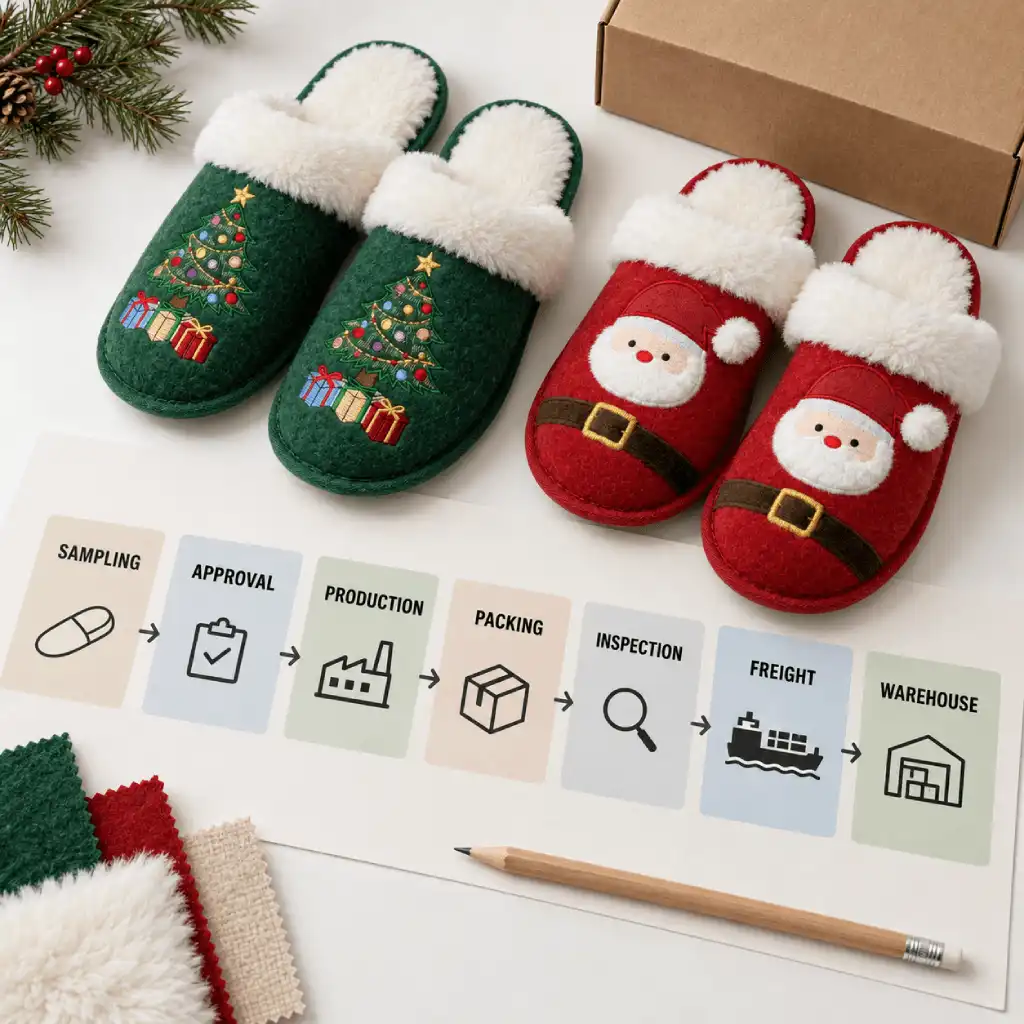
Start with the warehouse or launch requirement and work backward through freight, shipment preparation, inspection, packing, production, material preparation, final approval, revisions, and the first sample. This reveals which decisions must be closed early and where the program needs buffer.
As a general planning reference at UTOP, regular custom slipper sampling usually takes about 7–14 days. Bulk production usually takes about 30–45 days after sample approval and the other order details are confirmed. Those figures are not the complete Christmas slipper lead time. Custom materials, tooling, multiple revisions, testing, packaging development, order quantity, production scheduling, and freight can extend the calendar.
| Stage | Release condition | Typical timing risk |
|---|---|---|
| Brief and feasibility | Commercial brief, route, assortment, target date | Unclear requirements or an overextended range |
| Sampling and revisions | Materials, artwork, measurements, construction, feedback | Slow decisions or changes after each sample |
| Bulk release | Approved sample, final specification, order data, packaging | One approval remains provisional |
| Production and packing | Materials ready, production slot, control plan | Late component, change, rework, or packing mismatch |
| Inspection and shipment | Finished goods, correct assortment, documents, booking | Failed readiness check or missed logistics cut-off |
A calendar is credible only when its dependencies are visible. If packaging artwork must be approved before printed boxes can be ordered, show that relationship. If a laboratory report is required before shipment, include sample submission, test duration, review, and contingency—not only the test date.
Protect the critical decisions
Not every detail has the same timing impact. Product construction, tooling, exclusive materials, color approval, size grading, decoration method, testing scope, packaging structure, and order assortment can all sit on the critical path. A late change to one of them may require a new sample, new material, or new printed component.
When the selling window cannot move, decide in advance what can. The practical options might include using an established outsole, reducing colorways, choosing available materials, simplifying a trim, using standard packing, or moving a nonessential variation to a later delivery. These are commercial choices and should be agreed with the factory before the schedule becomes compressed.
Planning rule: do not subtract only “factory production days” from the launch date. Build the complete path from first brief to warehouse delivery, assign an owner to every approval, and keep a visible buffer for seasonal risk.
For a quotation and workable seasonal slipper production schedule, send the supplier the requested warehouse date as well as the destination, shipping method, and any fixed retailer milestones. That allows production and delivery assumptions to be discussed separately.
Bulk Christmas Slippers: FAQs and Next Step
How early should buyers start a Christmas slipper project?
Work backward from the required warehouse date and include product development, revisions, material preparation, packaging approval, bulk production, inspection, shipment preparation, freight, customs, and receiving. Start earlier when the program includes new tooling, exclusive materials, complex artwork, testing, or several retailer packs.
Can an existing slipper style be adapted for Christmas?
Yes, if the existing shape, construction, outsole, and fit direction suit the program. Buyers can then review seasonal colors, materials, embroidery, appliqué, labels, and packaging. The final combination still needs feasibility review and sample approval.
What information is needed to quote bulk Christmas slippers?
Provide reference images or a tech pack, estimated total quantity, quantity by motif and color, size range and ratio, materials, construction and outsole direction, artwork files, logo requirements, packaging, destination, target price position, and required delivery date.
How long do sampling and bulk production take?
At UTOP, regular custom slipper sampling usually takes about 7–14 days. Bulk production usually takes about 30–45 days after sample approval and other order details are confirmed. Actual timing depends on the materials, tooling, revisions, tests, quantity, packaging, and confirmed production schedule; freight is separate.
Which quality points deserve extra attention on festive slippers?
Check shade and pile direction, artwork readability and placement, embroidery or appliqué consistency, attached trims, pair symmetry, seams, outsole attachment, sizing, labels, barcode-to-SKU matching, assortment, and packing. Add product- and market-specific tests where required.
Turn the Collection Idea into a Production Brief
The strongest bulk Christmas slipper programs are not necessarily the most complicated. They are the ones in which the important choices are made early, recorded clearly, tested on representative samples, and carried through production and packing without uncontrolled changes.
UTOP Slippers supports B2B buyers with seasonal product review, sample development, material and construction coordination, bulk production, quality checks, private label packaging, and shipment preparation. Share the information you already have; the team can help identify what still needs to be confirmed.
Planning a seasonal slipper collection?
Send your reference style or artwork, expected quantity, assortment, size range, packaging direction, destination, and target delivery date for an initial project review.
Discuss Your Christmas Slipper Project