A quoted bulk slipper lead time can look comfortable until the buyer and factory discover they are working toward different dates. The buyer needs goods at the warehouse; the factory has allowed time only to finish production. Transport, inspection or a late packaging approval can consume the remaining window.
For a seasonal retail order, that gap matters. An order running late may leave you paying for faster transport or accepting an incomplete size range to meet a promotion date. Those decisions are easier to make while there is still time to change the plan.
This guide explains how to agree the dates, set approval deadlines and follow a bulk slipper order through production and shipment preparation. It is written for brands, importers, wholesalers and retail sourcing teams.
If you are still estimating how long development and production may take, start with our custom slipper production timeline. Here, the focus is managing the schedule once the order requirements begin to take shape.
1. Define What Your Bulk Slipper Lead Time Includes
Before accepting a delivery promise, ask the supplier to name its start and finish points. A bulk slipper lead time needs that context before you can use it in a buying calendar.
Separate factory completion from warehouse arrival
Record the production completion date, the date the packed order is ready for the agreed handoff, and the required warehouse arrival date separately. Identify who is arranging transport and obtaining the current transit estimate. Arrival planning may also need to allow for clearance, local delivery and a receiving appointment.
Agree the starting conditions
Confirm which approvals, order details and commercial conditions must be complete before the quoted period starts. Ask whether the estimate uses calendar days or working days, and whether material preparation, testing, final inspection and packing are included.
For UTOP’s usual custom slipper projects, sampling typically takes 7–14 days. Bulk production normally takes 30–45 days after sample approval and other necessary approvals are complete. Materials, outsole tooling, revisions, testing, quantity, branding and packaging can change the schedule; timing should be confirmed for the specific project.
Do not add a separate allowance for an activity until you know whether the factory has already included it. Equally, do not treat production time as a door-to-door delivery estimate.
2. Set Approval Deadlines Before Production
A buyer may approve the slipper’s appearance while the outsole color, size assortment or box artwork is still open. Ask which of those decisions can hold up material purchasing, production or packing. Each needs its own deadline.
Close the decisions that release the next task
- Product: approved sample, materials, colors, construction and any accepted deviations.
- Order mix: quantities by style, color and size, with any priority delivery groups identified.
- Branding and packaging: logo files, labels, barcode data, artwork and packing method.
- Checks: agreed testing, inspection requirements and approval responsibilities.
A dedicated molded outsole may require tooling approval. A custom-dyed upper may depend on an approved color reference. These should appear as named tasks in the slipper production schedule, with dates confirmed by the people responsible for completing them.
Keep one current approval record
Name the buyer’s approver and consolidate comments before sending them to the supplier. Identify the sample and file version being approved. “Use the latest artwork” is risky when two departments have different files.
A shoe tech pack and revision record can keep these decisions together. You do not need a finished technical document to open a discussion, but the production team does need a clear, current specification to work from.
3. Work Backward from the Required Delivery Date
Start with the date the goods must be available to your business. Then work backward with the factory and the party arranging transport. For a retail launch, use the warehouse receipt deadline rather than the first day of the promotion.
Build the plan from the delivery requirement
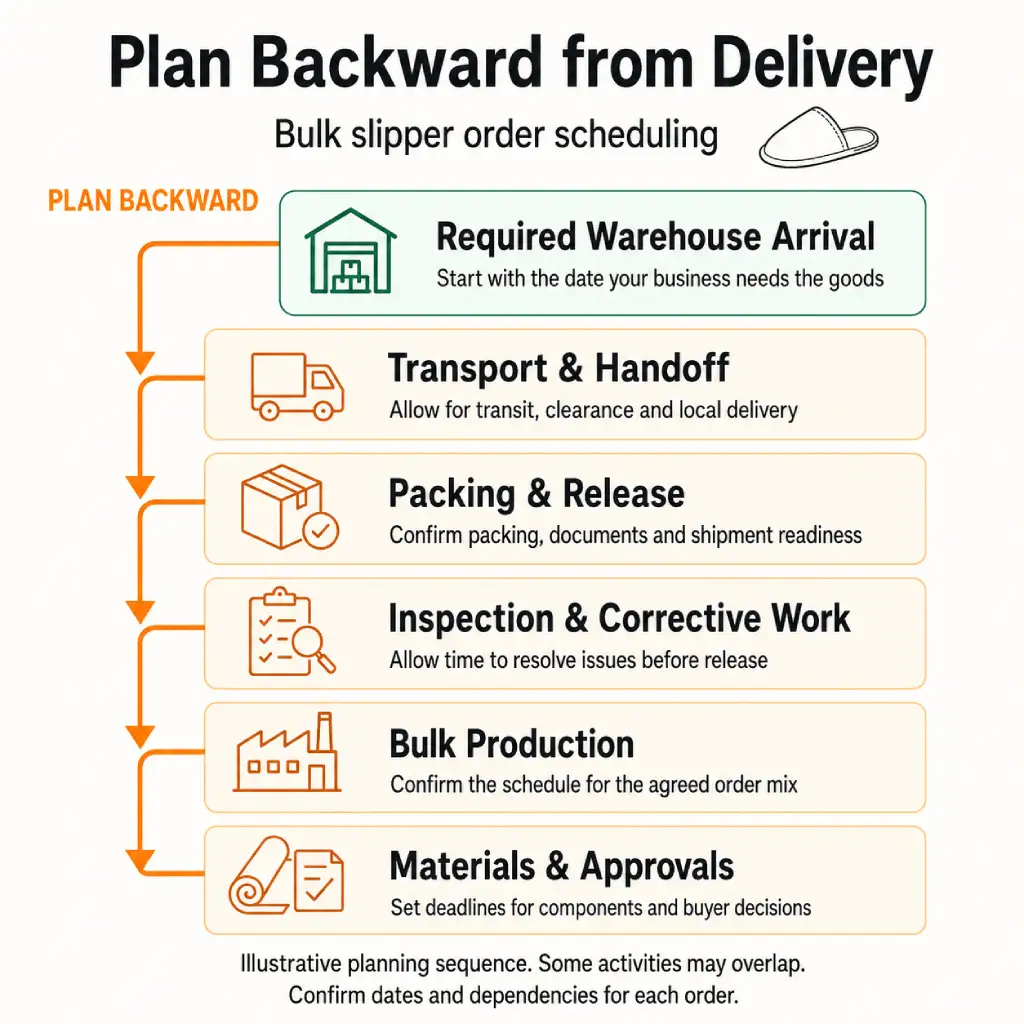
Confirm the transport and receiving allowance, then identify the required shipment handoff date. Work back through packing and release, inspection and any corrective work, production, materials and approvals. The production capacity review should establish whether the proposed order mix fits the available factory schedule.
A simple timeline is often enough. ASQ’s guide to Gantt charts explains how to display tasks, their timing and their progress. Record the dependencies alongside the dates so everyone knows what is waiting for what.
Allow time where the order is most exposed
Do not assume every task must run in sequence, or that every task can overlap. Outsole preparation and fabric sourcing may proceed together when specifications are approved. Cutting an unapproved material to recover time creates a different risk.
Check the working calendars of the factory, relevant component suppliers, inspectors and transport providers. Ask about shutdowns and return-to-work dates for the actual order period rather than applying a fixed holiday allowance.
Any buffer in a bulk slipper lead time should have a reason: a material approval still outstanding, a test result needed before release, or a transport connection with limited alternatives. A late non-critical task may fit within available time; a delay to a prerequisite can move the whole schedule.
4. Track Progress by Milestone, Style and Quantity
“Production is 80% complete” leaves several questions unanswered. Does that mean 80% of pairs are cut, assembled, inspected or packed? Does it include the colors and sizes needed for the first delivery?
Agree a reporting format that shows actual progress by style and delivery group. Keep the original planned date visible beside the current forecast. Otherwise, a repeatedly revised schedule can appear on track even while the order falls further behind.
| Milestone | Record to review | Compare dates | Owner and next action |
|---|---|---|---|
| Sample and specification approval | Approved version and any open decisions | Approval deadline / actual approval | Named approver; outstanding decision and due date |
| Materials and components ready | Ready and missing items by style or color | Required date / actual or forecast arrival | Purchasing contact; missing item follow-up |
| Production start | Start conditions and styles released to production | Planned / actual start | Production contact; unresolved prerequisite |
| Production progress | Pairs completed at each agreed stage, by style | Stage target / current completion forecast | Production contact; action for any shortfall |
| Inspection and corrective work | Results, affected quantities and open issues | Inspection target / forecast closure | Quality contact; corrective action and verification |
| Packing and shipment release | Pack ratios, quantities and release status | Ready date / actual or forecast readiness | Packing or release contact; outstanding check |
| Shipment handoff | Agreed handoff confirmation | Booked / actual handoff | Logistics contact; next transport update |
Use this as a suggested reporting format and fill in the dates and contacts for your order. Agree a regular review interval, but ask for an update sooner whenever a problem threatens an approval, production or shipment milestone.

Request evidence that answers the open question
A general workshop photograph may show activity without proving your delivery is on schedule. Request evidence relevant to the milestone: material arrival records, identified work-in-progress quantities, inspection findings or packed carton counts. Photos should identify the style or batch they illustrate.
Consider an order whose beige pairs are packed while the blue pairs are still waiting for labels. Reporting only the total finished quantity hides the problem if the first shipment needs both colors. That is why slipper order tracking should follow the delivery assortment as well as the production total.
Keep progress percentages tied to one defined stage and unit. Pairs, cartons and completed operations measure different things. A good update makes the remaining work clear enough for the buyer to decide whether action is needed.
5. Check the Schedule Before Changing the Order
Changing a label can seem minor from the buying office. If labels are already printed or sewn in, the same request may mean replacing stock or reopening finished work. The effect on bulk slipper lead time depends on when the change arrives and what has already been committed.
Before approving a change, ask the supplier to identify:
- The affected styles, quantities, materials and completed work.
- Any new sample, artwork, tooling or test approval required.
- The effect on production, inspection, packing and the shipment date.
- Additional costs, treatment of existing stock and the proposed decision deadline.
Request a revised schedule alongside the revised specification. An increase in order quantity, for example, should not automatically inherit the original completion date. The supplier needs to check the extra materials and available production time.
If the original plan remains workable, record that confirmation too. If it changes, keep the earlier plan in the revision history and make clear which date now applies. This gives both teams a shared record when purchasing, packaging and logistics arrangements need updating.
6. Respond to Delays with a Recovery Plan
When a supplier reports a delay, the first useful response is to establish what is affected. Ask for the cause, styles and quantities involved, the remaining work, and the next milestone at risk. A new finish date without those details is difficult to assess.
Compare the options before choosing one
| Delay | Check first | Possible response and trade-off |
|---|---|---|
| Late material or component | Missing item, expected arrival and affected styles | Resequence independent work; consider a substitute only after approval and any necessary validation. |
| Late buyer approval | Open decision, approver and downstream task | Consolidate comments and agree a decision date; ask the factory to reassess the available slot. |
| Production or quality issue | Affected quantity, correction method and verification time | Agree corrective work and a revised forecast; retain the required checks before release. |
| Only part of the order is ready | Available colors, sizes, pack ratios and release status | Evaluate a partial shipment against selling needs, extra handling and transport costs. |
| Transport arrangement changes | Cargo readiness and confirmed alternatives | Compare departure and arrival estimates, cost and receiving arrangements with the transport provider. |
Check whether the recovery plan helps the buyer
A partial shipment is useful only if it contains a workable assortment. Sending the easiest sizes first may leave stores unable to launch the range. Agree exactly what would ship, how it will be packed, and when the balance is expected.
Faster transport can sometimes recover time after the goods are ready, but it cannot complete missing production or resolve an unapproved quality issue. Likewise, a substitute material needs review for its effect on the finished slipper, not just its availability.
Ask for a recovery plan with a responsible contact, an action deadline and the next evidence update. If the target date is no longer realistic, knowing early gives the buying team more room to adjust the launch or delivery plan.
Bulk slipper lead time management should keep necessary inspection and release decisions visible throughout the recovery. For the checks themselves, refer to our footwear quality control guide.
7. Confirm the Order Is Ready for Shipment
The last pair coming off the line is an important milestone, but a bulk slipper order may still need sorting, inspection closure, labeling and packing. Confirm that these tasks are included in the shipment plan before treating the order as ready.
- Assortment: check released quantities by style, color and size, including any approved shortage or split.
- Packing: verify the agreed pair protection, labels, barcodes, pack ratios, carton quantities and carton marks.
- Quality release: close required corrective actions and obtain the agreed approval to ship.
- Handoff: confirm the booking, required documents, collection arrangements and the receiving party’s instructions.
Packaging deserves its own deadline. A finished slipper cannot be dispatched in the agreed retail format if its printed box or approved label is still missing. Our footwear packaging guide covers the product and packing details to confirm earlier in the order.
After handoff, record the actual date and the transport reference. Continue following the shipment to the agreed delivery endpoint. Keep factory completion, handoff and arrival performance separate so a later review identifies where time was lost.
8. Bulk Slipper Lead Time: Buyer Questions and Next Steps
When should a bulk slipper production schedule be confirmed?
Discuss the target dates at quotation, then confirm the working schedule when the order scope and starting conditions are clear. Show any outstanding approvals and their deadlines. Recheck the plan if quantities, specifications or approval dates change.
What should a production progress update include?
Include the style or delivery group, milestone, original target date, actual progress, current forecast, supporting evidence and any action needed. If a percentage is used, specify the production stage and quantity it measures.
Can repeat orders have a shorter bulk slipper lead time?
They may need less development work when the specification and approved references remain unchanged. Material availability, production capacity, quantity and packaging still need checking. A previous order’s timing is a useful reference, not an automatic commitment for the repeat.
What should buyers check before agreeing to a partial shipment?
Check whether the ready goods form a usable mix of styles, colors and sizes. Confirm their inspection and release status, packing, extra costs, and the schedule for the remaining quantity. Make sure the receiving team can handle separate deliveries.
Bring a defined order to the scheduling discussion
To review a bulk slipper lead time, prepare the style reference, quantities by color and size, current sample approval status, materials, branding, packaging, destination and required delivery date. State whether that date means factory handoff or warehouse arrival.
If the product is still being developed, UTOP’s custom slipper development services provide a starting point for the discussion. Identify the decisions still open so the schedule can reflect the work that remains.
Planning your next slipper order?
Share your order details and target dates with UTOP. We can discuss the sampling and production requirements and confirm timing for the specific project.