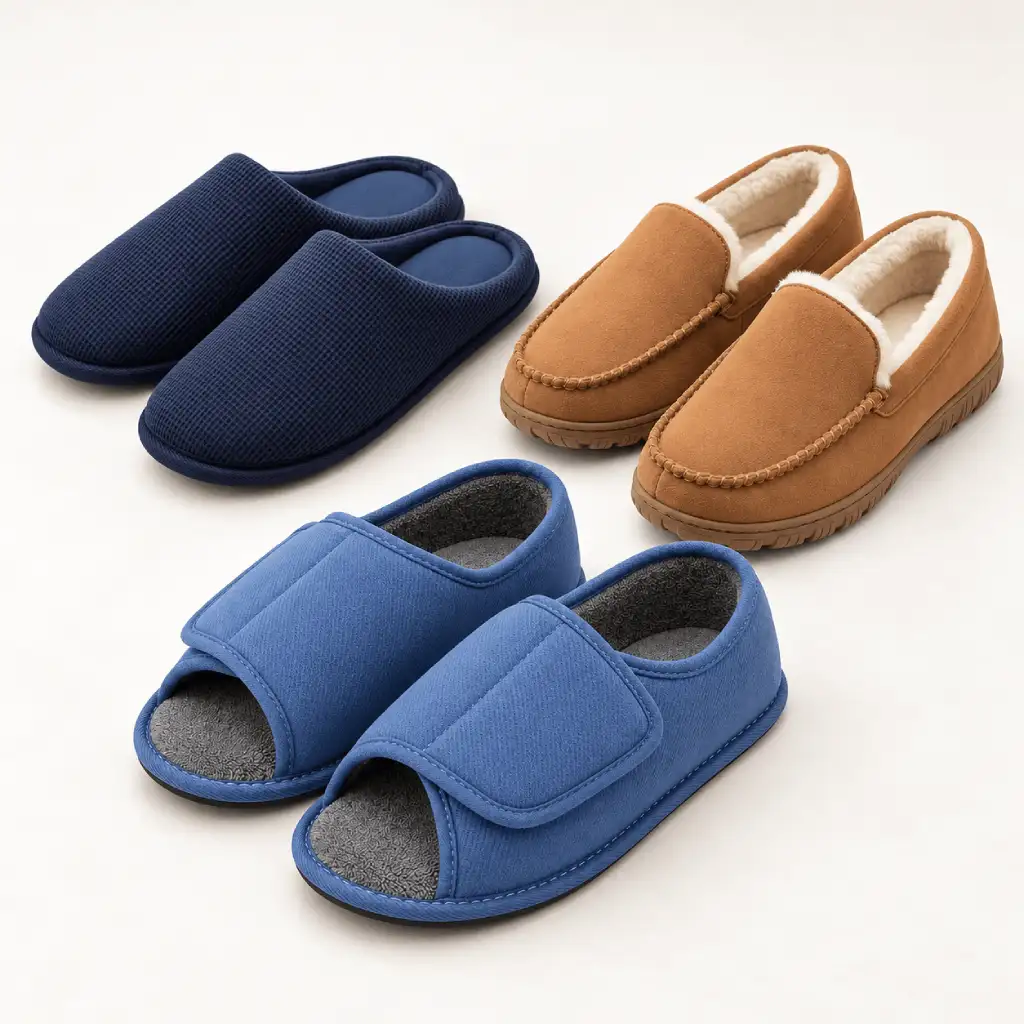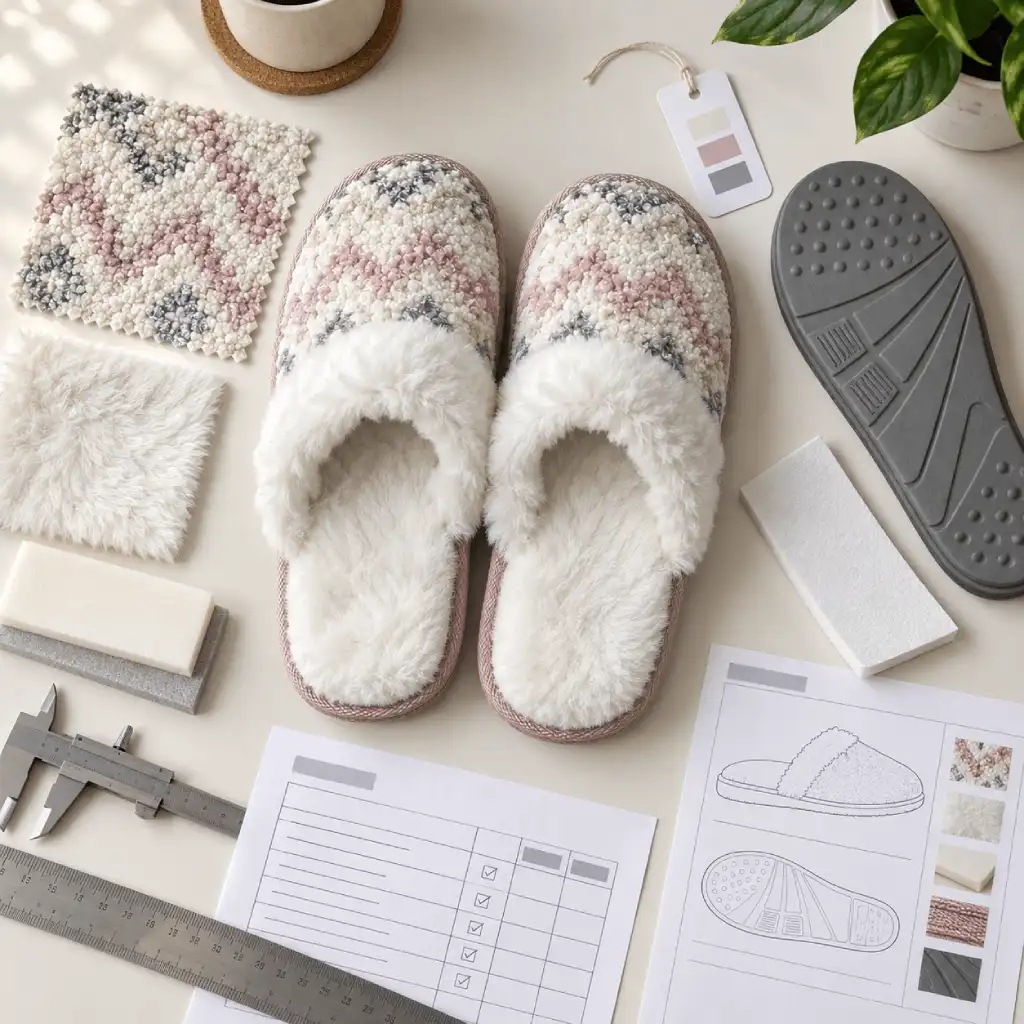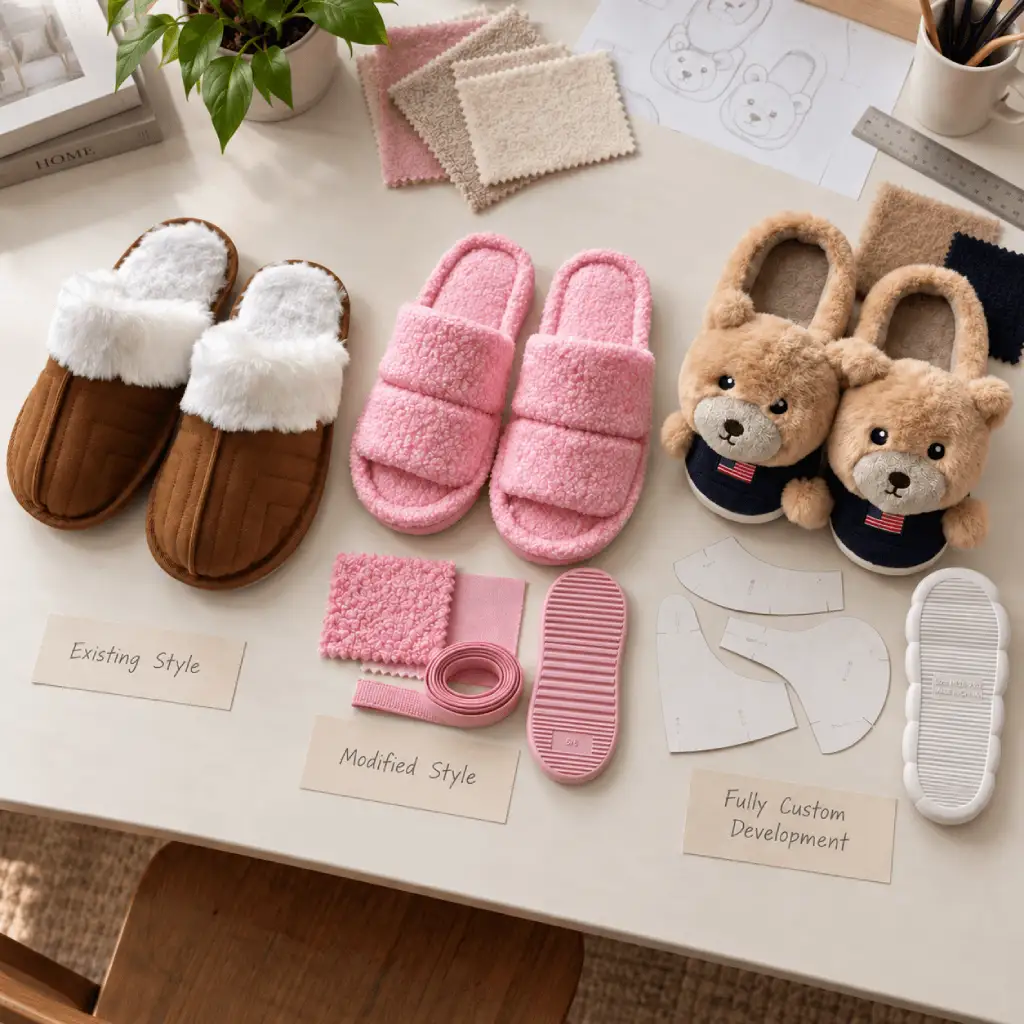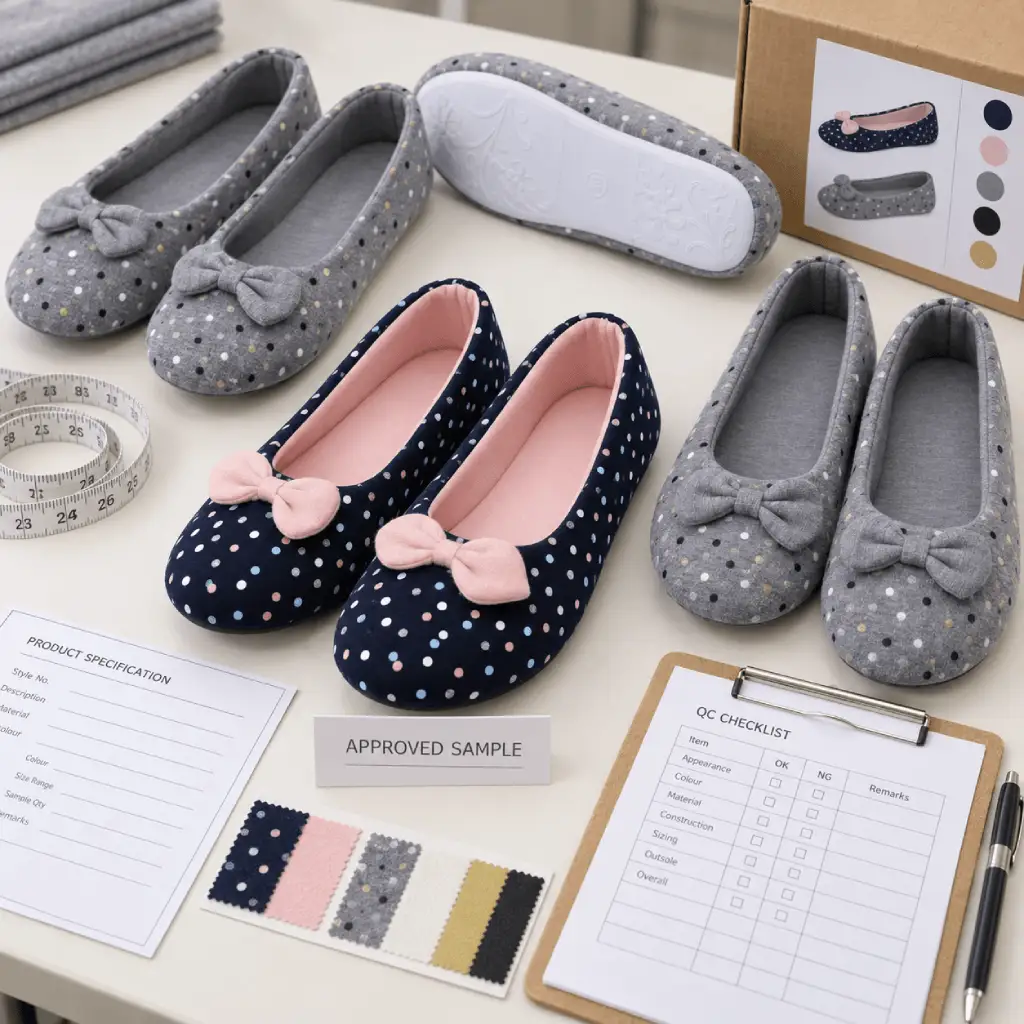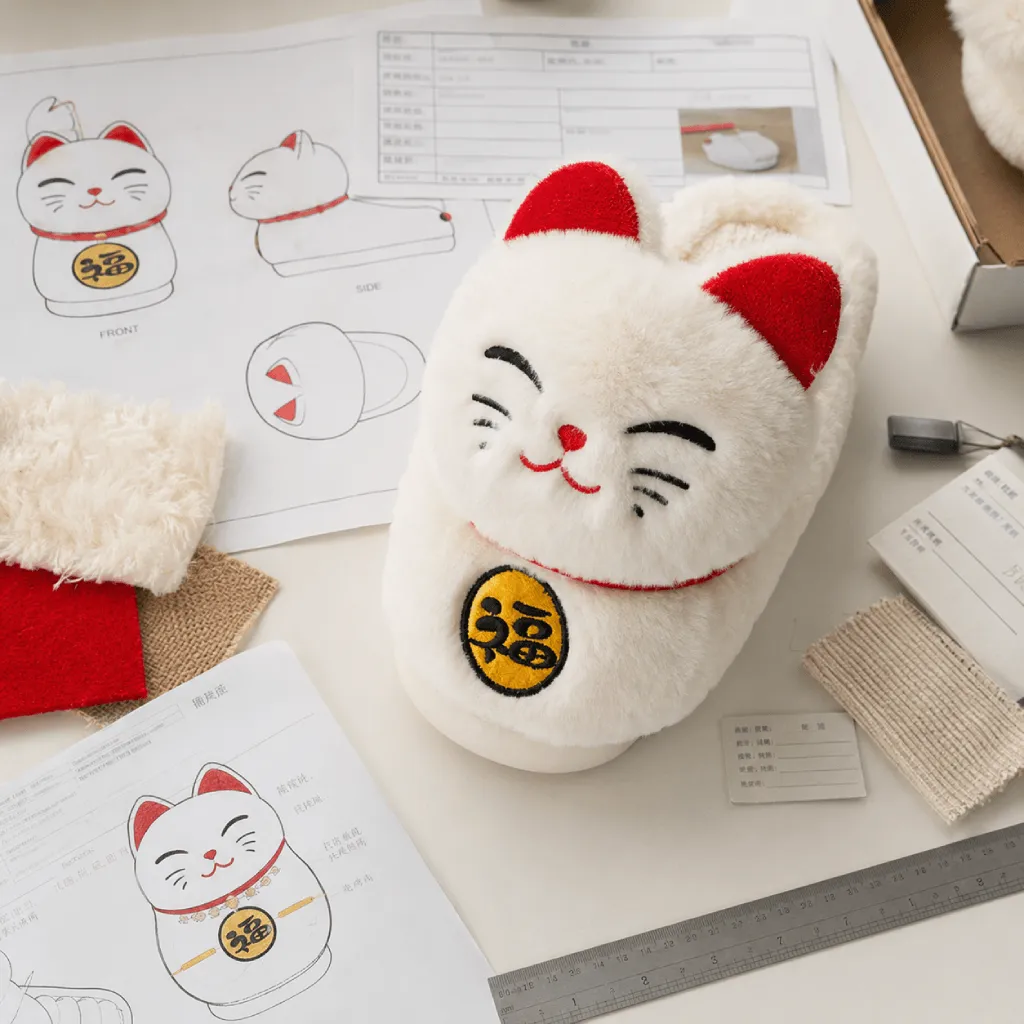
Footwear quality control for a bulk slipper order begins with a clear reference: the approved sample, confirmed product specification, buyer requirements, and agreed inspection method. Without that reference, an inspection may identify visible defects but still miss material, sizing, construction, branding, or packing differences that matter to the buyer.
Indoor slippers also require product-specific judgment. A welt-stitched house shoe, a side-stitched slipper with a molded TPR outsole, and a lightweight cold-glued slipper with a cut EVA sole do not share every inspection point. The quality plan should reflect the actual materials, construction, size range, sales market, and order risk.
This practical guide explains how brands, importers, wholesalers, and sourcing teams can establish inspection criteria, review production, use a footwear inspection checklist, select sampling or 100% inspection when required, and handle a nonconforming bulk order before shipment.
Buyer takeaway: Quality control should verify conformity to an agreed standard. Define the product, inspection scope, sampling method, reporting format, and release authority before production—not after a problem is found.
At UTOP, orders generally receive in-process and final inspection. AQL sampling, 100% inspection, and customer-facing photo or report formats are applied when required by the buyer or brand program.
Written by the UTOP Slippers Sourcing Team, with product, production, and inspection input from our indoor slipper manufacturing team.
1. What Is Footwear Quality Control for a Bulk Slipper Order?
Footwear quality control is the process of checking whether materials, components, workmanship, measurements, branding, packaging, and finished goods conform to defined requirements. For a bulk slipper order, those requirements should come from controlled references rather than an inspector’s personal impression of what looks acceptable.
The core references normally include the approved sample, product specification, purchase order, color and material approvals, size information, artwork files, packaging instructions, and any buyer-defined inspection or testing criteria. The inspection result is meaningful only when the factory, buyer, and any third-party inspector use the same version of those references.
Product conformity
Does the bulk product match the approved materials, dimensions, construction, appearance, branding, and packing requirements?
Lot acceptance
Does the inspected quantity meet the buyer-approved sampling plan, defect definitions, acceptance criteria, and release process?
Quality assurance and quality control are related but not identical. Quality assurance focuses on planning and preventing problems through specifications, approvals, process controls, and responsibilities. Quality control uses inspection, measurement, and agreed checks to identify whether the actual product conforms. A strong order needs both.
Quality is not a universal visual grade
A small appearance variation may be acceptable for one program and unacceptable for another. A dimensional tolerance may work for one construction but not another. The correct decision depends on the buyer-approved standard, intended use, defect severity, and impact on saleability or function.
For a wider view of specifications, sampling, branding, and bulk production, see our Private Label Indoor Slippers Manufacturing Guide.
2. Set the Quality Standard Before Production
An effective shoe quality control plan starts before bulk materials are cut or assembled. The buyer and supplier should identify which documents and samples control the order, which characteristics will be checked, how differences will be classified, and who can approve a change or release the shipment.
A single “approved sample” is useful, but it may not contain every answer. The factory may also need a size specification, approved color reference, outsole details, logo artwork, label data, packing instructions, and written comments from the sample review. When these references conflict, the conflict should be resolved before production.
| Control reference | What it should define | Approval point |
|---|---|---|
| Approved product sample | Overall appearance, material combination, construction, shape, and workmanship direction | Identify the controlled sample and approval date |
| Product specification | Materials, colors, dimensions, size range, outsole, branding, and tolerances | Confirm the latest revision used for production |
| Artwork and label files | Logo dimensions, placement, colors, wording, SKU, size, and barcode data | Approve final files and physical application when required |
| Inspection requirement | Inspection stage, sample size or 100% scope, defect classes, report format, and release authority | Agree before inspection is scheduled |
| Market and test requirement | Destination, buyer standard, retailer manual, restricted substances, and performance tests | Confirm the applicable method, laboratory, and acceptance criteria |
Document-control rule: keep approved samples, specifications, comments, artwork, and packaging data traceable. An obsolete file can create a consistent bulk order that is consistently wrong.
The same principle applies when comparing suppliers. Our Bulk House Slippers Wholesale Checklist explains which product and order details buyers should confirm before quotation and production.
3. Material and Component Inspection
Material inspection verifies whether production inputs match the approved specification and are suitable for the confirmed slipper construction. The check should identify the material accurately. Jersey knit, wool felt, plush fabric, lining, foam, insole materials, molded TPR, and cut EVA are not interchangeable descriptions.
The required checkpoints vary by project, but a practical footwear inspection quality control review may cover the following areas:
| Component | Possible control points | Reference |
|---|---|---|
| Upper and lining | Material identity, color, surface condition, hand feel, usable width, direction, and visible variation | Approved swatch, sample, and specification |
| Foam and insole | Material type, thickness or weight when specified, shape, recovery, and combination with the upper | Product specification and approved sample |
| TPR outsole | Material direction, color, dimensions, flatness, tread, molded detail, pairing, surface condition, and odor | Approved outsole or finished sample |
| Cut EVA sole | Sheet specification, thickness, density or hardness direction when specified, cutting accuracy, surface, and left-right matching | Approved material and dimensions |
| Decorations and trims | Color, dimensions, quantity, placement, orientation, attachment method, and approved safety requirements | Artwork, placement diagram, and approved sample |
Visual checks do not replace buyer-required material or chemical testing. If the destination market, retailer, or product program requires laboratory verification, the exact substance, method, sample, timing, and acceptance limit should be confirmed separately.
Avoid assumptions based on material names
TPR is not automatically more slip resistant or durable than EVA, and EVA is not automatically the lower-cost choice. Performance and cost depend on the specific formulation, hardness, density, thickness, outsole structure, processing method, quantity, and supplier quotation.
Compare these outsole directions in our TPR vs. EVA Sole for Slippers Guide.
4. In-Process Quality Checks
UTOP generally performs in-process inspection for each order. The purpose is to identify material, cutting, sewing, assembly, sizing, or appearance differences while production can still be reviewed and corrected. A final inspection alone may reveal a problem, but it cannot recover the time already spent producing an entire affected lot.
The exact checkpoints depend on the slipper and production stage. An in-process quality control in the footwear industry should focus on characteristics that can create repeated defects if the cause is not corrected early.
Cutting and preparation
- Correct pattern, size, material direction, and pair quantity
- Visible material defects or unacceptable shade variation
- Correct placement preparation for embroidery, print, labels, or decorations
Sewing and upper assembly
- Seam position, stitch appearance, thread condition, and symmetry
- Lining alignment, opening shape, decoration position, and pair consistency
- Early comparison with the approved sample
Bottom attachment
- Correct upper and outsole size combination
- Alignment, bonding or stitching direction, edge condition, and flex location
- Construction-specific process conditions where applicable
Finishing and packing preparation
- Shape, cleanliness, loose threads, visible adhesive, and pair presentation
- Correct size, color, SKU, labels, and approved accessories
- Separation of nonconforming products before packing
Process-control point: when the same defect appears repeatedly, correcting individual pairs is not enough. Production should identify the affected operation, material, machine, tool, method, or instruction and prevent the issue from continuing.
See examples of issues that should be controlled before shipment in our guide to Common Indoor Slipper Manufacturing Defects.
5. Final Footwear Inspection Checklist
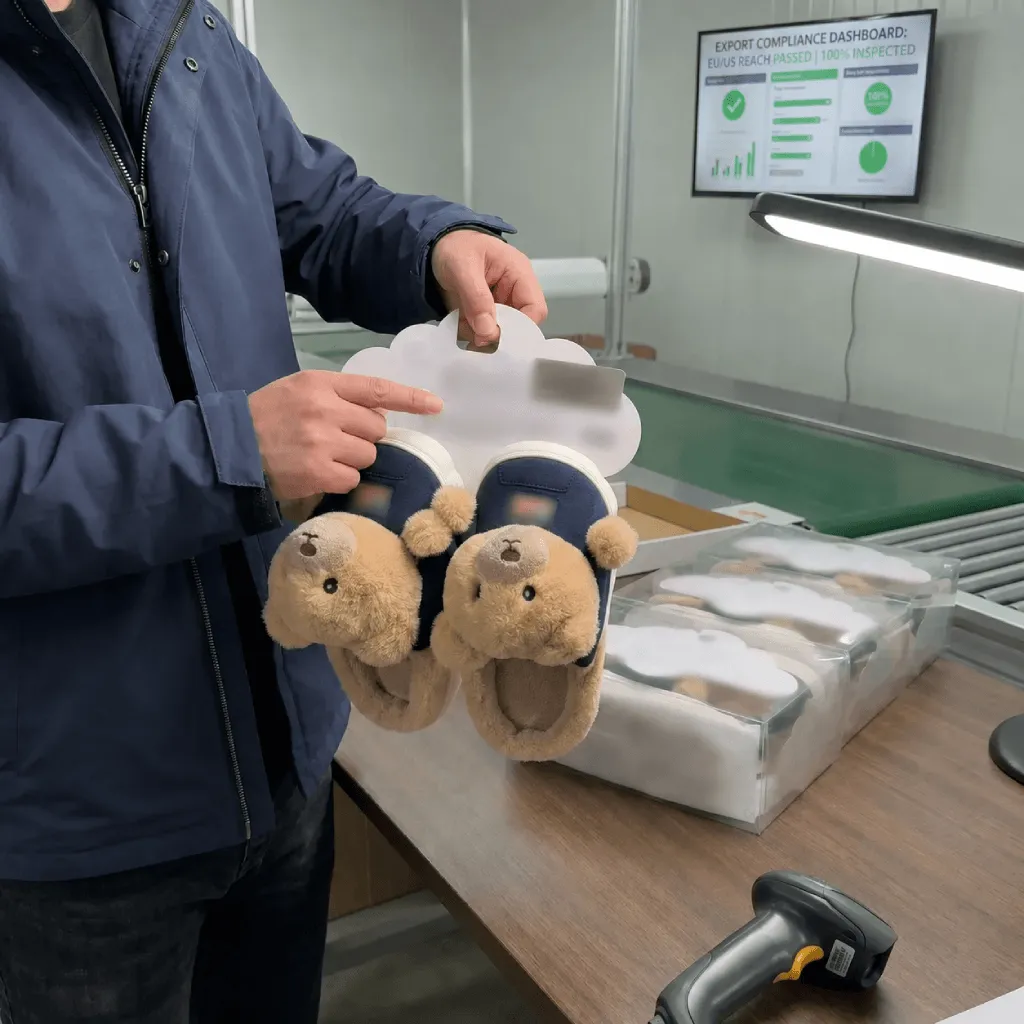
UTOP generally performs a final inspection for each order. The final review checks finished products against the approved references and confirms the order status before shipment. When the buyer requires a particular sample size, AQL plan, 100% inspection, report format, or third-party inspection, those requirements should be agreed in advance.
The following footwear inspection checklist is a planning framework. It should be adapted to the slipper type, construction, destination, purchase order, retailer manual, and buyer-defined acceptance criteria.
| Inspection category | What to check | Main reference | Possible nonconformity |
|---|---|---|---|
| Order identity | Style, purchase order, color, size, SKU, and quantity | Purchase order and SKU matrix | Wrong style, variant, assortment, or quantity |
| Materials | Upper, lining, insole, foam, outsole, trims, and approved color direction | Specification, swatches, and approved sample | Substitution, shade difference, surface flaw, or mixed material |
| Appearance | Shape, symmetry, cleanliness, color consistency, loose threads, marks, and visible adhesive | Approved sample and defect standard | Distortion, staining, asymmetry, finishing defect, or unacceptable variation |
| Construction | Seams, binding, attachment, bonding, outsole alignment, stitching, and finishing | Construction sample and product specification | Open seam, missed stitch, weak attachment, separation, or misalignment |
| Measurements and fit direction | Specified dimensions, left-right pairing, size identification, and size progression | Approved size specification and tolerance | Wrong size, inconsistent pair, out-of-tolerance dimension, or mixed grading |
| Outsole | Material, color, weight or thickness when specified, length, width, flatness, tread, flex position, and attachment | Approved sample and outsole specification | Warping, mismatch, wrong tread, incorrect dimension, or poor attachment |
| Branding and labels | Logo method, dimensions, placement, color, wording, size label, SKU, and barcode | Approved artwork and label data | Wrong logo, unreadable print, incorrect label, or mismatched barcode |
| Packaging and cartons | Individual pack, pair orientation, assortment, pairs per carton, carton condition, and shipping marks | Packed sample, packing instruction, and purchase order | Wrong ratio, missing component, crushed product, incorrect mark, or damaged carton |
| Required tests | Buyer-specified on-site checks and laboratory reports applicable to the order | Test plan, method, report, and acceptance requirement | Missing evidence, incorrect method, failed result, or unapproved deviation |
Inspection principle: record both the result and the reference used. “Pass” is not useful if the approved sample, specification revision, inspected quantity, and acceptance criteria are unclear.
Buyers can use this checklist together with their own inspection manual, retailer requirements, or third-party protocol. The scope should be finalized before the inspection date so that products, cartons, documents, tools, and approved references are available.
6. Construction-Specific Checks for Indoor Slippers
Construction-specific shoe quality control cannot be replaced by a generic checklist. The connection between the upper and sole, the edge finish, the outsole shape, and the flex behavior should be inspected according to how the slipper is made. A check designed for a molded athletic shoe may overlook problems specific to a soft indoor slipper.
| Construction | Key inspection points | Do not assume |
|---|---|---|
| Welt-stitched | Stitch continuity, spacing, edge distance, skipped or broken stitches, upper-to-bottom alignment, welt appearance, and pair consistency | The visible stitch alone does not prove stronger structural support |
| Side-stitched | Upper and molded sole alignment, stitch path, tension appearance, missed holes, thread ends, edge condition, and left-right symmetry | A stitched connection still requires correct component matching and workmanship |
| Cold-glued | Bonding area, alignment, open edges, visible adhesive, pressing result, surface preparation direction, curing condition, and flex location | Bonding performance cannot be judged from glue visibility alone |
At UTOP, welt-stitched slippers can commonly be developed with TPR or EVA bottoms. Side-stitched styles commonly use TPR outsoles, while cold-glued styles commonly use EVA bottoms. TPR can also be cold glued when the surface treatment, adhesive, pressing, and process conditions are matched to the specific construction.
Inspect the interface, not only the component
A correct upper and a correct outsole can still produce a nonconforming slipper if size matching, positioning, preparation, stitching, bonding, pressing, or finishing is incorrect. The upper-to-bottom interface should therefore have its own checkpoints.
Construction-related problems are also covered in our guide to Avoiding Common Indoor Slipper Manufacturing Defects.
7. Size, Measurement, and Pair Consistency
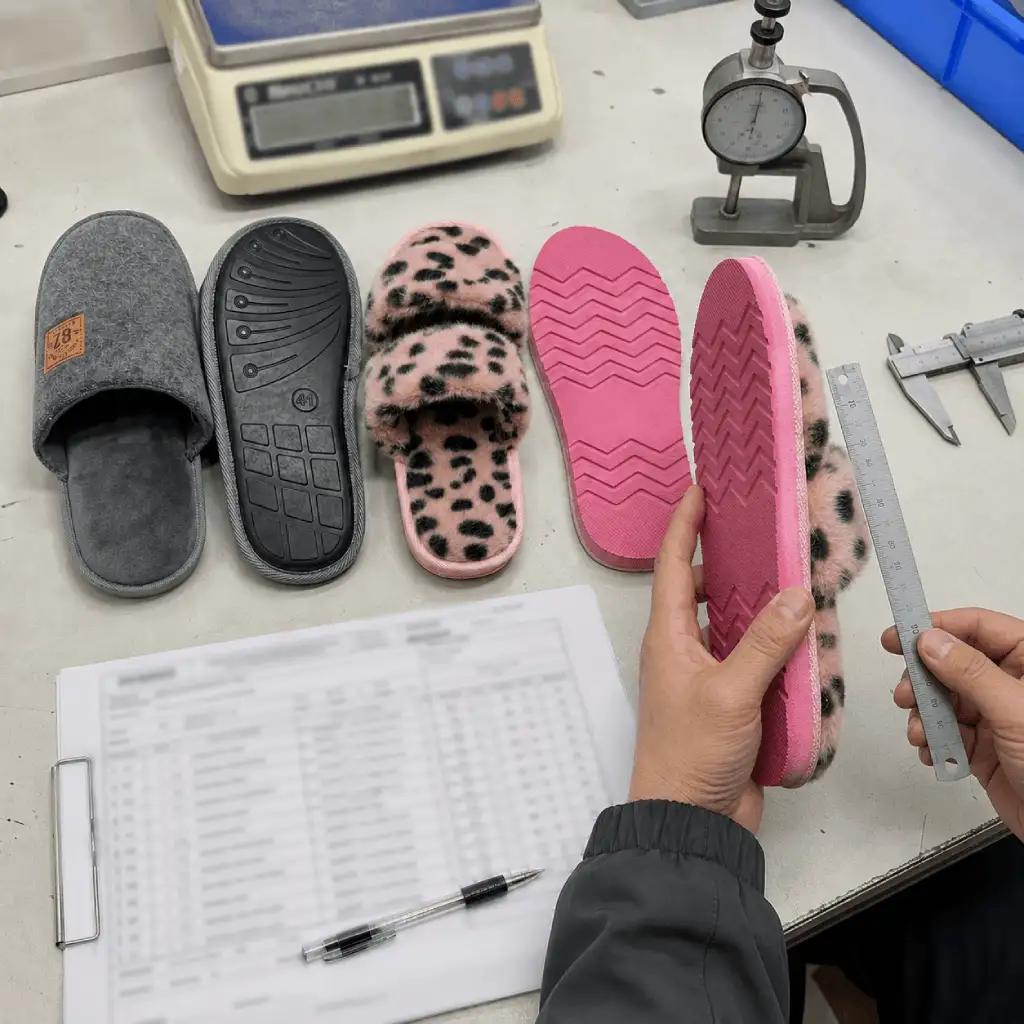
Size control is more than reading the printed size label. Inspectors should verify that the physical product, outsole, upper, insole, pair combination, and label correspond to the approved size specification. Measurements should be taken at defined locations with an agreed method.
The applicable dimensions depend on the slipper. A footwear quality control checklist may include outsole length and width, insole or footbed dimensions, opening, upper height, or another product-specific point. The buyer and supplier should confirm which measurements are critical instead of measuring every visible dimension without a purpose.
| Control point | Question to answer | Required definition |
|---|---|---|
| Measurement method | Where and how is the dimension taken? | Drawing, measurement points, tool, product condition, and unit |
| Tolerance | How much variation is accepted for this construction? | Buyer-approved upper and lower limits or other acceptance rule |
| Left-right pair | Do both slippers belong to the same size, color, construction, and visual grade? | Pairing and symmetry criteria |
| Size progression | Does the approved size range follow the intended grading direction? | Approved size set and size specification |
| Label match | Does the physical size match the product label, barcode, individual package, and carton assortment? | SKU matrix and packing instruction |
Important: there is no universal millimeter tolerance for every indoor slipper. The acceptable range should reflect the approved size specification, materials, pattern, construction, manufacturing method, and buyer requirement.
A measurement record should identify the style, size, inspected quantity, measuring point, requirement, actual result, and pass/fail decision. If a size issue affects more than one pair, the team should determine whether it is isolated, size-specific, component-specific, or systematic.
8. Outsole Quality Control: TPR and Cut EVA
The outsole affects dimensions, balance, flex behavior, appearance, and the connection between the upper and bottom. UTOP commonly works with molded TPR outsoles and cut EVA bottoms for indoor slippers, but the required checks depend on the actual specification and construction.
| Inspection area | Molded TPR outsole | Cut EVA bottom |
|---|---|---|
| Identity and appearance | Correct mold direction, size, color, surface, molded detail, and tread | Correct sheet material, color, surface, cutting direction, and edge finish |
| Dimensions | Length, width, sidewall or other specified molded dimensions | Length, width, thickness, and cutting accuracy |
| Physical comparison | Weight, hardness feel, flatness, pairing, odor, and flex position when specified | Weight, thickness, hardness or density direction, flatness, pairing, odor, and flex position when specified |
| Attachment | Alignment and side stitching, welt stitching, or prepared cold-glued connection as applicable | Alignment and cold-glued or welt-stitched connection as applicable |
| Performance evidence | Buyer-required slip, abrasion, flex, or other test result for the specified outsole | Buyer-required slip, abrasion, flex, or other test result for the specified bottom |
During sampling, UTOP normally reviews outsole material, color, odor, single or pair weight, thickness, hardness feel, outsole length and width, flatness, tread, left-right pairing, flex position, and upper-to-sole bonding or stitching quality as applicable. During bulk production, weight, hardness, dimensions, or flex checks can be performed against the approved sample or customer inspection requirement.
Performance boundary: visual inspection and hand comparison cannot prove slip resistance, abrasion resistance, or long-term durability. These properties depend on the actual formulation, hardness, thickness, tread, outsole structure, test surface, and test method.
For material-selection considerations, read our TPR vs. EVA Sole for Slippers comparison.
9. Branding, Labels, Packaging, and Carton Checks
A technically acceptable slipper can still be unsuitable for sale if the logo, size label, barcode, individual package, assortment, or carton marking is wrong. These details connect the physical product to the buyer’s inventory, retail, warehouse, and distribution systems.
Branding and packaging should therefore be included in the final footwear quality control scope rather than reviewed as separate decoration after production.
| Area | Checks | Control document |
|---|---|---|
| Product logo | Method, dimensions, position, orientation, color, clarity, and attachment | Approved artwork, placement diagram, and sample |
| Product labels | Brand, style, size, color, material wording, care or origin information when required, and label position | Approved label file and destination requirement |
| Barcode and SKU | Correct code, readable print, data-to-variant match, label size, and placement | Buyer-provided barcode and SKU matrix |
| Individual packaging | Correct format, artwork, package size, pair orientation, included components, and product condition after packing | Approved packed sample and packaging specification |
| Carton assortment | Sizes, colors, pairs per carton, inner-pack relationship, and remaining quantity | Purchase order, pack ratio, and packing list |
| Carton and shipping marks | Carton condition, style and variant data, carton number, quantity, destination marks, and routing labels | Approved marks, buyer manual, and shipping instruction |
Data-control point: the physical slipper, product label, barcode, individual package, carton label, carton mark, and packing list should all use the same approved size, color, and SKU logic.
Packaging checks in this article focus on order release. Packaging selection, artwork development, carton optimization, and approval should be completed earlier in the product-development process. Buyers can also review UTOP’s Bulk House Slippers Wholesale Checklist before finalizing an order.
10. AQL Sampling and 100% Inspection
An AQL inspection for footwear uses an agreed acceptance-sampling plan to inspect a defined sample from a production lot and make an acceptance or rejection decision. It does not mean that every pair has been inspected, and an AQL value should not be described as a simple guarantee that the same percentage of the complete order is defective.
At UTOP, AQL sampling is used when the buyer requires it. The buyer or brand generally defines the applicable standard, inspection level, AQL values, defect classifications, and release rules. If the buyer requires 100% inspection instead, the exact characteristics included in that check should also be defined.
| Approach | What it does | What must be agreed |
|---|---|---|
| AQL sampling inspection | Uses a defined sample and acceptance plan to assess a lot | Standard and version, lot definition, inspection level, AQL values, defect classes, sample selection, and acceptance/rejection numbers |
| 100% inspection | Checks every unit for the characteristics included in the inspection scope | Which characteristics are checked, defect standard, inspection method, records, segregation, and reinspection rule |
| Targeted inspection | Concentrates on a known risk, affected size, component, operation, or reworked quantity | Affected scope, traceability, inspection depth, acceptance criteria, and relationship to the final release inspection |
In practice, footwear AQL inspections still need a product-specific defect list and clear release authority. One current international reference for lot-by-lot inspection by attributes is ISO 2859-1:2026. Buyers should identify the standard and edition required by their own quality system rather than assuming that every supplier or inspector uses the same table or revision.
Defect classification must be product-specific
Critical, major, and minor classifications should be defined by the buyer’s defect standard and the effect of the nonconformity. A sharp object, wrong size label, open seam, slight removable mark, or small appearance variation does not automatically belong to the same class across every product and market.
Buyer decision: sampling and 100% inspection are not interchangeable promises of perfect quality. Select the approach from product risk, order history, buyer policy, inspection cost, timing, and the consequences of a missed defect.
11. Inspection Records, Laboratory Testing, and Nonconformity Response
A useful footwear quality control result should make the decision traceable. Depending on the buyer’s requirement, UTOP can provide inspection photos, tables, or reports. The requested format, language, checkpoints, measurement data, photo scope, and approval route should be confirmed before inspection.
A practical inspection record
- Supplier, order, style, color, size, lot, and inspection date
- Approved references and specification revision
- Inspection stage, inspected quantity, and sampling method
- Checkpoints, requirements, actual findings, photos, and measurements
- Defect classification, result, corrective action, and release status
Inspection is not laboratory testing
Visual, dimensional, pairing, packing, and workmanship checks can be performed at the factory. Slip resistance, abrasion, restricted substances, and other performance or chemical requirements need the specified method, equipment, sample preparation, and competent laboratory when applicable.
For buyers who need to organize these requirements before sampling or production, our footwear testing plan for custom slipper orders explains how to define each test item, sample stage, acceptance criteria, report requirement, and the link between tested samples and bulk production.
Independent footwear testing and assurance providers such as Intertek describe testing across materials, components, and complete footwear. For UTOP orders, any slip, abrasion, chemical, or other laboratory testing is confirmed or arranged according to the target market, customer standard, and specific order. A previous report should not be assumed to cover a different material, outsole, construction, color, supplier batch, or test method.
What happens when a bulk order does not conform?
When a material nonconformity or inspection failure affects shipment release, UTOP follows a controlled response sequence:
| 1 | 2 | 3 | 4 | 5 | 6 | 7 | 8 |
|---|---|---|---|---|---|---|---|
| Hold shipment | Issue report | Confirm affected scope | Analyze cause | 100% sort, rework, or remake | Internal reinspection | Third-party reinspection | Buyer’s written release |
The exact action depends on the defect, affected quantity, order timing, buyer requirement, and whether the product can be restored to the approved standard. Rework or sorting should be followed by verification; it should not automatically trigger shipment release.
Release control: after an inspection failure, shipment remains on hold until the corrective scope is completed, required reinspection is passed, and the buyer provides written release.
12. Buyer Checklist and Frequently Asked Questions
Before confirming a bulk slipper order, buyers should provide enough information to turn a general shoe quality control expectation into an inspectable requirement.
Information to confirm with the supplier
- Product reference, materials, construction, outsole, colors, sizes, and quantity
- Approved sample and controlled specification revision
- Critical dimensions, measurement method, and tolerances
- Branding, label, barcode, packaging, assortment, and carton instructions
- Destination market, retailer manual, and required laboratory tests
- In-process, final, third-party, AQL, targeted, or 100% inspection requirements
- Defect classifications, acceptance criteria, report format, and release authority
- Corrective-action and reinspection expectations if the order does not conform
What is footwear quality control?
Footwear quality control checks whether materials, construction, measurements, appearance, branding, packaging, and finished products conform to approved samples, specifications, buyer requirements, and agreed inspection criteria.
Does UTOP inspect every bulk slipper order?
UTOP generally performs in-process and final inspection for each order. The exact checkpoints, inspected quantity, report format, and use of third-party inspection depend on the product and customer requirements.
Does UTOP use AQL for footwear inspections?
AQL sampling is used when required by the customer. The buyer or brand generally determines the applicable standard, inspection level, AQL values, defect classifications, and acceptance rules.
Is 100% inspection better than sampling?
Not automatically. A 100% inspection checks every unit only for the characteristics included in its scope, while a sampling plan assesses a lot through a defined sample and acceptance rule. The choice should reflect product risk, buyer policy, order history, timing, cost, and the consequences of missed defects.
What should a footwear inspection report include?
Depending on the buyer’s required format, it may include order identification, approved references, inspection stage, sample size, checkpoints, measurements, photos, defect records, classification, corrective action, result, and release status.
Can a visual inspection confirm slip resistance or abrasion resistance?
No. Visual and hand checks can identify appearance, dimensions, flatness, tread, pairing, flex direction, and workmanship differences, but performance claims require the applicable test method, equipment, sample, conditions, and acceptance criteria.
What happens if a slipper order fails inspection?
Shipment is placed on hold, a report is issued, the affected scope and cause are reviewed, and the required 100% sorting, rework, or remake is completed. The order then undergoes internal reinspection, required third-party reinspection, and buyer written release before shipment.
Final takeaway: reliable footwear quality control is built on clear product references, construction-specific checkpoints, agreed sampling or inspection scope, traceable results, and a controlled release decision.
Review UTOP’s current custom slipper product directions, learn more about UTOP Slippers, or send your product and inspection requirements for project review.