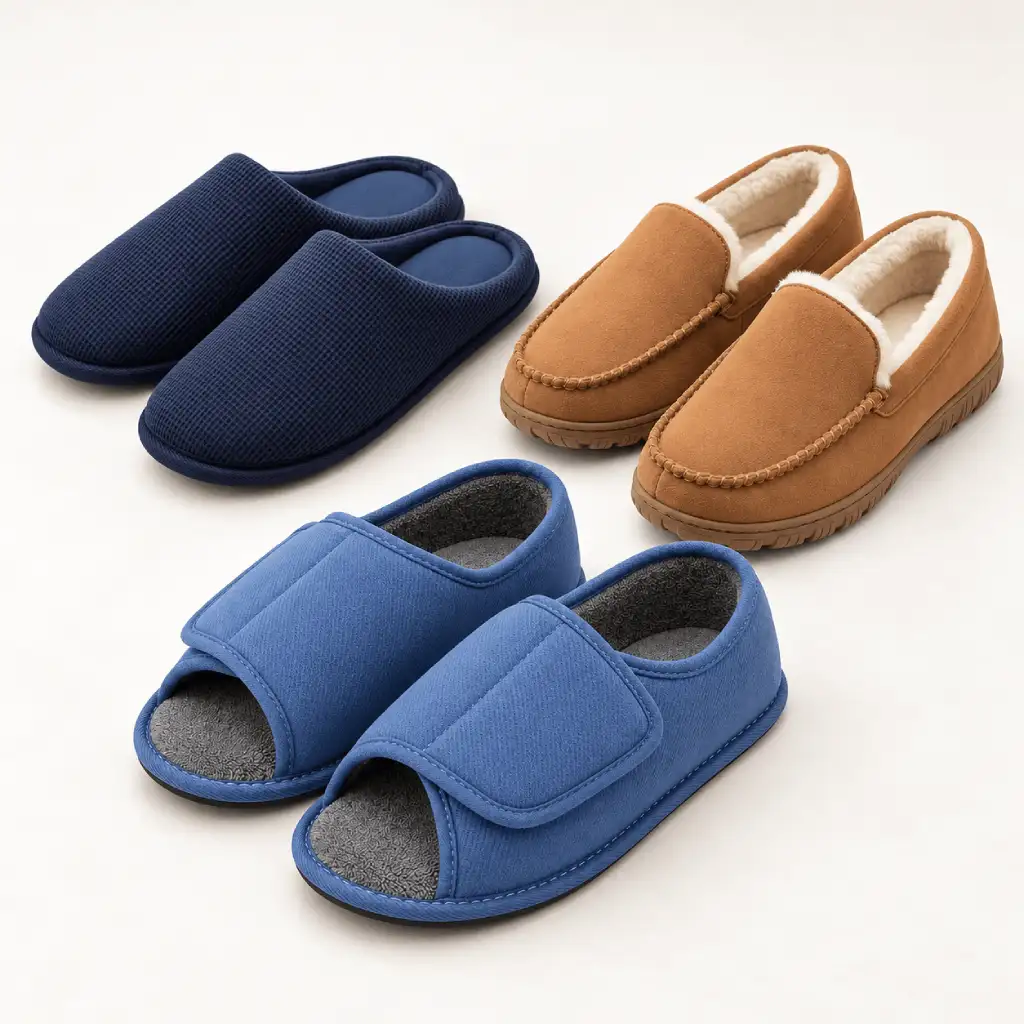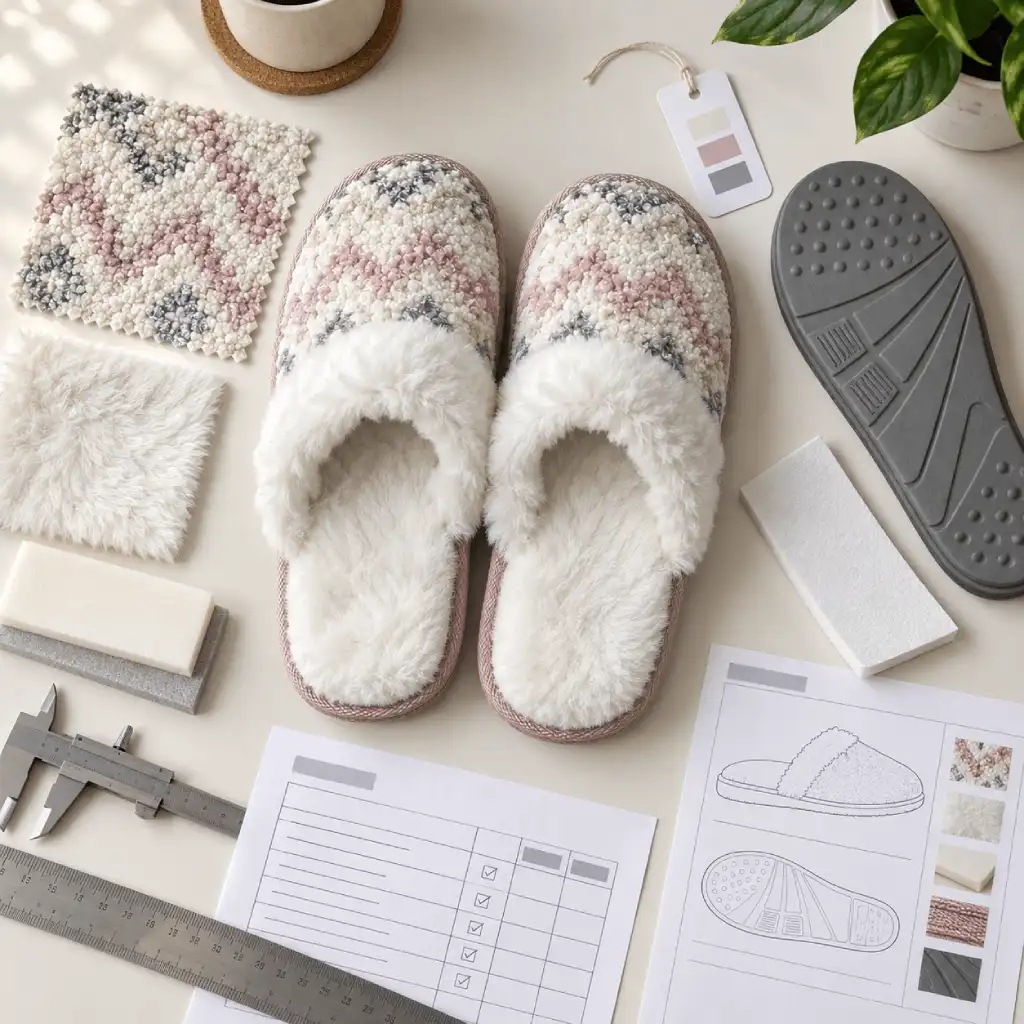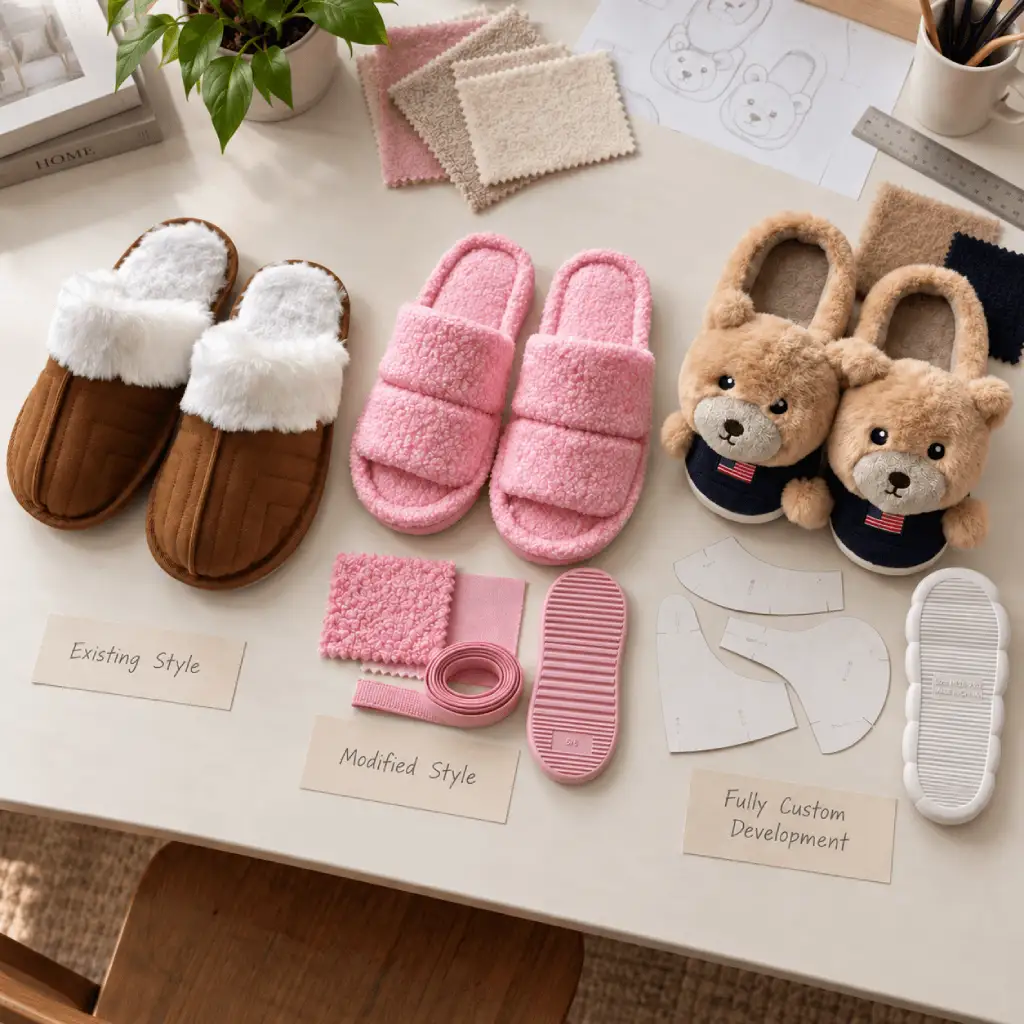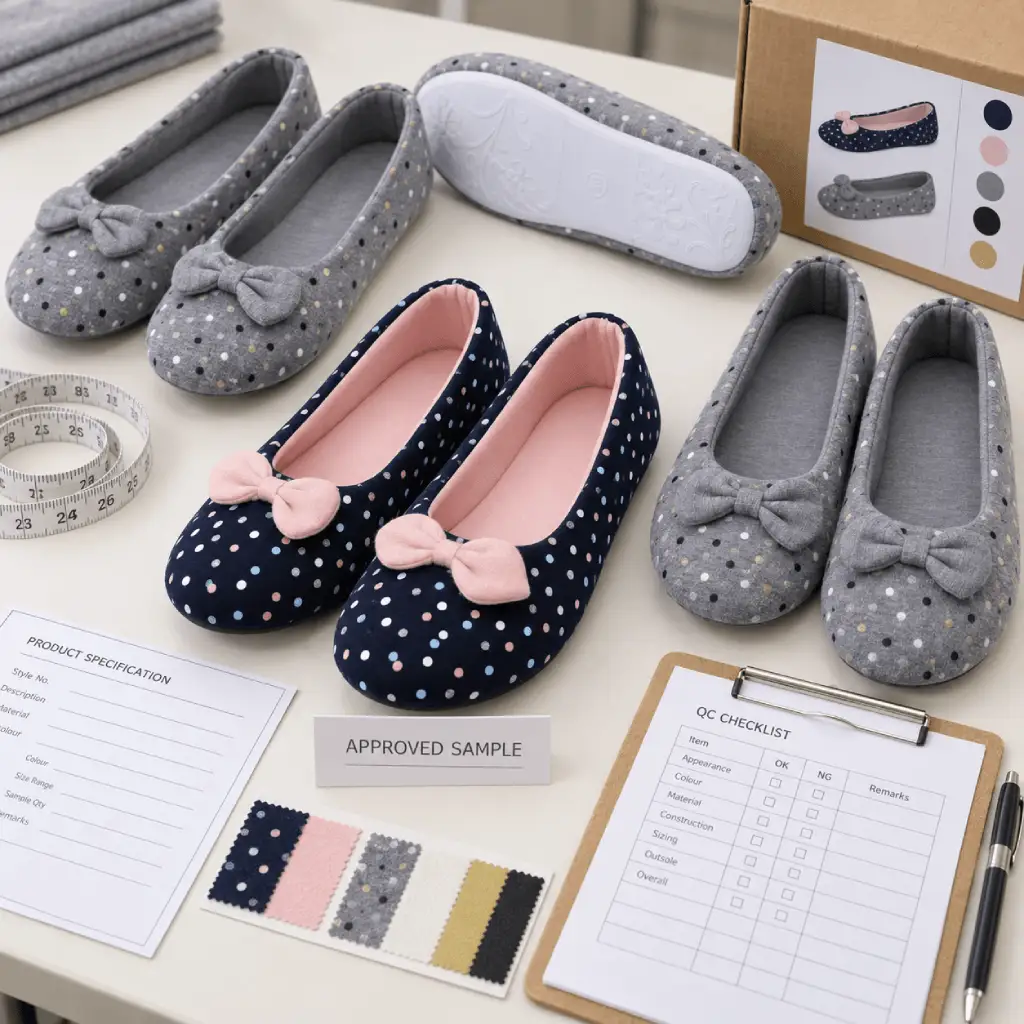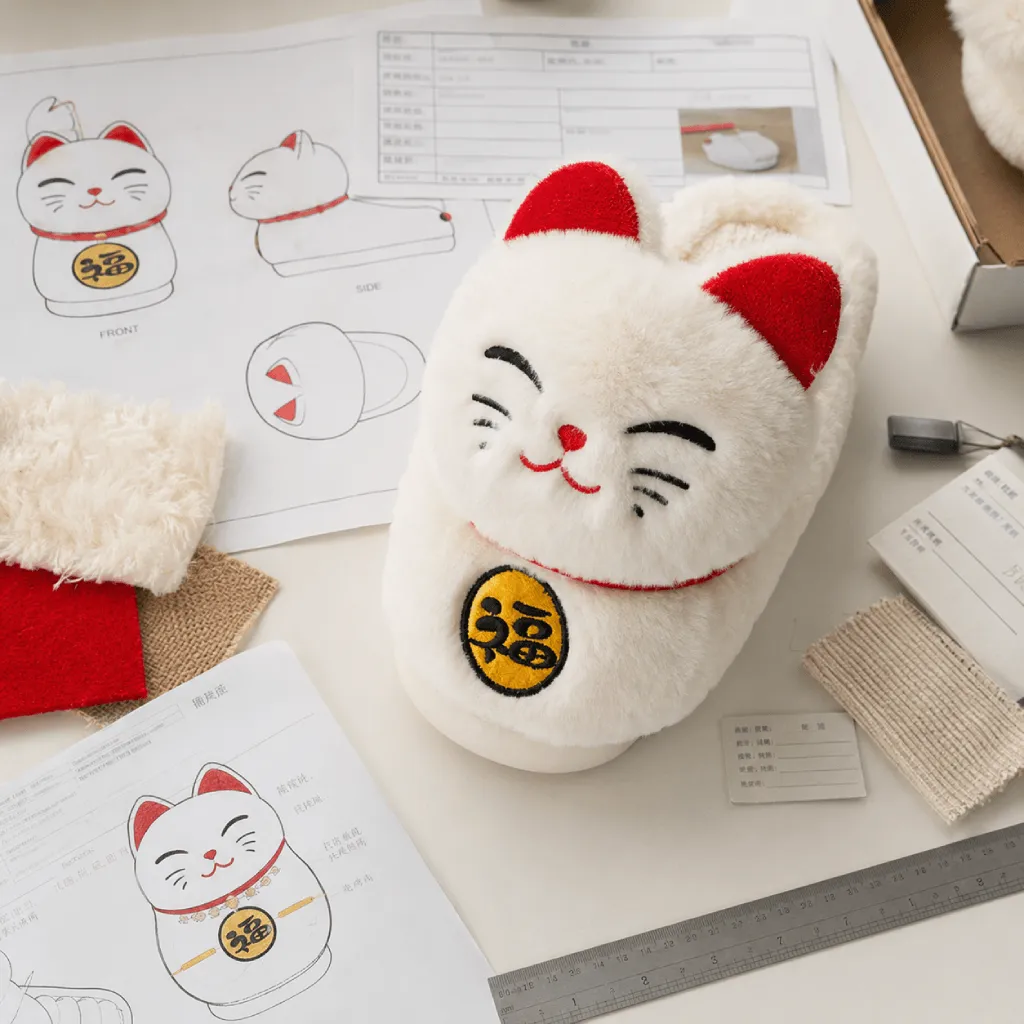
A custom slipper manufacturing cost is not a fixed price attached to a photograph. It is the result of a product specification: the upper and lining, the cushioning system, the outsole, the way the slipper is assembled, the branding, the order breakdown, the packaging and the commercial terms behind the quotation.
That is why two suppliers can receive the same reference image and return noticeably different prices. One may assume an available fabric and outsole, while the other allows for a buyer-specific material, new tooling, retail packaging or additional quality requirements. Until those assumptions are visible, the two quotations are not describing the same product.
This guide is written for brands, importers, retailers, distributors and sourcing teams comparing custom or private label slipper quotations. It explains where the cost differences come from, which charges may sit outside the unit price and how to prepare an RFQ that produces a more useful answer.
Buyer takeaway: Compare specifications first and prices second. A low quotation is only meaningful when the materials, construction, quantity, packaging, testing scope and trade term match the alternatives being considered.
Scope: This article explains manufacturing cost drivers and quotation comparison. For the wider development and production sequence, see UTOP’s Private Label Slippers Manufacturing Guide. It does not publish a universal price list because an accurate quotation requires a defined project.
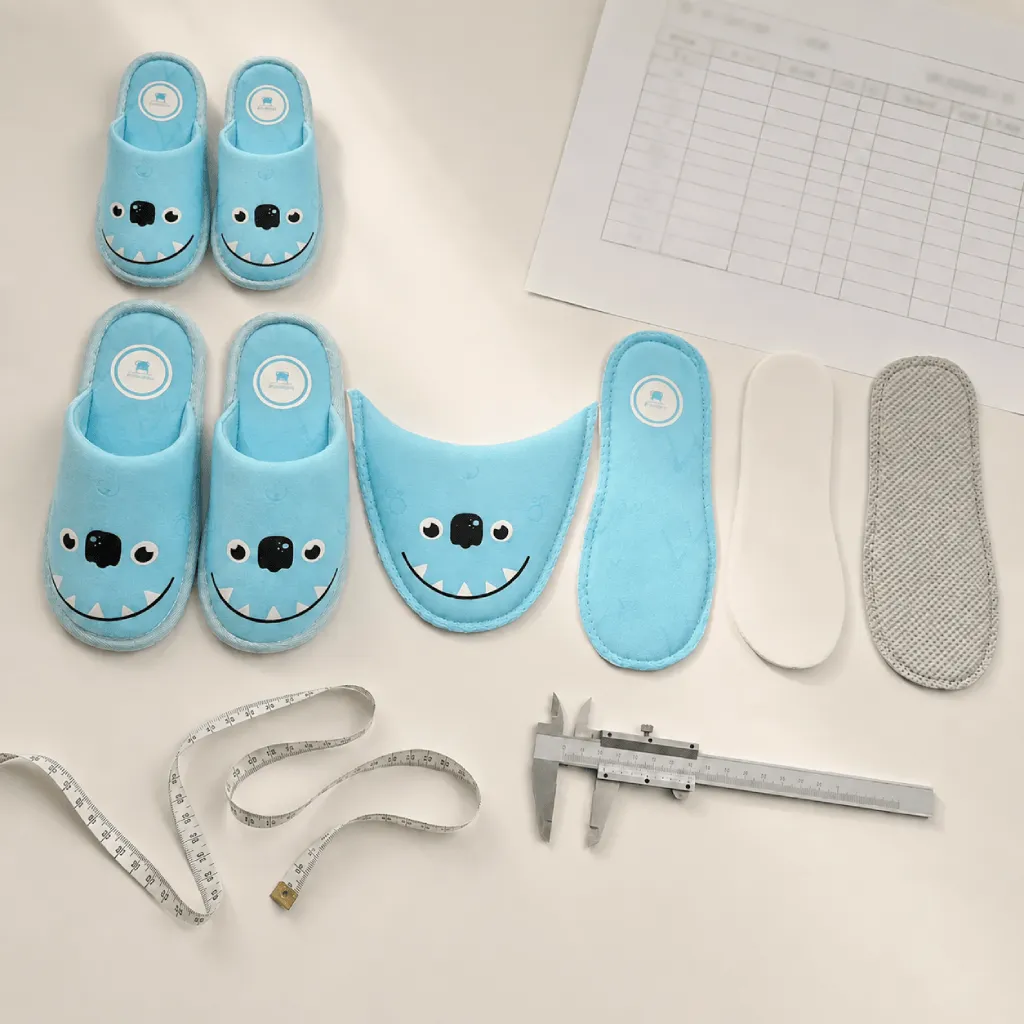
1. What Does a Custom Slipper Manufacturing Cost Include?
A factory quotation normally combines several types of cost into one unit price. Buyers rarely need the supplier’s internal accounting detail, but they do need to know what product and service scope the quoted figure represents.
A practical slipper cost breakdown starts with four groups: the physical product, the work needed to make it, the order-specific requirements and the commercial basis of the quotation.
| Cost group | Typical items | What the buyer should confirm |
|---|---|---|
| Materials and components | Upper, lining, foam or other cushioning layers, footbed, binding, trims, thread and outsole | Specification, color, thickness, weight or density where relevant, and approved reference |
| Manufacturing work | Cutting, sewing, assembly, bonding or stitching, finishing, inspection and packing | Construction method, workmanship reference and included inspection scope |
| Buyer-specific requirements | Logo, labels, hangtags, retail packaging, barcodes, tests and documentation | Artwork, placement, packing specification, destination market and required standard |
| Commercial basis | Order quantity, color and size breakdown, currency, trade term, payment and quotation validity | Whether each supplier is quoting the same quantities and delivery responsibility |
The quoted unit cost may also absorb part of the supplier’s operating cost and project handling. That does not make a simple formula suitable for every factory. What matters to the buyer is that no important product requirement is hidden behind a broad description such as “standard quality” or “normal packing.”
It is also useful to distinguish unit manufacturing cost from total project spending. Samples, tooling, testing, inspection, freight, duties and local delivery may be separate. A quotation that looks higher at first can be more complete; another may simply stop at a different point.
2. Define the Product Before Comparing Prices
The fastest way to create a misleading custom slipper quotation is to send a photograph and a total quantity with no further explanation. The image may show the general appearance, but it does not establish fabric composition, lining thickness, foam structure, outsole construction, size ratio, logo method or packaging.
Suppliers then fill in the missing details themselves. Their assumptions may be reasonable, but they are unlikely to be identical. The resulting prices cannot be compared line by line.
A quotation baseline should identify:
- the product style and intended use;
- upper, lining, cushioning, footbed and outsole direction;
- construction and key workmanship requirements;
- quantity by color and size, not only the total order;
- branding, labels and packaging;
- destination market, required tests or retailer standards;
- currency, trade term, shipment point and requested delivery window.
A reference sample can be more useful than a picture, but it still needs comments. The buyer may want to keep its shape and change the lining, improve the cushioning, use another outsole or remove a decorative feature. State which details are references and which are open for factory proposals.
For original or heavily modified designs, a structured shoe tech pack helps connect drawings, materials, dimensions, sizing, artwork and packaging to one current version. For simpler projects, a concise written brief can work well as long as the open decisions are clearly marked.
The specification does not need to be perfect before the first discussion. It does need to become stable before a final supplier comparison. When a factory proposes an alternative, record the change beside its price so the lower custom slippers cost is not mistaken for the cost of the original specification.
3. Which Product Decisions Change Slipper Cost?
The main factors affecting slipper price are connected. A thicker lining can change fit; a different foam stack can change upper volume; a new outsole can affect the pattern, attachment method, weight and carton plan. For that reason, cost should be reviewed as a product system rather than a list of independent upgrades.
Upper and lining materials
“Plush,” “felt” and “knit” are broad families, not complete specifications. Fabric composition, usable width, pile height, weight, backing, stretch, color and finish can all affect purchasing and cutting. Yield matters as well: two fabrics with a similar price per metre may produce a different number of usable components after pattern placement and waste are considered.
Custom colors or buyer-specific materials can introduce supplier minimums and preparation work. An available stock fabric may support a straightforward sample, while an exclusive color or construction may require a larger commitment. These are project conditions, not permanent rules for a material name.
UTOP’s guide to custom indoor slipper materials explains how upper, lining, cushioning and outsole choices interact with fit, appearance, construction and bulk consistency.
Cushioning and internal layers
A request for “memory foam” does not define the complete footbed. The quotation may also depend on foam type, density, thickness, layer sequence, support layers, covering material and how the stack is secured inside the slipper. A thick first sample is not automatically a better product if it compresses unevenly, changes the fit or cannot be repeated reliably in production.
Ask the supplier to identify the intended layer structure and approve the finished feel on the actual slipper. If the cushioning is changed to meet a target cost, review fit, foot position, upper contact and packing again. This keeps a material saving from creating another problem elsewhere in the product.
Outsole specification and tooling
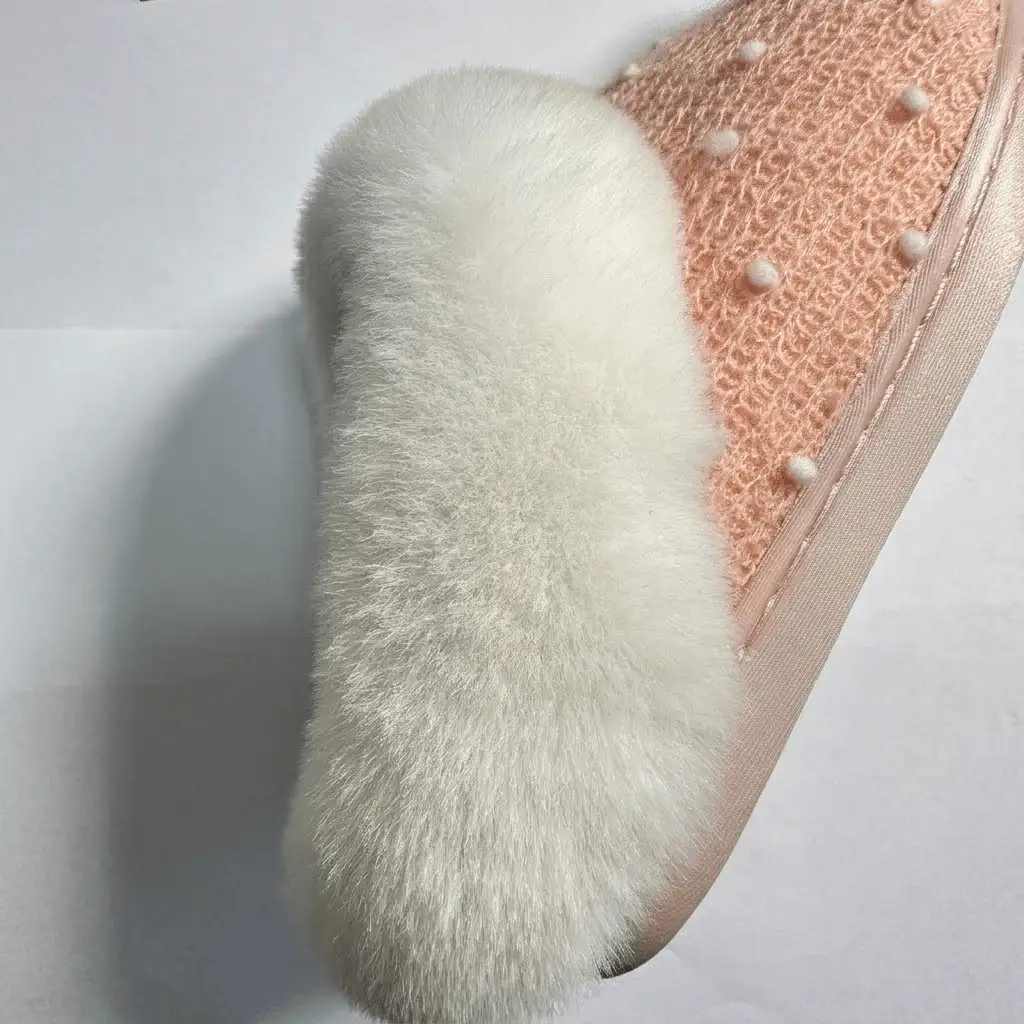
Outsole choices may include textile or faux-suede bottoms, dotted anti-slip fabrics, cut-sheet EVA and molded TPR, depending on the product. The cost cannot be judged from the material name alone. Thickness, weight, hardness, formulation, tread, color, size coverage, construction, mold status and order quantity all matter.
At UTOP, welt-stitched styles can commonly be developed with TPR or EVA bottom directions. Side-stitched styles commonly use a suitable molded TPR outsole, while cold-glued styles commonly use cut EVA. TPR can also be cold glued when compatible surface treatment, adhesive, pressing and process conditions are established. These construction relationships should be confirmed for the actual design.
A buyer-specific outsole shape, tread or logo may require new tooling. An existing outsole may avoid that one-time development cost, but only if its dimensions, sidewall, flex direction, appearance and available sizes suit the project. The TPR vs EVA sole guide covers the specification and tooling questions in more detail.
Construction and manufacturing work
Two slippers made from similar materials may still require different operations. Pattern complexity, number of cut components, binding, piping, embroidery, matching requirements and finishing all influence production work. Welt-stitched, side-stitched and cold-glued slippers also use different upper-to-bottom relationships and control points.
A simpler appearance is not always simpler to manufacture. Curved seams, thick plush, small decorative parts or a logo crossing a seam can require careful handling even when the finished product looks minimal. Ask the factory to price the approved construction rather than a visual approximation.
Branding and private label presentation
Private label slippers cost may include embroidery, woven or printed labels, heat transfer, insole printing, hangtags and buyer-specific packaging. The price effect depends on the method, artwork size, color count, position, material surface and quantity. A small detailed logo on long-pile plush can be harder to reproduce than a larger, simpler mark on a flat fabric.
Approve the branding on the intended material. Artwork that looks clean on screen may lose detail on plush, distort on stretch fabric or feel uncomfortable on a footbed. UTOP’s custom slipper logo guide outlines the information buyers should provide before comparing decoration options.
Quantity, colors and size breakdown
A larger order can improve purchasing and production efficiency, but total quantity is only part of the calculation. Five thousand pairs in one material and two colors are not planned in the same way as five thousand pairs divided across ten colors, several labels and many small size runs.
Factories therefore look at quantity per style, color, material and size—not only the headline number. Fragmentation can affect material minimums, changeovers, cutting plans, packing and the amount of work needed to control the assortment. This is why a slipper manufacturing cost should be tied to the exact order breakdown used in the quotation.
Packaging and carton requirements
A basic individual polybag and a retail-ready box are different cost scopes. Hangers, inserts, tissue, barcode labels, size stickers, printed pouches, display boxes, assortments and master-carton marks all require materials, artwork approval and packing work.
Packaging can also change freight efficiency. A bulky slipper, molded outsole or rigid box may increase carton volume even when the product unit price stays the same. Confirm the packing method early enough to include it in both the quotation and sample review. The Footwear Packaging Guide provides a fuller approval checklist.
Cost review rule: When one component changes, ask which connected specifications must be reviewed again. The cheapest isolated option is not necessarily the lowest-risk finished product.
4. Which Charges Sit Outside the Unit Price?
A useful custom slipper cost comparison separates recurring unit costs from one-time or separately billed work. Otherwise, one supplier may spread a setup charge across the order while another lists it on a separate line.
| Possible charge | Why it may be separate | Question to ask |
|---|---|---|
| Samples and revisions | Development work occurs before bulk production and may involve several versions | What sample type, material and revision scope does the charge cover? |
| Outsole or component tooling | A buyer-specific shape, tread, logo, die or fixture may need initial development | Who owns it, which sizes are included and can it be used for repeat orders? |
| Branding and packaging setup | Embroidery digitizing, print screens, dies or packaging artwork setup may be project-specific | Is setup included, charged once or repeated when artwork changes? |
| Testing and documentation | Scope depends on the destination market, buyer program, test method and responsible party | Which materials or finished products are tested, by whom and against what requirement? |
| Inspection and logistics | External inspection, freight, insurance, duties and destination handling may fall outside the factory price | Where does the quoted supplier responsibility end? |
Testing should be defined before the final quotation, not added as a vague request after the product is approved. Depending on the market and buyer program, footwear evaluation may involve materials, components or finished footwear. The SATRA footwear testing overview illustrates why the applicable test scope must be connected to the actual product and destination requirements.
This external reference does not imply that UTOP holds a SATRA certification or that every slipper project requires the same tests. UTOP can discuss project-specific testing and inspection requirements, but the method, sample selection, acceptance criteria, laboratory, timing and cost need to be agreed for the order.
Ask for one-time charges to be identified even when the supplier agrees to absorb or credit them under particular order conditions. Clear visibility makes later repeat-order pricing easier to understand and prevents a development fee from being confused with the ongoing custom slipper manufacturing cost.
For the wider relationship between approved references, in-process checks and final inspection, see UTOP’s Footwear Quality Control Guide.
5. How Can Buyers Compare Supplier Quotations?
A price sheet is easy to compare; a product assumption is not. Before choosing a slipper supplier quotation, rebuild each offer into the same set of specifications and commercial terms.
Consider two suppliers quoting from the same reference photograph. Their prices may differ because they have quietly filled the missing details in different ways:
| Quotation item | Supplier A assumption | Supplier B assumption | Why the difference matters |
|---|---|---|---|
| Upper and lining | Available plush and standard lining | Buyer-selected plush weight and thicker lining | Material use, appearance, fit and minimums may differ |
| Cushioning | Single foam layer | Specified multilayer footbed | Feel, thickness and assembly are not equivalent |
| Outsole | Available outsole in current size range | Buyer-specific tread and logo requiring tooling | Unit and one-time costs have different bases |
| Branding and packaging | One woven label and polybag | Embroidery, hangtag, barcode and printed box | Decoration, packing work and carton volume change |
| Testing and trade basis | Testing excluded; factory handoff basis | Defined test allowance; named-port basis | The figures include different responsibilities |
Neither example is automatically the better quotation. Supplier A may suit a project that can use existing components and simple packing. Supplier B may be closer to a buyer’s controlled specification. The correct comparison begins by deciding which product the buyer actually intends to order.
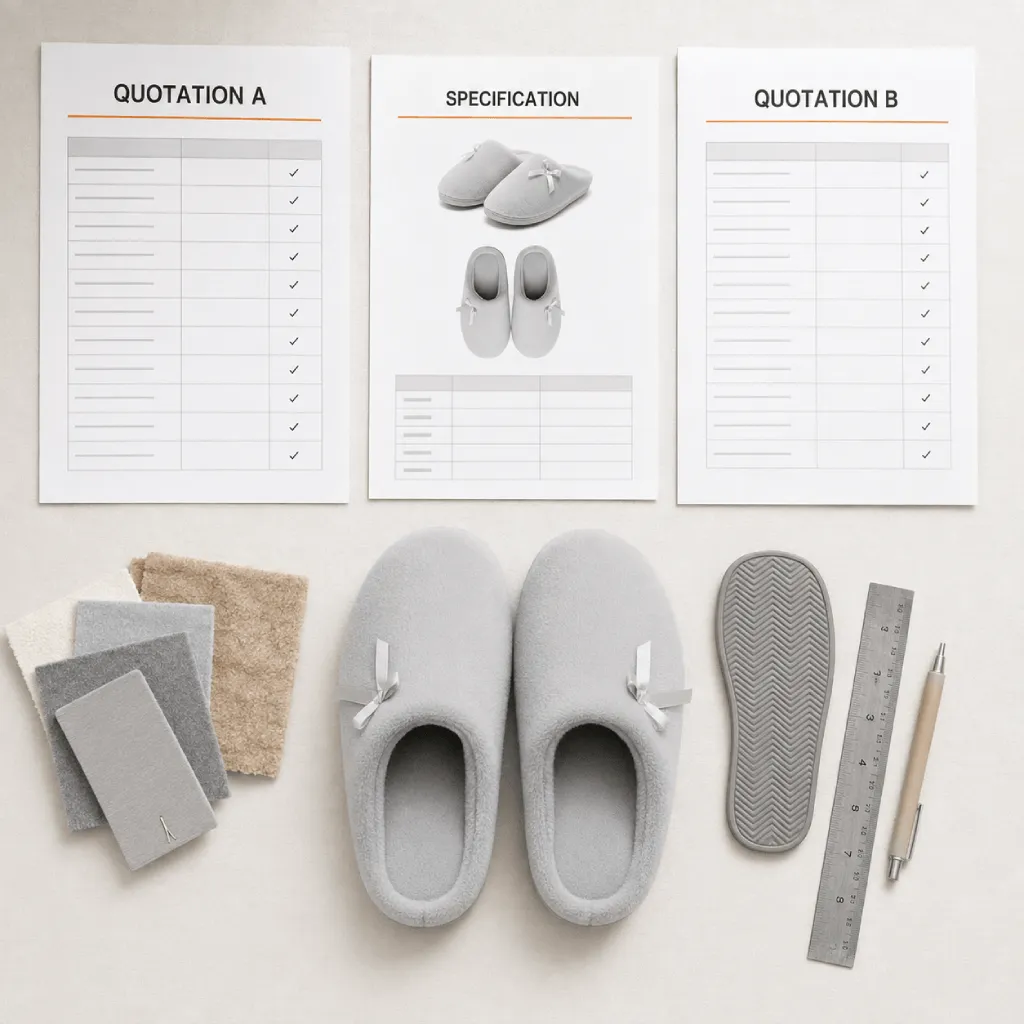
Normalize the quotation before negotiating
Put each offer into one comparison sheet. Where an item is missing, mark it as open rather than assuming it is included. The following headings are usually enough to expose the important differences:
- Product: upper, lining, cushioning, footbed, outsole, construction and workmanship reference.
- Order structure: quantity by style, color and size, size ratio and any agreed over or under tolerance.
- Brand presentation: logo method, labels, hangtags, inserts, barcodes, individual packing and shipping cartons.
- Development: sample type, revision scope, tooling, artwork setup and approval responsibilities.
- Quality scope: approved sample, inspection requirements, tests, documentation and action if a requirement is not met.
- Commercial basis: currency, payment terms, quotation validity, trade term, named place or port and excluded costs.
Trade terms need particular care. EXW and FOB do not describe the same seller responsibilities, and a term without a named place or port is incomplete for comparison. The International Chamber of Commerce explains that Incoterms® 2020 rules allocate costs, risks and obligations between buyers and sellers. Use the current agreed rule and named location in the RFQ and purchase documents.
Unit price should also be separated from landed cost. Freight, insurance, import duties, customs charges, inland delivery and warehouse handling are not manufacturing inputs, yet they affect the commercial result. Compare those costs with current information from the parties responsible for transport and import, not with a generic percentage in a blog article.
A useful follow-up question: “Please identify every assumption, one-time charge and exclusion behind this price.” The answer often reveals more than asking for a discount before the specification is aligned.
6. Can a Factory Work Backward from a Target Cost?
Yes—provided the target is treated as a product-development constraint, not as a request to reproduce every visible detail at any price. A useful target-cost discussion starts with the intended market position, expected quantity and the features that cannot change.
Separate the brief into two groups:
Non-negotiable requirements
Brand identity, required size range, fit direction, target use, retailer or market requirements, essential construction and approved delivery conditions.
Development variables
Available versus buyer-specific materials, outsole route, layer structure, decoration method, number of colors, packaging format and order consolidation.
The factory can then suggest controlled alternatives. It may be possible to use an existing outsole that fits the design, simplify a hidden internal layer, reduce artwork complexity, consolidate colors or revise the retail pack. Each proposal should state what changes, why it affects the custom slipper manufacturing cost and which sample checks need to be repeated.
A target-price exercise should not quietly replace specified materials with unapproved substitutes or remove quality controls. The buyer needs to see the trade-off. A lighter component may change feel; a different outsole may change appearance and attachment; a smaller box may compress the upper; fewer embroidery stitches may change the logo.
Ask for two or three named options rather than an unexplained lower figure. Review physical samples against the same priorities, then update the specification and quotation together. UTOP’s custom slipper development services explain how a project can begin from an existing style, reference sample, image, drawing or technical package.
7. What Should You Send in a Slipper RFQ?
A good RFQ does not have to answer every technical question on day one. It should show the supplier what is confirmed, what remains open and what commercial decision the quotation needs to support. That is enough to reduce avoidable assumptions and produce a more reliable custom slipper cost estimate.
| RFQ section | Information to provide | Useful status note |
|---|---|---|
| Project and market | Destination, sales channel, target wearer, season, expected retail position and intended use | Confirmed / supplier advice requested |
| Product reference | Product link, clear images, drawing, tech pack or physical sample; identify which features are references | Copy direction / adaptation / original development |
| Specification | Upper, lining, cushioning, footbed, outsole, construction, colors, size range and fit reference | Fixed item / acceptable alternative / open question |
| Branding and packing | Vector logo, dimensions, placement, labels, hangtags, inserts, barcodes, individual pack and carton marks | Artwork ready / concept only / supplier option requested |
| Order structure | Estimated quantity by style and color, size ratio, repeat-order potential and permitted quantity tolerance if known | Forecast / trial order / confirmed program |
| Quality and compliance | Buyer manual, destination requirements, requested tests, inspection method, acceptance criteria and documentation | Required / under review / not yet defined |
| Commercial request | Target cost direction if applicable, currency, Incoterm and named place, delivery window and quotation deadline | State which information is needed in the supplier response |
Ask the supplier to return a written specification summary with the price. It should identify alternatives, minimums, one-time charges, sample assumptions, exclusions and quotation validity. This turns the RFQ into a working comparison record instead of a collection of numbers from different product interpretations.
A structured shoe tech pack becomes more important as the design and approvals develop. For a broader sourcing list covering product details, sizing, branding, packing, quality and delivery, use UTOP’s Bulk House Slippers Wholesale Checklist.
Before sending the RFQ: Mark every line as confirmed, open or optional. That one habit makes supplier questions easier to answer and helps prevent a temporary assumption from becoming an accidental approval.
8. Custom Slipper Cost FAQ
How much do custom slippers cost to manufacture?
There is no dependable universal price. The cost depends on the confirmed materials, cushioning, outsole, construction, branding, packaging, quantity by color and size, tooling, testing scope and trade basis. Send the same specification to each supplier and ask them to list assumptions and separate charges.
Why do factories quote different prices for the same slipper?
They may not be pricing the same slipper. A reference image leaves room for different assumptions about fabric, lining, foam, outsole, workmanship, labels, packing and quality requirements. Suppliers may also quote different quantities, currencies, trade terms or validity periods.
Does a larger order always reduce the unit cost?
Not automatically. Higher volume may improve material purchasing and production planning, but the result also depends on how the order is divided. Many colors, materials, labels, package versions or small size runs can reduce the efficiency gained from a larger total quantity.
How much does private label branding add?
It depends on the branding method and surface. Embroidery, labels, heat transfer, insole printing, hangtags and printed packaging use different materials and setup work. Provide the artwork, size, colors, position and quantity before asking for a branding cost.
Is a TPR outsole always more expensive than EVA?
No. TPR and EVA costs depend on the material specification, formulation, thickness, weight, molding or cutting method, tooling, construction, size range, quantity and current supplier quotation. Compare the exact outsole and finished construction rather than using the material name as a price rule.
Is tooling included in the quoted unit price?
Sometimes it is listed separately; sometimes an agreed amount is allocated across an order. Ask the supplier to identify the tooling charge, size coverage, ownership, approval process, maintenance responsibility and availability for repeat orders. Do not infer these terms from the unit price alone.
What is the best way to compare custom slipper quotations?
Use one comparison sheet covering the product specification, quantities, branding, packaging, development charges, quality scope, currency, Incoterm, named place, validity and exclusions. Resolve material differences before negotiating price. This makes the final custom slipper manufacturing cost easier to explain internally and to control during sampling.
Conclusion: A Better Price Starts with a Better Specification
Manufacturing cost becomes useful when it can be traced back to an agreed product and order structure. Define the slipper, separate recurring and one-time charges, normalize the commercial terms and keep the quotation aligned with every approved change.
The goal is not to make every supplier return the same number. It is to understand what each number buys—and whether that product is the one your market, launch plan and quality requirements actually need.
Request a project-specific quotation review
Send UTOP your product reference, materials, outsole direction, construction, quantities by color and size, logo files, packaging, target market, quality requirements, delivery window and preferred trade term. If some details are still open, mark them clearly. Our team can review the brief, identify the main cost variables and propose a practical quotation basis.