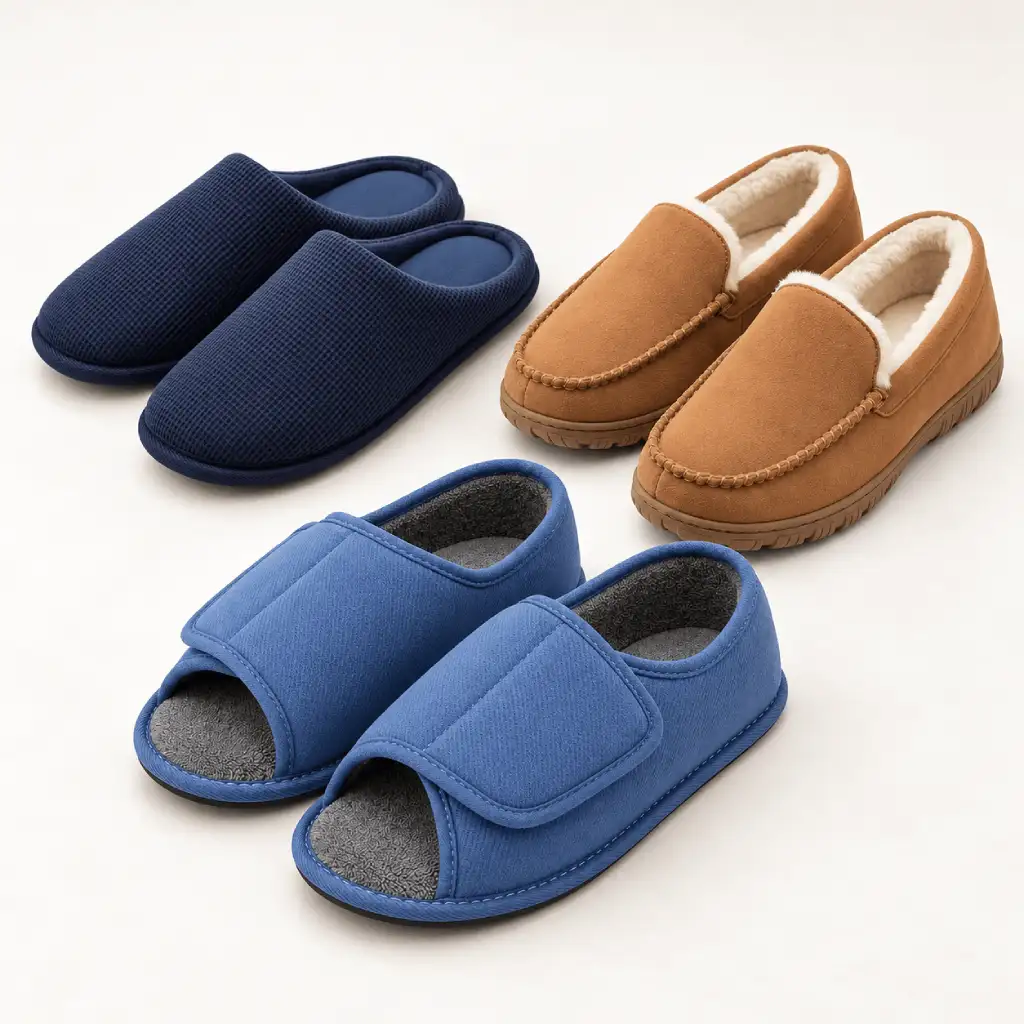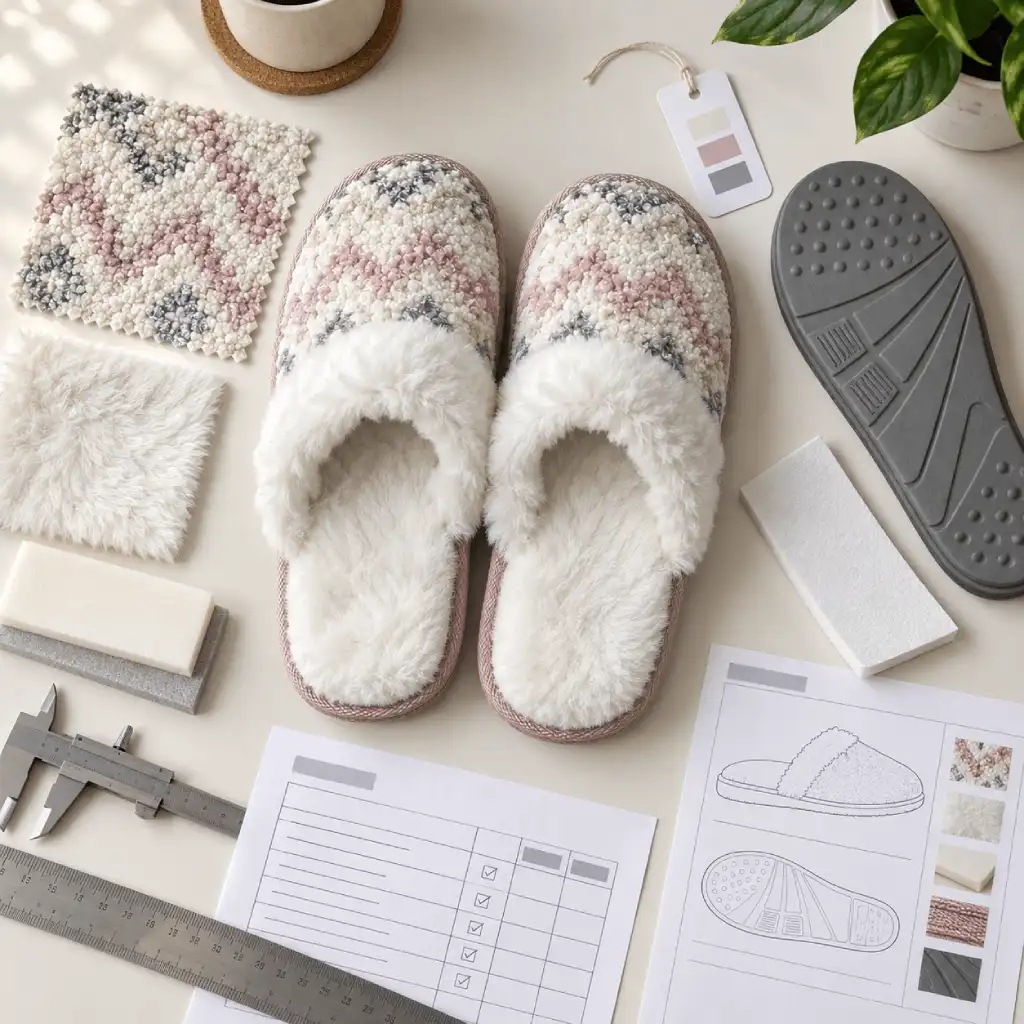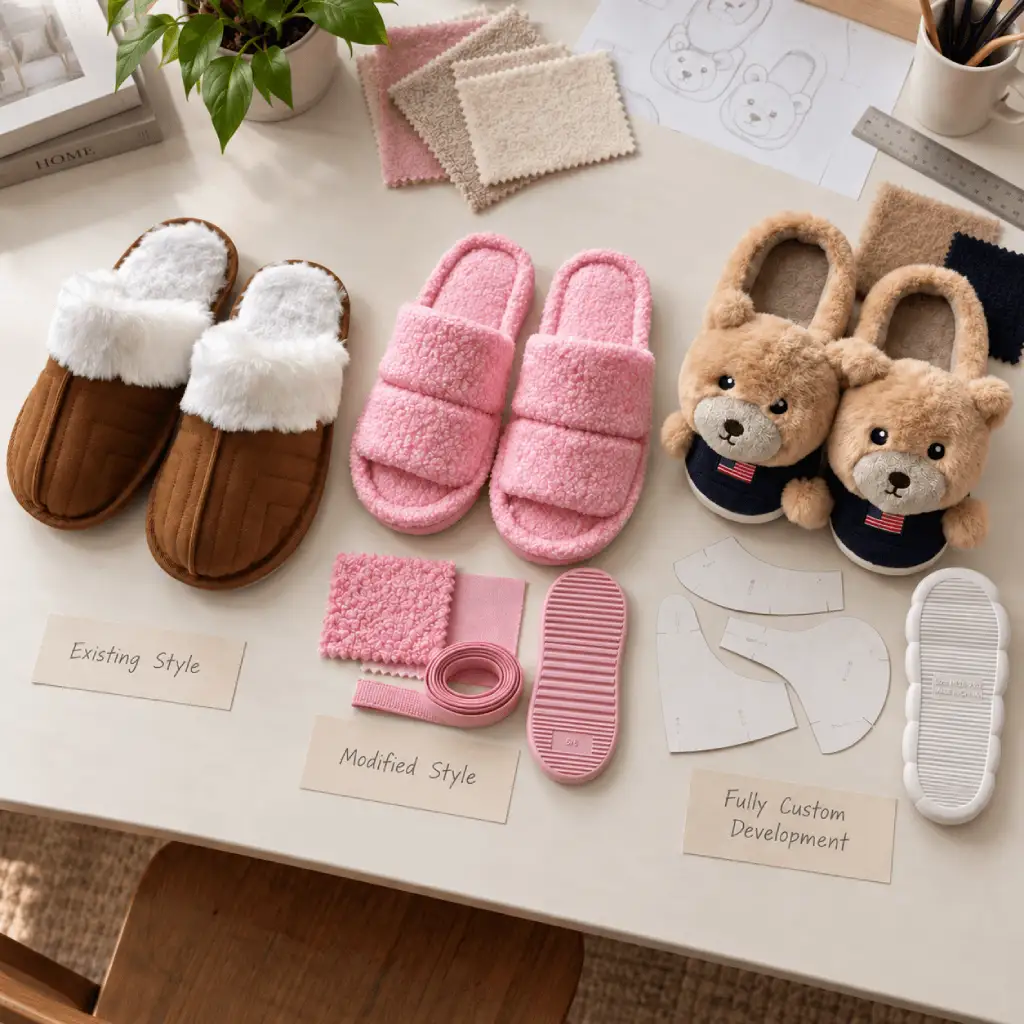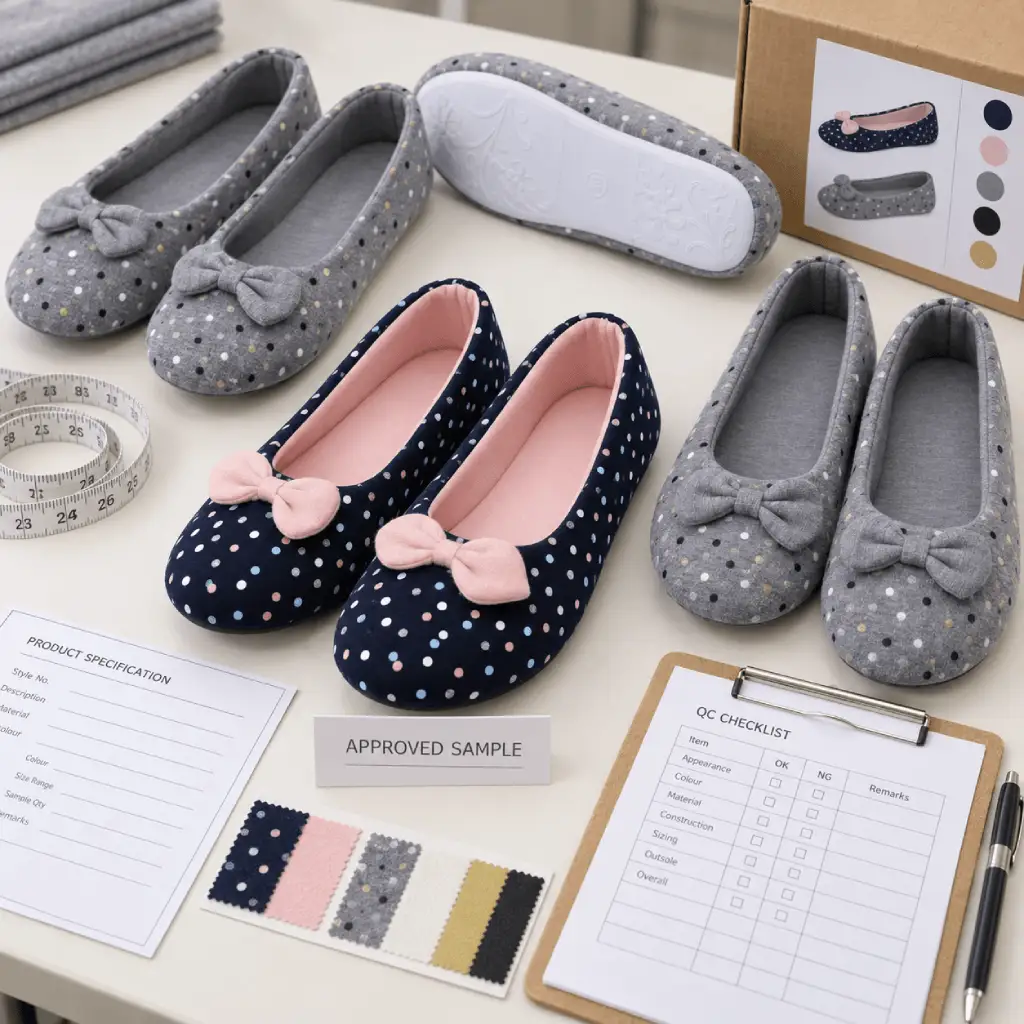
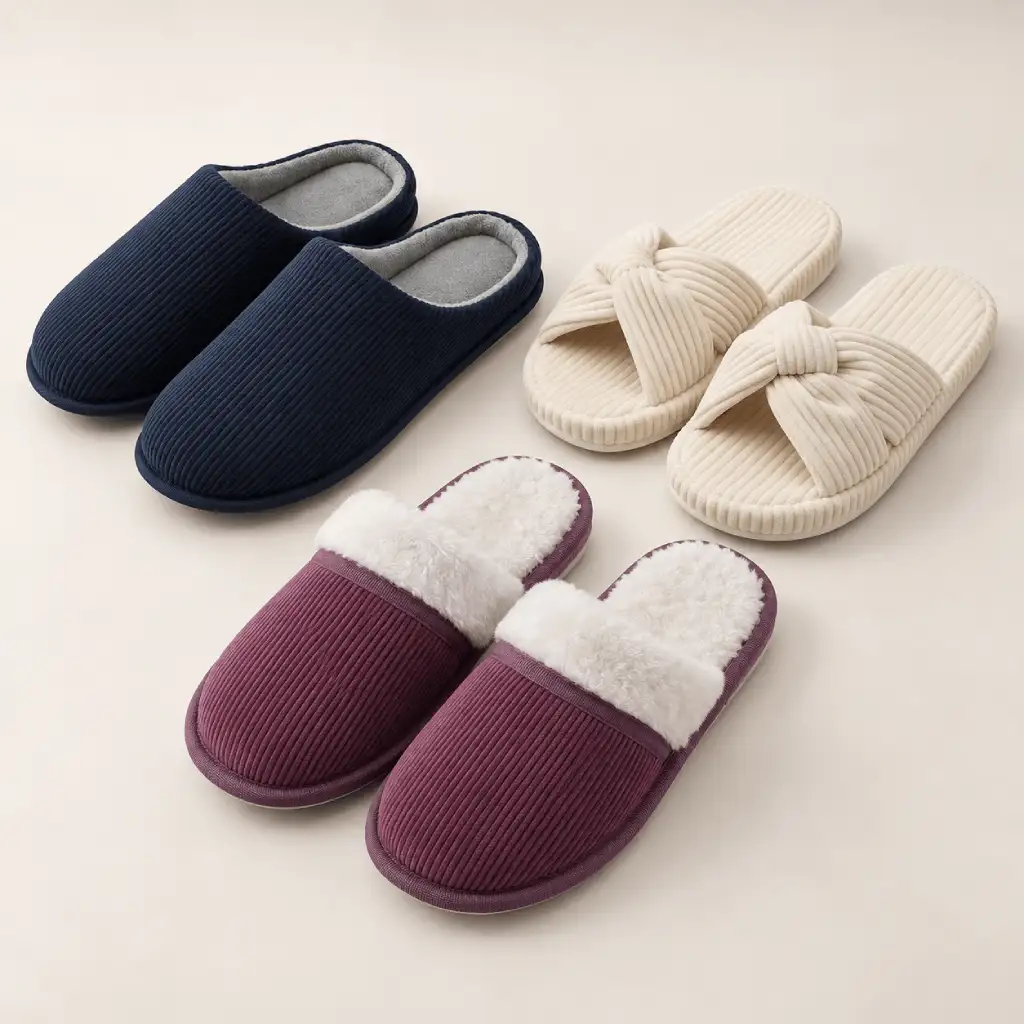
Corduroy house shoes are easy to recognize on a retail shelf. The ribs give a plain indoor slipper more texture, and the fabric works naturally with autumn, winter, homewear, and gift collections. That visual appeal is usually what starts the conversation. For a wholesale buyer, however, the more important questions come next: which corduroy, which construction, which lining, and how will the approved look be repeated across colors and sizes?
A supplier cannot answer those questions with a fabric name alone. Two swatches described simply as “corduroy” may differ in wale width, pile character, backing, weight, stretch, shade, and sewing behavior. Once the material is combined with cushioning and an outsole, those differences affect shape, fit, branding, packing, and pair consistency.
This guide is written for brands, importers, retailers, and sourcing teams planning wholesale corduroy slippers. It explains how to turn a style idea into a workable specification, what to approve during sampling, and where to place quality checks before a bulk order is packed.
Buyer takeaway: approve the corduroy, lining, cushioning, outsole, fit, branding, and packaging as one product. A good-looking fabric swatch is only the first reference.
Scope: this is a B2B sourcing guide for custom, private-label, and bulk indoor slipper programs. Test methods, acceptance limits, labeling, and compliance requirements must be confirmed for the destination market and the actual product.
Buyers who want to begin with a current product direction can review UTOP’s UT-MS1001 men’s corduroy slippers, a closed-toe, open-back style with a corduroy upper, coral fleece interior, and molded TPR outsole.
1. Define the Range Before Choosing the Fabric
A buyer may arrive with one corduroy swatch and still have several very different products in mind. A men’s core house shoe, a women’s gift slipper, and an online color story can all use the same fabric family, but they will not share the same fit, packaging, price structure, or order plan.
Begin by giving the corduroy house shoes a clear role in the assortment. Are they a year-round neutral, a winter texture, a promotional style, or part of a coordinated homewear collection? That decision helps the supplier judge how many colors are practical, whether the upper needs more structure, and how much variation the range can absorb.
| Range decision | What the buyer should define | Why it changes the product |
|---|---|---|
| Target wearer | Men’s, women’s, unisex, age group, and expected fit direction | Affects shape, volume, size range, and color plan |
| Sales channel | Store, e-commerce, gift, homewear, or wholesale distribution | Affects display, pack recovery, labeling, and returns risk |
| Season and climate | Launch window, indoor temperature, and intended season | Guides lining volume, coverage, and material weight |
| Price position | Target retail level and required product features | Frames material, outsole, branding, and packaging choices |
| Order architecture | Total quantity, colors, sizes, and units per SKU | Determines whether the proposed variation is commercially workable |
For corduroy slippers wholesale programs, total quantity tells only part of the story. A large order split across too many colors and sizes can create small material lots and fragmented production runs. Share the planned SKU breakdown early so the quotation reflects the range you actually intend to buy.
Practical starting point: build a focused core range first. Add extra colors or decorations only when the sales plan justifies the added sampling, material, and inventory complexity.
2. Choose the Construction Before Finalizing Materials
Corduroy can give several slipper shapes a familiar, relaxed look, but the silhouette should be settled before the fabric specification is locked. The same swatch behaves differently on a shallow open-toe scuff, a closed-toe mule, and a fuller closed-back house shoe.
| Construction direction | Typical range use | Points to review in the sample |
|---|---|---|
| Closed-toe, open-back | Men’s and women’s core homewear ranges | Vamp depth, opening, heel landing, upper support, and easy entry |
| Open-toe scuff | Women’s seasonal, gift, and lighter indoor programs | Band width, toe exposure, decoration position, foot hold, and edge finish |
| Closed-back house shoe | Higher-coverage indoor ranges | Entry, heel shape, topline, internal space, and size grading |
| Soft or compact slipper | Gift, travel, or flexible pack formats | Shape recovery, outsole flexibility, seam bulk, and packed presentation |
There is no universal “best” construction for corduroy house slippers. A broad wale may suit a simple upper with few seams, while a finer rib can be easier to place around smaller panels or a more detailed silhouette. The final choice should be judged on the actual pattern and size range.
UTOP’s UT-WS1012 corduroy bow slippers show an open-toe women’s direction, while UT-MS1001 provides a men’s closed-toe, open-back reference. These are useful starting points rather than fixed specifications for every buyer.
If the style is being developed from an image, an existing sample, or a new concept, the wider custom indoor slipper development process explains how construction decisions move through feasibility review, sampling, approval, and production handoff.
3. Specify Corduroy for House Shoes
Corduroy is a pile fabric with lengthwise ribs, commonly called wales. As CottonWorks explains in its corduroy construction overview, the number and structure of those wales can vary considerably. That is why “navy corduroy” is not a complete upper-material description.
A workable specification for corduroy house shoes should identify the visible effect and the production controls behind it. The buyer does not need to dictate every mill setting, but the supplier needs enough information to source, cut, compare, and replace the material consistently.
| Specification point | What to record | What to review on the slipper |
|---|---|---|
| Fiber composition | Confirmed composition and supplier reference | Hand feel, appearance, care direction, and market requirements |
| Wale character | Wale count or approved rib width and visual reference | Scale of the ribs against the upper pattern and logo |
| Weight and thickness | Agreed method, target, and tolerance where needed | Seam bulk, drape, edge turning, and finished shape |
| Backing or stabilization | Backing material, lamination status, or approved prepared composite | Cutting stability, stretch, shape, and flexibility |
| Color and finish | Color standard, finish, approved face, and lot-control method | Shade, surface direction, luster, and pair matching |
| Cut direction | Approved wale and nap orientation for each pattern piece | Consistent light reflection and appearance across the pair |
Do not approve from a screen image alone. Review a physical swatch, then review the corduroy after any backing, lamination, embroidery, folding, or edge treatment required by the design. The prepared material may feel and behave differently from the original roll.
Approval rule: keep an identified swatch or material reference with the approved sample and specification. Descriptions such as “fine corduroy,” “heavy corduroy,” or “soft corduroy” are useful discussion terms, but they are too open to interpretation for bulk production.
Set tests around the product and the market
Surface wear and color transfer are sensible concerns for a pile fabric, but a supplier should not invent a universal pass level for every corduroy slipper. The test method, specimen, condition, acceptance requirement, and responsible party need to be agreed for the project.
For reference, ASTM D4685/D4685M addresses pile-fabric abrasion and specifically includes woven corduroy within its scope. ISO 105-X12:2016 describes a method for checking textile color fastness to dry and wet rubbing. Whether either method is required—and what result is acceptable—depends on the buyer’s market, product specification, and quality plan.
Approve the fabric in more than one condition
A swatch laid flat does not reveal every issue that may appear in wholesale corduroy slippers. Review the fabric when it is bent over the toe, stitched through several layers, paired left to right, brushed in both directions, and compressed in the intended packaging. If the color is dark or saturated, include rubbing and transfer requirements in the material plan rather than relying on a visual check.
- Check the face and reverse against the approved material reference.
- Confirm the same wale and nap direction on corresponding pattern pieces.
- Compare color under an agreed lighting condition.
- Review fraying, seam bulk, and edge finish on the finished upper.
- Repeat relevant checks if the mill, color lot, backing, or finish changes.
For a wider component-level framework, see UTOP’s guide to materials for custom indoor slippers.
4. Coordinate Lining, Cushioning, and Fit
The upper gets most of the attention, but the inside of a corduroy slipper often decides whether the finished sample feels correct. A fuller fleece or plush lining occupies more internal space. Extra cushioning raises the foot. A binding or padded topline can make the opening feel smaller. Each choice may be acceptable on its own, yet the combination can change fit noticeably.
For corduroy slippers, review the outside material and the internal package together:
| Component | Specification questions | Finished-product check |
|---|---|---|
| Lining | Material, pile or thickness, color, backing, and coverage | Internal volume, seams, wrinkles, edge finish, and comfort against the foot |
| Footbed cover | Material, color, print or logo, grain direction, and attachment | Flatness, alignment, surface feel, and appearance after wear simulation |
| Cushioning | Layer materials, thicknesses, location, and approved feel | Evenness, hard spots, compression, recovery, and effect on fit |
| Opening and upper | Pattern, vamp depth, binding, padding, and seam allowance | Ease of entry, foot position, toe space, and heel landing |
| Size grade | Size labels, inside measurements, outsole groups, and approved range | Consistency through representative small, middle, and large sizes |
Do not approve cushioning by a broad label such as “memory foam” or “high density” alone. Record the layer construction and retain an approved physical feel reference where practical. If a layer changes, recheck the opening, internal length, foot position, and packed height.
UTOP’s slipper size chart and bulk sizing guide explains why inside length, upper volume, lining, and construction must be read together. The same numerical length does not guarantee the same fit across two different house shoes.
5. Select the Outsole and Attachment Method
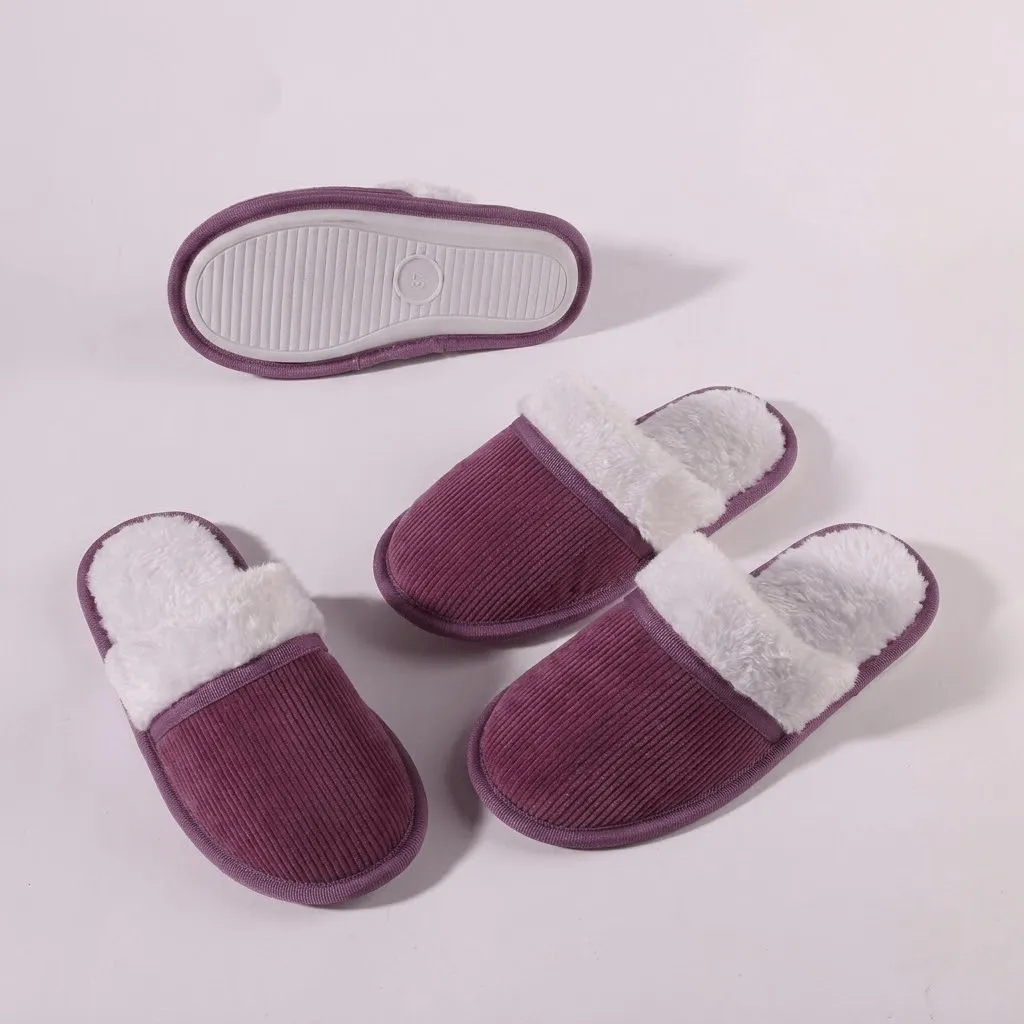
Outsole selection changes more than the bottom view. It affects weight, flexibility, visual profile, available tread, tooling, pack volume, and the way the upper is joined to the bottom. The right choice depends on the design and intended conditions of use.
Within UTOP’s common indoor slipper projects, a molded TPR outsole can provide a more defined sidewall, outline, and tread direction. A cut EVA bottom is often selected for a lighter, more flexible product. These are development directions, not automatic performance or price rankings. Formulation, hardness, thickness, weight, tread, construction, order quantity, tooling, and supplier quotation all matter.
Common UTOP construction routes
- Welt-stitched corduroy house shoes can commonly be developed with TPR or EVA bottoms.
- Side-stitched slippers commonly use molded TPR outsoles.
- Cold-glued slippers commonly use cut EVA bottoms.
- TPR can also be cold glued when the surface treatment, adhesive, pressing, and process conditions suit the specific construction.
Do not describe a slipper as slip resistant or suitable for outdoor wear from the material name or tread appearance alone. Grip and abrasion depend on the complete outsole specification, surface, dry or wet conditions, and the selected test method. When measurable performance matters, agree on the applicable standard, sample, condition, and acceptance criteria before production.
During sampling, review outsole material, color, odor, weight, thickness, hardness feel, dimensions, flatness, tread, left-right pairing, flex position, and upper-to-bottom connection as applicable. The slip-resistant outsole guide provides a fuller framework for materials, testing, and quality control.
6. Control Nap Direction, Color, and Pair Appearance
Corduroy changes character as light moves across its raised surface. Two panels cut in different directions can appear to be different shades even when they came from the same roll. That makes cutting direction and pair matching visible commercial issues, not merely factory details.
For a wholesale corduroy slippers order, the control sequence should begin before cutting:
- Identify the approved face and direction. Mark the required wale and nap orientation on the pattern or cutting instruction.
- Separate material lots. Record roll or lot information and avoid casual mixing when shade or surface character differs.
- Keep corresponding pieces together. Bundling controls help the left and right slippers follow the same material and direction.
- Inspect the assembled pair. Compare toe shape, wale direction, color, luster, seam position, and overall symmetry under an agreed light.
- Check after packing. Compression can alter the presentation of the pile or upper shape, particularly when cartons are tightly loaded.
The goal is not to remove every natural textile variation. The buyer and supplier should agree which differences are acceptable and which would make a pair look mismatched at retail. A clear visual standard is more useful than asking for “perfect color” or “no variation.”
| Stage | Appearance check | Reference |
|---|---|---|
| Incoming material | Color, wale, pile, finish, face, and visible flaws | Approved swatch and material record |
| Cut upper | Orientation, panel consistency, fraying, and marks | Pattern and cutting instruction |
| Finished pair | Left-right shade, rib direction, shape, seams, and cleanliness | Approved pair and defect criteria |
| Packed product | Pile marks, crushing, distortion, and recovery after unpacking | Approved packed sample |
For examples of how visible material, shape, outsole, and packing problems should be tied to an approved standard, review UTOP’s guide to common indoor slipper manufacturing defects.
7. Develop Branding and Packaging on the Real Product
A logo that looks clean on a flat artwork file may change when it crosses raised ribs, sits near a curved seam, or is stitched through a backed upper. The same applies to woven labels, printed details, insole branding, and decorative trims. Approve the method on the selected material and finished construction.
For private label corduroy slippers, give the supplier the original artwork file, color reference, target dimensions, placement measurements, and an orientation view. Then inspect edge clarity, stitch coverage, distortion, backing visibility, thread or print color, and left-right positioning on the sample. If the logo becomes hard to read, changing its size, location, or application method may be more effective than asking production to force the original layout.
Let the packaging prove it can protect the upper
Corduroy pile and soft slipper uppers can show pressure marks after tight packing. Test the real pack method, inserts, tags, pair orientation, units per carton, and expected storage time with the intended product. A packed sample should be opened and allowed to recover before the buyer judges its retail presentation.
Packaging check: confirm that the pair remains correctly shaped, the corduroy surface is not permanently marked, the logo stays visible, labels and barcodes match the SKU, and the carton arrangement follows the approved assortment.
Common options may include woven or printed labels, embroidery, insole branding, hang tags, insert cards, polybags, pouches, shoe boxes, display boxes, barcode labels, and custom carton marks. Availability and suitability depend on the product and order. UTOP’s footwear packaging guide explains how to connect the retail pack, SKU information, carton quantity, and shipment requirements.
Buyers planning a wider branded program can also use the private label slippers manufacturing guide to coordinate product specifications, branding, sampling, packaging, and bulk production.
8. Use Sampling and Quality Control as One System
The sample room and the production line should work from the same decisions. If the buyer approves a pair but the fabric lot, pattern direction, lining, cushioning, outsole, logo, or pack method remains undocumented, bulk production still has too much room for interpretation.
Sampling for corduroy house slippers is more useful when each sample has a clear purpose:
| Sample or approval | What it should answer | Record to keep |
|---|---|---|
| Material swatch | Corduroy face, wale, color, hand, backing, lining, and outsole direction | Supplier reference, lot or quality code, date, and approval status |
| Development sample | Shape, material combination, construction, workmanship, and first fit review | Style, size, version, measurements, photos, and consolidated comments |
| Size-set or fitting sample | Size mapping, inside space, grade, edge sizes, and wearer direction | Size table, measurement method, fitting result, and approved range |
| Branding and packing sample | Logo execution, labels, barcode, product support, and recovery after packing | Final artwork, placement, pack instructions, and packed reference |
| Final approved reference | The complete direction authorized for production | Identified pair plus current specification and open-item status |
Approval comments should be consolidated and versioned. “Make the upper firmer” is not enough if one person expects a backing change and another expects a pattern change. Record what changes, which sample it applies to, and which earlier version is no longer active.
The footwear quality control guide explains how an approved sample and current specification continue into incoming-material, in-process, finished-product, and packing checks.
Carry the reference into bulk production
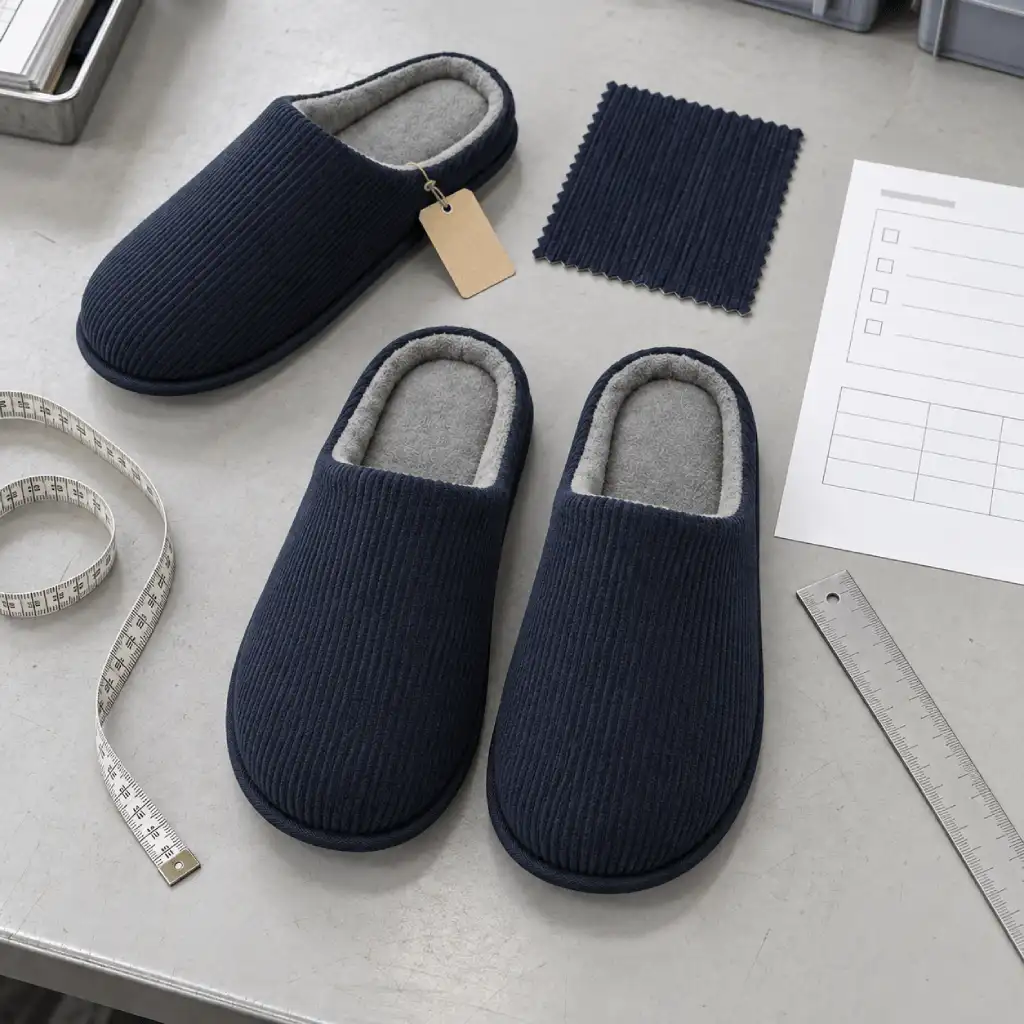
A final inspection cannot efficiently correct every material or construction decision made earlier. The control plan for wholesale corduroy slippers should place checks where a problem can still be contained.
| Production stage | Corduroy-specific focus | Wider product checks |
|---|---|---|
| Material receiving | Wale, color, pile, face, backing, roll condition, and lot identity | Lining, foam, outsole, trims, labels, and packaging components |
| Cutting | Nap and wale direction, panel matching, flaws, and bundle control | Pattern, size, quantity, identification, and cut accuracy |
| Sewing and upper making | Rib alignment, seam appearance, puckering, fraying, and marks | Shape, symmetry, lining, binding, logo, and workmanship |
| Assembly and finishing | Surface cleanliness, pile disturbance, pair shade, and upper shape | Sizing, outsole alignment, stitching or bonding, flatness, and pairing |
| Packing and release | Compression marks, distortion, and recovery | Correct SKU, size, color, labels, barcode, pack quantity, and carton marks |
Define whether inspection will use sampling, 100% checking for selected points, or another agreed approach. Any AQL level, defect classification, test plan, and release authority should be agreed for the order rather than copied from an unrelated footwear program.
Change-control rule: if the corduroy quality, color lot, backing, pattern, lining, cushioning, outsole, logo, or packing changes after approval, record the change and assess which connected checks must be repeated.
9. Prepare a Quotation-Ready Wholesale Brief
A quotation is only comparable when every supplier is pricing the same product and commercial scope. “Corduroy upper, fleece lining, TPR sole” leaves too many decisions open. A useful RFQ connects the product, quantity, approvals, packaging, testing, and delivery target.
Include these details where available:
- Reference product, drawing, sample, or tech pack
- Destination market, channel, wearer, and season
- Total quantity and breakdown by color and size
- Corduroy quality, wale, color, backing, and cut direction
- Lining, footbed cover, cushioning, and fit direction
- Outsole material, construction, tread, and attachment
- Logo artwork, labels, barcode, and packaging
- Required tests, reports, and inspection method
- Incoterm, packing quantity, destination, and shipment plan
- Requested sample date, approval window, and delivery date
For UTOP’s usual custom corduroy slippers projects, sample development typically takes 7–14 days. After the necessary samples and other approvals are complete, bulk production commonly takes 30–45 days. The actual calendar depends on material preparation, outsole tooling, sample revisions, testing, order quantity, branding, packaging, and current production planning.
Work backward from the required delivery date. Allow time for material review, sample transport, buyer comments, revisions, size or fitting checks, tests, artwork, packaging, order confirmation, production, inspection, and shipment. A factory production estimate is only one part of the launch calendar.
If the program will enter the EU, identify the materials and product scope before deciding what documentation or testing is required. The European Commission’s overview of the REACH Regulation is a useful official starting point, but product-specific obligations should be confirmed for the actual market and supply chain.
A structured shoe tech pack can keep the current material, construction, measurements, artwork, packaging, comments, and approval status together as the product changes.
Frequently Asked Questions About Corduroy House Shoes
What should a buyer specify for corduroy house shoes?
Specify the product shape, target wearer, size range, corduroy composition and quality reference, wale character, color, backing, cut direction, lining, cushioning, outsole, construction, branding, packaging, testing, quantity, and delivery requirements. Keep the approved material reference with the final sample and current specification.
Is fine-wale or wide-wale corduroy better for slippers?
Neither is automatically better. Wider ribs create a stronger visual texture and may work well on simple panels. Finer ribs can suit smaller components or a more restrained look. Judge the wale against the pattern, seam layout, logo, size range, and finished sample.
How can color and nap mismatch be reduced in bulk production?
Approve the material face and direction, mark each pattern piece, separate material lots, keep corresponding panels together, and inspect the completed pair under agreed lighting. The final standard should show the acceptable direction, shade, rib appearance, and pair relationship.
Should corduroy slippers use TPR or EVA outsoles?
Choose according to the product structure and intended use. A molded TPR outsole can provide a defined profile and tread direction, while a cut EVA bottom is often used for a lighter and more flexible product. Cost and performance depend on the complete specification, construction, tooling, quantity, and test requirements—not the material name alone.
Can corduroy slippers be customized for a private label?
Yes. Depending on the style and order, buyers can discuss corduroy quality and color, lining, cushioning, outsole, size range, embroidery, labels, insole branding, packaging, barcodes, and carton marks. Each selected option should be confirmed on the relevant sample and specification before bulk production.
How long do custom samples and bulk production take?
UTOP’s usual sample-development window is 7–14 days. Bulk production commonly takes 30–45 days after the required samples and order details are approved. Materials, tooling, revisions, testing, quantity, branding, packaging, and production loading can change the actual schedule.
Build the Product Around an Approved Reference
Successful corduroy house shoes are not defined by one impressive material claim. They come from a connected set of decisions: a fabric that suits the pattern, a lining and cushioning package that preserves fit, an outsole and attachment method that match the construction, and approval records that continue into production and packing.
If you are developing wholesale corduroy house shoes, send UTOP your preferred style or reference image, target market, estimated quantity, colors, size range, corduroy direction, outsole preference, logo file, packaging needs, and requested delivery window. Our team can review the brief and identify the material, sampling, and production questions that should be resolved before quotation.
Planning a corduroy slipper collection?
Discuss Your Project with UTOP