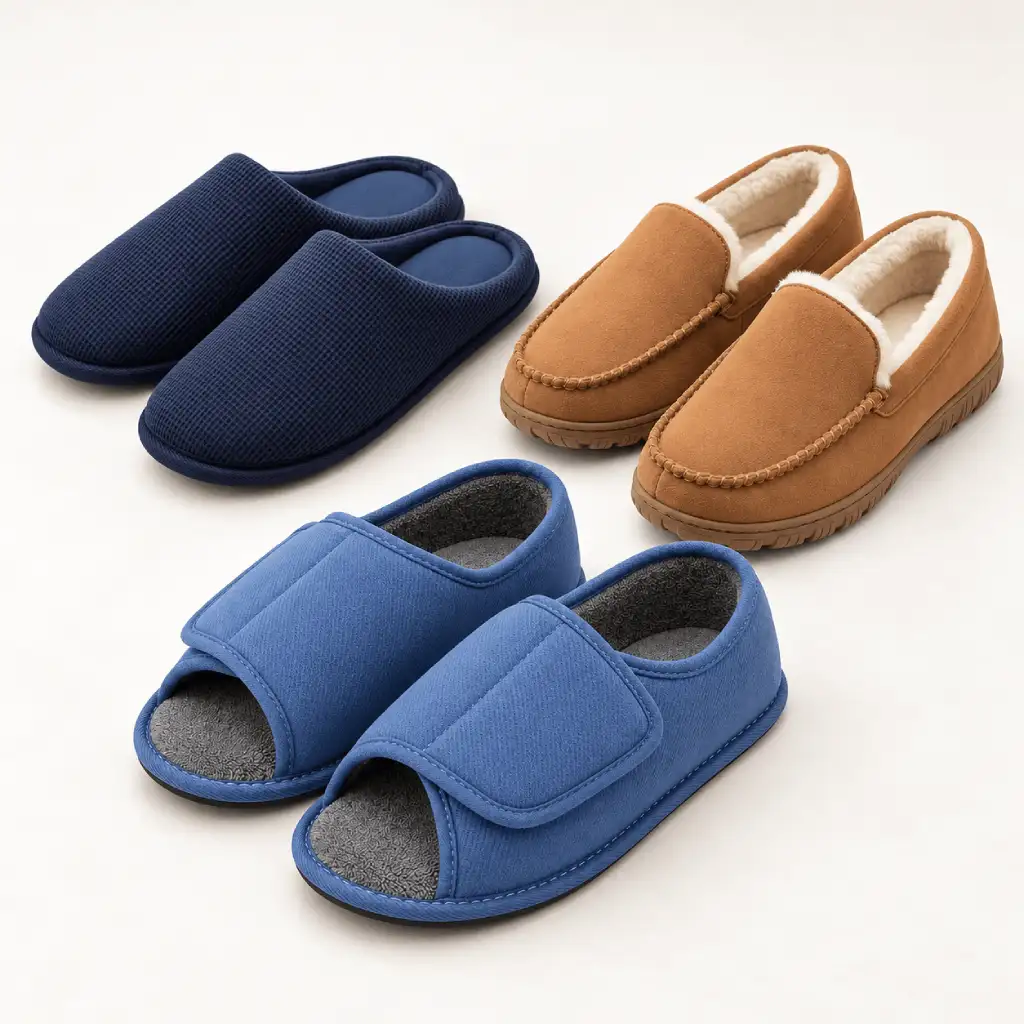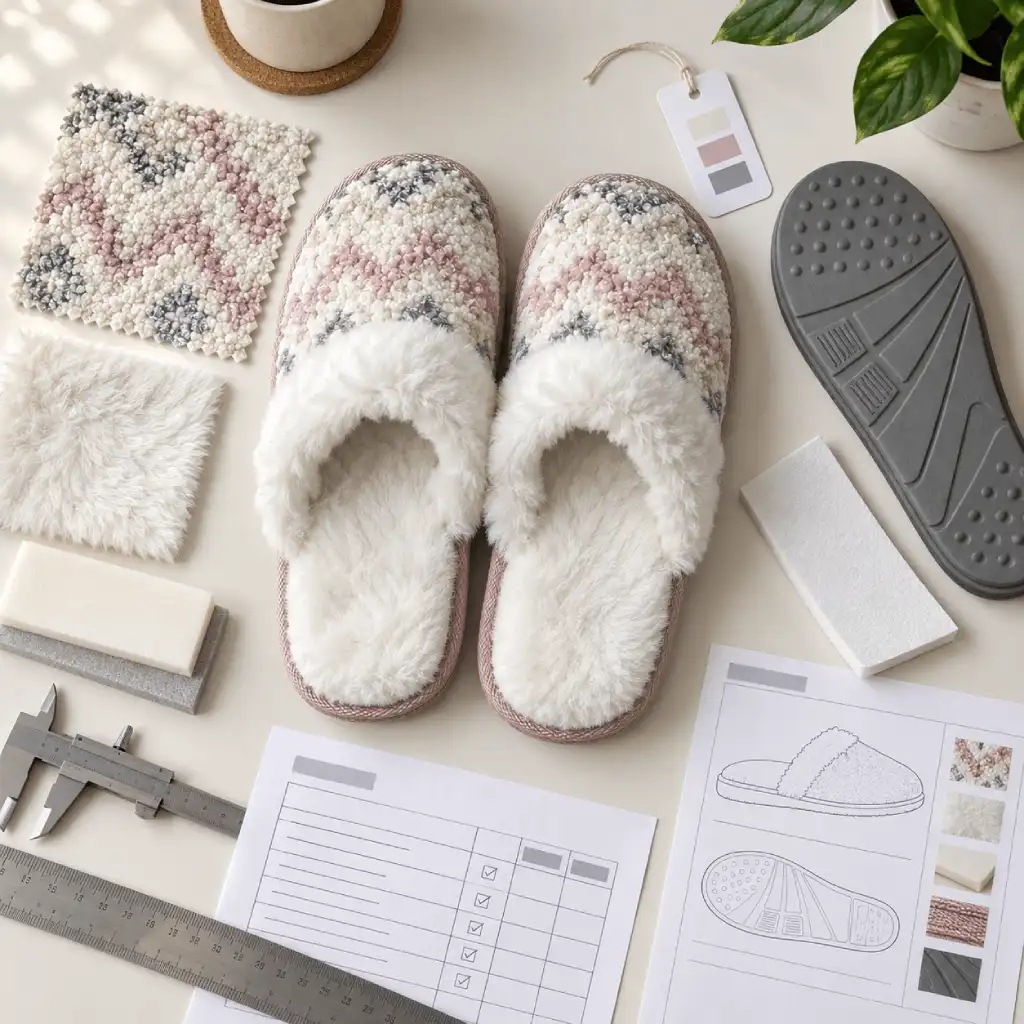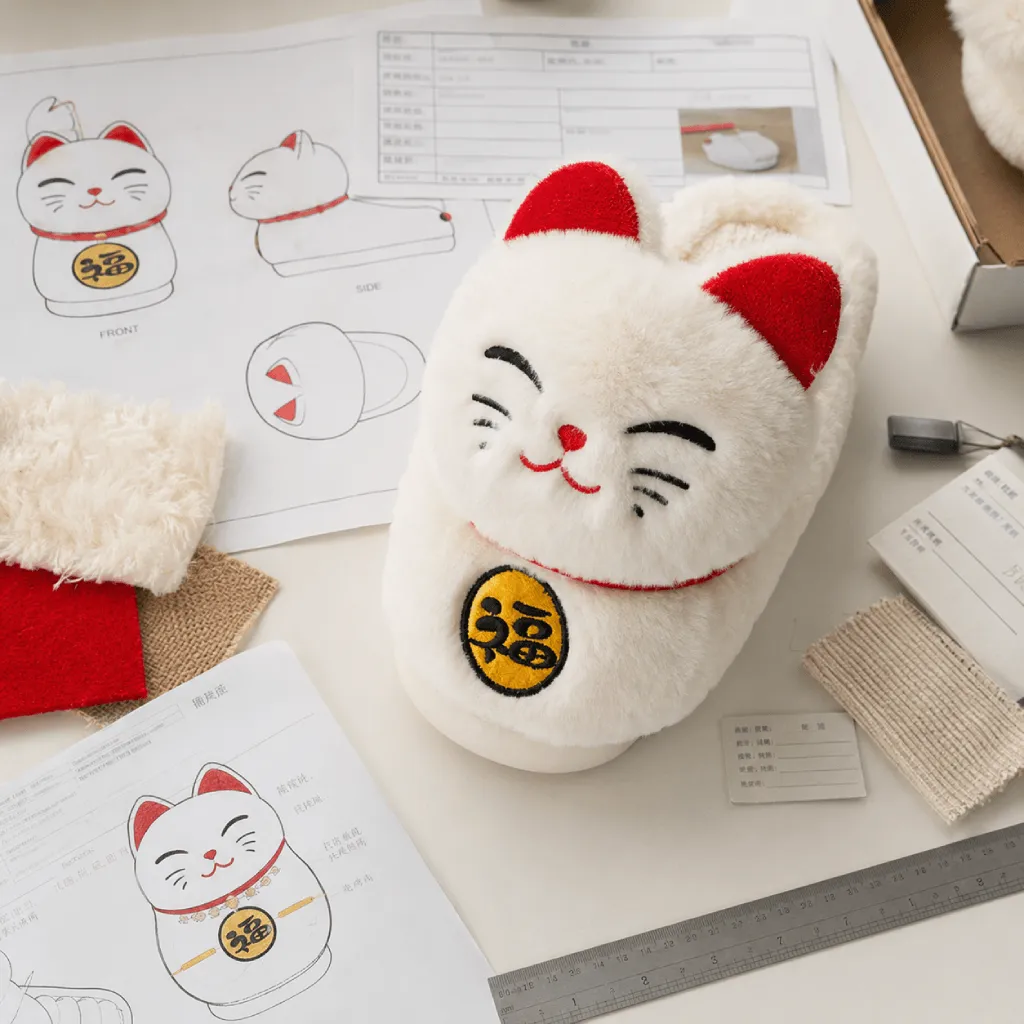
Bulk house slippers are easy to compare by unit price and difficult to compare as complete programs. Two quotations may describe a similar-looking pair while using different upper specifications, lining weights, cushioning, outsole constructions, size ratios, logo methods, packaging, inspection plans, or delivery assumptions.
For wholesalers, importers, retailers, and private-label brands, the safest time to resolve those differences is before sampling and bulk production. A clear buying checklist makes quotations more comparable, gives the approved sample a defined purpose, and reduces late changes that can affect cost or schedule.
This guide presents ten practical checks for sourcing wholesale house slippers. It covers product definition, materials, outsoles, fit, branding, packaging, RFQs, samples, quality control, and delivery—without assuming that one material or construction is automatically suitable for every market.
Buyer takeaway: compare complete, written specifications—not product names alone. A reliable bulk order starts when the buyer and supplier are quoting, sampling, producing, inspecting, and packing the same defined product.
Scope: this article addresses reusable indoor house slippers for retail, wholesale, gift, e-commerce, and private-label programs. Disposable hotel and spa slippers have different material, packing, and usage requirements and should be reviewed as a separate product category. Buyers ready to compare styles can begin with UTOP’s custom indoor slipper product center.
Written by the UTOP Slippers Sourcing Team, with product-development, production, and quality-control input from our indoor slipper manufacturing team.
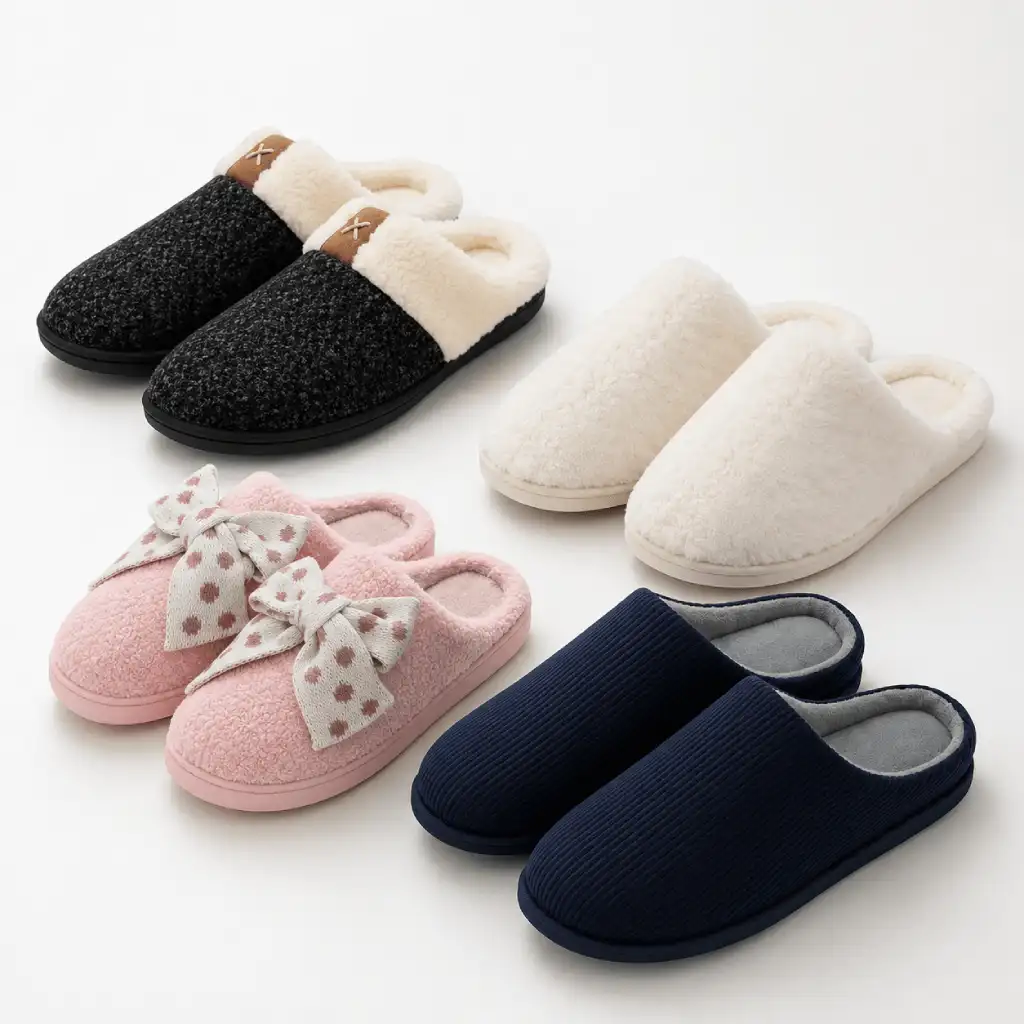
1. Clarify the Buyer Program and Sales Channel
Before asking for house slippers in bulk, define where the product will be sold and who will wear it. A winter supermarket promotion, an e-commerce gift item, a department-store homewear range, and a private-label core style can require different presentation, size assortments, durability expectations, and packaging.
| Program question | Why it changes the specification | Information to give the supplier |
|---|---|---|
| Who is the wearer? | Affects silhouette, fit direction, size range, materials, and decoration | Women, men, kids, unisex, age range, and fit expectations |
| Where will it sell? | Retail shelves, online fulfillment, and gift programs use different packs and labels | Sales channel, retail position, display method, and warehouse needs |
| When will it sell? | Season influences upper coverage, lining, color direction, and launch timing | Season, target launch date, and requested delivery window |
| Which market receives it? | Destination requirements can affect labels, testing, documentation, and packaging | Country or region, buyer standards, and applicable market requirements |
Do not use “general indoor use” as the entire brief. Explain whether the slipper is intended mainly for bedrooms and lounges, short household movement, gifting, or a specific retail promise. If measurable slip resistance, abrasion, washability, or chemical requirements matter, identify the relevant test method and acceptance criteria before quotation.
Buyer check: write a one-sentence program definition: “A women’s closed-toe indoor slipper for a winter retail collection in [market], sold in [pack type], with delivery required by [date].” This gives the wholesale house slippers project a usable commercial starting point.
2. Define the Product and Quantity Plan
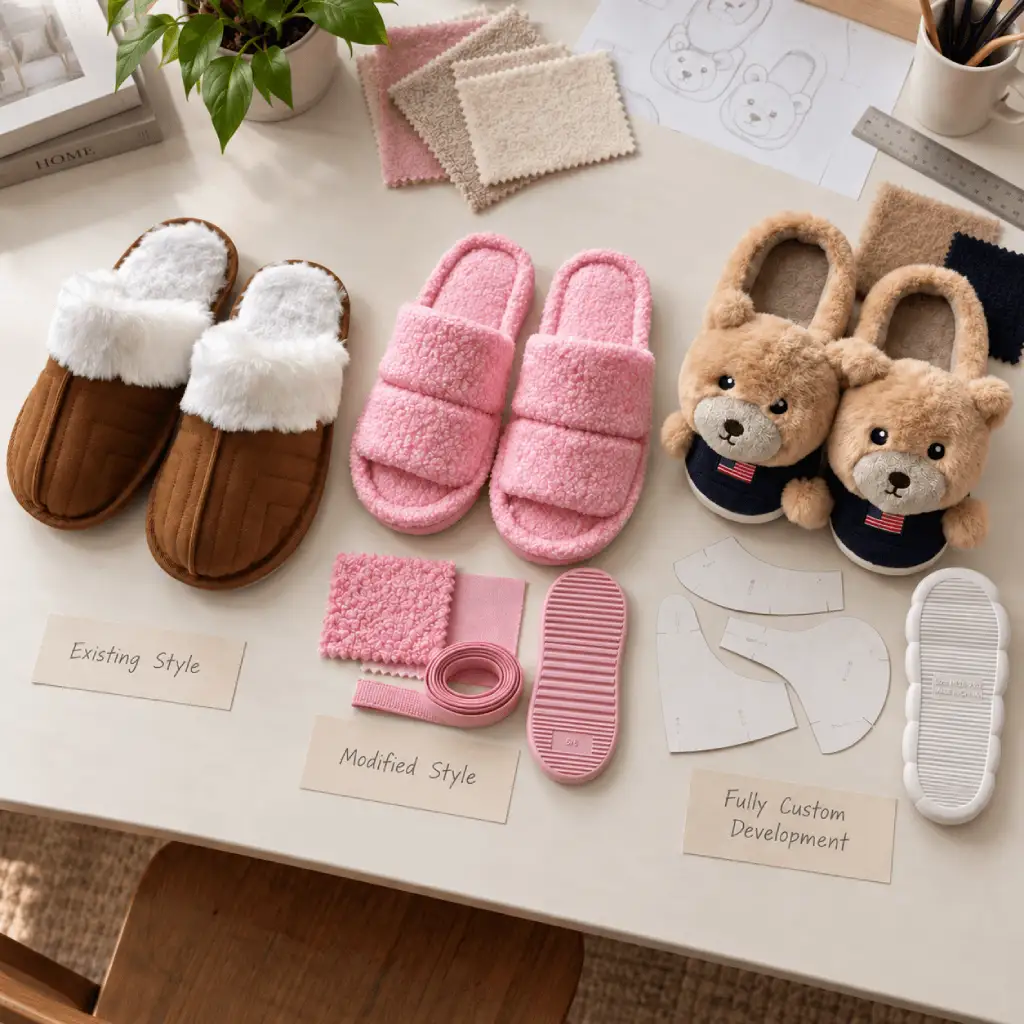
“Slipper” is not a complete product specification. A request for house slippers bulk should identify the silhouette, upper coverage, heel construction, expected structure, outsole direction, color plan, and size assortment. A supplier SKU, reference product link, technical drawing, or clearly labeled reference image can help establish the starting point.
Separate search terms from technical definitions
Buyers and suppliers may use “house slippers,” “indoor slippers,” “bedroom slippers,” and “house shoes” differently. These terms can describe the market or use, but they do not settle construction. Define the actual product as open-back, closed-back, bootie, ballerina, slide, mule, or another agreed shape, then document the components.
- Product direction: wearer, silhouette, toe and heel coverage, season, and intended use.
- Total volume: estimated pairs for the complete order.
- Breakdown: quantity by style, color, size, and packaging variation.
- Assortment: units per color and the size ratio within each color.
- Reference status: which details should be matched and which can be developed.
Quantity affects more than price. Material minimums, color preparation, logo setup, outsole tooling, packaging print runs, carton assortments, and line planning may each have separate thresholds. Instead of asking only for a general MOQ, give the proposed breakdown and ask the supplier to identify the practical constraint behind each minimum.
Avoid this quotation gap: “10,000 pairs in four colors” is not the same production plan as “10,000 pairs, with 2,500 pairs per color and an agreed size ratio.” The second version lets a house slippers wholesale supplier review materials, production, and packing more accurately.
3. Confirm Materials and Construction
A fabric name is only the first layer of a bulk house slippers specification. Plush, fleece, jersey knit, wool felt, faux suede, corduroy, and velvet differ in surface, backing, stretch, thickness, cutting behavior, sewing stability, and availability. “Soft” or “warm” cannot replace a controlled material reference.
| Component | Confirm in writing | Review on the sample |
|---|---|---|
| Upper and lining | Material type, construction, weight or thickness where relevant, color reference, backing, and approved supplier quality | Handfeel, pile direction, stretch, coverage, seams, color, and shape |
| Cushioning and footbed | Foam type or combination, thickness, density or hardness when controlled, and cover material | Initial feel, recovery, fit effect, edge shape, and pair consistency |
| Stitching and assembly | Construction method, seam position, thread direction, reinforcement, and upper-to-bottom connection | Seam balance, skipped stitches, puckering, loose threads, alignment, and attachment |
| Trim and decoration | Material, dimensions, position, orientation, attachment method, and left-right rule | Placement, appearance, security, comfort, and packing recovery |
Construction terminology also matters. A welt-stitched slipper, side-stitched slipper, cold-glued slipper, and injection-molded footwear style use different assembly routes. Do not approve one method from a photograph while expecting another production structure. If the product uses jersey, call it jersey knit rather than wool felt; if it uses felt, state the fiber or composition information required for the project.
Ask the supplier to retain or identify approved swatches for visible materials and critical components. If a material is changed after approval because of availability, color, or production concerns, the change should be documented and reviewed before it enters the wholesale house slippers order.
4. Select the Outsole by Intended Use
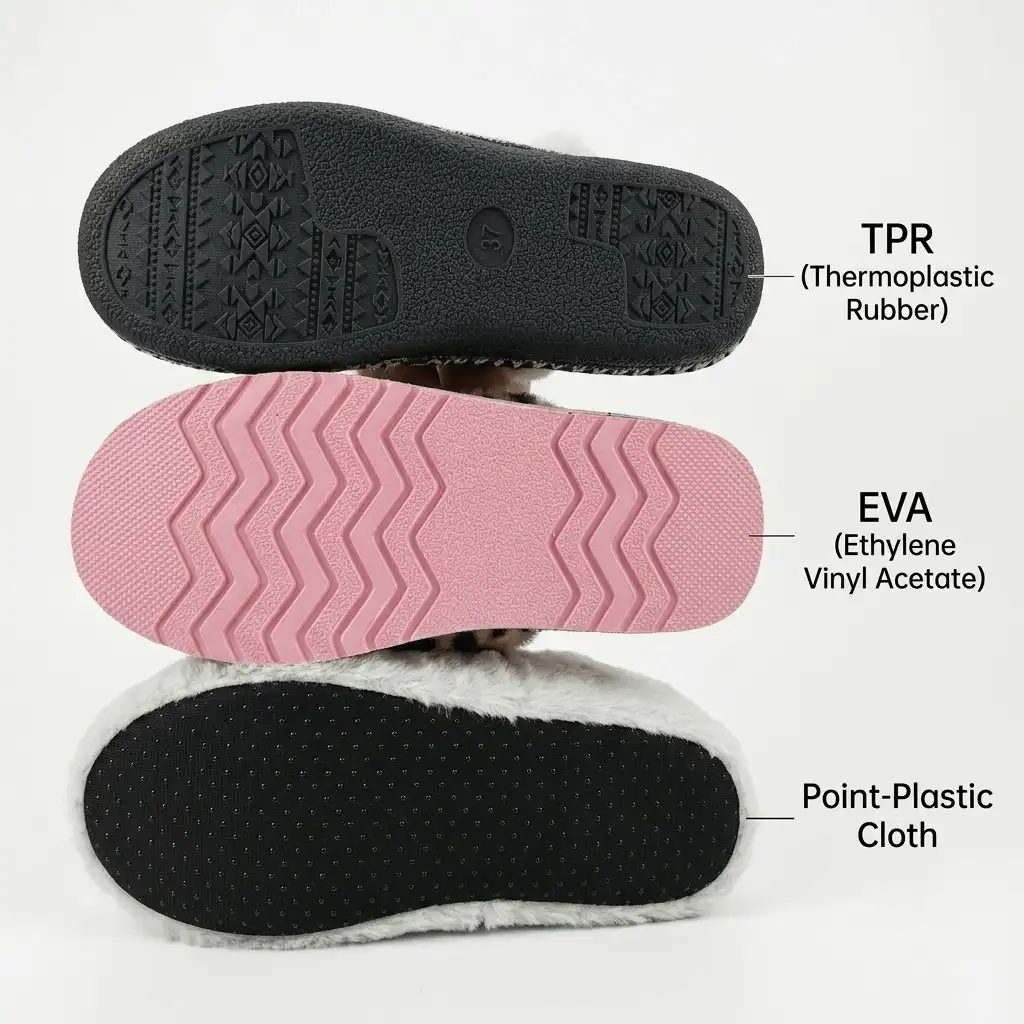
TPR and EVA are common directions for reusable wholesale house slippers, but the material name does not determine the complete result. Formulation, hardness, density, thickness, weight, tread, outsole shape, attachment method, floor surface, and test conditions can all affect flexibility, grip, abrasion, noise, support, and cost.
| Outsole direction | Typical structural direction | Buyer checks |
|---|---|---|
| Molded TPR | Often used where a defined outsole profile, sidewall, tread, or structured house-shoe appearance is required | Formulation, hardness, thickness, weight, tread, flex behavior, attachment, tooling, and target use |
| Cut EVA | Often used for a lighter, more flexible bottom assembled from sheet material | Density or hardness, thickness, compression, edge finish, tread layer if used, bond preparation, and target use |
| Other fabric or molded bottoms | Selected for a particular construction, price position, packing requirement, or wearing condition | Complete layer structure, attachment, durability expectation, floor contact, labeling, and any required tests |
UTOP commonly works with cut EVA as well as molded TPR directions. Welt-stitched constructions can generally be developed with TPR or EVA, side-stitched styles commonly use TPR, and cold-glued styles commonly use EVA. These are production directions, not absolute rules: the confirmed design, outsole preparation, adhesive system, pressing, and factory process determine the workable construction.
If a custom molded tread, outsole logo, or exclusive outsole shape is required, confirm tooling ownership, cost, lead time, usable size range, maintenance responsibility, and future repeat-order access. For a more detailed comparison, use UTOP’s TPR vs. EVA Sole for Slippers Guide.
Performance boundary: a tread pattern or material label alone does not prove slip resistance. When measurable performance matters, define the floor surface, dry or contaminated condition, test method, laboratory or buyer protocol, and acceptance requirement. See the Slip-Resistant Outsole Guide for the wider evaluation framework.
5. Approve the Size Range and Fit
Ordering house slippers in bulk requires more than converting labels between EU, US, or UK systems. A marked size does not establish the actual inside length, width, opening, instep volume, toe allowance, heel hold, or fit of the finished slipper.
Build a product-specific size specification around the approved construction. Thick lining, plush pile, cushioning, binding, closed-back shaping, and outsole walls can reduce usable internal space even when the outside length looks correct. Open-back slippers may require different fit checks from closed-back or bootie styles.
Review sizes as a set
- Confirm the labeled size system and the target wearer.
- Record project-specific dimensions, measuring points, and tolerances.
- Approve a fit sample in the base size before relying on label conversion.
- Check small, base, and large sizes to confirm grading and proportion.
- Confirm the purchase quantity ratio by size, not only the available size range.
- Keep size labels, outsole marks, packaging labels, and carton assortments consistent.
A generic conversion chart can support communication, but the actual wholesale house slippers must be approved against their own pattern, materials, lining, footbed, and construction. UTOP’s Slipper Size Chart and Bulk Sizing Guide explains the difference between foot length, inside length, outsole length, fit review, and bulk size ratios.
Approval rule: do not approve only the middle size and assume every size grades correctly. Review representative sizes and define which dimensions, proportions, and fit points must remain consistent across the range.
6. Lock Branding and Labeling Details
Private-label bulk house slippers may use embroidery, woven labels, printed labels, heat transfer, insole printing, outsole embossing, hangtags, or branded packaging. The best method depends on the actual surface, pile height, stretch, logo detail, color count, expected appearance, and production repeatability.
| Branding item | Approval details | Common risk |
|---|---|---|
| Logo artwork | Vector file, dimensions, colors, orientation, and approved simplification if needed | Fine details close up or distort on plush or stretch fabric |
| Application | Method, backing, thread or ink color, placement reference, and attachment | A digital mockup is approved without a sample on the real material |
| Product labels | Brand, size, fiber or material information where required, care, origin, SKU, and language | Data differs between the shoe, hangtag, retail pack, and carton |
| Barcode data | Buyer-supplied number, symbology, size, quiet zone, contrast, position, and scan approval | The visual layout is approved without checking encoded data or scan quality |
Approve branding on the actual selected material. A logo that looks clear in a PDF may sink into long pile, stretch on knit, become uneven across a seam, or feel uncomfortable at the foot contact area. Placement should use measurable reference points rather than instructions such as “roughly centered.”
For retail identification, the brand owner should confirm its own numbering and retailer requirements. The official GS1 barcode standards overview explains the role of barcodes in identifying products and supply-chain units. UTOP can apply buyer-approved barcode artwork, but the buyer should control the assigned data and final approval.
Use the Custom Logo Guide for Bulk Slippers when comparing logo methods for a house slippers wholesale program.
7. Confirm Packaging and Carton Requirements
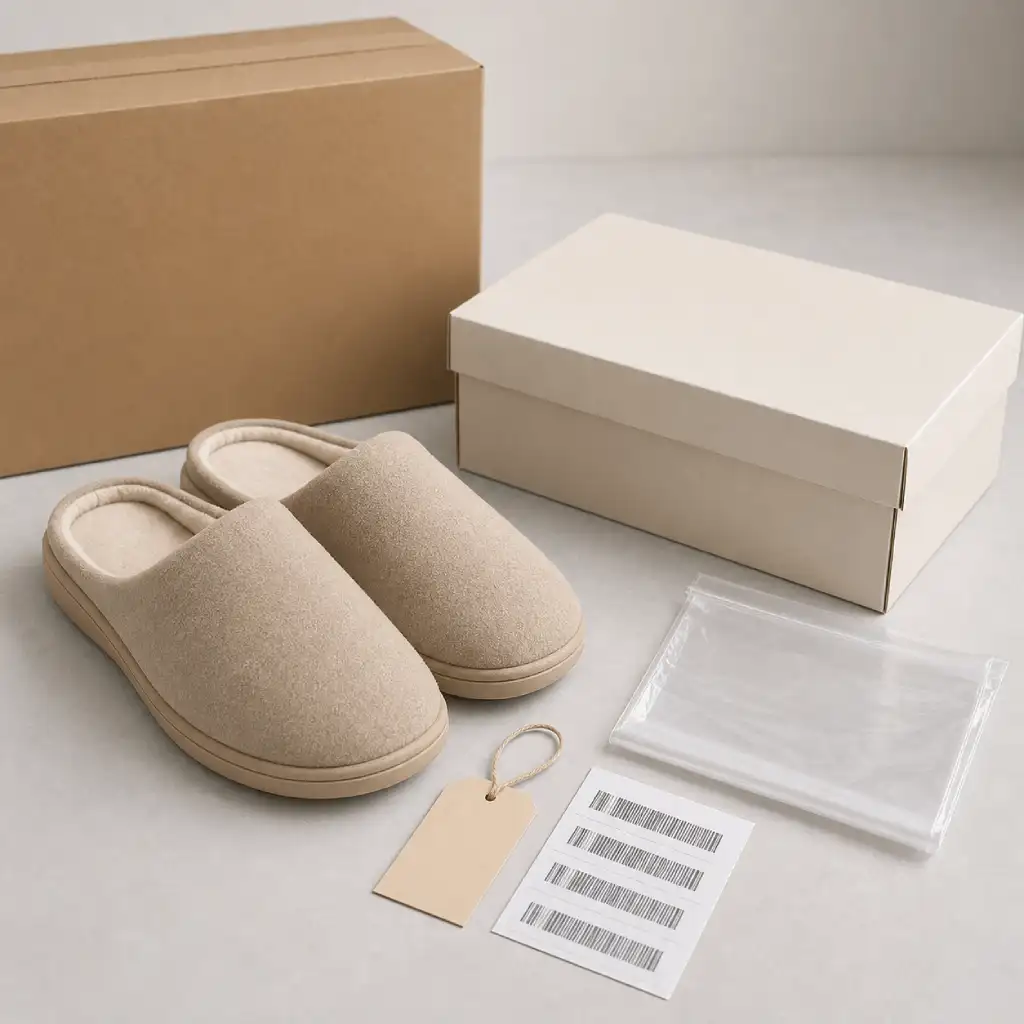
Packaging affects the landed result of house slippers bulk orders. It influences presentation, product protection, label accuracy, carton utilization, warehouse handling, e-commerce fulfillment, and recovery after compression. Confirm it before final quotation—not after the slippers have entered production.
Define every packing level
- Inside the pair: tissue, stuffing, shaper, insert, moisture-control item if approved, and left-right presentation.
- Individual pack: polybag, pouch, belly band, hanger, color box, display box, closure, ventilation, warnings, and labels.
- Inner pack: pairs per inner carton or assortment, if used.
- Master carton: pairs per carton, size/color ratio, dimensions, weight limits, carton strength requirement, sealing, and shipping marks.
- Data control: SKU, product name, color, size, barcode, quantity, country of origin, and destination-specific information.
Approve a fully packed sample when the retail presentation or compression method can change the product. Plush uppers, closed backs, bows, ears, pom-poms, and structured outsoles may need shaping or a recovery check after unpacking. A loose sample does not prove that the finished pack will reach the customer in the approved condition.
Buyer check: reconcile the individual pack, assortment, pairs per carton, carton count, and total order quantity. A one-line packing instruction can create repeated label and quantity errors across an otherwise acceptable wholesale house slippers shipment.
For a complete approval list covering individual packs, labels, barcodes, assortments, and shipping cartons, use UTOP’s Footwear Packaging Guide.
8. Send a Complete RFQ and Compare Like for Like
A low unit price does not make two wholesale house slippers quotations comparable. One quote may exclude custom packaging, testing, tooling, sample revisions, or a required material standard. Another may assume a different size ratio, outsole weight, logo method, Incoterm, or delivery destination.
| RFQ block | Required information | Quotation point to compare |
|---|---|---|
| Product | Style reference, wearer, season, materials, cushioning, outsole, construction, and target quality | Whether every supplier priced the same component structure |
| Assortment | Total pairs, colors, size range, and quantity by color and size | Minimums, surcharges, and pricing basis by variation |
| Branding and pack | Artwork, logo method, labels, barcode data, individual pack, assortment, and carton marks | Setup, tooling, print, packaging, and packing costs included or excluded |
| Quality and compliance | Approved references, tolerances, inspection plan, testing requirements, documentation, and destination market | Test scope, laboratory responsibility, inspection cost, and acceptance criteria |
| Commercial terms | Currency, Incoterm and named place, payment, sample plan, requested date, and ship-to location | Included logistics, lead-time assumptions, validity, and payment exposure |
Ask suppliers to list assumptions and exclusions instead of filling gaps silently. Then normalize the comparison: unit cost, tooling, sampling, testing, packaging, inspection, transport basis, payment terms, lead time, and the cost of each approved variation.
Market requirements should be treated as project inputs, not generic supplier claims. For EU-bound programs, the European Commission’s REACH Regulation overview provides the official starting point for chemical requirements. For products sold in California, review the official Proposition 65 information. The buyer should determine which rules, buyer standards, tests, labels, and records apply to the specific product and destination.
Useful request: “Please quote this specification and list every assumption, exclusion, tooling charge, test charge, packaging cost, and lead-time dependency.” That sentence makes a house slippers wholesale comparison more transparent than asking only for the “best price.”
9. Use Sample Approval as Production Control
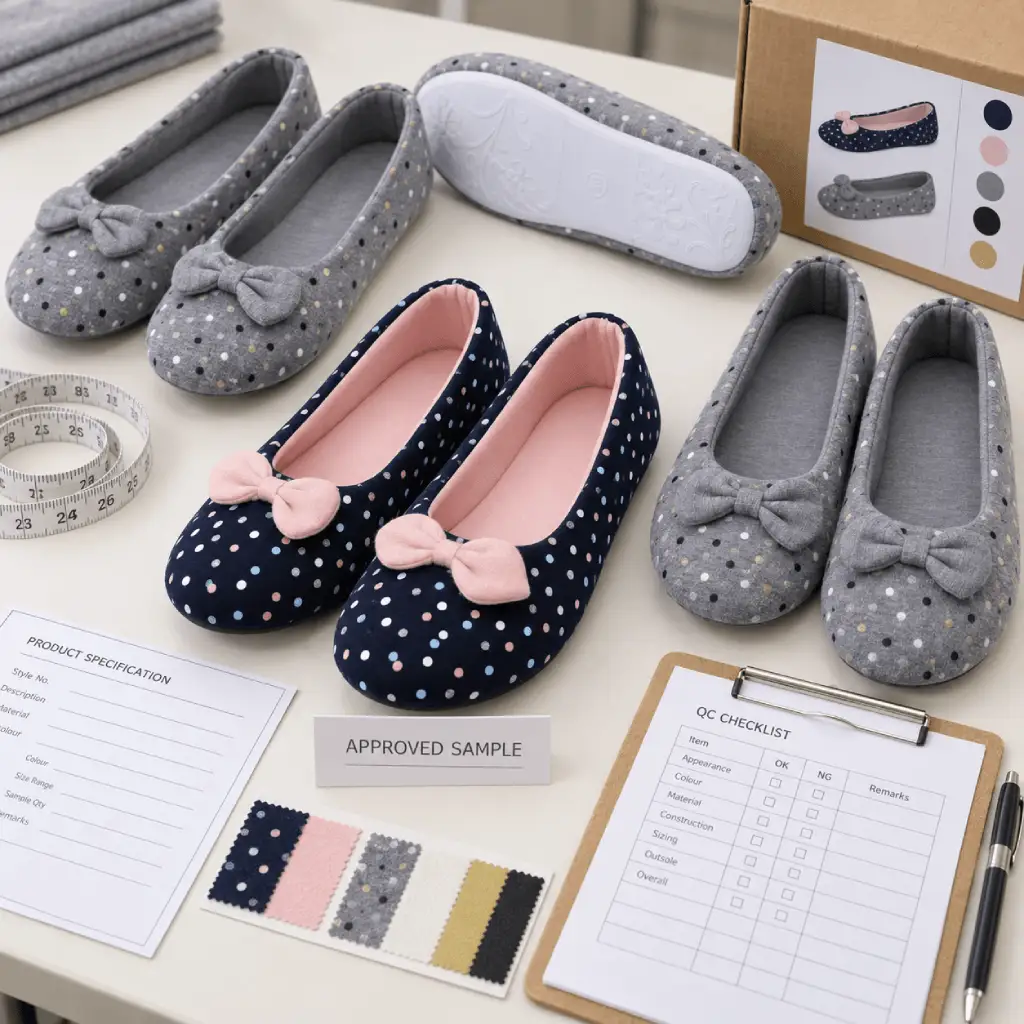
A sample is not only a sales presentation. For bulk house slippers, the approved physical pair and the final written specification should work together as the production reference. Photographs cannot fully define handfeel, material identity, dimensions, cushioning, outsole hardness, attachment, fit, or packing recovery.
What to record during approval
- Identity: sample version, date, style, color, size, and approval status.
- Materials: upper, lining, foam, footbed cover, outsole, thread, trims, labels, and color references.
- Measurements and fit: agreed measuring points, tolerances, fit notes, and representative size review.
- Workmanship: shape, pair symmetry, seams, edges, attachment, decoration, logo, and cleanliness.
- Bottom: material, thickness, hardness or density if controlled, tread, markings, flatness, flexibility, and connection.
- Pack: labels, barcode data, shaping, individual packaging, assortment, carton quantity, and shipping marks.
- Tests: agreed method, sample size, conditions, laboratory, result format, and acceptance criteria where required.
A sample review should identify both accepted features and required corrections. Approving “with comments” is risky when the corrected points are not incorporated into a new sample, sealed reference, or clearly controlled production document. When changes affect fit, materials, outsole, logo, construction, or packaging, confirm whether another approval round is necessary.
UTOP’s typical custom sample development time is about 7–14 days, but the actual schedule depends on material preparation, artwork, tooling, construction, packaging, testing, and revision scope. The broader sequence is covered in the Private Label Indoor Slippers Manufacturing Guide.
Change-control rule: after the sample is approved, do not replace a material, size rule, logo, outsole, construction, or packaging component without documented buyer review. The wholesale house slippers reference must stay aligned with what production is instructed to make.
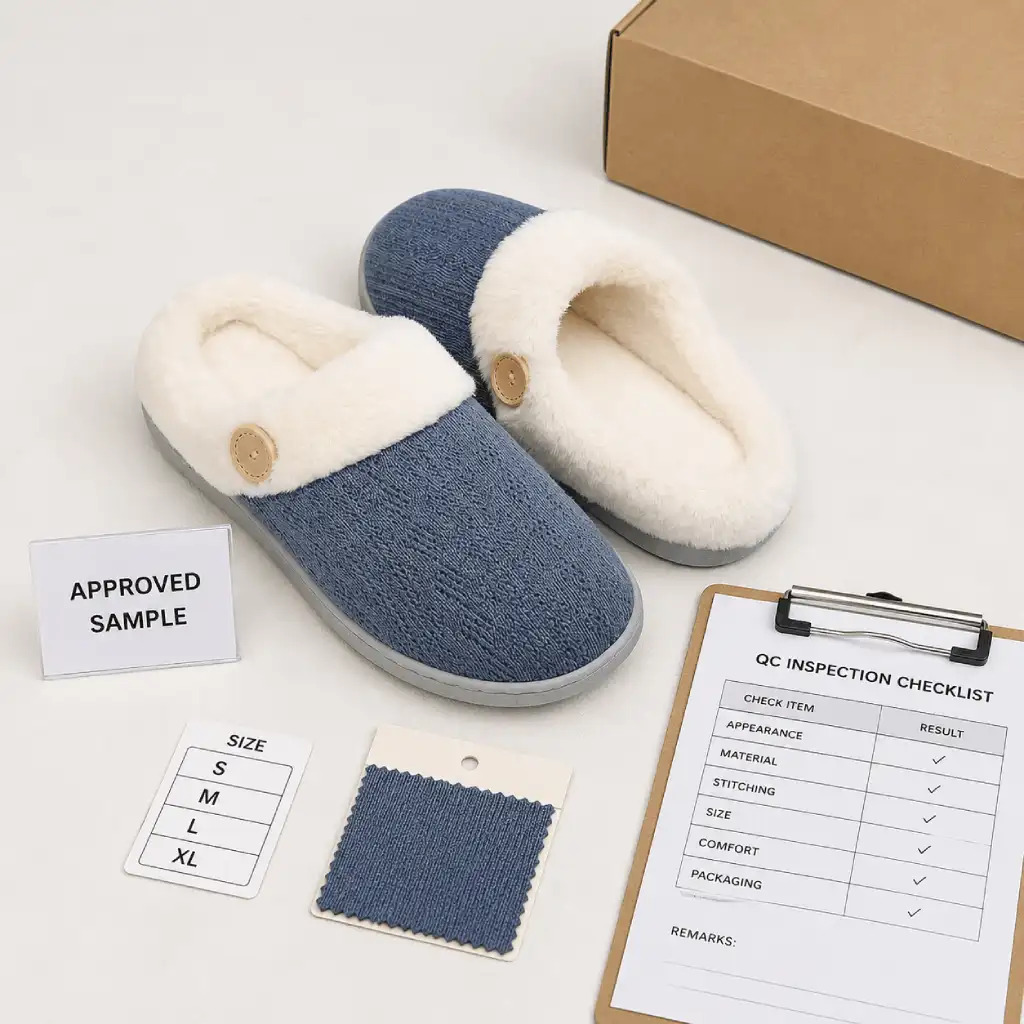
10. Control Bulk House Slippers Quality, Delivery, and Supplier Handover
Sample approval does not remove production variation. The production plan for house slippers in bulk should identify what will be checked, when checks occur, which references apply, how nonconforming results are handled, and who authorizes shipment.
At sample and bulk stages, relevant checks can include material and color, odor, weight, thickness, hardness or density where specified, dimensions, flatness, tread, left-right pairing, flex behavior, upper-to-bottom attachment, logo, labels, packaging, and carton data. The exact inspection plan depends on the product, order, buyer requirements, and risk.
Use one final 10-point wholesale checklist
- Program: target wearer, channel, season, market, price position, and delivery need are clear.
- Product: silhouette, intended use, total quantity, colors, sizes, and assortment are defined.
- Materials: upper, lining, cushioning, footbed, trims, and color references are controlled.
- Outsole: material, construction, thickness, hardness or density where relevant, tread, tooling, and attachment are agreed.
- Fit: size system, measurements, tolerances, base-size fit, grading, and size ratio are approved.
- Branding: artwork, method, colors, position, labels, SKU, and barcode data are approved.
- Packaging: individual pack, inserts, assortment, carton quantity, labels, marks, and packed sample are confirmed.
- Commercial terms: price basis, tooling, sampling, testing, Incoterm, payment, validity, and exclusions are comparable.
- Approval: the final sample, written specification, artwork, measurements, test requirements, and revision status agree.
- Production and release: material checks, in-process controls, final inspection, packing verification, nonconformity response, and shipment authority are assigned.
UTOP’s typical bulk production time is about 30–45 days after sample and other required approvals, but actual timing depends on order volume, materials, tooling, packaging, testing, production capacity, and the confirmed schedule. The plan should work backward from the required arrival or launch date and include approval time, production, inspection, booking, transit, and destination handling. See the Bulk Slippers Lead-Time Management Guide for a fuller timeline.
Evaluate the supplier’s control system, not only the sample
A good development sample is useful, but buyers should also review how the supplier controls approved materials, revisions, size assortments, production records, inspections, packing data, and communication. Ask who owns each handover from development to purchasing, production, QC, packing, and shipment.
UTOP has nearly 15 years of international trade experience and works with an indoor slipper manufacturing team in Anhui, China. Our focus is converting confirmed requirements into scalable sampling, production, inspection, packing, and delivery plans for B2B buyers. For the wider QC framework, read the Footwear Quality Control Guide for Bulk Slipper Orders.
Frequently Asked Questions About Bulk House Slippers
What should I include in a wholesale house slippers RFQ?
Include the product or reference style, intended wearer and market, estimated quantity, color and size breakdown, materials, outsole, construction, logo, labels, packaging, testing or inspection requirements, delivery destination, Incoterm, and requested schedule. Ask the supplier to state assumptions and exclusions.
Is TPR or EVA better for house slippers in bulk?
Neither is automatically better. Suitability depends on the required product structure, formulation, hardness or density, thickness, weight, tread, flexibility, attachment method, floor conditions, test requirements, tooling, and target cost. Compare complete outsole specifications and approved samples rather than material names alone.
How should buyers approve sizing?
Confirm the marked size system, actual product dimensions, fit sample, measuring method, tolerances, and size grading. Review representative small, base, and large sizes, then approve the purchase ratio by size. A generic conversion table does not prove the fit of a specific slipper.
How long do custom samples and bulk production take?
For UTOP’s usual custom slipper projects, sampling typically takes about 7–14 days. Bulk production typically takes about 30–45 days after the sample and other required approvals. Actual timing varies with materials, quantity, artwork, tooling, packaging, testing, revisions, production capacity, and the confirmed order schedule.
Does an approved sample guarantee bulk quality?
No. The approved sample and written specification create the production reference, but the order still needs controlled materials, in-process checks, final inspection, packing verification, change control, and an agreed response to nonconforming results.
What information should I send UTOP for a project review?
Send the closest product link or SKU, reference images or drawings, target market, intended customer, estimated quantity, size and color plan, materials, logo file, packaging requirements, destination, and requested delivery date. UTOP can then review construction, customization, sampling, production feasibility, and quotation details.
Turn the Checklist Into a Production-Ready Brief
Sourcing bulk house slippers becomes more reliable when commercial requirements and technical details are confirmed together. Define the program, product, quantity, materials, outsole, fit, branding, packaging, RFQ basis, approved sample, QC plan, and delivery responsibility before production begins.
The checklist will not remove every production risk, but it makes decisions visible and gives the buyer and supplier a shared reference. That is more useful than comparing sample photographs or headline prices without knowing what each quotation includes.
Planning a Wholesale House Slippers Program?
Send UTOP your product direction, reference style, estimated quantity, target market, size and color breakdown, branding, packaging, destination, and requested schedule. Our team will review the project before sampling and quotation.
Discuss Your Bulk Slipper Requirements