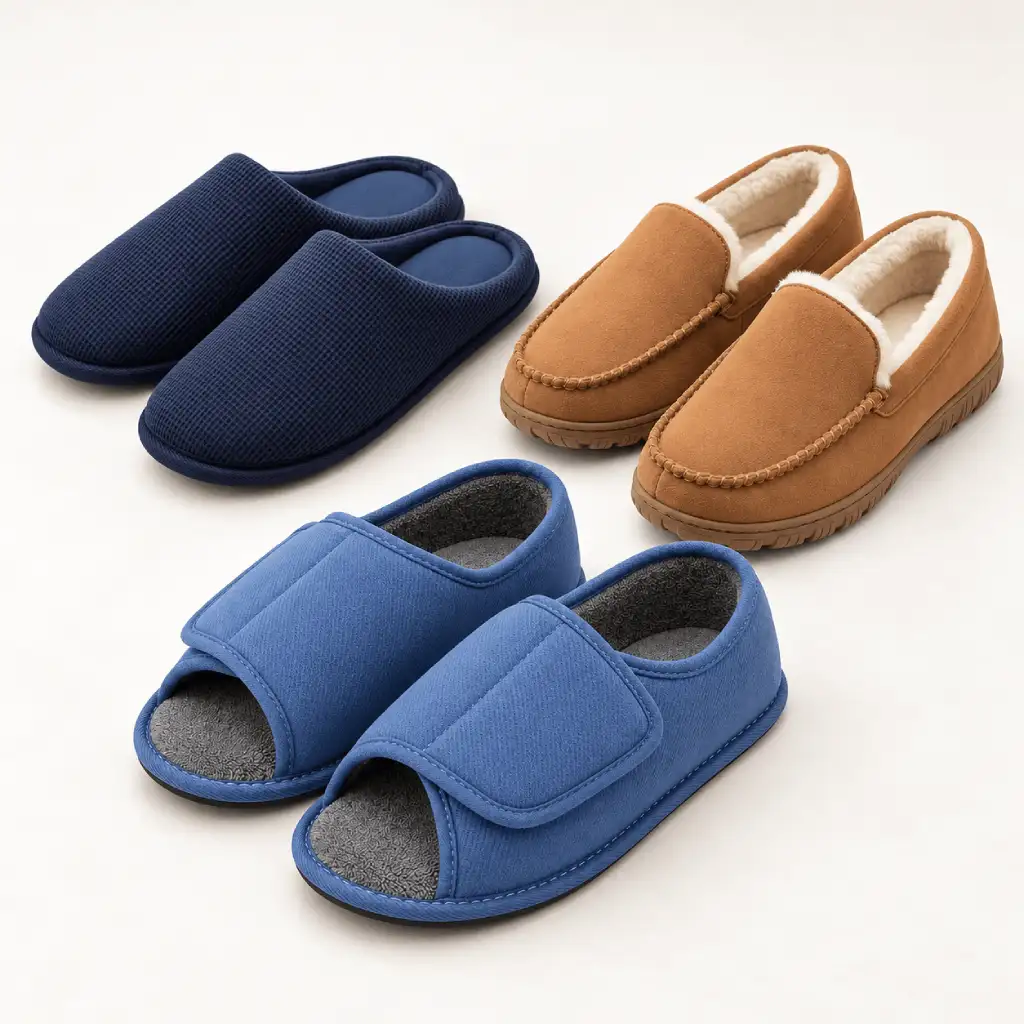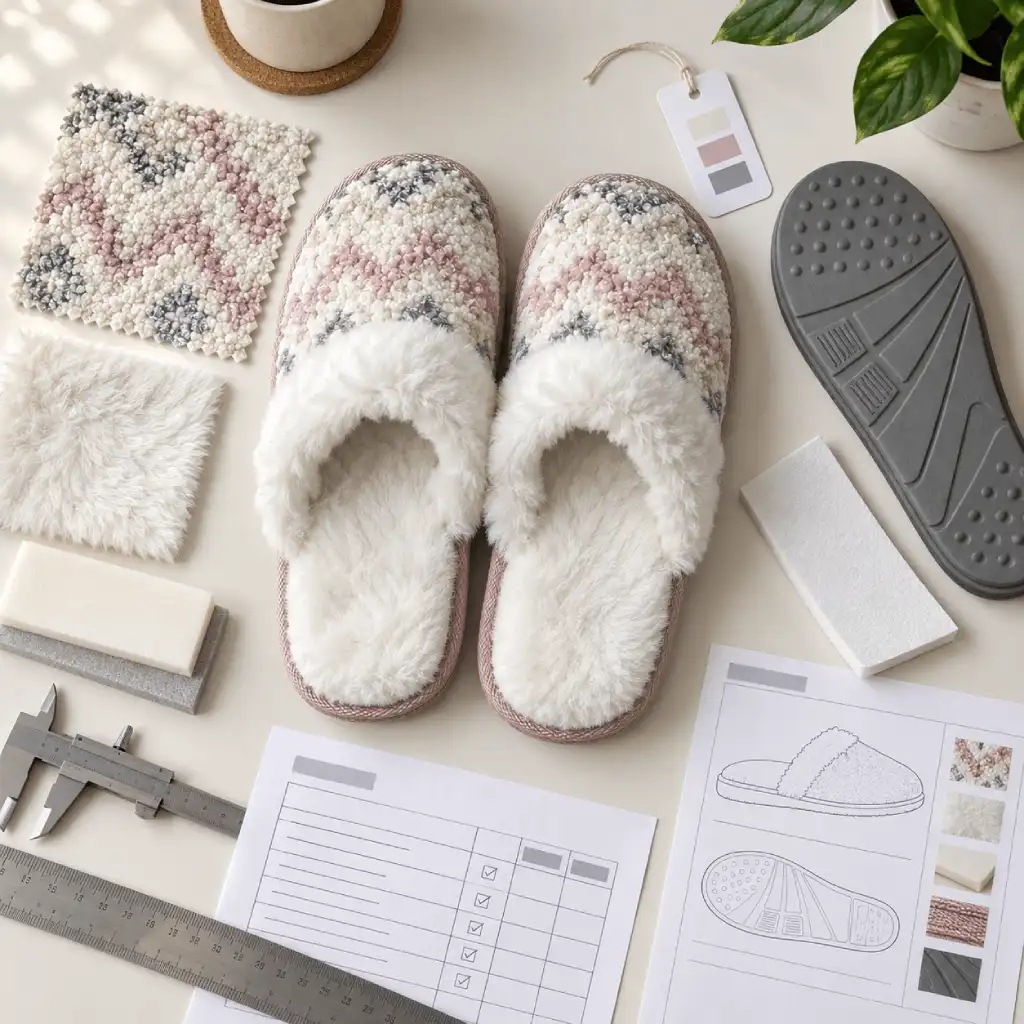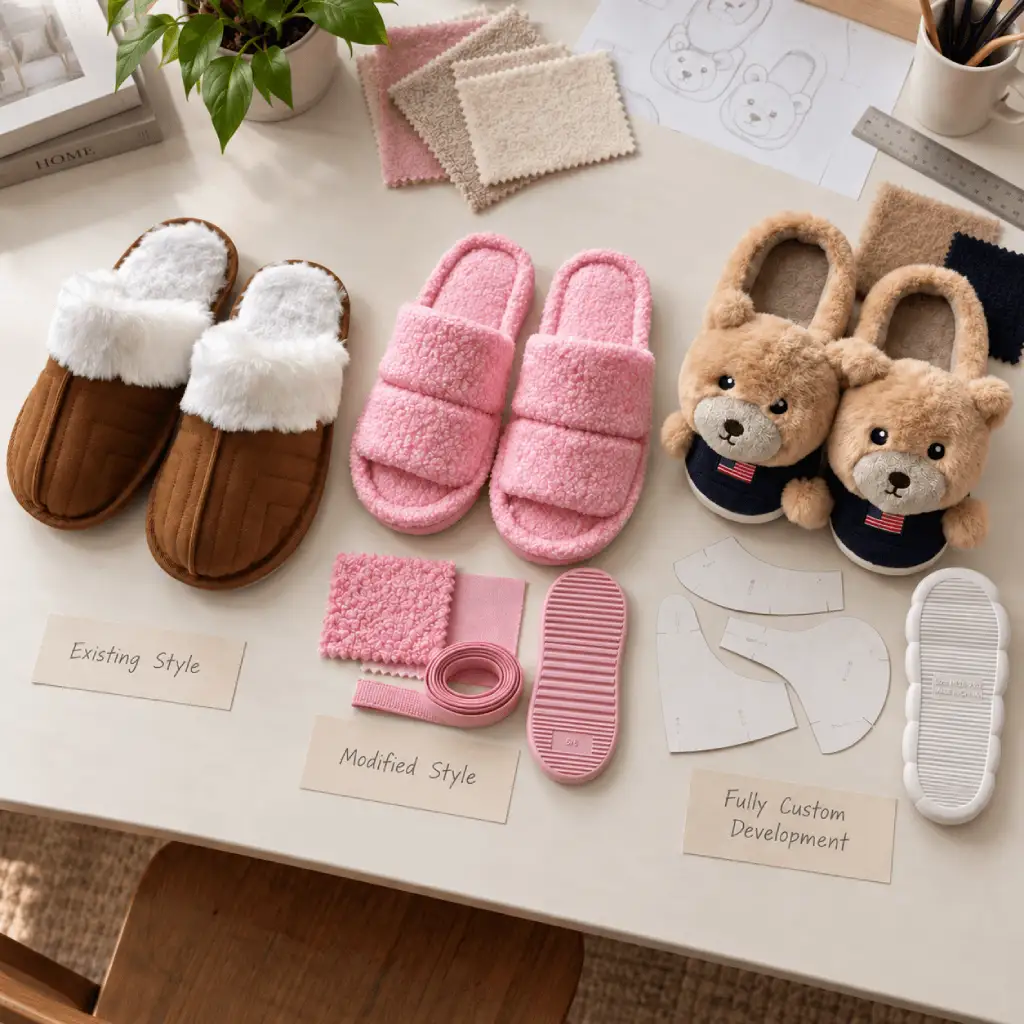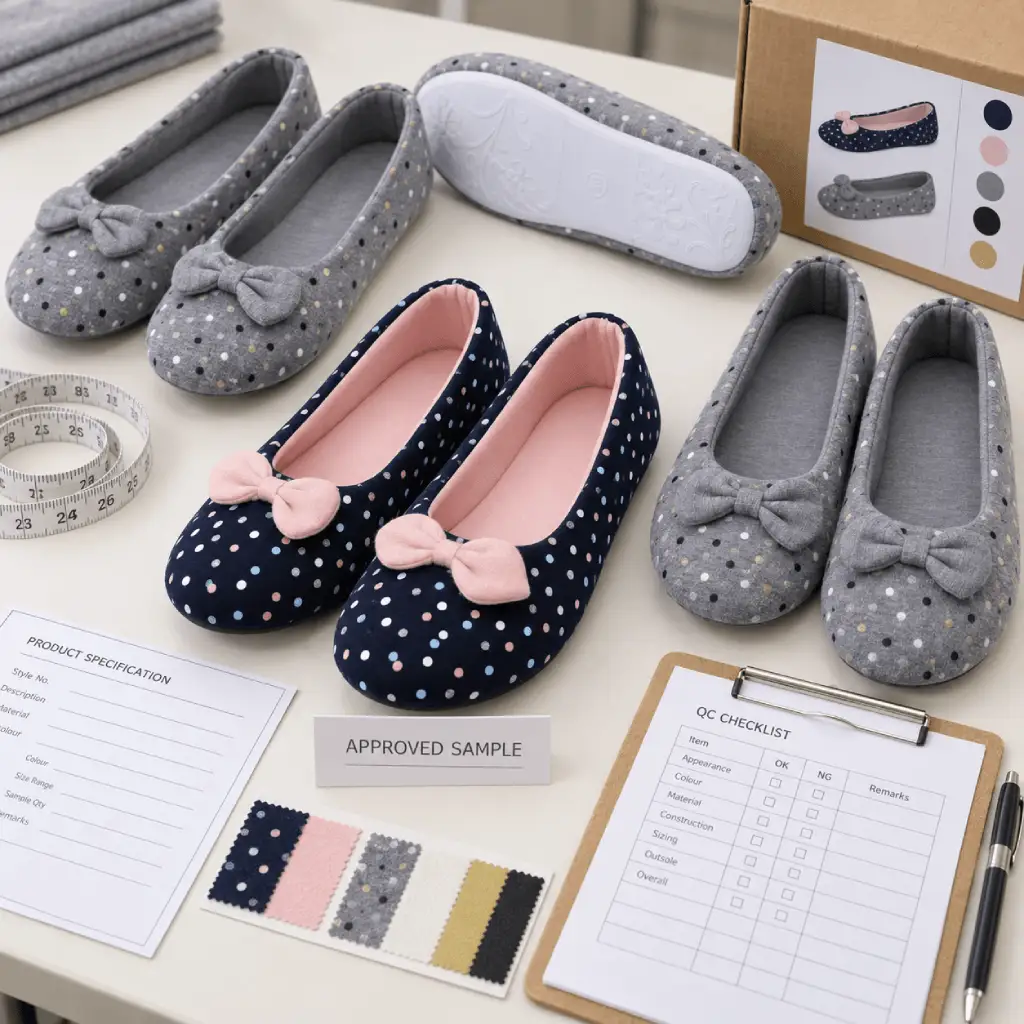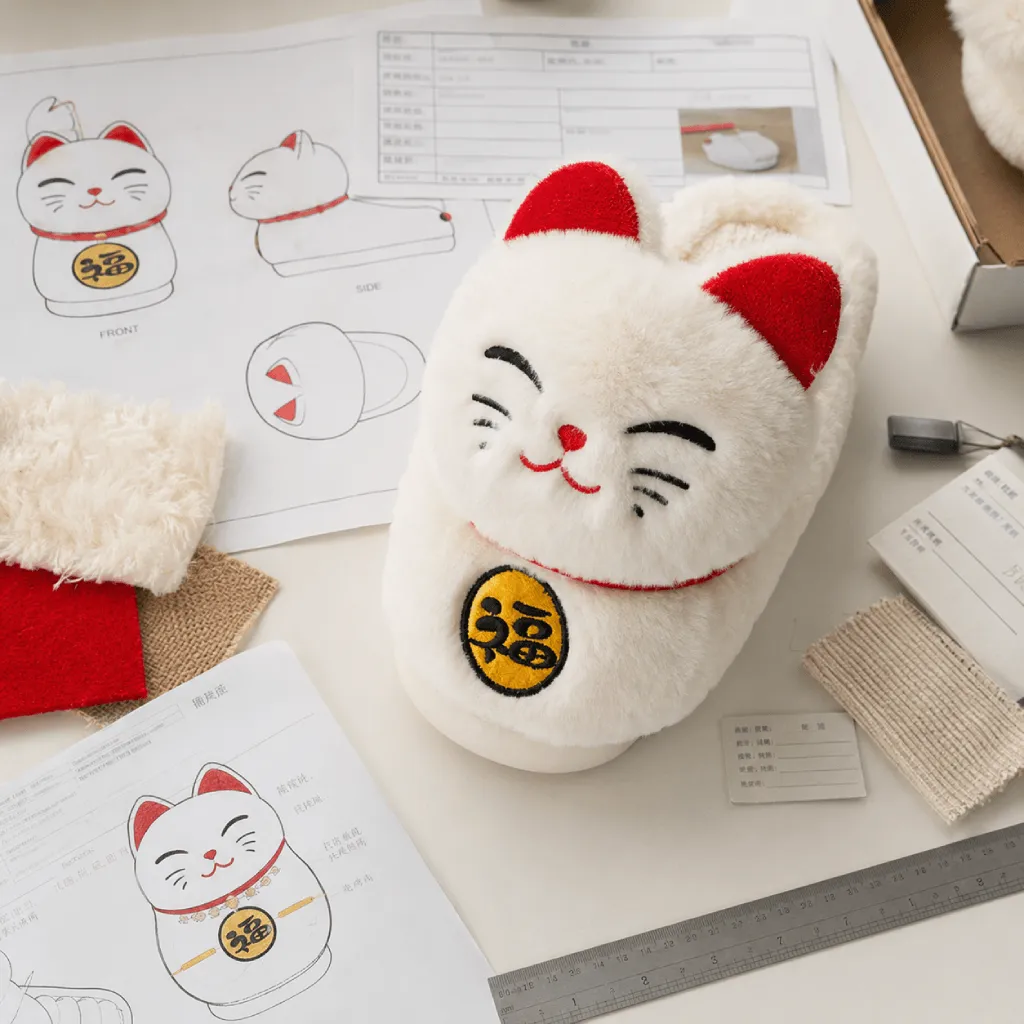
A slip-resistant outsole for an indoor slipper is not defined by one material name or an aggressive-looking bottom pattern. Its performance depends on the outsole formulation, hardness or density, thickness, tread geometry, contact area, finished-slipper construction, floor surface, contamination condition, sample preparation, and test method.
For brands, importers, wholesalers, retailers, and private-label buyers, the practical task is to convert a broad request for non slip slippers into a controlled product specification. The outsole material, tread drawing, dimensions, attachment, approved sample, test conditions, and bulk inspection points should be agreed before production.
This guide explains how buyers can compare molded TPR and cut EVA directions, review tread and floor contact, approve samples, define slip-resistance testing, and control outsole consistency during bulk slipper production.
Buyer takeaway: approve a complete outsole system, not a claim. Define the real material, construction, target surface, test condition, acceptance requirement, and production controls that apply to the finished slipper.
Claim boundary: this article does not describe any outsole as slip-proof, guaranteed to prevent falls, or safe on every surface. Performance language should remain limited to the approved construction and the conditions covered by suitable evidence.
For a wider production-control framework, buyers can use this guide together with UTOP’s Footwear Quality Control Guide for Bulk Slipper Orders.
Written by the UTOP Slippers Sourcing Team, with product-development and quality-control input from our indoor slipper team.
1. What Does a Slip-Resistant Outsole Mean?
In consumer search language, non slip, non skid, and slip resistant are often used interchangeably. In product development, a slip-resistant outsole should be treated as a performance direction that still needs defined conditions and suitable evidence. The wording alone does not establish a measurable result.
A usable buyer requirement should identify the intended flooring, whether the surface is dry or contaminated, the sample construction and conditioning, the applicable test or buyer protocol, and the acceptance criteria. Without those details, a generic non slip outsole request can be interpreted differently by the buyer, factory, laboratory, and marketing team.
| Term | Common use | Buyer interpretation | Required control |
|---|---|---|---|
| Non-slip | Popular retail and search wording | An intended grip direction, not an absolute guarantee | Use only with clear claim evidence and limitations |
| Non-skid | Common alternative consumer expression | Usually overlaps with non-slip in search intent | Do not treat the phrase as a separate test result |
| Slip-resistant | More controlled performance wording | Resistance is conditional, not universal | State the surface, condition, method, sample, and acceptance rule |
| Slip-proof | Absolute marketing language | Implies no slip risk | Avoid this claim |
Non Slip vs Slip Resistant: Is There a Technical Difference?
There is no universal product-development rule that makes every use of “non-slip” technically different from every use of “slip-resistant.” The important distinction is how the claim is supported. For buyers comparing non slip vs slip resistant wording, the safer approach is to link performance language to a defined product, surface, test condition, method, and result rather than relying on the phrase itself.
Decision rule: the stronger the claim, the stronger and more specific the supporting evidence should be. Never convert a material name, tread drawing, or informal wear impression into a universal safety promise.
2. What Makes a Shoe Slip Resistant?
Buyers often ask whether rubber, TPR, or EVA creates the best grip. Material matters, but what makes a shoe slip resistant is the interaction of the complete outsole system with a specific floor condition. Two outsoles made from the same material category can behave differently when their formulation, hardness, thickness, tread, surface finish, or contact geometry changes.
1. Compound, Hardness, or Density
The real formulation affects deformation, surface behavior, and the way the outsole meets the floor. For molded TPR, buyers may control a compound reference and hardness direction. For cut EVA, density, hardness direction, thickness, and sheet specification may be relevant. These values should be confirmed for the selected material and construction instead of copied from an unrelated style.
2. Thickness, Profile, and Flex
Thickness and outsole profile change how weight is distributed and where the slipper bends. A sole that is too soft, too rigid, warped, or poorly matched to the upper may not maintain the intended contact across the heel, midfoot, and forefoot.
3. Tread Geometry and Contact Area
Raised blocks, grooves, channels, edges, and flex lines divide the contact surface. A deep tread is not automatically better. Narrow or rounded blocks may reduce actual contact, while an almost flat surface may not manage dust, moisture, or directional movement as intended.
4. Complete Slipper Construction
The upper, insole, cushioning, outsole attachment, fit, and finished weight influence how the wearer loads the bottom. Testing a loose material sheet can support development, but it does not always represent the finished slipper under flex and realistic loading.
5. Floor and Contamination Condition
Dry ceramic tile, wet tile, polished wood, laminate, vinyl, and a floor carrying dust, oil, or cleaning residue create different interfaces. No slip resistant sole for shoes should be assumed to deliver the same result across all of them.
Material terminology: “rubber sole” is often a loose retail description. Purchase documents, samples, test requests, and quality records should identify the confirmed material, such as molded TPR or cut EVA, rather than substituting a broad consumer term.
3. Compare Molded TPR and Cut EVA Slipper Outsoles
Molded TPR and cut EVA are two common outsole directions for indoor slippers at UTOP. Neither one is automatically the better slip-resistant outsole. The correct choice depends on the product brief, full specification, upper construction, desired weight and flexibility, target floor conditions, tooling needs, sample result, and buyer-required testing.
| Comparison point | Molded TPR direction | Cut EVA direction | Buyer approval |
|---|---|---|---|
| General structure | Molded shape with defined profile, sidewall, and tread potential | Cut from sheet material, often lightweight and flexible | Confirm actual material type and production method |
| Key controls | Compound, hardness, thickness, weight, tread, dimensions, and molded detail | Sheet specification, density or hardness direction, thickness, cut accuracy, surface, and flatness | Record measurable or comparable references |
| Customization | Custom tread, logo, shape, or molded mark normally requires suitable tooling | Custom cut shape, thickness, color, and approved surface direction may be developed | Confirm tooling, minimum quantity, tolerances, and approval process |
| Attachment | Side stitching, welt stitching, or prepared bonding according to design | Often cold-glued in UTOP projects; welt-stitched options depend on design | Approve the finished upper-to-sole interface |
| Slip performance | Depends on formulation, hardness, profile, tread, floor, and test condition | Depends on density, surface, embossing or tread, thickness, floor, and test condition | Do not infer a result from the material name |
| Cost | Affected by compound, weight, tooling, molding, size range, and quantity | Affected by EVA type, density, thickness, cutting or molding, waste, and quantity | Compare project quotations using equivalent specifications |
For a deeper material and construction comparison, see UTOP’s TPR vs. EVA Sole for Slippers Guide. It explains why grip, durability, flexibility, and cost should be reviewed by specification rather than by material name alone.
Selection rule: start with the required product structure and use condition, then approve the real outsole specification and finished sample. Do not select TPR or EVA only because one is assumed to be more slip resistant or less expensive.
4. Review Tread Design and Contact Area
Tread is not simply decoration on a slip-resistant outsole. It divides the floor-contact area, creates edges and channels, influences bending, and affects whether the outsole sits evenly. A pattern that looks aggressive in a drawing may still produce limited or inconsistent contact on the finished slipper.
Start with Useful Contact Area
Raised tread blocks should contact the reference surface at the intended heel, forefoot, and other functional zones. Very narrow, rounded, uneven, or distorted blocks may reduce effective contact. An almost flat outsole, meanwhile, may provide insufficient channel structure for the intended dusty or contaminated condition.
Review Direction and Zones
Longitudinal grooves, crosswise channels, multi-directional blocks, heel zones, and forefoot zones respond to movement differently. The layout should be considered together with heel landing, weight transfer, push-off, and the natural bend point of the finished slipper.
Check Manufacturability
Fine lines may not reproduce clearly in molding. Deep isolated blocks may deform. Thin cut EVA sections may compress or curl. Tread depth and spacing may also change across mold groups or sizes. Buyers should compare the approved drawing with physical outsoles from the actual size range.
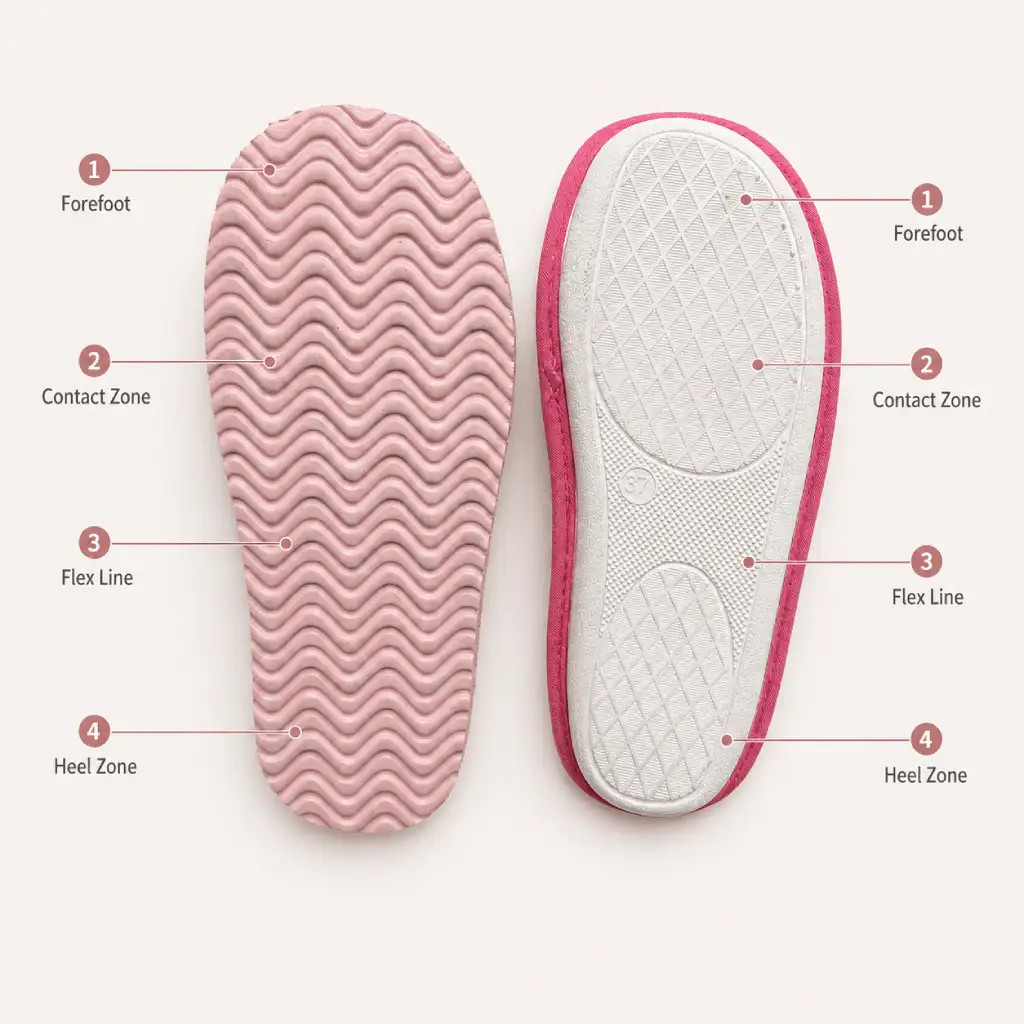
Tread Details Buyers Should Approve
- Overall floor contact and whether the complete pair sits flat
- Heel, midfoot, and forefoot zones
- Groove and block direction
- Critical tread depth, width, and spacing where specified
- Edge profile and the risk of curling or catching
- Flex lines and how the pattern opens or compresses during bending
- Left-right symmetry and size-to-size repeatability
- Surface cleanliness, flash, incomplete detail, and visible damage
Many searches for slip resistant soles for shoes focus on pattern depth. For buyers, the better approval question is whether the tread geometry, material, flatness, and finished construction create repeatable contact under the intended test conditions.
Tread rule: approve the physical outsole and finished pair, not only a two-dimensional pattern. A deeper or more complex tread does not by itself prove better slip performance.
5. Match the Outsole to Indoor Floor Conditions
A non slip outsole cannot be evaluated without a surface and condition. Indoor slippers may be used on hardwood, laminate, ceramic tile, vinyl, or transitions between carpet and hard flooring. Dust, water, oil, cleaning residue, wear, and packaging debris can change the interface again.
| Surface or use condition | Primary buyer concern | Sample review | Evidence boundary |
|---|---|---|---|
| Dry hardwood or laminate | Stable contact, marking direction, noise, and flatness | Clean outsole, edge shape, contact area, pair balance, and intended floor reference | A dry result does not cover wet or contaminated flooring |
| Dry ceramic tile | Contact on a smooth, hard surface | Compound or material direction, tread, flatness, and finished construction | The exact tile or defined test surface should be identified |
| Wet or contaminated tile | A defined higher-risk condition | Test surface, contaminant, amount, conditioning, orientation, and acceptance requirement | Do not generalize to other liquids or surfaces |
| Vinyl or resilient flooring | Consistent traction without unintended sticking or noise | Surface texture, formulation, tread, cleanliness, and wear condition | Confirm the reference flooring and product condition |
| Carpet-to-hard-floor transition | Stable transition without catching at the edge | Toe and heel profile, fit, flex, outsole width, and edge geometry | Slip testing does not replace fit and trip-hazard review |
Slippers for Hardwood Floors Need More Than Grip
Buyers sourcing slippers for hardwood floors should also review marking, sound, edge curl, and whether the pair sits evenly. Release agent, loose textile fibers, adhesive residue, or carton debris may reduce clean contact even when the outsole material and tread were approved.
Consumer terms such as non skid slippers can guide keyword coverage, but the development brief should name the actual floor conditions. A general factory floor trial is not a substitute for the defined reference surface or laboratory method required by the buyer.
Surface rule: write the intended flooring and condition into the sample and test plan. Never assume that dry hardwood, dry tile, wet tile, and vinyl are interchangeable.
6. Approve the Finished Slipper Sample
The outsole for non slip slippers should be approved as part of the complete finished product. Instructions such as “use a good rubber sole” or “make the bottom more anti-slip” do not define the material, construction, dimensions, tread, test condition, or acceptance standard needed for repeat production.
The approved sample should represent the intended upper, lining, insole, cushioning, outsole, size, and attachment method. Changing one layer can alter finished weight, bend position, outsole loading, and floor contact. When the order includes several colors, sizes, or mold groups, confirm which outsole details remain common and which require separate approval.
Sample Approval Checklist
- Material: exact outsole type, formulation or supplier reference where applicable, and confirmed color
- Physical direction: hardness or density control appropriate to the material, thickness, and outsole or pair weight when specified
- Geometry: tread drawing, critical tread details, outsole dimensions, size grouping, edge profile, and flatness
- Construction: bonding, welt stitching, side stitching, or combined attachment as applicable
- Finished pair: left-right match, balance, natural flex point, visible deformation, cleanliness, and upper-to-sole alignment
- Performance plan: target surface, condition, method or buyer protocol, sample conditioning, acceptance requirement, and report format
- Packing: individual packaging, carton method, and recovery after compression where shape may be affected
- References: signed or otherwise controlled sample, current specification, approved comments, and revision date
Sampling should also check outsole material, color, odor, weight or thickness where specified, hardness handfeel, dimensions, flatness, tread, pairing, bend position, and attachment. These practical checks establish production references; they do not replace a required laboratory test.
For a complete development workflow covering materials, branding, packaging, sample approval, and production, buyers can review UTOP’s Private Label Indoor Slippers Manufacturing Guide.
Approval rule: control both the outsole component and the finished pair. A correct loose sole can still produce an inconsistent slipper if size matching, positioning, bonding, stitching, or packing is wrong.
7. Define Slip-Resistance Testing
A meaningful test request must state what is being tested, on which surface, under which condition, and against what acceptance requirement. A supplier cannot responsibly confirm universal slip resistance without knowing the sample, method, reference floor, contamination, conditioning, orientation, and reporting needs.
Where the objective is to evaluate the complete product, testing finished slippers or a representative finished construction is generally more informative than testing material plaques alone. Loose outsole pieces may help compare development options, but they may not reproduce the finished slipper’s weight distribution, flex, edge profile, or contact geometry.
Recognized Methods Are Not Interchangeable Shortcuts
The current ASTM F2913-24 page describes a whole-shoe tester method for evaluating relative slip performance between footwear and flooring under reproducible laboratory conditions. The official SATRA TM144 page covers footwear, outsole units, sheet soling materials, test floors, and defined contaminants. Buyers should still confirm whether a method is appropriate for their product, target market, claim, and intended use.
ISO 13287:2019 is specifically titled as a test method for the slip resistance of personal protective equipment footwear. Ordinary indoor slippers should not be presented as PPE merely because a footwear slip-resistance method exists. The applicable regulatory and claim context must be reviewed separately.
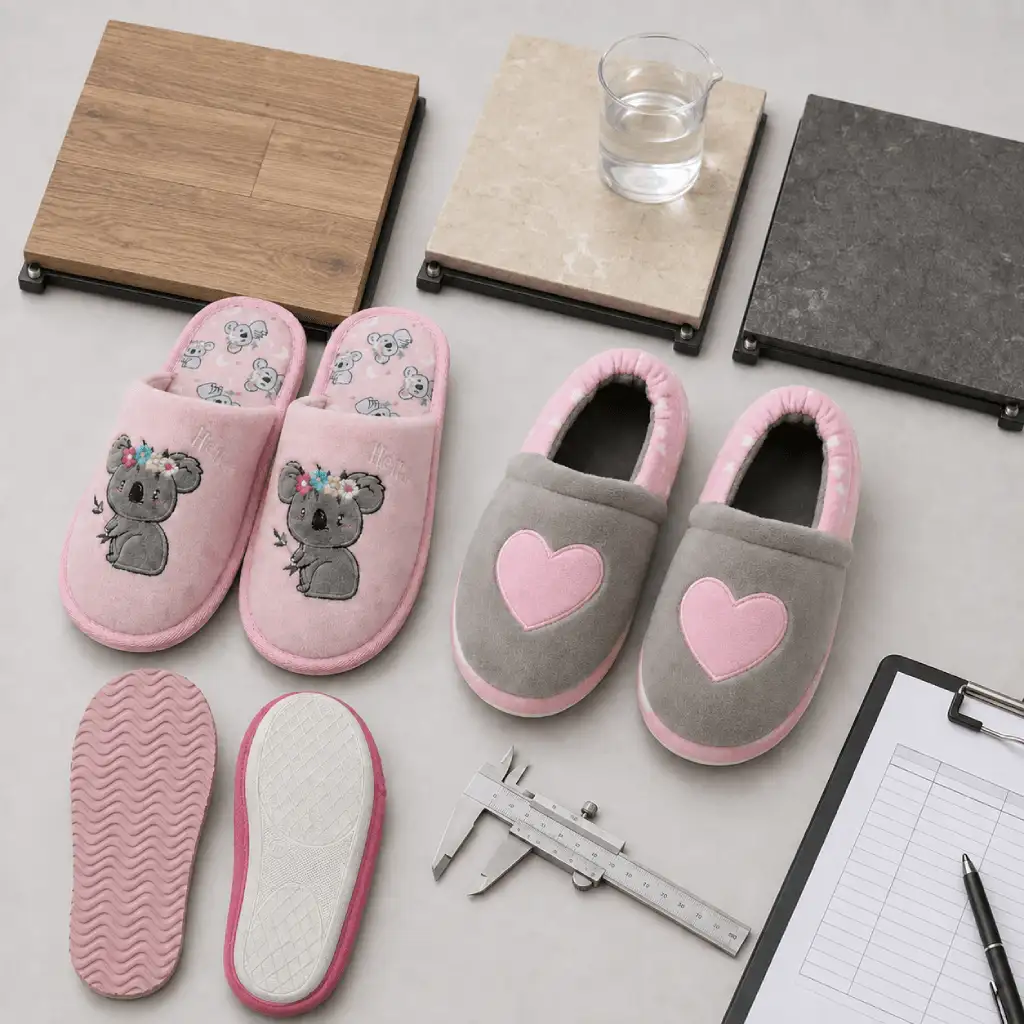
A Complete Test Request Should Define
- The test method, edition, or buyer protocol
- The floor or calibrated reference surface
- Dry, wet, or otherwise contaminated condition
- The contaminant type and application where relevant
- Sample conditioning, cleaning, pre-treatment, or wear state
- Finished product size, outsole, upper construction, and attachment
- Test orientation or contact mode where required
- Number of samples and repeat measurements
- Acceptance criteria and decision rule
- Laboratory, report format, traceability, and third-party requirements
Control the Product State
Temperature, humidity, cleaning, visible wear, floor contamination, and post-wash condition may change the outsole-floor interface. If the slipper carries a washable claim, the approved wash and drying procedure should identify whether a post-wash outsole review or performance test is required.
Important: this guide does not set a universal coefficient-of-friction value, pass threshold, sample quantity, or test surface. Those requirements should come from the buyer’s market, retailer manual, claim strategy, risk assessment, and applicable method.
Testing rule: record the exact sample, method, surface, condition, and acceptance criteria. A report for one outsole, construction, color, size, or material batch should not automatically be assumed to cover a changed product.
Outsole testing should form part of a wider product verification process. See how to include slip resistance and other performance checks in a footwear testing plan for custom slipper orders.
8. Control Slipper Outsoles During Bulk Production
An approved slip-resistant outsole sample protects the order only when production controls the same characteristics. Bulk quality control should focus on features that can change contact, alignment, flex, cleanliness, or consistency between sizes and pairs.
| Inspection stage | What to check | Reference | Why it matters |
|---|---|---|---|
| Incoming outsole | Material direction, size, color, dimensions, flatness, tread, pairing, and contamination | Approved outsole, specification, and material reference | Stops wrong or visibly nonconforming components before assembly |
| First production | Upper-to-sole match, alignment, attachment, edge profile, flex point, and pair balance | Approved finished sample and current comments | Confirms line setup before repeated production continues |
| In-process | Bonding area, stitching, sole position, left-right match, distortion, and surface cleanliness | Construction sample and workmanship criteria | Finds repeated problems while correction is still possible |
| Finished pair | Dimensions, tread condition, floor contact, flatness, flex, appearance, and attachment | Approved sample, outsole specification, and inspection plan | Checks the assembled slipper rather than only the loose component |
| Packed goods | Recovery after compression, edge curl, pair match, debris, labels, and carton assortment | Approved packed sample and packaging instruction | Confirms that packing has not changed outsole shape or cleanliness |
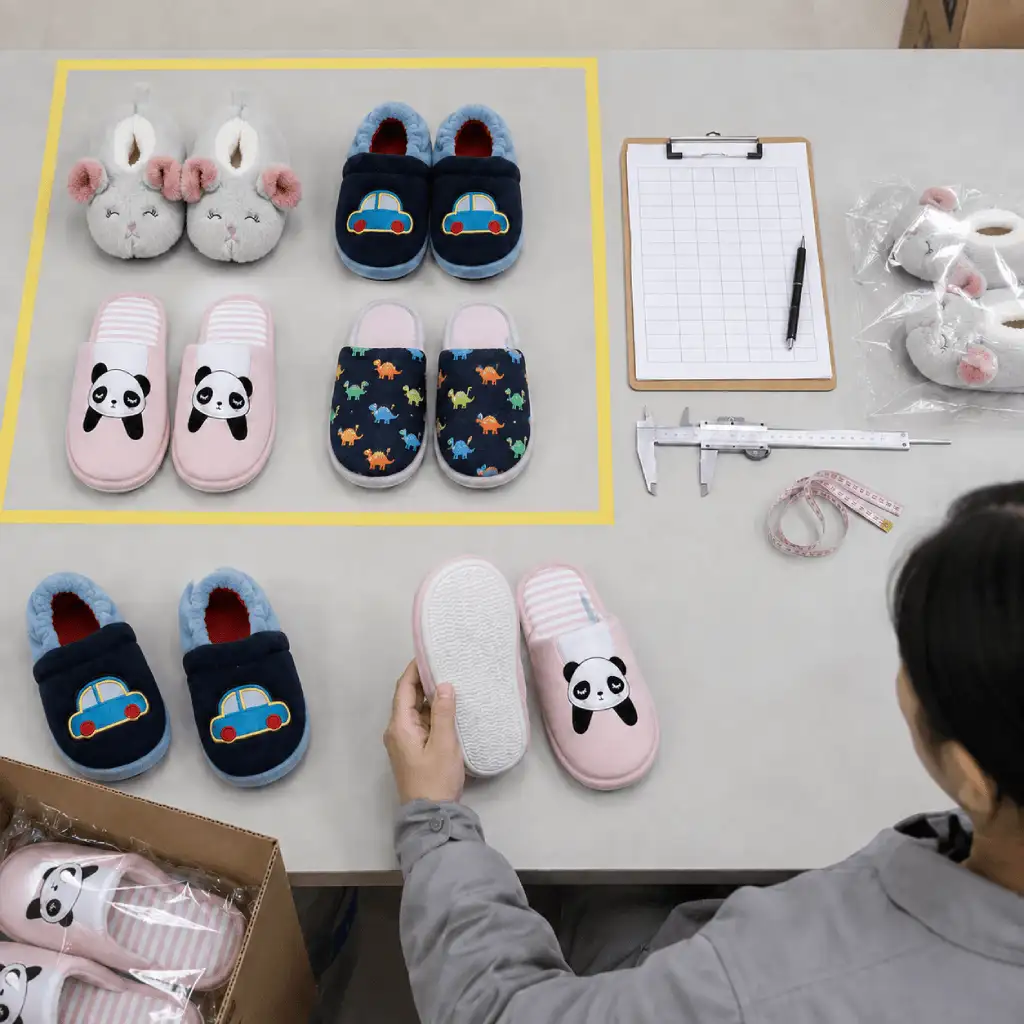
Construction-Specific Outsole Checks
Molded TPR and cut EVA require different component checks. Molded TPR may need review of molded profile, sidewall, tread completeness, flash, size marks, hardness direction, weight, and distortion. Cut EVA may need review of sheet identity, thickness, density or hardness direction, cutting accuracy, edge finish, surface texture, flatness, and compression behavior.
The upper-to-sole interface also needs its own control. Correct components can still create a nonconforming pair when size matching, preparation, positioning, pressing, bonding, stitching, curing, or finishing is inconsistent.
UTOP’s Footwear Quality Control Guide provides the wider inspection framework, while the guide to Common Indoor Slipper Manufacturing Defects shows how outsole warping, tread issues, open edges, and related workmanship differences should be controlled against approved references.
Inspection boundary: visual and hand checks can assess material identity, dimensions, flatness, tread, pairing, flex direction, and workmanship. They cannot prove slip resistance, abrasion resistance, or long-term durability without the applicable test method and evidence.
Bulk-control rule: inspect risk at the stage where it can still be prevented or corrected. Final inspection is important, but it cannot replace incoming, first-production, and in-process controls.
9. Slip-Resistant Outsole Pre-Production Checklist
Before confirming a bulk order, convert the desired marketing direction into a written product, test, and quality plan. This helps prevent a visually attractive sample from entering production without controls for material identity, tread repeatability, floor contact, test scope, or claim language.
| Decision area | Information to confirm | Controlled reference |
|---|---|---|
| Market and user | Target country, channel, wearer profile, indoor use environment, and primary floor surfaces | Product brief and market requirements |
| Outsole specification | Material type, formulation reference where applicable, hardness or density direction, thickness, color, dimensions, and weight when controlled | Specification, approved outsole, and material reference |
| Tread and geometry | Drawing, zones, critical dimensions, edge profile, flex lines, size grouping, and tooling | Approved drawing, tooling record, and physical sample |
| Finished construction | Upper, insole, cushioning, outsole attachment, flatness, pair balance, flex, and approved size set | Controlled finished sample and size specification |
| Testing and claims | Method, edition, surface, contamination, conditioning, sample, acceptance criteria, laboratory, report, and allowed wording | Test plan, applicable requirements, report, and approved claim copy |
| Production control | Incoming, first-production, in-process, final, packed-goods, and third-party checks where required | Quality plan, defect standard, inspection scope, and release authority |
| Packaging and delivery | Individual pack, compression, recovery period, pair match, assortment, carton condition, and order documentation | Approved packed sample, packing instruction, and purchase order |
UTOP’s Bulk House Slippers Wholesale Checklist provides a broader order-planning reference for product details, sizing, branding, packaging, inspection, and delivery.
Pre-production rule: resolve conflicting samples, drawings, comments, and specifications before the production line starts. A controlled reference is useful only when every party works from the same current version.
10. Sourcing Custom Slip-Resistant Slippers: FAQs and Final Guidance
For OEM, ODM, and private-label projects, outsole development should begin with the complete slipper brief. Share the target market, intended indoor floors, product silhouette, upper and insole direction, preferred outsole structure, size range, branding, packaging, order quantity, and any required test method or retailer standard.
UTOP commonly develops indoor slipper projects using molded TPR outsoles and cut EVA bottoms. Hardness or density direction, thickness, color, tread, outsole shape, and attachment can be reviewed according to the project. A proprietary molded tread, logo, mark, or outsole shape normally requires suitable tooling and project-specific confirmation.
A responsible sourcing process does not replace a defined test with a broad promise. The objective is a repeatable product that matches the approved sample, uses the confirmed outsole specification, and is checked at the stages where variation can still be prevented or corrected. Buyers can review UTOP’s custom indoor slipper product directions before preparing a development brief.
Frequently Asked Questions
What is the difference between non-slip and slip-resistant slippers?
The terms often overlap in consumer language. In sourcing, either claim should be tied to a defined finished product, floor surface, contamination condition, test method, and acceptance requirement. “Slip-resistant” is conditional wording; it still does not mean slip-proof or safe on every surface.
What makes a shoe slip resistant?
The result depends on the outsole formulation, hardness or density, thickness, tread geometry, contact area, edge profile, flex, attachment, complete slipper construction, floor surface, contamination, sample condition, and test method. No single material name proves performance.
Are TPR soles always more slip resistant than EVA soles?
No. Molded TPR and cut EVA can both support suitable indoor slipper designs, but performance depends on the specific formulation or sheet, hardness or density, thickness, surface, tread, floor, and test condition. Compare approved specifications and evidence, not material names.
Can EVA slippers use a non slip outsole pattern?
EVA can use an approved embossed surface, texture, or tread direction depending on the EVA type and production method. Buyers still need to control thickness, density or hardness direction, cut or molded geometry, flatness, compression, and the performance of the finished slipper.
How should buyers test non slip slippers before bulk production?
Define the method and edition, reference floor, dry or contaminated condition, sample conditioning, finished size and construction, test orientation where applicable, sample quantity, acceptance criteria, laboratory, and report format. Use the approved finished product or a clearly representative assembly when complete-product performance is the objective.
Can a supplier guarantee that slippers will never slip?
No responsible supplier should make an absolute guarantee for every user, floor, contaminant, and wear condition. Claims should remain within the scope of the approved construction, applicable method, tested condition, result, and target market requirements.
Which outsole defects matter most during bulk inspection?
Key concerns include the wrong material or size, incomplete or damaged tread, warping, uneven floor contact, edge curl, contamination, outsole misalignment, bonding gaps, stitching variation, left-right mismatch, incorrect dimensions, and deformation after packing.
Conclusion
A reliable slip-resistant outsole program is not created by selecting the deepest tread or writing “rubber sole” into a purchase document. It is built by controlling the real outsole material, physical specification, tread geometry, finished-slipper construction, target floor condition, test request, and production references.
For buyers, the practical sequence is clear: define the use environment, select and document the outsole direction, approve tread and attachment on a finished sample, agree on suitable testing, control incoming and in-process production, and inspect the finished and packed pairs. This supports more repeatable sourcing and more defensible performance language.
Planning a custom slipper outsole?
Share your product reference, target market, intended indoor floors, upper and outsole direction, size range, branding, packaging, estimated quantity, and required test or inspection standard. UTOP can review the information needed for sampling and bulk production.