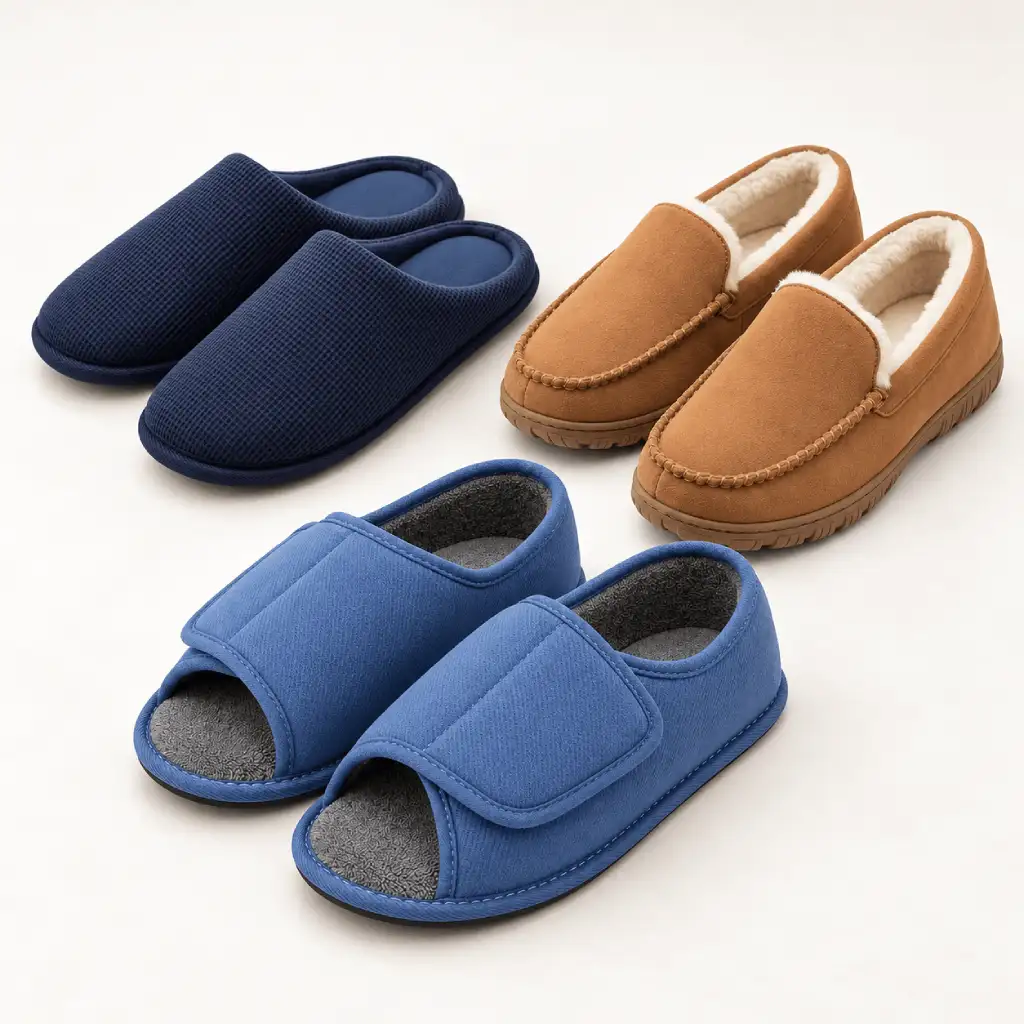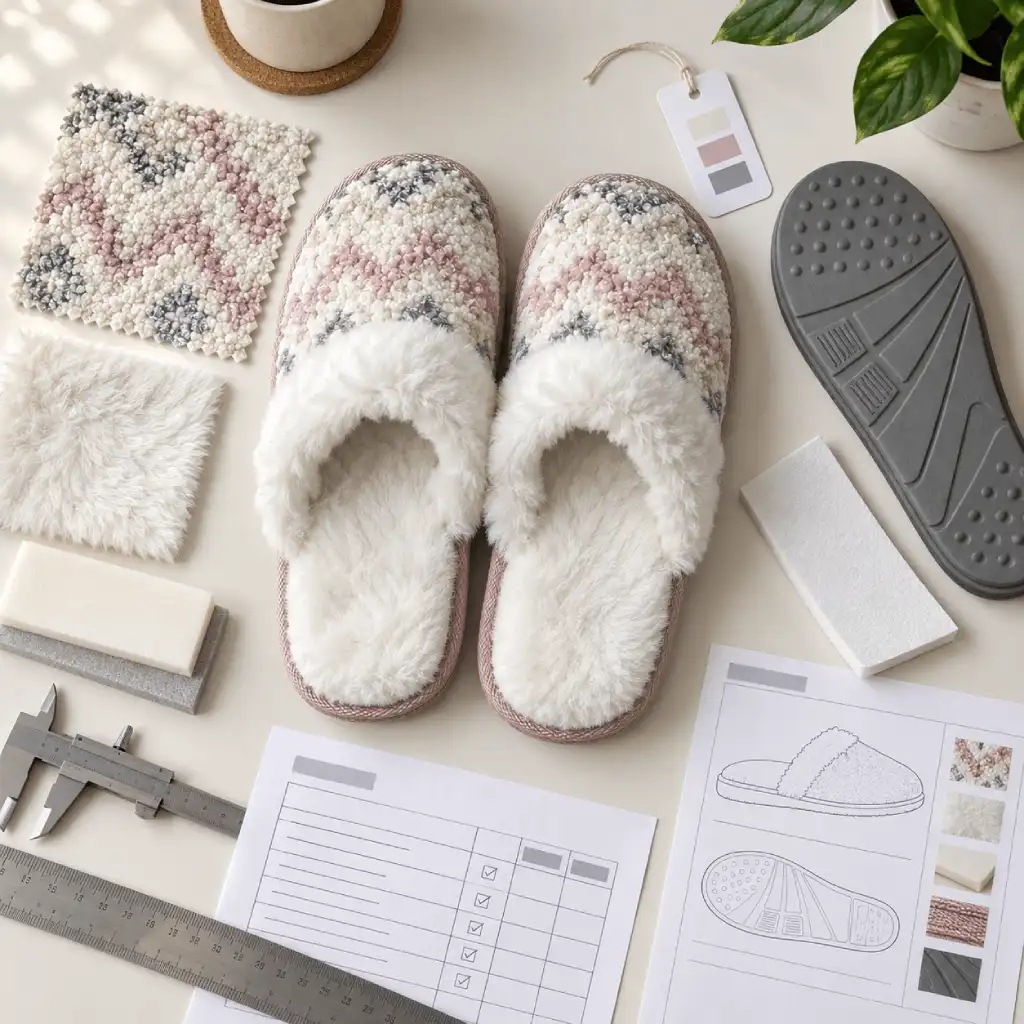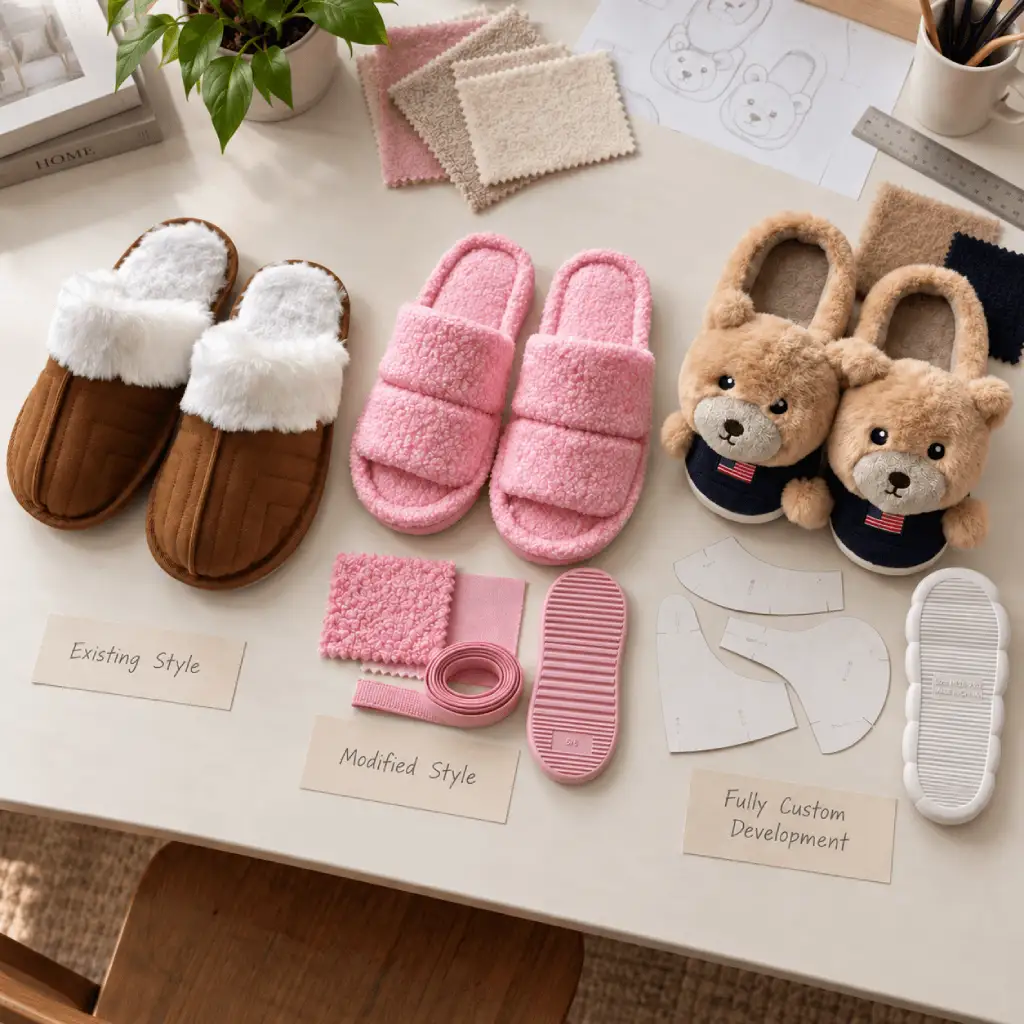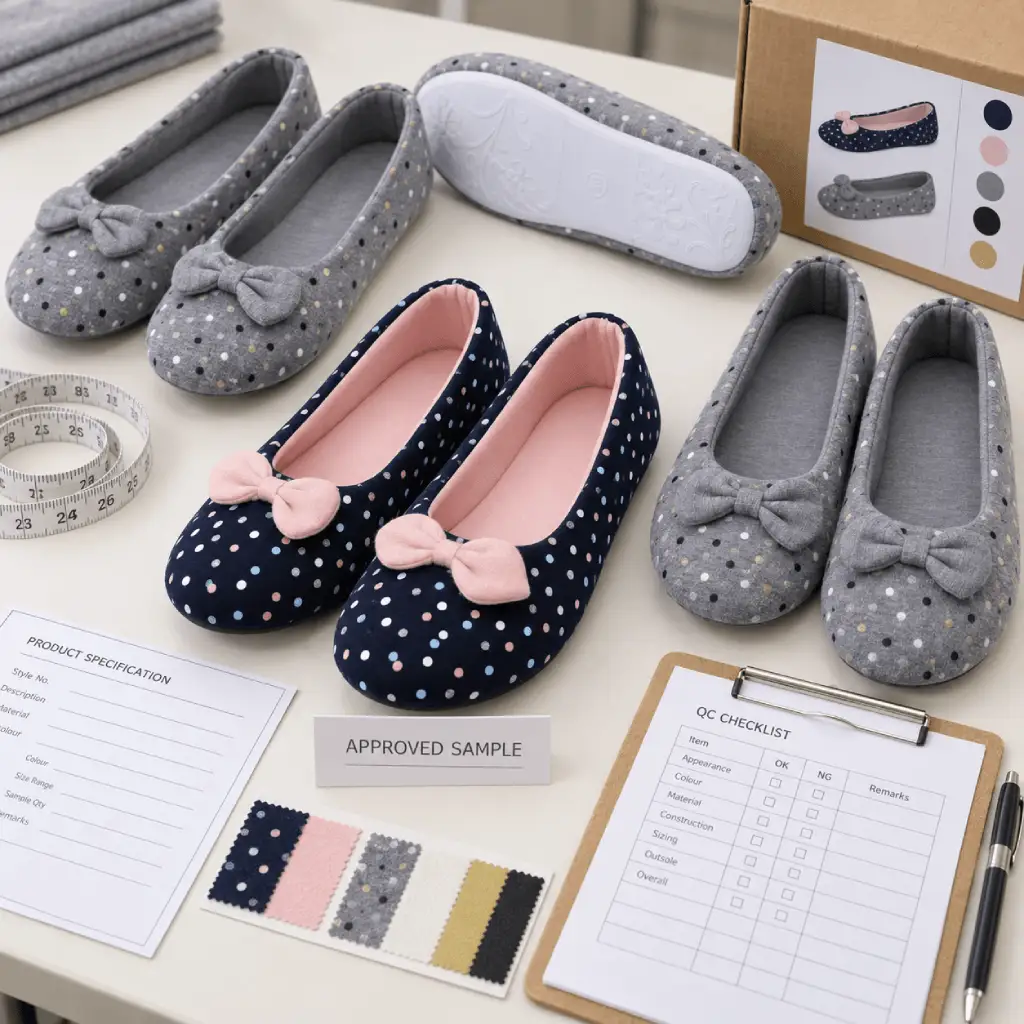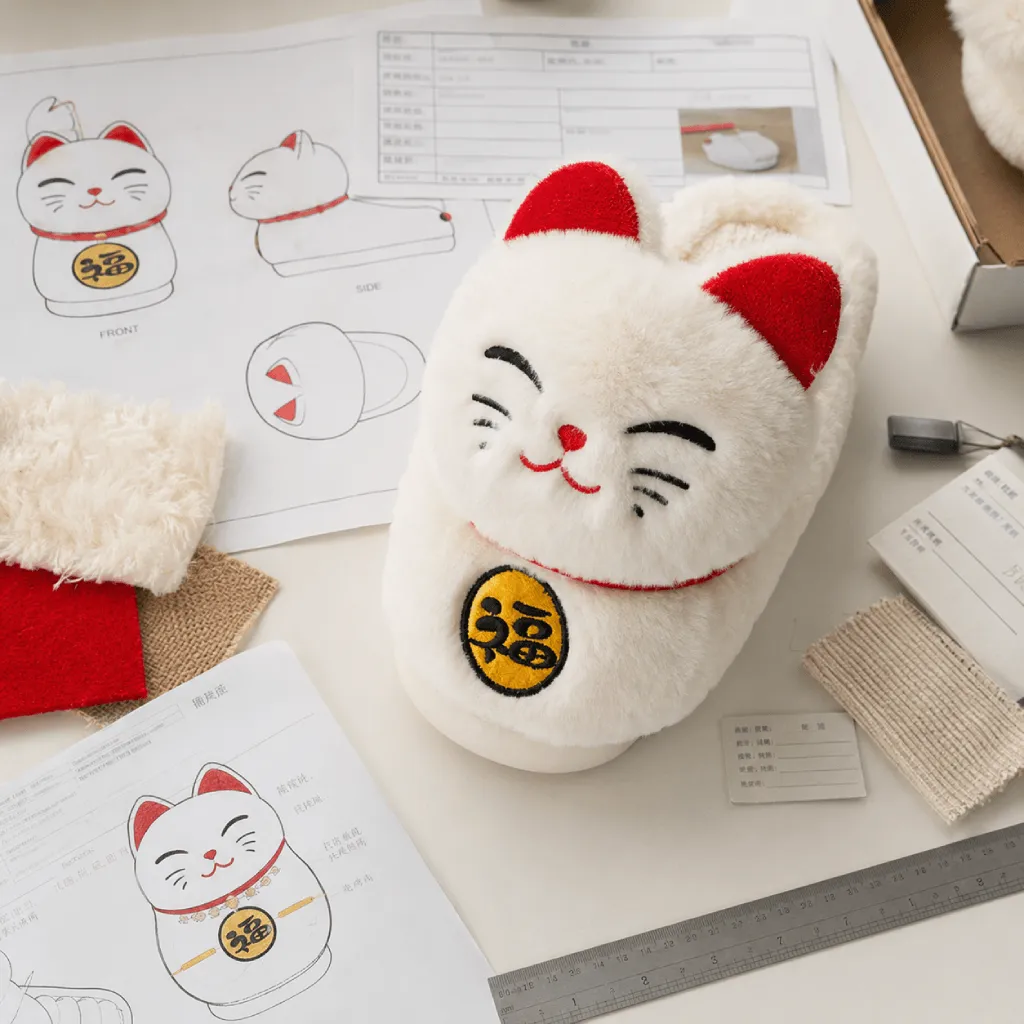
What are slippers made of? Most indoor slippers are not made from one material. They are a system of upper fabric, lining, padding, a foot-contact layer, cushioning or support components, an outsole, thread, adhesives where required, and branding or decorative parts.
Common slipper materials include plush, fleece, jersey knit, felt, faux suede, corduroy, and velvet for uppers; textile or plush linings; polyurethane foam, memory foam, or EVA in the cushioning stack; and molded TPR, cut-sheet EVA, or point-plastic textile bottoms for ground contact. The right combination depends on the product brief, not on a universal material ranking.
This guide helps brands, importers, wholesalers, retailers, and private-label teams compare indoor slipper materials by function, season, construction, target market, sample approval, and bulk-production control.
Buyer takeaway: approve a complete material system. A fabric name or outsole label does not define composition, weight, thickness, hardness, backing, color, construction, fit, performance, or production consistency.
Selection boundary: there is no single best material for slippers. Suitability depends on the intended wearer, climate, floor conditions, sales channel, care claim, price position, construction method, packaging, and any buyer-required test criteria.
For a broader framework covering approved samples, production checks, final inspection, and nonconformity handling, use UTOP’s Footwear Quality Control Guide for Bulk Slipper Orders.
Written by the UTOP Slippers Sourcing Team, with material, product-development, and quality-control input from our indoor slipper team.
1. Understand the Complete Slipper Material System
When a buyer asks what materials are used to make slippers, the most useful answer is a component map. Each layer has a different job, and a change in one layer can affect fit, weight, flexibility, appearance, packing, or the way another component performs.
| Component | Typical material direction | Buyer should define |
|---|---|---|
| Upper | Plush, fleece, jersey knit, felt, faux suede, corduroy, velvet, or another approved textile | Composition, weight or construction, thickness, stretch, backing, color, surface, and direction |
| Lining | Plush, fleece, jersey, tricot, or another textile suited to the design | Hand feel, thickness, color, stretch, seam behavior, and effect on internal volume |
| Cushioning and footbed | PU foam, memory foam, EVA, textile cover, and structural layers where required | Material grade, thickness, firmness or density where relevant, layer order, feel, fit, and recovery reference |
| Outsole | Molded TPR, cut-sheet or molded EVA, point-plastic fabric, or another approved bottom | Material type, hardness or density direction, thickness, weight, tread, flex, attachment, and intended use |
| Assembly and details | Thread, adhesive, binding, elastic, labels, embroidery, print, and decorations | Method, placement, color, dimensions, compatibility, appearance, and attachment requirement |
A quotation that says only “plush upper, foam insole, TPR sole” is a starting point, not a production specification. Those broad slipper materials still need measurable details, approved swatches, a finished reference sample, and clear construction notes.
System rule: review both the component and its interface. A correct upper and a correct outsole can still create a poor result if their size matching, preparation, bonding, stitching, or flex position is wrong.
2. Define the Product Brief Before Choosing Indoor Slipper Materials
The best material for slippers cannot be selected before the product brief is clear. A winter retail slipper, a washable homewear style, a lightweight hospitality slipper, and a structured house shoe may use very different material systems even when their silhouettes look similar.
Before requesting material recommendations or quotations, confirm these project conditions:
- User and use: adults or children, indoor-only or limited indoor/outdoor transition, expected floor conditions, and intended wearing duration
- Market and season: destination country, climate, selling season, retail channel, price position, and expected visual style
- Comfort direction: warm or breathable, soft or structured, lightweight or more substantial, flexible or supportive
- Care and packing: proposed care claim, compression during packing, retail presentation, carton plan, and expected recovery after unpacking
- Commercial controls: order quantity, colors, size range, branding, delivery plan, and testing or compliance requirements
| Project direction | Material priorities to review | Common approval risk |
|---|---|---|
| Cold-season retail | Warm hand feel, lining volume, pile appearance, outsole structure, and recovery after packing | A thicker lining reduces internal fit space or hides branding |
| Lightweight indoor | Lower bulk, flexibility, simple construction, compact packing, and sufficient footbed comfort | A thin specification becomes unstable or feels different after assembly |
| Washable concept | Complete material compatibility, color behavior, dimensional change, bonding, decoration, and validated care method | Care is assumed from one textile instead of tested on the finished pair |
| Structured house shoe | Upper stability, reinforcement, fit retention, defined outsole profile, and construction compatibility | The selected fabric is attractive but cannot hold the required shape |
If washability is part of the brief, review it as a finished-product claim. UTOP’s slipper washing guide explains why upper, lining, cushioning, adhesive, decoration, outsole, and drying method must be considered together.
3. Compare Slipper Upper and Lining Materials
Slipper upper materials shape the first visual impression, but appearance is only one buying criterion. Buyers also need to review fiber composition, fabric construction, weight, thickness, stretch, backing stability, pile direction, cutting behavior, sewing performance, color repeatability, branding compatibility, and packing recovery.
| Material family | Useful product direction | Details to approve |
|---|---|---|
| Plush, faux fur, sherpa, or fleece | Warm, tactile, gift, novelty, and cold-season indoor slippers | Pile type, height, density, backing, direction, shedding appearance, seam visibility, logo clarity, and compression recovery |
| Jersey or other knit fabric | Soft, flexible, printed, quilted, or lightweight homewear styles | Knit structure, weight, stretch direction, lamination, print, edge curl, sewing stability, and dimensional behavior |
| Felt | Clean surface, shaped panels, structured appearance, and seasonal house shoes | Fiber composition, weight or thickness, density, hand feel, edge finish, surface variation, color, and shape retention |
| Corduroy, velvet, faux suede, or woven surfaces | Fashion, classic, textured, or more structured retail designs | Surface direction, shade, rub or marking sensitivity, backing, seam performance, decoration, and pair matching |
Material names must remain accurate. Jersey is a knit construction; it is not a synonym for any soft fabric. Felt may be polyester, wool, or a blend, so “wool felt” should be used only when the confirmed fiber composition supports that description.
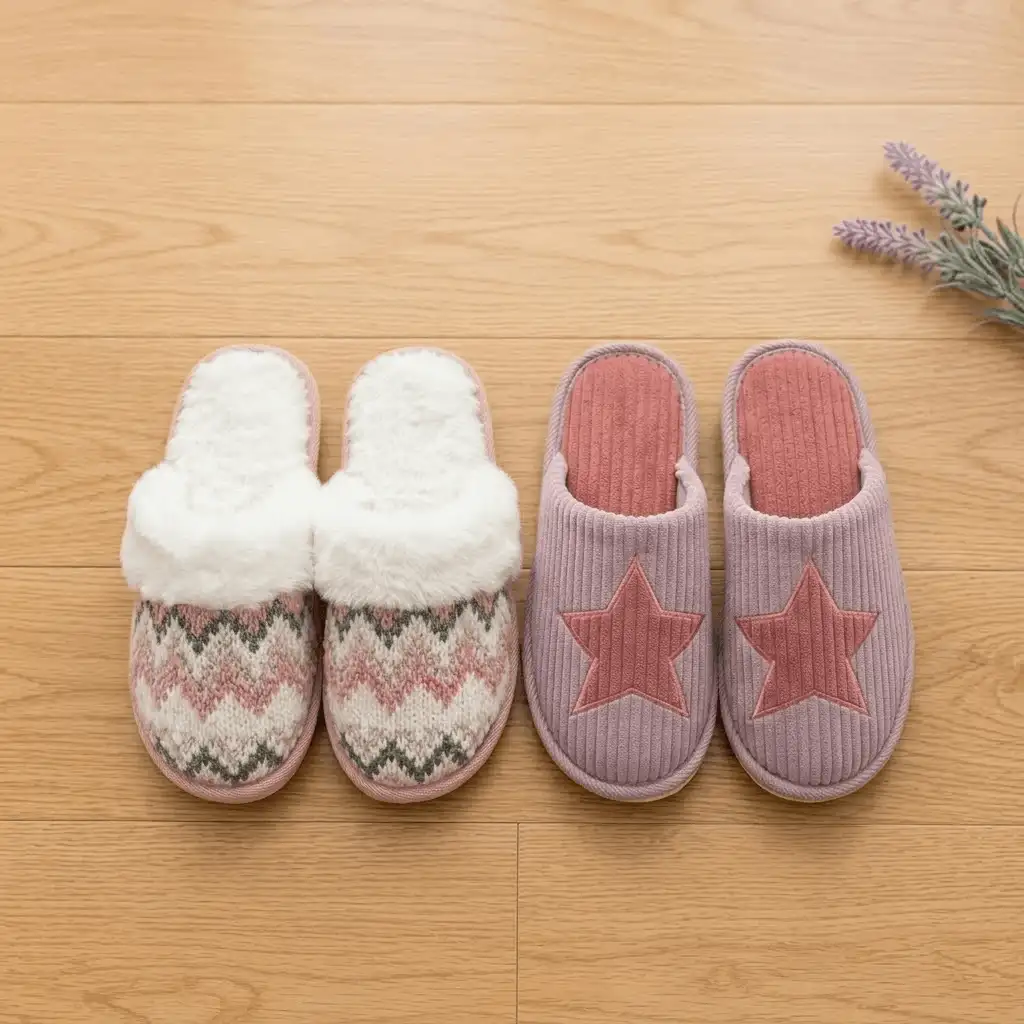
Upper and Lining Must Be Approved Together
An upper swatch may look suitable on a table and behave differently after lamination, cutting, sewing, turning, and packing. The lining adds another variable. A thick plush lining can make a slipper feel warmer, but it can also reduce internal volume, change the opening, and alter the size impression.
For indoor slipper materials, compare the upper and lining as a finished combination. Check hand feel, color, stretch, visible surface direction, seam bulk, toe and heel shape, pair symmetry, and whether the combination supports the intended logo method.
Long-pile materials may hide detailed embroidery or small labels. Stretch fabrics may need reinforcement or lamination around a logo. Heat-transfer or hot-fix decoration must be reviewed against the actual surface and process conditions. For a deeper material review, see UTOP’s Plush Slippers Wholesale Guide.
Approval rule: keep an approved material swatch and a finished slipper sample. The swatch identifies the material; the finished pair shows how that material behaves in the real pattern, lining, construction, logo, and packing method.
4. Specify Cushioning and Footbed Materials
The soft feeling underfoot comes from a stack, not from a marketing term. Common slipper making materials in this area may include an insole cover, PU foam or memory foam, an EVA support layer, and a structural component where the design needs additional form.
Each layer should have a defined location and purpose:
- Foot-contact cover: controls the first touch, visible finish, moisture interaction, seam detail, and color presentation.
- Comfort foam: creates the initial cushioning feel; specify the foam type or grade, cut thickness, and firmness or compression reference where required.
- Support layer: limits excessive sink, changes resilience, and helps tune the finished feel. If EVA is used here, record that it is an internal layer rather than the outsole.
- Structural layer: may help the footbed or bottom assembly retain the intended shape, depending on the slipper construction.
Do not confuse density with firmness: density describes mass per unit volume, while firmness describes resistance to compression under defined conditions. A higher-density foam is not automatically firmer or better.
“High-density foam,” “extra-thick cushioning,” or “memory foam insole” is not enough for an OEM specification. Buyers should state where thickness is measured, whether the value describes the incoming sheet or assembled stack, how the finished pair should feel, and which approved sample will control production.
More cushioning can also reduce internal fit space, raise the foot position, change the flex point, and increase packing pressure. Approve the complete slipper across relevant sizes rather than choosing a foam from a loose swatch alone.
Cushioning rule: define the layer sequence from the foot-contact surface to the outsole, then approve thickness, fit, feel, recovery, and left-right consistency in the finished pair.
5. Compare Slipper Sole Materials
A slipper sole material should be selected by the complete bottom specification and intended use. “TPR,” “EVA,” and “non-slip fabric” are category labels; they do not by themselves define weight, flexibility, grip, abrasion, thickness, tread, appearance, or attachment quality.
| Bottom direction | Common characteristics | Buyer should confirm |
|---|---|---|
| Molded TPR outsole | Defined sole profile, sidewall, molded tread, and visible bottom detail | Compound direction, hardness, thickness, weight, dimensions, flatness, tread, color, tooling, and attachment method |
| Cut-sheet EVA | Often lightweight, flexible, and visually simple; cut from approved sheet material | Sheet grade, density or hardness direction, thickness, weight, cutting accuracy, surface texture, embossing, and bonding construction |
| Molded EVA | Compression-molded or injection-molded forms can create different profiles and production requirements | EVA type, formulation direction, density, hardness, dimensions, shrinkage control, tread, tooling, and attachment |
| Point-plastic textile bottom | Soft, compact, and commonly associated with lightweight indoor-only designs | Base fabric, dot compound and coverage, thickness, flexibility, sewing compatibility, floor conditions, and buyer-required performance |
TPR and EVA are not automatic opposites. EVA itself may be cut-sheet, compression-molded, or injection-molded, and those forms do not create the same structure. TPR compounds and molded designs also vary. Cost must therefore be quoted by the actual project rather than assumed from the material name.
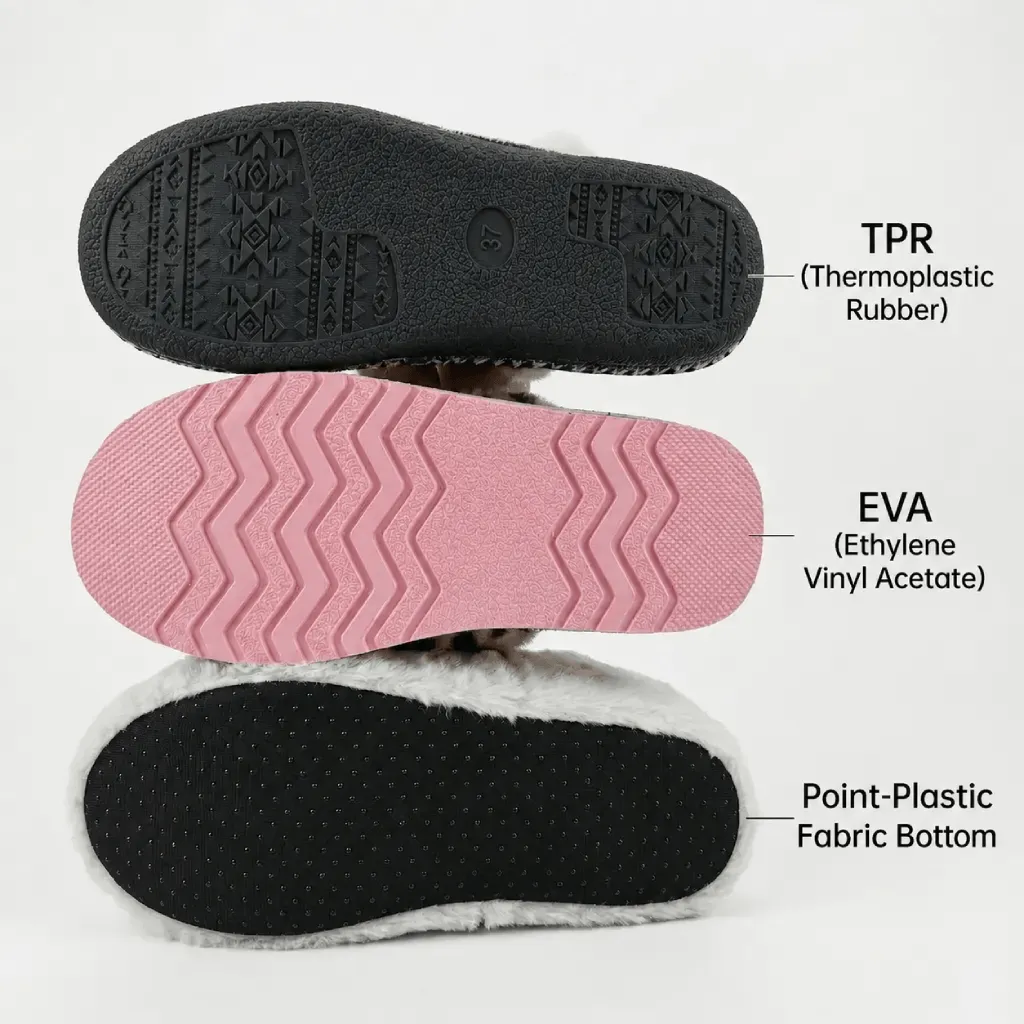
Is There a Best Sole Material for Slippers?
There is no universal best sole material for slippers. Molded TPR may suit a project that needs a defined profile, visible tread, or a more structured house-shoe appearance. Cut-sheet EVA may suit a lightweight, flexible indoor style. A point-plastic textile bottom may suit a soft, compact design intended for limited indoor conditions.
Grip and abrasion cannot be guaranteed by material name. They depend on the formulation, hardness or density, thickness, tread geometry, bottom structure, floor surface, contaminants, temperature, wear condition, and test method. If the buyer needs measurable slip or abrasion performance, define the applicable method, test surface, conditioning, specimen, and acceptance criteria before production.
For a more detailed comparison of TPR and EVA types, tooling, tread, construction, sample approval, and bulk control, use UTOP’s TPR vs EVA Sole for Slippers Guide.
Outsole rule: compare material type, structure, thickness, hardness or density direction, weight, tread, tooling, attachment, intended floor conditions, and test requirements as one outsole specification.
6. Match Slipper Materials to the Construction Method
Slipper materials for manufacturing cannot be approved independently of the assembly method. The same upper or outsole may need different preparation, edge design, reinforcement, stitching allowance, adhesive system, pressing conditions, or tooling when the construction changes.
| Construction | Common UTOP material direction | Interface checks |
|---|---|---|
| Welt-stitched | Can commonly be developed with TPR or EVA bottoms | Welt material, stitch position, upper and bottom size match, edge condition, pair symmetry, and flex location |
| Side-stitched | Commonly developed with molded TPR outsoles designed for side stitching | Stitch groove or edge design, hole or needle effect, tension, alignment, upper preparation, and outsole pairing |
| Cold-glued | Commonly used with EVA bottoms; TPR may also be glued with a matched process | Surface preparation, compatible adhesive and primer where required, application, open time, pressing, curing, alignment, and bond checks |
| Injection-molded | Selected molded footwear projects with dedicated materials, tooling, and process requirements | Material-process compatibility, mold design, dimensions, surface, color, upper interface, and process-controlled trial approval |
Welt stitching and side stitching describe connection methods; they do not make every material combination automatically durable. Their contribution to connection and structural stability depends on the thread, stitch path, component design, edge quality, material strength, size match, and overall construction.
Likewise, cold-glued construction should not be judged by adhesive alone. Surface treatment, material compatibility, application, timing, pressure, curing, flex position, and production control all matter. UTOP’s guide to common indoor slipper manufacturing defects shows why the upper-to-bottom interface needs its own checks.
Construction rule: specify materials and assembly as one controlled design. A material substitution may require a new process review and sample approval even when the visual appearance seems unchanged.
7. Choose the Best Material for Slippers by Project
For B2B sourcing, the best material for slippers is the combination that meets the approved use, appearance, comfort, construction, compliance, cost, and production requirements with acceptable repeatability. It is not necessarily the thickest, softest, heaviest, or most expensive option.
| Buyer priority | Possible material direction to evaluate | Do not assume |
|---|---|---|
| Warm winter presentation | Plush, fleece, sherpa, faux fur, or felt directions with a suitable lining and bottom | A longer pile automatically means better warmth, quality, logo clarity, or recovery |
| Lightweight flexibility | Jersey or lighter textiles, a controlled foam stack, and cut-sheet EVA or another suitable indoor bottom | Lower weight automatically proves adequate support, grip, or durability |
| Defined house-shoe structure | More stable upper materials, reinforcement where needed, and a molded outsole direction | A molded sole alone creates a stable fit or correct flex |
| Compact hospitality or travel use | Lightweight upper and lining materials with a simple bottom selected for the intended conditions | Every lightweight textile bottom is suitable for every floor or wet condition |
| Private-label visual identity | A surface and backing that support the chosen embroidery, label, print, patch, or decoration | Artwork that looks clear on screen will reproduce equally on every pile or stretch fabric |
Use the table as a screening tool, not a formula. The next step is to review actual swatches, component samples, and finished prototypes against the target product. Buyers can also compare UTOP’s current custom indoor slipper directions before selecting a starting style.
Decision rule: translate “best” into priorities and acceptance criteria. If two priorities conflict—such as low packing volume and a highly structured upper—decide which one controls the project before sampling.
8. Approve OEM Slipper Materials During Sampling
A material approval should connect the supplier record, approved swatch, component, and finished slipper. This is especially important for custom indoor slipper materials, because a change in fabric backing, foam grade, EVA sheet, TPR compound, lining thickness, or surface direction may alter more than appearance.
During sampling, UTOP normally reviews relevant points such as:
- Material identity: supplier or internal reference, composition where specified, structure, color, surface, hand feel, and approved swatch
- Upper and lining: direction, stretch, usable appearance, thickness, seam behavior, internal volume, logo compatibility, and pair matching
- Foam and footbed: layer sequence, thickness at the stated stage, single or pair weight where useful, hand-feel firmness, recovery reference, and finished fit
- Outsole: material type, color, odor, weight, thickness, hand-feel hardness, length and width, flatness, tread, pair matching, and flex position
- Assembly: upper-to-bottom size match, alignment, stitching or bonding quality, edge condition, symmetry, and visible finish
- Packing trial: pair orientation, pressure points, surface transfer, deformation, and agreed review after representative packing and unpacking
Not every project needs every checkpoint, and the list does not create universal tolerances. The buyer and supplier should identify the characteristics that control the order, how they will be checked, and what reference or limit determines acceptance.
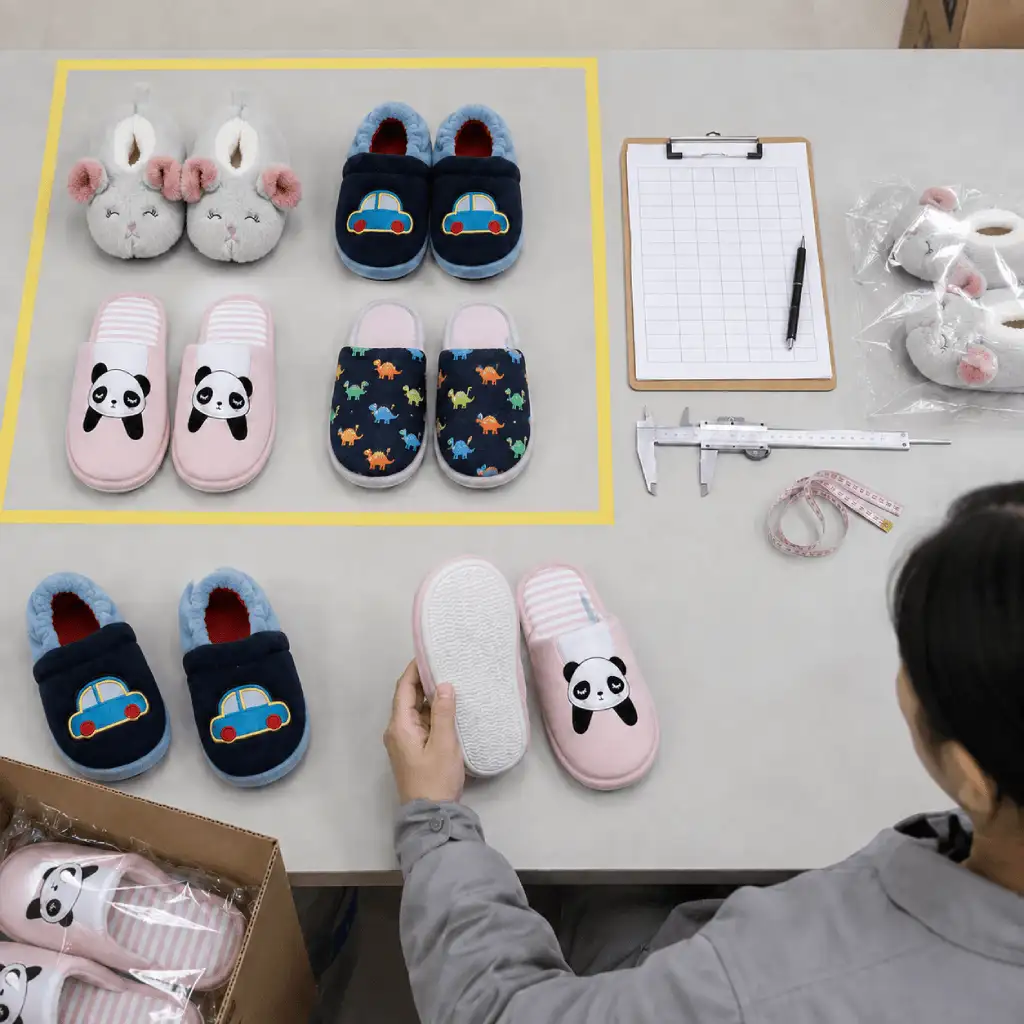
Build an Approval Package, Not a Verbal Memory
A useful OEM slipper materials approval package may include the product specification, approved swatches, component references, color standards, outsole details, layer sequence, logo artwork, size information, packaging instructions, test requirements, approval comments, and a controlled finished sample.
The record should also identify the sample version and approval date. If one change is accepted—such as a new lining color or outsole hardness—the document should state whether that change affects any previous approval. Otherwise, teams may combine instructions from different sample rounds.
Review more than one relevant size when material thickness, stretch, outsole tooling, or grading can change fit across the range. The approved middle size may not reveal pressure, opening, toe-volume, or bottom-alignment issues in the smallest and largest sizes.
For the wider OEM workflow covering requirements, branding, sizing, packaging, sampling, and production, use UTOP’s Private Label Indoor Slippers Manufacturing Guide.
Change-control rule: no bulk material substitution should be approved only because it has a similar name or color. Review its specification, process compatibility, finished result, and any affected test requirement.
9. Control Slipper Materials in Bulk Production and Compliance
Bulk quality control should follow slipper materials from receipt through cutting, assembly, finishing, and packing. A final visual inspection can identify many defects, but it may be too late to correct a repeated material or process problem economically.
| Control stage | Material-focused checks | Primary reference |
|---|---|---|
| Incoming materials | Identity, color, surface, direction, odor, weight, thickness, hardness or density direction where specified, dimensions, and visible condition | Approved swatch, component, material specification, and purchase record |
| First production and in-process | Cutting direction, shade grouping, lamination, seam behavior, layer order, outsole matching, alignment, bonding or stitching, and repeated defects | Approved sample, specification, process instructions, and first-production confirmation |
| Finished pairs | Overall material match, surface, color, weight where required, fit and dimensions, pair symmetry, flex, tread, attachment, cleanliness, and presentation | Controlled finished sample, size specification, artwork, and inspection criteria |
| Packed goods | Correct SKU and labels, compression, dye or surface transfer, deformation, decoration protection, recovery, and carton assortment | Approved packed sample, packaging artwork, pack ratio, and carton instruction |
Separate Product Inspection from Compliance Testing
Visual and physical production checks do not prove chemical compliance or a specific performance claim. The test plan should come from the destination market, retailer or brand requirements, product category, materials, risk assessment, and current applicable rules.
For EU-bound programs, buyers should review the current European Commission overview of REACH and confirm the relevant substance restrictions and responsibilities for the actual product. For California programs, the official OEHHA Proposition 65 resources explain the law, chemical list, warnings, and related regulations.
These links are starting points, not a complete compliance determination. Buyers should provide the required substances or performance items, test method, sample source, timing, acceptance limit, report format, and responsible laboratory or approval authority.
For the complete inspection framework, including sampling plans, defect classification, reporting, and release decisions, see UTOP’s bulk slipper quality-control guide.
Evidence boundary: material names, visual checks, and hand comparisons cannot prove slip resistance, abrasion resistance, chemical compliance, or service life. Make such claims only from the agreed test evidence for the actual product.
10. Slipper Material Specification Checklist and FAQs
Buyer Checklist Before Quotation and Sampling
- Target customer, destination market, sales channel, season, intended use, and price position
- Reference product, drawing, or link plus expected shape, fit, and comfort direction
- Upper and lining composition, construction, weight or thickness, stretch, backing, surface, color, and approved reference
- Foot-contact cover, cushioning grade, layer sequence, thickness measurement point, finished feel, and recovery reference
- Outsole type, EVA form where relevant, hardness or density direction, thickness, weight, dimensions, tread, tooling, attachment, and floor conditions
- Construction method, reinforcement, thread, adhesive system where used, flex position, and upper-to-bottom interface
- Size range, grading direction, fit samples, label system, color and size ratios, and pair-matching criteria
- Logo method, artwork, placement, dimensions, color, surface compatibility, and attachment requirements
- Care claim, packaging, compression trial, recovery requirement, barcode data, carton plan, and delivery needs
- Buyer-required testing, compliance documents, inspection method, acceptance criteria, and change-control process
Packaging should be confirmed against the finished material system, especially for plush surfaces, thick linings, molded outsoles, and raised decorations. UTOP’s Footwear Packaging Guide covers individual packing, retail presentation, labels, pack ratios, and carton controls.
Frequently Asked Questions
What are slippers made of?
Slippers are usually made from a combination of upper fabric, lining, padding, a foot-contact cover, cushioning or support layers, an outsole, thread, adhesive where required, and branding or decorative components. Plush, fleece, jersey knit, felt, PU foam, memory foam, EVA, TPR, and point-plastic textile bottoms are common options, but the exact system varies by design.
What is the best material for indoor slippers?
There is no universal best material. The right choice depends on climate, warmth, breathability, fit, surface appearance, construction, floor conditions, care claim, packaging, price position, and buyer-required performance. The complete finished sample should be approved rather than a material name alone.
Is TPR or EVA the best slipper sole material?
Neither is automatically better. Molded TPR can provide a defined outsole profile and tread detail. Cut-sheet EVA is often selected for lightweight, flexible constructions, while molded EVA is another distinct direction. Suitability depends on the exact material specification, outsole design, attachment method, intended use, and test requirements.
Are higher-density slipper materials always better?
No. Density is one property, and its meaning depends on the material and application. It should not be treated as a universal quality score or confused with hardness and firmness. Review density where relevant together with thickness, structure, weight, feel, fit, process compatibility, and the approved sample.
Can the materials in custom indoor slippers be changed?
Many upper, lining, cushioning, outsole, color, branding, and packaging details can be developed for OEM or private-label projects, subject to material availability, construction compatibility, tooling, order requirements, testing needs, quotation, and sample approval. A substitution should be reviewed as a controlled product change.
What should buyers send for a slipper material quotation?
Send the preferred style or reference, estimated quantity, target market, season, size range, colors, upper and lining direction, cushioning feel, outsole and construction requirements, logo artwork, packaging, test requirements, destination, and delivery target. Clear priorities help the factory recommend suitable materials and prepare a comparable quotation.
Conclusion: Specify the System, Then Approve the Pair
The answer to what are slippers made of is broader than a list of fabrics and soles. A slipper is a connected material and construction system. Upper, lining, cushioning, support, outsole, assembly, branding, and packaging all influence the finished result.
For buyers, the practical sequence is clear: define the product brief, compare materials by function, match them to the construction, record measurable specifications, approve swatches and finished samples, control any change, and inspect production against the same references.
Planning a custom indoor slipper project?
Share your reference style, target market, estimated quantity, size range, upper and lining direction, cushioning feel, outsole and construction requirements, logo artwork, packaging, testing needs, destination, and target delivery date. UTOP can review the information required for material selection, sampling, and bulk-production planning.